Interview With Hugo Jacomet
1February 19, 2013 by Ville Raivio
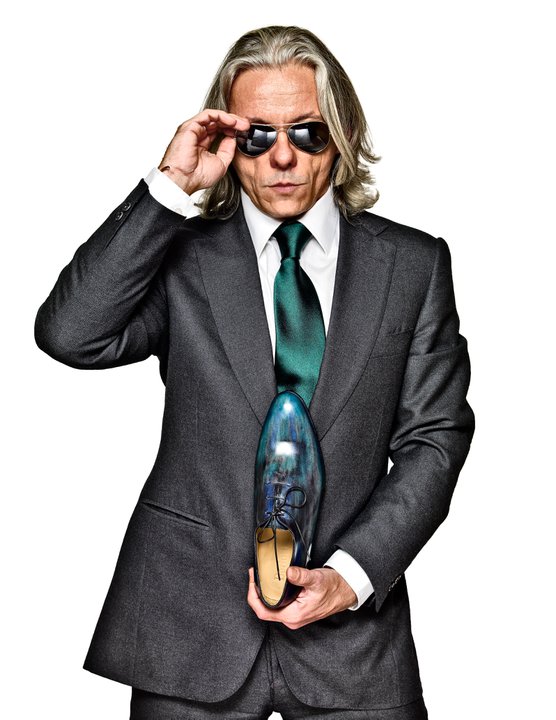
“[I am] 47 years old. Multi entrepreneur, producer, director, screenwriter, owner of a communication company [with a] University degree in International Business.
Divorced. Two kids, my son is 21, working with me on PG and in the Bespoke addiction already, my daughter 16. They love my style quest. Inspiring for them. My grand-father was a “bottier”, my mother a dress maker… It’s a family tradition. I’ve always been interested in style. When i was 10 years old, when i had new shoes, i used to sleep with them in my bed and did not want to wear them in order not to damage the sole ! I think the search of personal style and excellence is in my DNA… Some key books of course (“Dressing the Man” and “The suit”), but mainly with my personal experience and researches. I used to be, before turning Bespoke, a nightmare for the shop salesmen with my sharp questions. My eyes are my best advisors and my motto is “first learn the rules, than break them”. But the first part takes a long time…
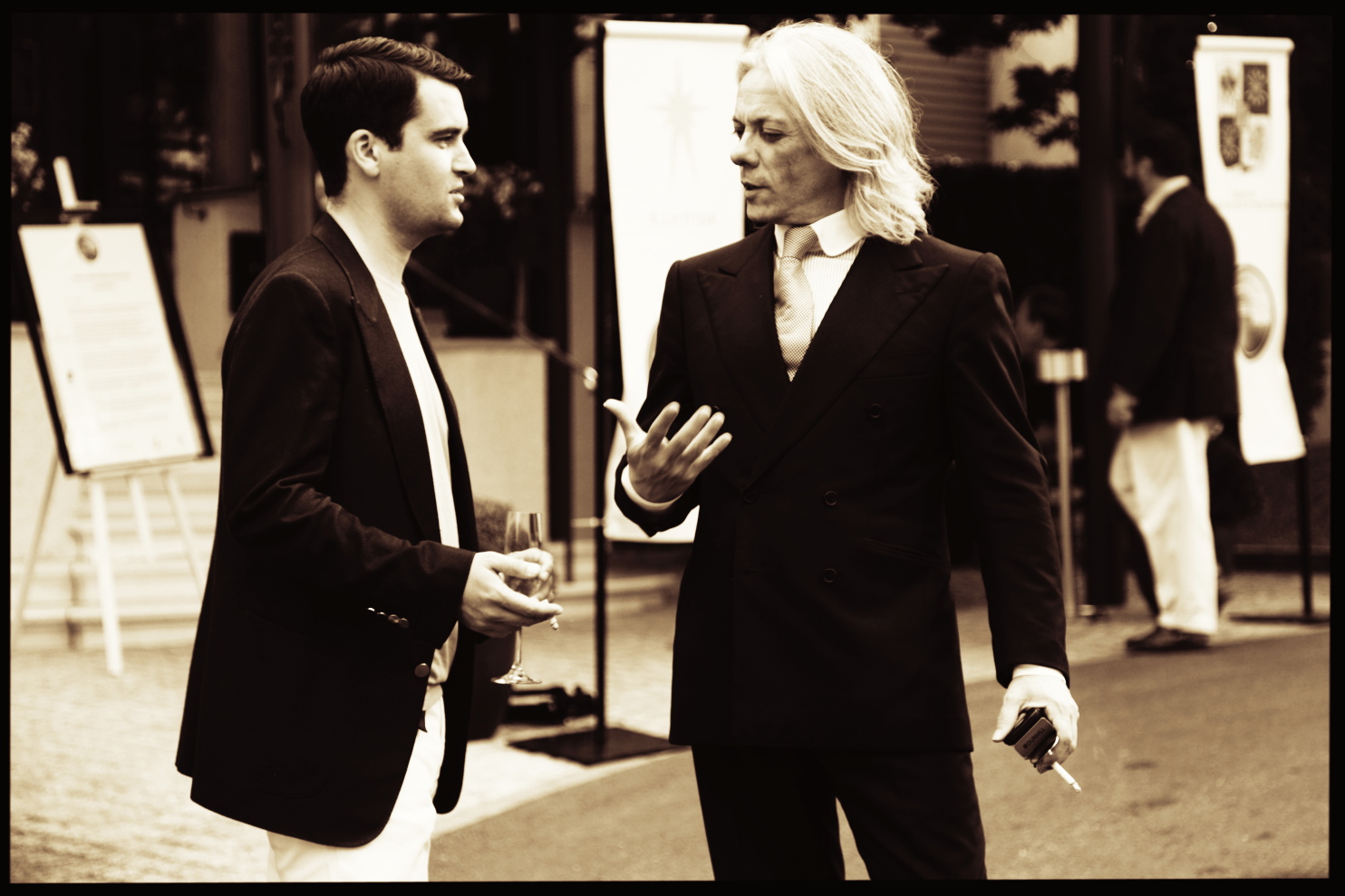
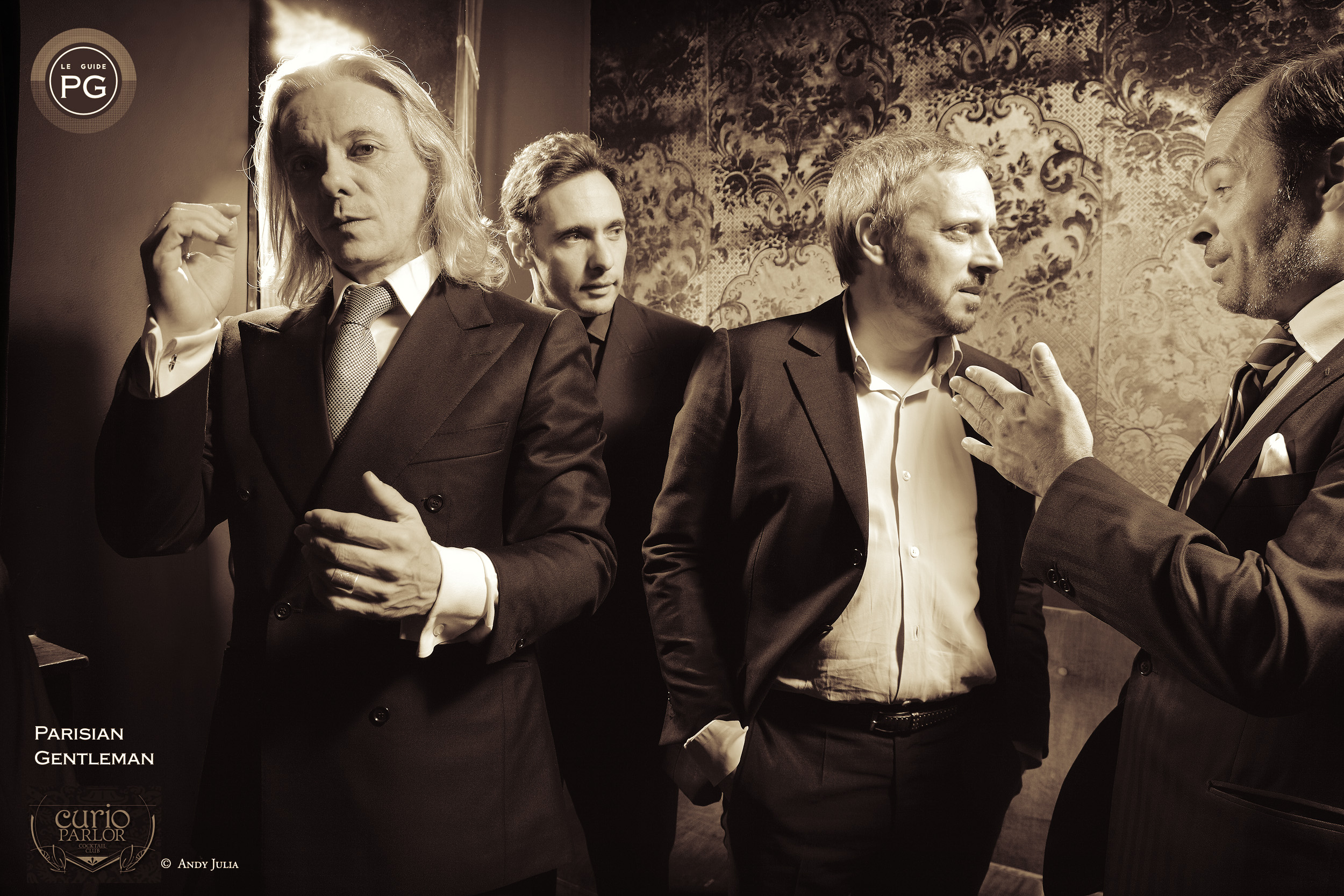
My shoulder long white hairs give me a special look, and allows me to play with it. I would say, sophisticated, classic but with a freedom of speech, even in my clothes. I love making some tests, mixing patterns, try unusual things…. But always with understatement (even if with my face it’s not easy to be honest). I’m a style searcher. Everyday it takes me 1 hour and a half to choose my garments. It’s almost an illness i guess ! I dress only bespoke for suits. I’m very loyal to Cifonelli in Paris who is, for me, the top of the world with a unique mix of Italian roots (fluidity, creativity), of english strictness (measures are made in inches, it’s very pure traditional bespoke tailoring) and of french “chic” (surnatural attention to details, 6 to 7 fittings, the purest milanese button holes in the world). And their ww famous shoulder construction is just amazing. Small chest, very high armholes, very masculine and very slimering effect. For me Cifonelli is in the Top 5 tailoring houses in the world with, maybe, Cesare Attolini, Anderson and Sheppard, A. Caraceni Milano and Timothy Everest (for his incredible creativity). But it’s a question of taste. It’s like in life, when you have found your tailor, i think you stay with him all your life. By the way i feel it’s easier to find your all-life tailor than your wife ! For the shoes i’m loyal to Pierre Corthay fantastic RTW all goodyear. I also believe this house is the best of the best ww. But I also like the “handcrafted” line of the portugueese Carlos Santos and the RTW of Gaziano and Girling. For my shirts i make all my bespoke in a very small french traditional atelier called Courtot in Paris. I sometimes buy some RTW shirts and Ties at Marc Guyot, an amazingly stylish person who offers very stylish garments from head to toe.
At the beginning [Parisian Gentleman] was only a personal diary, but it has become, surprisingly, a world wide phenomenon. My goals were simple : sharing my experiences and knowledge, giving high level advices and help elegant men to dress better with genuine and independent point of views. I just wanted to help making a more elegant world as i feel very bad in this “ready-to-wear” and mostly “ready-to-think” world. It’s quite a philosophical quest. I hate the mass culture and fight against it as much as i can. I know that i’m a little David against Goliath, but as i often say, David has always been more elegant and perseverant than any Goliath. And now i’m glad to see i helped creating a sort of a movement with some of my fellow bloggers like Simon Crompton in the UK. Now PG has become very big, is translated in English, in Japaneese in the next weeks, than in the coming months it will be translated also in russian, italian and arabic. I have a lot of other developement projects but i don’t want to tell to much for the moment… The only thing i can say is that these projects are huge.
I’m now writing in several big newspapers in france and europe. I do some radio shows on style. I have a lot of propositions for shootings and consulting work on the subject of style. I also had the chance to build a very strong relationship with James Sherwood who is, probably, one of the most important writer on english tailoring in the world and editor-at-large at The Rake. We have a HUGE project together for Pitti Uomo January 2012. I can’t tell too much now, but it could be a world-wide “premiere” gathering the top 20 bespoke tailoring houses in the world presenting their craft together to the world at Pitti Uomo. I’m currently writing 2 books for big publishers and my goal is, very soon, to spend 100% of my time on PG and my style work. [My interests include] Philosophy, Sciences of Complexity works, High level wine and whiskies and Fitness (in order to stay perfectly slim and with a nice body…). But sartorial research is very addictive for me.
1st rule : never trust the salesman in the shop. 2nd rule : study the basics (Flusser book, blogs, magazines). 3rd rule : when you know the basics, take your time to imagine the way who would like to look and make as many tries you can. 4th rule : be your own advisor and try to be better each time… It’s a never-ending quest that has, by the way, nothing to do with money. You will make a HUGE difference by “simply” studying the basics rules on proportions, coordination etc…. My biggest advice : if you have some money issues, never compromise with the line of the suit. You can compromise with the fabric, the trims, but NEVER with the line. And remember that the style is personal and has nothing to do with fashion. Don’t follow trends… Create your own style.”
Pictures: © Stéphane de Bourgies/Abacapress and Andy Julia
~ Originally published in Finnish on the 4th of December 2011
Category Arbiter Elegantiae, Interviews, Men of style
Ruskin
0February 19, 2013 by Ville Raivio
“There is hardly anything in the world that some man can’t make a little worse and sell a little cheaper, and the people who consider price only are this man’s lawful prey.”
~ John Ruskin
Category Aphorisms
Interview With Michael Anton
1February 17, 2013 by Ville Raivio
Your age and occupation?
’41 [this interview took place last year], corporate communications.’
What’s your educational background?
‘I have graduate degrees in political philosophy and the “great books.” As an undergraduate, I studied, English, history and philosophy.’

Have you any children or spouse (and how do they relate to your style enthusiasm)?
‘They don’t care except to the extent that it costs money from the family treasury. My daughter will often say that I look “nice” but she says that about a lot of things and does not appear to be all that discriminating. She does enjoy looking at swatches.’
How about your family members?
‘They don’t care either and to the extent that they do they think is a mildly silly hobby.’
How did you first become interested in clothes, and when did you turn your eyes towards classic clothing?
‘I can’t remember exactly what triggered it but it happened in high school. My father is an attorney and always got custom clothes. He got a real bug for Hermès ties and I caught that bug too. Wall Street came out when I was a freshman in college and that had a big impact on me.’
How have you gathered your knowledge of clothing — from websites, books or somewhere else?
‘All of the above. The web came much later, though. Flusser’s book Clothes and the Man was a huge influence on me, as were issues of Apparel Arts from the 1930s. My local public library had (and still has) four issues of these, which I more or less memorized back in the day. I have also made it a point to visit every famous and not-so-famous clothing store wherever I travel and I have even taken a number of trips whose purpose was more or less to shop. London is a frequent destination and I have been going there for almost 30 years now. I also like to talk to tailors, shoemakers, cloth weavers, etc., and find that most of them are very generous with their advice, stories, lore, and opinions.’
How would you describe your personal style?
‘Conservative Business Dress. I wear a suit five days a week, mostly single-breasted, mostly solids, with some that are a bit more out there. Ties are pretty conservative, shirts mostly blue, white, cream, pink, solid or Bengal striped. For casual jacket and tie, button downs and khakis or flannels. My odd jacket ensembles are a bit like how I dressed (or was dressed) for formal occasions as a child, what the Internet would call “trad” or “preppy,” but I don’t like Sack cut coats or flat front pants. I also no longer wear blazers with brass buttons.’

Which tailors/RTW stores do you frequent?
‘I use Luigi Solito from Naples a lot and I also have an English tailor who cuts clothes in the Anderson&Sheppard style. I tend to prefer the Naples SB and the London DB, though DB constitutes well under 20% of my closet. Over the years I have used a lot of tailors and have not been all that loyal, to be honest, but these days I am sticking with those two. For shoes, I have a variety but lately I have just been buying Vass (to the extent that I buy shoes at all any more). Ties are also from everywhere but the vast majority I have bought recently are from Cappelli in Naples. All my shirts come from Geneva Custom Shirts in New York. Other than that, I stop into the major New York retailers from time to time and go to nice shops whenever I travel.’
Please tell us about your goals in writing ‘The Suit’.
‘I had two goals. One was to write a book that is more detailed than all the other clothing books out there, that really goes into the arcana in a new and fundamentally more thorough way. The second was to write a parody/pastiche of Machiavelli that uses as many of his literary devices as I could master and included and that makes some philosophical points under the cover of a clothing book. What I found from my years of studying this and talking to tailors, observing the well dressed, and talking to those (few) really well-dressed men who will divulge their secrets is that there is a lot of lore that is not written down anywhere. I wanted to record as much of that as I could.
I also, over the course of years, developed a lot of opinions of my own that I wanted to convey. People who read the book carefully will be able to tell when I am conveying the former versus the latter. The indicators are not obvious but they are there. There are also, in the book, a lot of devices such as numerical patterns, misused or altered quotations, intentional contradictions, inapt examples, things like that, which if a careful reader were to puzzle through would find that certain opinions are conveyed only “between the lines.” Honestly, though, I don’t think anyone is ever going to bother. But it was fun to do.’
Has the book changed your life?
‘Not one iota. The book made money and continues to sell (in small numbers) but to call it “popular” would be a stretch.’
What other hobbies or passions do you have besides style?
‘Cooking.’
Has your popularity among SF members brought about any interesting projects or such?
‘I’ve made a lot of friends on the forum, sold some books because of it, and had a lot of fun talking about my hobbies with other enthusiasts. I have a few times been approached about writing a magazine piece or giving a speech. But other than that, no.’
-Many of my readers are young or only recently decided to change their style towards a classic approach. What tips would you give to someone who has only recently become interested in classic style?
‘I would tell them, first, to get a copy of Flusser’s Clothes and the Man, study that carefully. You don’t have to do everything he says but that remains the best book on the fundamentals and it will probably never be surpassed. Second, I would watch old movies with the greatest dressers, above all Astaire and Grant. Very little of what they wore has dated at all and it will still translate today. Their style was so simple that it carries you almost anywhere. Third, resist the impulse to be a peacock, which is something that young people have to be restrained from doing. Fourth, buy quality to the extent you can afford it. Learn the value proposition for various types of garments. Don’t get sucked into overspending on trendy, designer or over-marketed names. There are value propositions at almost every price point; learn what they are. Fifth, beware of sales and “deals” and don’t end up buying stuff that’s heavily marked down just because it’s cheap. Ugly is ugly and stuff you fall out of love with in a year is expensive no matter how much you paid for it.’
http://www.neh.gov/humanities/2008/marchapril/feature/the-dandy
Pictures: © Ashbrook Center
~ Originally published in Finnish on the 1st of October 2011
Category Arbiter Elegantiae, Interviews, Men of style, Styleforum, Writers
Rubinacci Pochettes
0February 17, 2013 by Ville Raivio
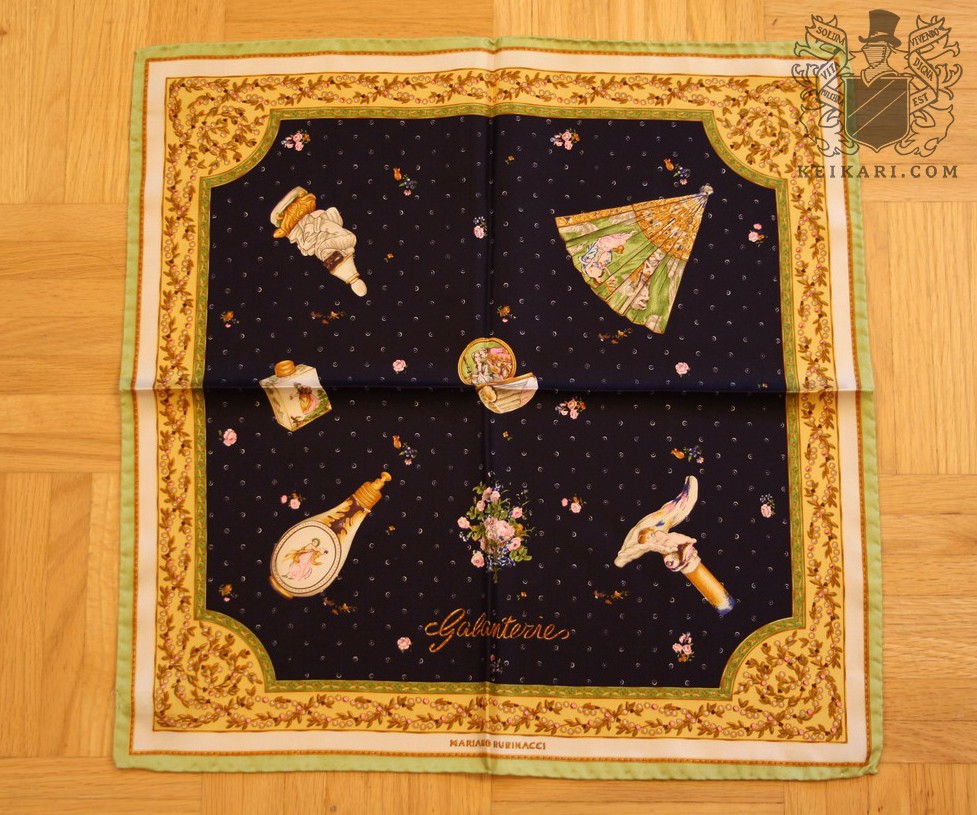
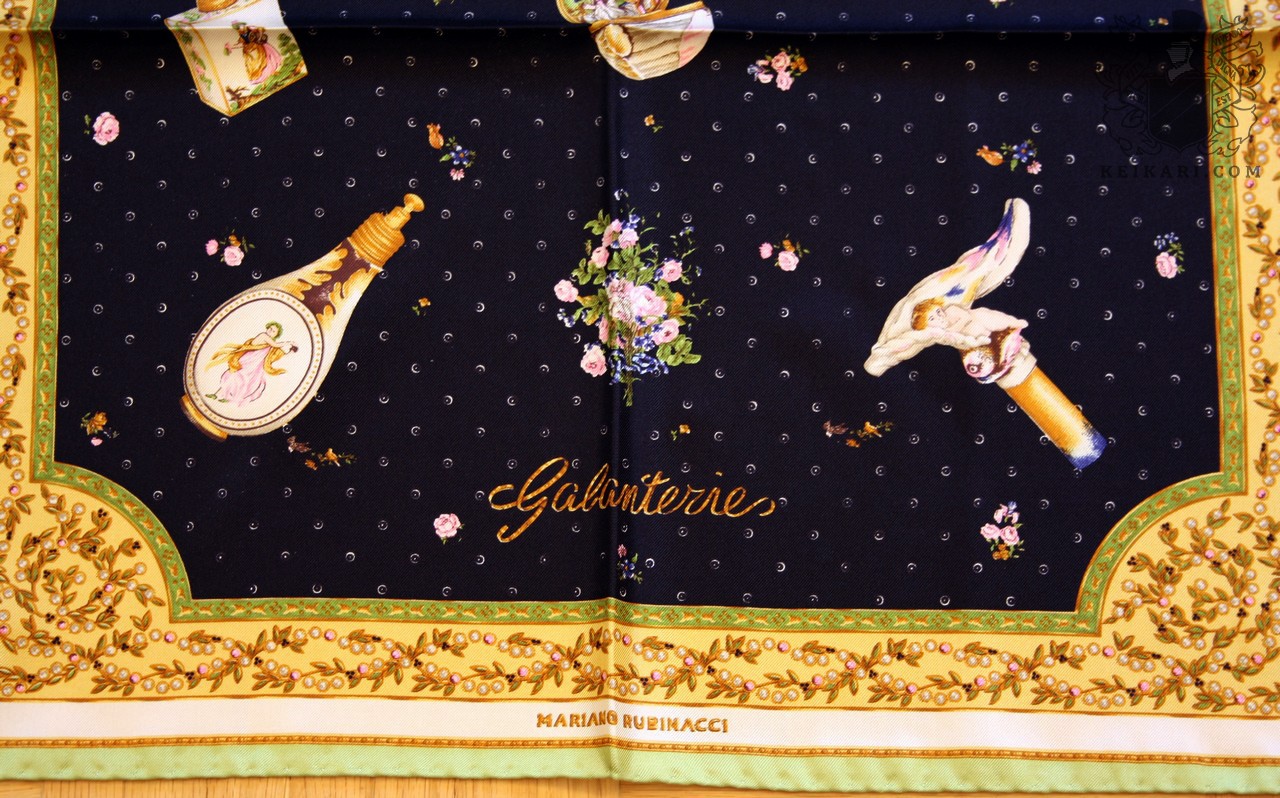
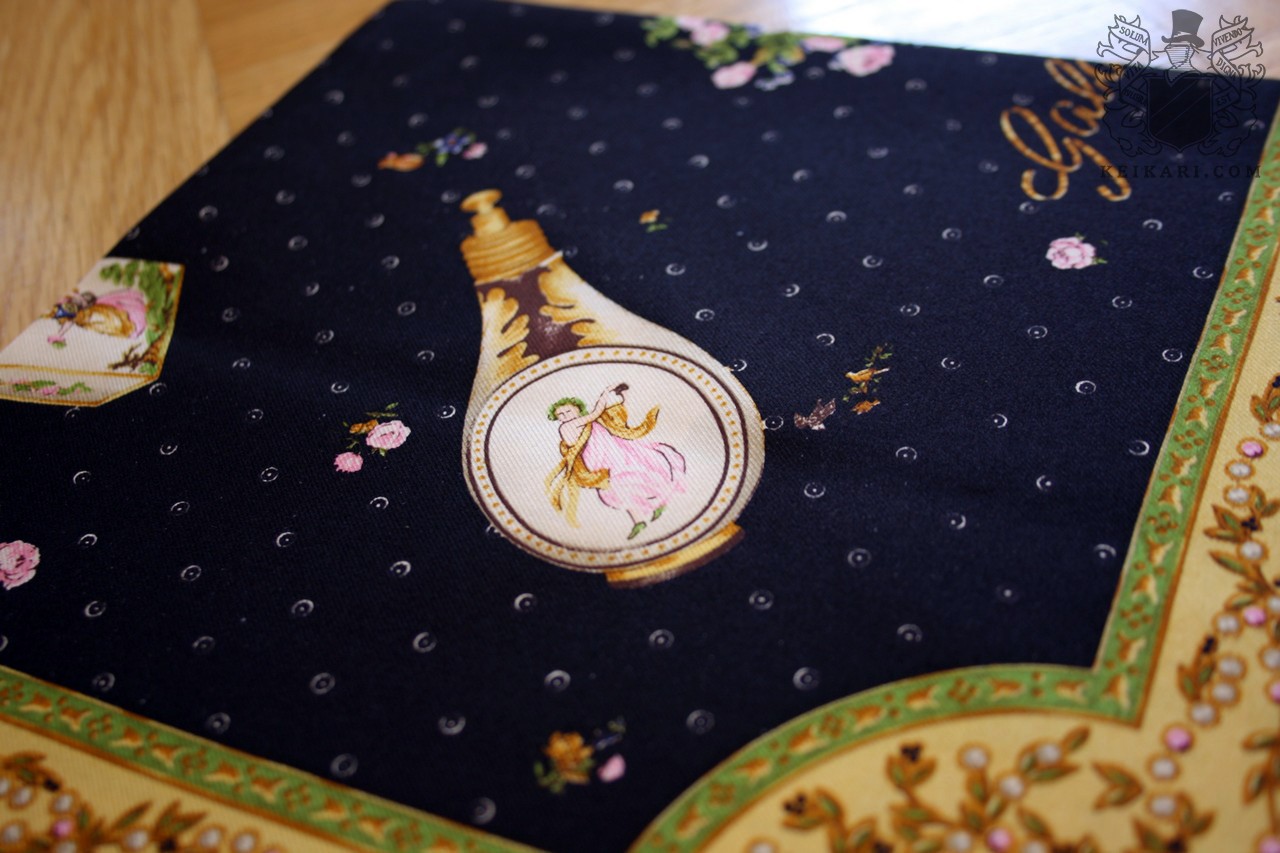
I’ve seen and handled more handkerchiefs than is necessary for any man. Aside from the most common printed silkens and wisp-thin linens, the hank is a wonderful platform for endless creations. French fashion houses have taken silks closer to wearable art while the men’s hanky has remained austere in its mostly white guise. I’m sure any white piece is smart and in order for most uses, but the handkerchief could be much more. Leave it to Italians to come up with the answer. The Neapolitan tailoring house Rubinacci has elevated silken prints with a wide array of pictures from its native culture and folklore.
The current selection offers 35 intricate images in several main colours. The end result is my favourite collection. When folded, the hanks have enough bulk to hold their shape and not fall victim to a common problem, drowning inside the breast pocket. The large images offer plenty of choice for selecting different parts for different occasions, and if the thought of folding and hiding seems unpleasant, the pochettes can also be framed. Rubinacci has decorated its stores with framed hanks instead of conventional paintings. After all, Naples calls for something different. While the maker has a premium for its designs, fine deals can be found on retail sites. Exquisite Trimmings has a few prints on sale.
Category Accessories, Deals, Naples
How To Measure For eBay
3February 17, 2013 by Ville Raivio
eBay is a wonderful source of tailored clothing for the frugal man. Most sellers have measured their listings, but not all give accurately describe how the measurements were taken. To help my reader in his online ventures, I’ve listed some common ways for measuring a jacket. The post can also be applied to coats with no troubles. The more measurements the seller is willing to give, the easier the task of finding out if the listing fits.
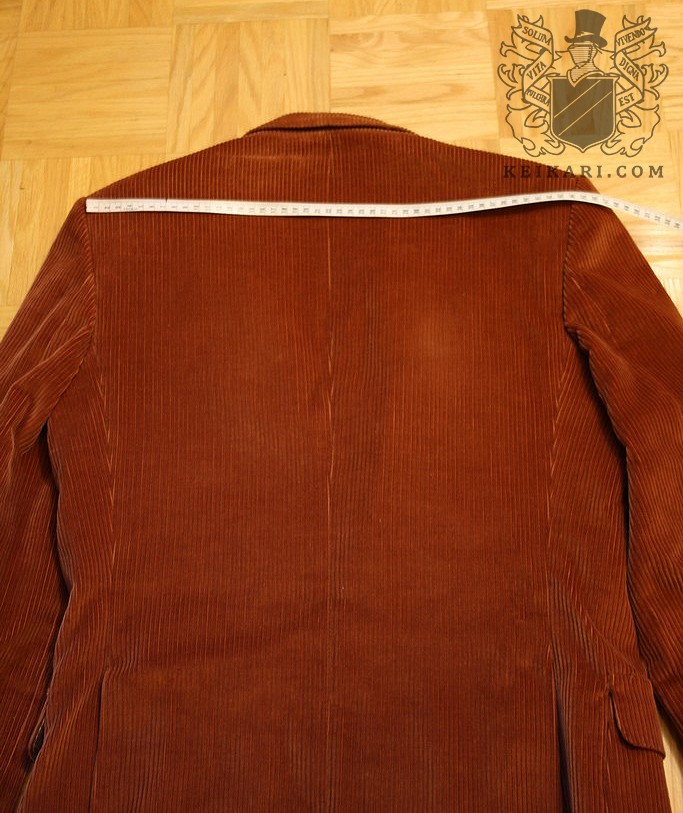
The most important point is the shoulder seam to shoulder seam measurement, as alterations for slimming any coat or jacket are most expensive on this section. All well-tailored jackets have additional fabric hidden inside all seams, but it’s up the bidder to ask for this info. Some jackets have been altered before adding them on eBay and nasty surprises are common. All jackets should be measured laid flat. In addition to these six points, jackets can also be measured for the girth of the sleevehead as well as girth of sleeve on the bicep and wrist. Sometimes I’ve asked for these on eBay, most sellers aren’t too keen on seeing the effort.
First up: shoulder seam to shoulder seam, measured from behind
Then: armpit to armpit, measured from behind
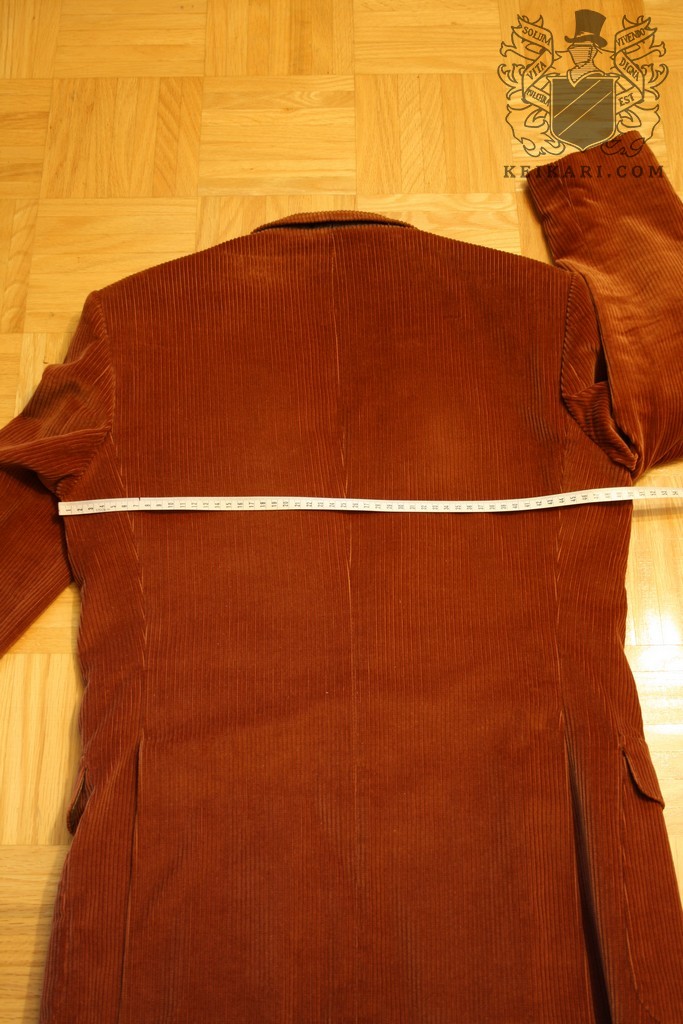
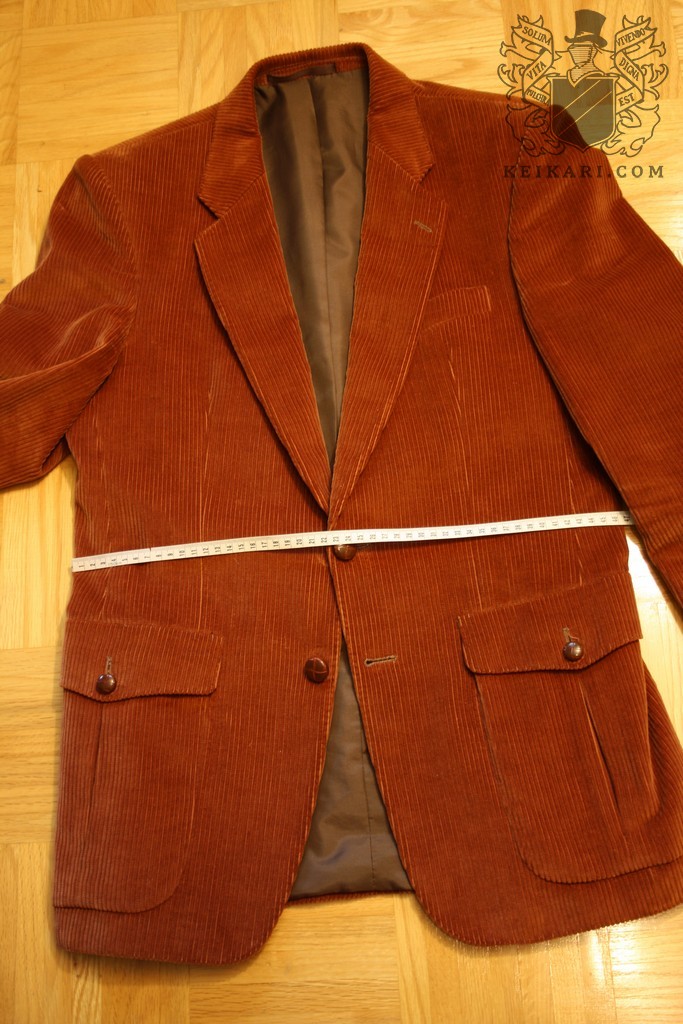
Third: girth on the waist, measured on the upper button on jacket fronts with two buttons, on the middle button on three-button jackets
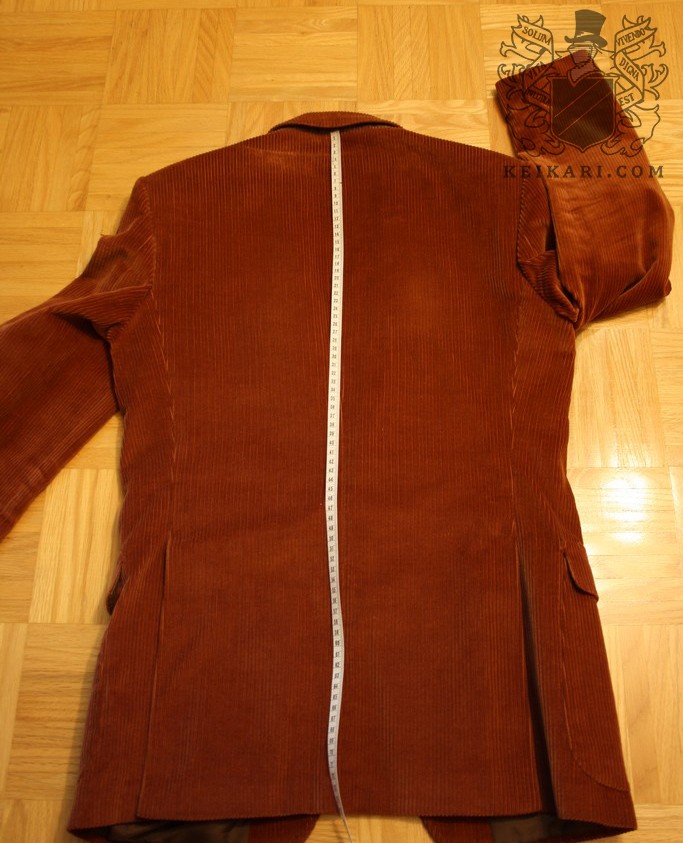
Fourth point: jacket length, measured from the collar down to hem
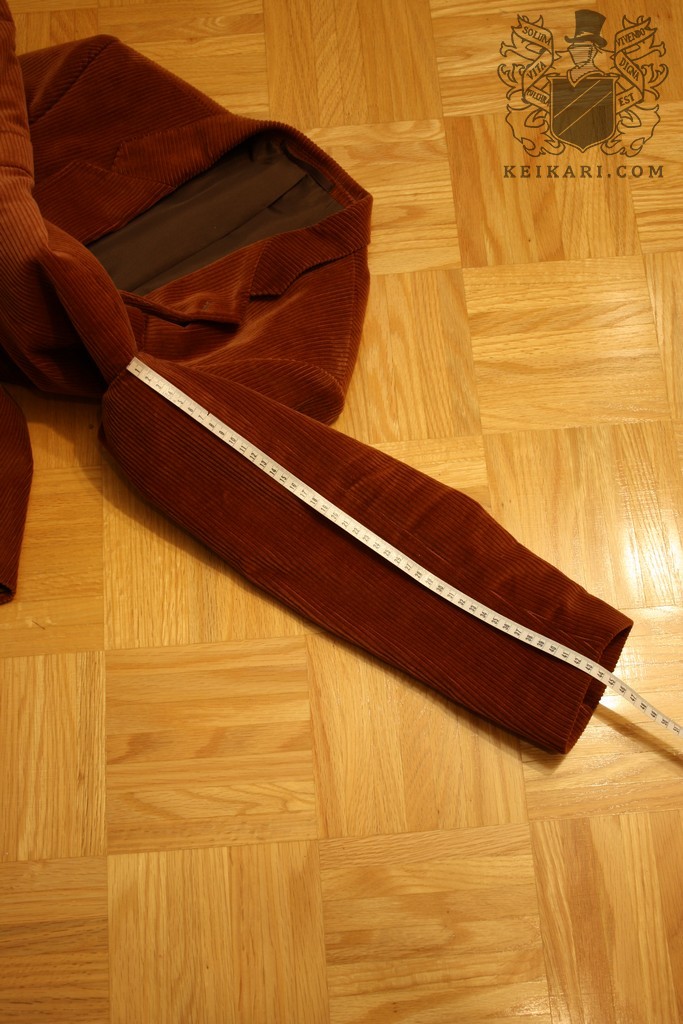
Fifth point: length of sleeve, measured from the shoulder seam to sleeve end
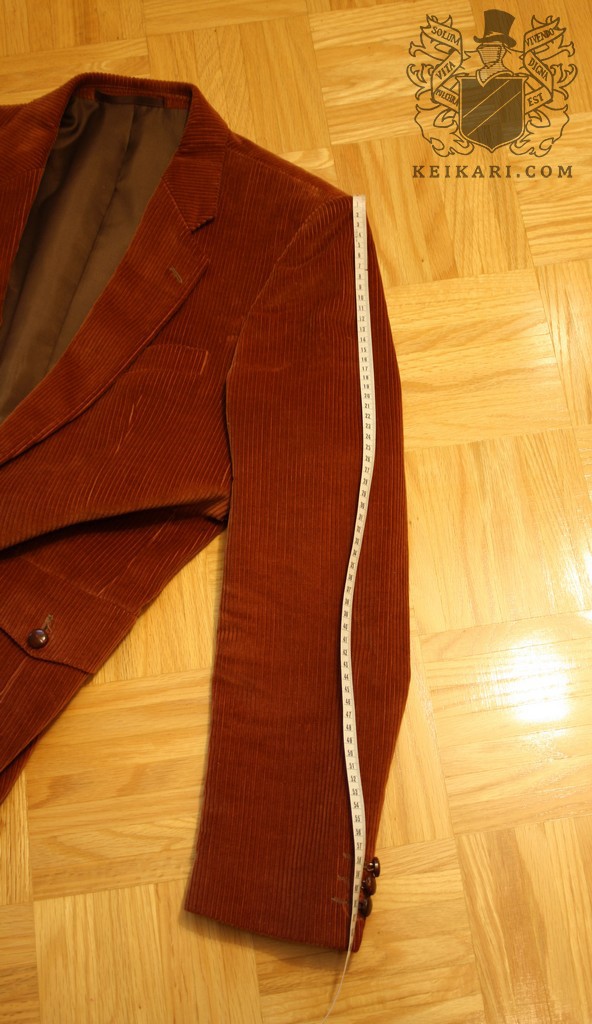
Sixth point: length of sleeve, measured from the armpit to end of sleeve
Copyright © 2013 Ville Raivio