Interview With G. Bruce Boyer
9February 21, 2013 by Ville Raivio
“I’m 70 years old [this interview took place two years ago], and continue to write about men’s clothing. I write regularly for The Rake, which I think is the best men’s fashion magazine in the world. I’ve also just written a book about the film star Gary Cooper with his daughter, Maria Cooper Janis — Gary Cooper: An Enduring Style — which will be published by Powerhouse Books in November of this year. It’s a study of Cooper’s style and the book contains over 100 photos from the family archive which have never been seen before. I’m very proud of this production.
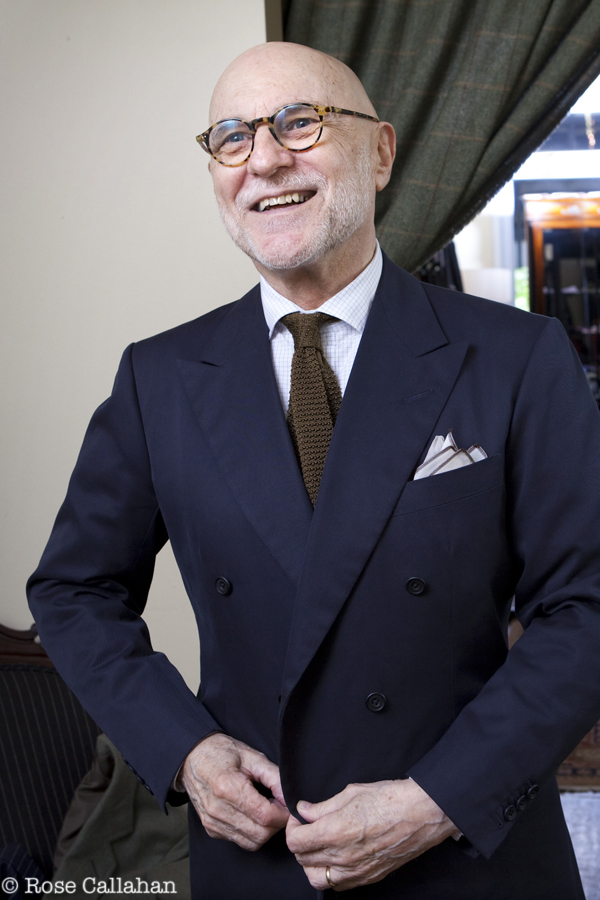
I have a Bachelor’s and Master’s degree in Literature and was a professor of English Literature for 7 years before starting to work as a men’s fashion writer for Town & Country magazine. My wife and I have been married for 28 years, and have no children. My wife was a research editor for Prevention magazine for 15 years, and is a good critic and editor of my writing. She has always been a beautiful woman, but doesn’t take as much interest in fashion as I do. She’s much more interested in our two Papillon dogs and cooking.
I have no siblings, but I credit my mother — who died just a few years ago — with my interest in clothes. She allowed me to choose my own clothes from the time I was a small child, and to experiment with different styles. This is the way I learned about clothes, by trying different types of clothes and discovering what suited me best. She allowed me to develop a familiarity and comfort with clothes, and so I was never afraid of trying different styles. I would say that I was aware of the importance of clothes — the effect they could have on people — by the time I was 10 or 12 years old. Like many Americans, I went to the movies regularly and was enchanted by the great actors with style — Fred Astaire, Cary Grant, Gary Cooper, Clark Gable among them — and how effortlessly they dressed. I tried to imitate them as best I could. I studied they way they tied their neckwear and what sort of shoes they wore and the cut of their trousers, the style of their shirt collars, that sort of thing.
I was interested in all sorts of clothes, from Zoot suits to motorcycle gear, and that made me understand that all clothing is a costume of sorts, a uniform worn by a certain group of people, and that we dress to identify with a certain group in society. When I was about 14 I became interested in the Ivy League/Preppy style of classic American clothes because I wanted to identify with university students. Then when I was about 18 I began to be interested in the British style of dress, I suppose because so many of the film stars I then admired were British — Sean Connery, Rex Harrison, Terry Thomas, Ian Carmichael, men like that — and a few Italian stars. Marcello Mastroianni I thought wore clothes beautifully. European films were a big influence in the USA in the 1950s.
In addition to films, there were two American men’s fashion magazines which were very good at the time: Esquire and GQ. I read each edition every month, studied them and learned a great deal. Today I learn a great deal from the bloggers, many of whom I find are young and very intelligent and stylish. I’m a regular follower of Ivy Style, Simply Refined, Maxminimus, Rugged Old Salt, The Trad, The Sartorialist, The London Lounge, A Continuous Lean, Die, Workwear, Manligheter, Men of Habit, Permanent Style, Tweedland, The Daily Prep, to name only a few. And now Keikari of course. I also read books on costume history because I’m interested in how clothing has developed. So I’d say I’m interested in clothing in both a fashion and an academic sense.
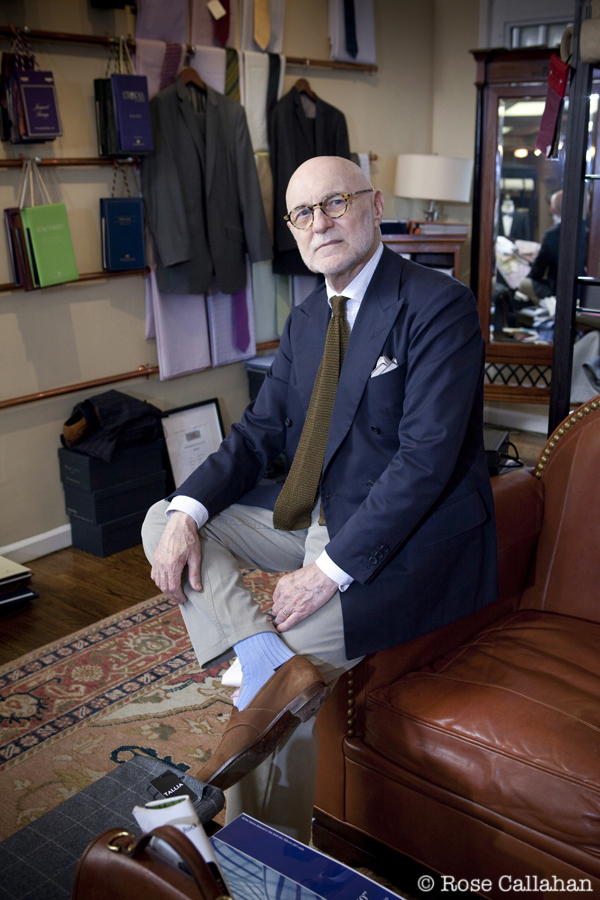
My personal style is transatlantic: part American Ivy League, part English Savile Row, with perhaps a small dash of Italian brio for color. I’ve always been very conservative in my personal tastes. It’s probably the only part of me that is conservative. I prefer tailored clothing that is easy-fitting but with some shape. I don’t like tight, restricting clothing, which I find is too much the style today. My particular addiction is to tweed sports jackets (worn with jeans, khakis, cavalry twills, flannels, or corduroy trousers). My grandfather bought me a Harris Tweed sports jacket when I was 14, and I’ve loved tweed ever since. I also prefer button down shirts and suede oxfords with everything.
I’ve bought custom tailored clothing since I was 18, although I’ve also bought off-the-rack on occasion. In readywear tailored clothing I think the Italians are now the best — Brioni, Kiton, Castangia, Corneliani, and several others. I find I’m always impressed with the better makers of English shoes, such as Edward Green and John Lobb and G. Cleverley. I’m also a fan of Ascot Chang shirts, and Drakes of London ties and scarves. My favorite tailors would be Cheo and Logsdail in New York, Anderson & Sheppard and Steven Hitchcock in London, and Rubinacci in Naples. To complete my wardrobe I wear John Locke hats, Brooks Brothers tie-back undershorts, and Roger & Gallet eau de cologne. My tastes are very simple.
I’ve never been as interested in fashion as I am in taste, style, and quality. Style is the most enigmatic and interesting because it’s so inexplicable and you can find it anywhere. It seems to have nothing to do with wealth or intelligence or any particular skill. As far as fashion is concerned, I’ve always agreed with Oscar Wilde, that it’s something so dreadful, we must change it every several months or so. Fashion is based on communal exaggeration, style in based on self-awareness.
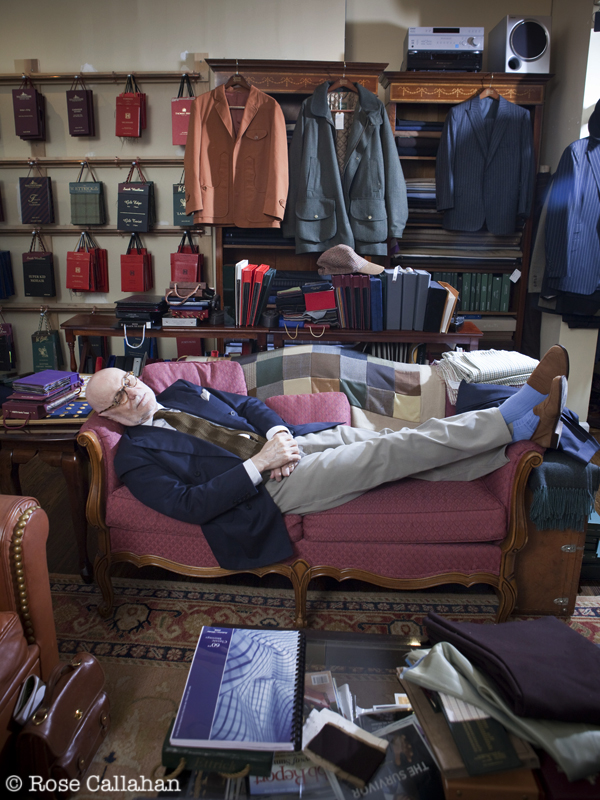
When I first left off teaching I thought I would miss it terribly, but in retrospect I was probably not suited for the academic life. I was, I believe, a good teacher, but not the best scholar. Working for magazines like Town & Country and others allowed me to travel a great deal, to meet interesting people who were experts in their various fields, and to test my ideas in print. Writing books gave me a certain validity in the field, it increased my stature a bit as an opinion-maker. I love every aspect of the clothing business — the designers, retailers, manufacturers, promotional people, and media — but I particularly am enamored and respectful of the true craftsmen, the tailors and shirtmakers and bootmakers and cloth experts. Craftsmen are artists, they give their hearts and lives to their work, they are more interested in perfection than riches. They are always the most interesting people.
Apart from clothing, the great loves of my life are music and literature. I’m an aficionado of jazz and blues, particularly between 1925 -1965. In literature I used to read more novels and poetry, but now I read more memoirs and biography. I’ve had a long interest in British Restoration-Augustan literature, and 20th Century Afro-American literature.
For young men just starting out, I would want to persuade them to slowly build a wardrobe based on conservative taste and good quality. Three good pairs of shoes are better than six cheap ones because the good ones will last longer and look better even when they’re old; the cheap ones will look cheap even when new and they won’t last long. I always feel I can never afford to buy cheap clothes. I have shoes and ties and shirts and sports jackets that are more than 20 years old, and they fit and feel marvelous, and look more wonderful than when they were new.
Start with a few classics: a good blazer and gray worsted suit (the weight of which will depend on your climate); a few good light blue shirts; a good pair of dark brown oxfords; a few simple dark blue silk ties. Then add a few pairs of odd trousers (khakis, flannels), a tweed or lightweight sports jacket, a nice cashmere sweater. A few more ties, a pair of slip-ons, that’s the way to build a wardrobe. Never buy anything that can only be worn with one outfit; a tie that can only be worn with one certain suit or jacket is an expensive tie no matter what it costs. Resist fashion trends. Just because this season a lot of people are wearing red trousers doesn’t mean it’s a good idea for you. Learn what works best for you, what you like and feel comfortable with, and stick to it.”
Pictures: © the inimitable Rose Callahan
~ Originally published in Finnish on the 23rd of October 2011
Category Arbiter Elegantiae, Interviews, Men of style, Writers
Logan Pearsall Smith
0February 21, 2013 by Ville Raivio
“Don’t laugh at a youth for his affectations; he’s only trying on one face after another till he finds his own.”
~ Logan Pearsall Smith
Category Aphorisms
Fused, Unfused and Soft Collar
0February 20, 2013 by Ville Raivio
The rich world of tailored shirts offers an endless array of fabrics, dozens of weaves and a myriad of collars, but only three methods for collar construction. Apart from button-down shirts and some Italian creations, the soft collar is in the minority. This method joins the front and back parts of the collar together without lining or fusing between them. The collar gains its shape from cutting, not from the usual lining materials. If the collar points are attached to buttons, it will usually form a roll when the design and proportions allow. The model can also be left unbuttoned or unironed for a nonchalant look with soft wrinkles. The softest unstructured collars are made from one piece of shirting, with a very thin backing. I’ve owned one of these, and found it impossible to iron. The Italian maker Truzzi had clearly designed it with a louche appearance in mind.
The most common methods for collar construction are fused and unfused. The most obsessed dressers and shirtmakers are locked in an endless battle of words between the merits and failings of both methods, and it seems one has the choose a side over the other. In fused shirts, the lining material is attached with glue and placed between the collar’s front and back parts. Thanks to its fusing, the collar gains a very smooth and clean surface. This method is very common, especially in Italian shirts, with the exception of those favouring extremely soft collars. American shirtmaker Alexander Kabbaz has explained this construction thoroughly elsewhere. In unfused construction, the lining material is not glued in place, but either left free-flowing or sown in place. Shirts with these kinds of collars are harder to iron, as the cloth’s surface wrinkles easily under heat and moisture and has no fusing to keep it in place.
You can find out your shirts collar’s construction by pinching its surface. On fused collars the front piece cannot be lifted upwards from the lining, as the glue keeps it in place. On unfused collars the front is lifted easily, as the lining is not not attached to it. Finally, on soft collars no fusing can be felt as the collar is made up of but two pieces of cloth. All collar constructions have downsides. Soft collars made from thin fabrics are hard to iron, they crease esily and have a casual look. Fused collars can bubble or wrinkle permanently, if the fusing has been done with poor materials. I’ve had this happen to several shirts I’ve owned, including so-called high-end makers, prompting me to only use unfused and soft collars these days. Fused collars are also stiffer and won’t roll neatly. The unfused collar may wrinkle permanently, if its lining material and fabric shrink in different pace. The surface is also harder to iron than on fused shirts.
The decision to opt for one method over the other is left at the reader’s hands, as all three have advantages and pitfalls. Obsessive-compulsive construction comparisons are not even needed, if one is content with the current shirts and couldn’t be bothered. Often the greater impact on the overall look rests on the collar’s cut, not on its construction. Nearly all collars can also be applied to smart occasions with a bit of help from starch, which makes even the droopiest of collars stand up for the occasion.
Interview with Simon Crompton
0February 20, 2013 by Ville Raivio
“[I’m] 30, journalist. I have spent my career running and editing several business-to-business magazines, all multimillion-pound titles in revenue. I am currently editor of Managing Intellectual Property, which is the world’s biggest magazine on patents, trade marks and copyright. I was educated at Trinity College, Oxford, where I studied PPE (philosophy, politics and economics). I’m married with two young daughters. Fortunately my wife isn’t a big fan of clothes. I think we can only afford one in the family. My parents also live in London and are retired. My father was a management consultant. I have a brother and a sister, who work in advertising and asset management respectively.
[I became interested in clothes] when I first started being paid enough to spend money on suits, I think. I wanted to know why designer, made to measure and bespoke suits were more expensive. A geeky side to my personality took over and began burrowing into the detail. It hasn’t stopped. Books and websites are great, but far better are personal contacts. I am fortunate to know most of the master tailors in London now, as well as shoemakers, shirtmakers, tie makers etc. And I have watched every aspect of them being made, including visiting factories around the UK and Europe. There’s nothing like a factory visit. You see rather than being told; there’s none of the PR bullshit of shops and branding – you can’t hide anything in a factory.
[My personal style is] English style sold to the Italians. A phrase I unashamedly steal from Michael Drake. When Italians try to dress like the English, they strip away all the gimmicks or ‘eccentricities’ and reveal what we do best – simple, classic clothing for every walk of life. The English look has dominated the world of tailoring and high-end menswear ever since Marie Antoinette took to country living. And rightly so. [My tailors are] many, these days. It’s frustrating going to a new tailor and trying to get your pattern just right, but the curiosity in me always overcomes that. The tailors I go back to time and again are Anderson & Sheppard, Cifonelli, Rubinacci and Graham Browne. For different things and different values, but they are all superb.
[I founded Permanent Style] to stop boring my friends. That was how it started five years ago. Men may want to know the geeky details of how a suit is made – and practical advice on how to wear a sports jacket with jeans – but they rarely want to ask and the answers can be long and a little tiresome. So I started writing down my findings. I also like to think Permanent Style features better writing – more rigour, more detail, more practical advice and less PR – than any men’s magazine out there.
[My site’s popularity] funds my buying habits, which my wife appreciates, and has enabled those to grow. I also get recognised in some odd places. Like Peckham Rye high street, or law firm elevators. Probably most importantly, it has enabled me to help lots of companies I love with online strategy, write for them, and encouraged publishers to back me in writing books. My first of these is out now (Le Snob: Tailoring), my second based on factory visits will be completed next year and we are in talks on a third. That has been very satisfying. As easy as it may be to self-publish these days, there’s something very substantial about having written a book.
[Interests beyond style are] none. I don’t have the time or the money. No, seriously, fiction, films and road cycling are the only ones I’ve been able to hang on to after the blog and the kids.”
Mr Crompton’s advice for those seeking wardrobe changes:
2 Try to have suits, at least jackets, cut for you. Don’t worry too much about the quality of the make, but hand cutting makes the biggest difference. And spend more on shoes.
3 Start by dressing simply. As personal as style might be, every style icon in history has agreed on several things. And one of them is that dressing with well-informed discretion is the base to any personal aesthetic.
4 You have to wear clothes to feel comfortable in them. Hats are a classic example. No one feels comfortable the first time they wear one, because nobody else is doing so. But the third day you wear it, it will feel natural. And practical.”
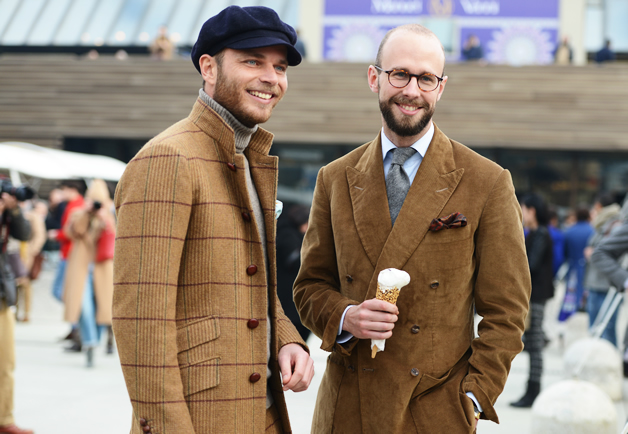
Picture: © Tommy Ton for GQ, featuring Luca Rubinacci (left) and Simon Crompton (right)
Mr Crompton’s unique site can be found at http://www.permanentstyle.co.uk/
~ Originally published in Finnish on the 9th of October 2011
Category Arbiter Elegantiae, Interviews, Men of style
Almighty Bruce
0February 19, 2013 by Ville Raivio
“And the best always is the cheapest, if you have the money to buy it in the first place. The way we do it today is ask how much it costs. Nobody asks how much it costs over its lifetime — it’s just the initial price. And if you only look at the initial price, you’re going to get screwed every time.”
~ G. Bruce Boyer
Category Aphorisms
Copyright © 2013 Ville Raivio