Boyer
0February 16, 2013 by Ville Raivio
“Perfection must never be the goal because it can never be achieved. One who courts perfection must fail, since we are all only human, but to achieve a nicety without appearing to have even tried is another matter. It leads us to wonder what grand design might have been accomplished had the effort been made. The nature of sprezzatura is deception.”
~ G. Bruce Boyer
Category Aphorisms
References
0February 15, 2013 by Ville Raivio
Keikari’s content is based on my experiences, the contents of my library, the talks I’ve had with those in the business and the countless pieces I’ve read online. The best source for all things concerning style is still Styleforum.net, whose thousands of members make up for an incomparable hive mind. The main task for anyone reading the site is to sift through all the opinions, advice and conflicting statements on offer. This will be easier if the reader is already familiar with the basics of style, and takes SF’s content with a grain of salt. The forum also boasts a wonderful collection of tailors, cordwainers, retailers, makers and style nerds who share a passion. There’s just something about style, about the pleasant sensations of fabrics, and the play of light on their surface.
My book references so far are:
- Alan Flusser: “Dressing the man”
- Alan Flusser: “Clothes and the Man”
- Nicolas Antongiavanni: “The Suit”
- G. Bruce Boyer: “Elegance”
- G. Bruce Boyer: “Eminently Suitable”
- Brian Dobbs: “The Last Shall Be First”
- Hal Rubenstein: “The Gentry Man”
- Peter McNeil& Vicki Karaminas: “The Men’s Fashion Reader”
- Bernhard Roetzel: “Gentleman – A Timeless Fashion”
- HRH The Duke of Windsor: “Winsor Revisited”
- Stephen Howarth: “Henry Poole – Founders of Savile Row”
- Eric Musgrave: “Sharp Suits”
- Ellen Moers: “The Dandy – Brummell to Beerbohm”
- James Sherwood: “Bespoke – the Men’s Style of Savile Row”
- Richard Anderson: “Bespoke – Savile Row Ripped and Smoothed”
- Lázsló Vass&Magda Molnár: “Handmade Shoes For Men”
- Richard Walker: “The Savile Row Story”
- Heini Welling: “Turhamainen mies – narri vai sankari?”
These are backed by old magazines like Esquire and Gentry.
The site’s pictures are either my own or borrowed from online sources, with a clear reference to the original uploader. When the original photographer is not mentioned or I’ve saved the picture a long time ago, I will mark the picture as © original uploader. If the reader wants to have his or her picture removed, please contact me. Some pictures are copyright-free due to their age.
I have also used Wikipedia’s pages with a large number or references. Most of what can be found on the site is still based on my observations and experiences. Thus, the statements made are subjective and this point should be remembered. What works for me may not suit the reader. When the reader finds an error in any text, I urge him to contact me so the text can be revised. The site is not an academical one, thus no direct references, apart from quotes and links, are used.
Category References
Josh Sims states
0February 15, 2013 by Ville Raivio
”While the women’s wardrobe has its classics – lasting styles often reinterpreted and frequently updated – there are arguably more of these in the men’s wardrobe. In part this is because womenswear is more a product of fashion, which can be defined as frequent change for its own sake. Menswear, on the other hand, is also a product of fashion but this tends to be apparent only in the details, in a ponderous, evolutionary advancement rather than in sweeping statements. Men’s styles are variations on a recognizable, well known theme, rather than a new score altogether.”
~ Josh Sims
Category Aphorisms
Interview with Will Boehlke
1February 15, 2013 by Ville Raivio
“My occupation is men’s clothing. I write about it, consult on it, speak about it, and design it.

I have been interested in clothing since early in my teen years (I was voted the best dressed boy in my class in secondary school). I blame my mother who to this day has more shoes than any man should contemplate. That interest was initially in the American Ivy style clothing that’s now known as trad, and I first found it at Brooks Brothers. What a great place that was, and when they lost their way in the 1970s I lost mine as well for about a decade. Fortunately, I found Savile Row when I began travelling to England frequently in the 1980s. That’s also about when I began to be influenced by Alan Flusser’s use of color and combinations.
I found, and probably learned the most from, the late English designer Hardy Amies. And I’ve borrowed freely from sources as diverse as Luca di Montezemolo (CEO of Ferrari) for office dress, Apparel Arts and Esquire magazine illustrations published in the 1930s, and the usual list of great clothes horses: Astaire, Cary Grant, the late Duke of Windsor and Gianni Agnelli. But books and photos are just the beginning, and I’ve learned the most from the weavers, tailors, haberdashers and shoemakers who have shared their knowledge with a hobbyist.
Not quite [seven] years ago I was casting about for something to do and ended up starting A Suitable Wardrobe because it occurred to me that the current generation of men literally had nowhere to go where they could learn how to dress with style. It was difficult initially as I was working alone, but I persevered and today I’m very happy with the friends I’ve made around the world and the great clothes I get to spend my time around. The site is attracting more than 100,000 visits every month, and half of the visitors are regulars.
We’re on a journey together, both those with well developed wardrobes and men who are just starting out. As I said, I began ASW as a source for men to learn about classic style and I definitely enjoy helping men start out with their first gray and navy suits and build from there. As you know, classic style has little to do with fashion and a lot to do with timelessness. A well dressed young man can attract a partner without wasting his money on high fashion items that look inappropriate in a year or two. Clothing is expensive enough without that.
My own style is a very personal version of soft tailoring. I acquire cloth from England and have it made up there and in Hong Kong. I wear English shoes, though I’m planning to commission a pair from Dimitri Gomez in Paris. And I get the odd accessory from Italy, most recently a pair of slippers from Rubinacci. Most of my tailored clothing is bespoke, because I care about fit and I get to have exactly what I want. That said, I don’t hesitate to use made to measure when it makes sense, as it does for Raglan sleeved overcoats as well as pajamas, shirt jackets, shirts and casual trousers. The only ready to wear clothing that I own is my raincoat, underwear, socks and pocket squares.
When I’m not thinking about clothing I’m blessed to have a great wife who has been with me for many years and a home on the sea on the California coast. We have house guests frequently on the weekends, and we entertain in what I think of as a California version of English country house style. We like to drive open topped cars to taste wine, eat great food, walk the beaches and through the Redwood trees, and give thanks that life has turned out pretty well for us so far.”
http://asuitablewardrobe.dynend.com
Picture: (C) Dynamic Endeavors
~ Originally published on the 2nd of September 2009
Category American style, Arbiter Elegantiae, Bloggers, Interviews, Men of style
Shirt fabrics explained
0February 15, 2013 by Ville Raivio
A dress shirt is as durable as its cloth. Fabric mills are thousandfold, but the sowing machines shirtmakers use do not differ greatly, and so the durability of seams can be trusted. Fabrics are an entirely different matter. Concerning shirtings, the material, mill, thickness, weight, thread count and weave all affect the price, drape and the most important factor, durability. The sum of these variables cannot be counted at the store, for ready to wear shirts only mention the used material and recommended washing. Thus, the following words are most useful for the man buying made to measure shirts and can select his shirtings. An empirical fondling does reveal thickness and eyes tell the weave, but the weight, thread count and mill are left for guessing. Factories know this and use the same method for fabrics as was used for the so-called light bulb conspiracy; very thin and fine cloths are favoured and marketed strongly, so the customer would choose as the maker wants. These thin shirtings last poorly, wrinkle more easily and the buggers are also painfully hard to iron. The end results are goods that face less use, and which the customer will discard faster.
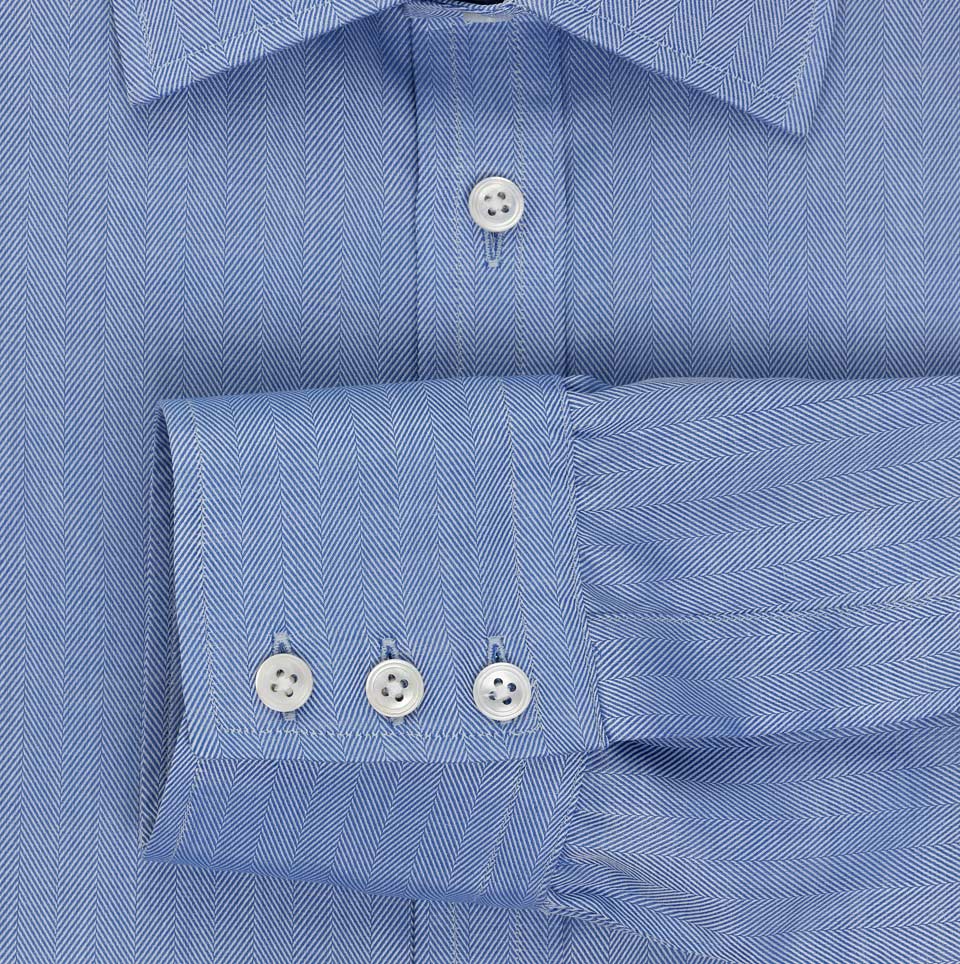 Herringbone weave
On shirt fabrics the thread count marks the size of yarns: the more threads are used in the making, the thinner the fabric will be. For example, a thread count of 110 means that the cloth has 110 hanks of yarn in one pound. Based on the shirts I’ve owned so far, a certain critical point is reached when the thread count hits 140. Shirtings finer than this are far too thin, needlessly expensive and have a shorther lifespan. I’m sure exceptions abound, but this takes more effort in finding the right mills, weaves and cloths. From the shirtmaker and material junky’s perpective these fine cloths are certainly triumphs of weaving technology: extremely smooth and translucent fabrics, whose application in goods is good business. Correspondingly, when the thread count drops down to 60 one holds a very thick fabric that only works in casual shirts. It is clearly more durable and thicker than its cousins topping the number 100, but is not suitable for dresswear. The principles mentioned in this paragraph also apply to fabric weight: the more robust flannel and oxford fabrics weight close to 200 grams per square metre, and the finest of the fine weight less than one hundred. The difference between these two is significant.
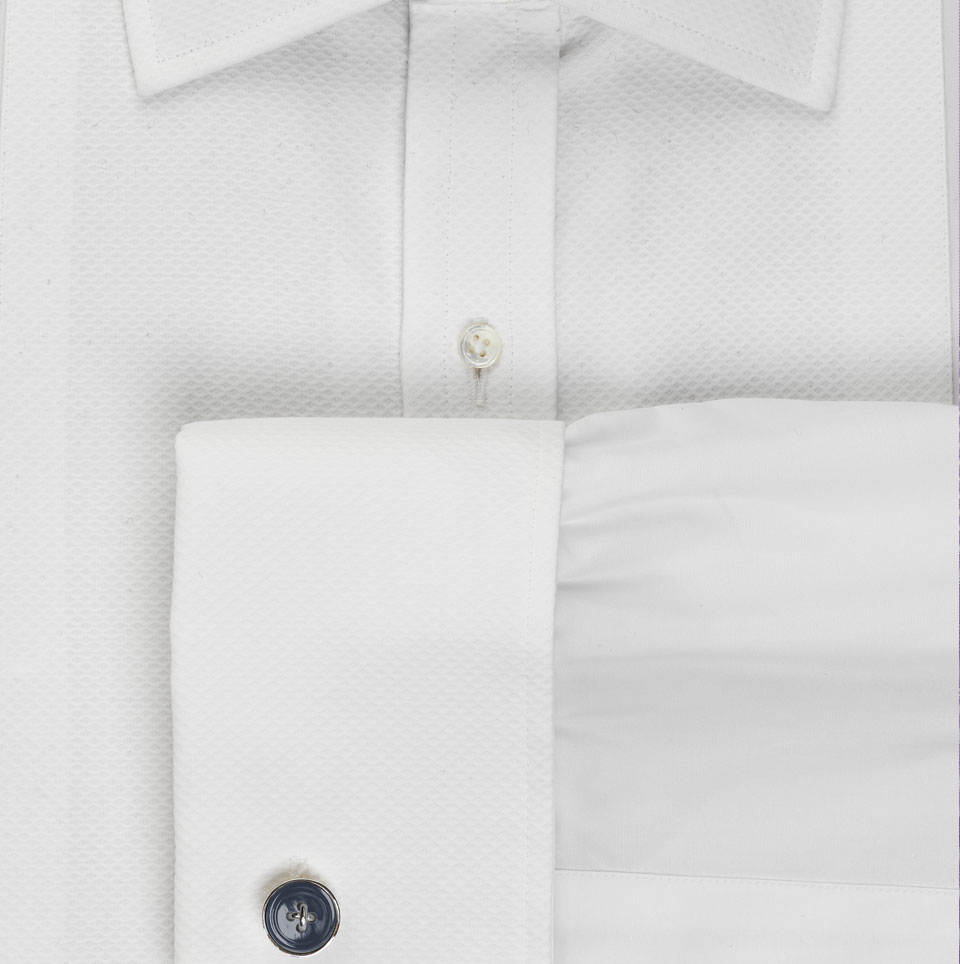 Marcell fabric
The fabric’s weave has a clear effect on durability and wear comfort. As examples I mention oxford, twill and basket weaves, which all are among the most durable types. Shirtings with an open weave, like panama, are prone to tearings and won’t last as long. Cotton is by far the most used fabric on shirtings, but is offered on the market from the exquisite to downright muck. Even poor cotton can be finished to look and feel pleasant when new, until the truth is dissolved with a few weeks’ wear. This issue is taken advantage of by clothing giants like H&M, who makes its revenue by selling huge lots for cheap prices. Similarly, valuable cotton can raise the end price of any fabric, but is more likely to last years of loving neglect. Fabric mills number in the thousands around the globe, but on the upscale market only about a dozen of them compete for the same clients.
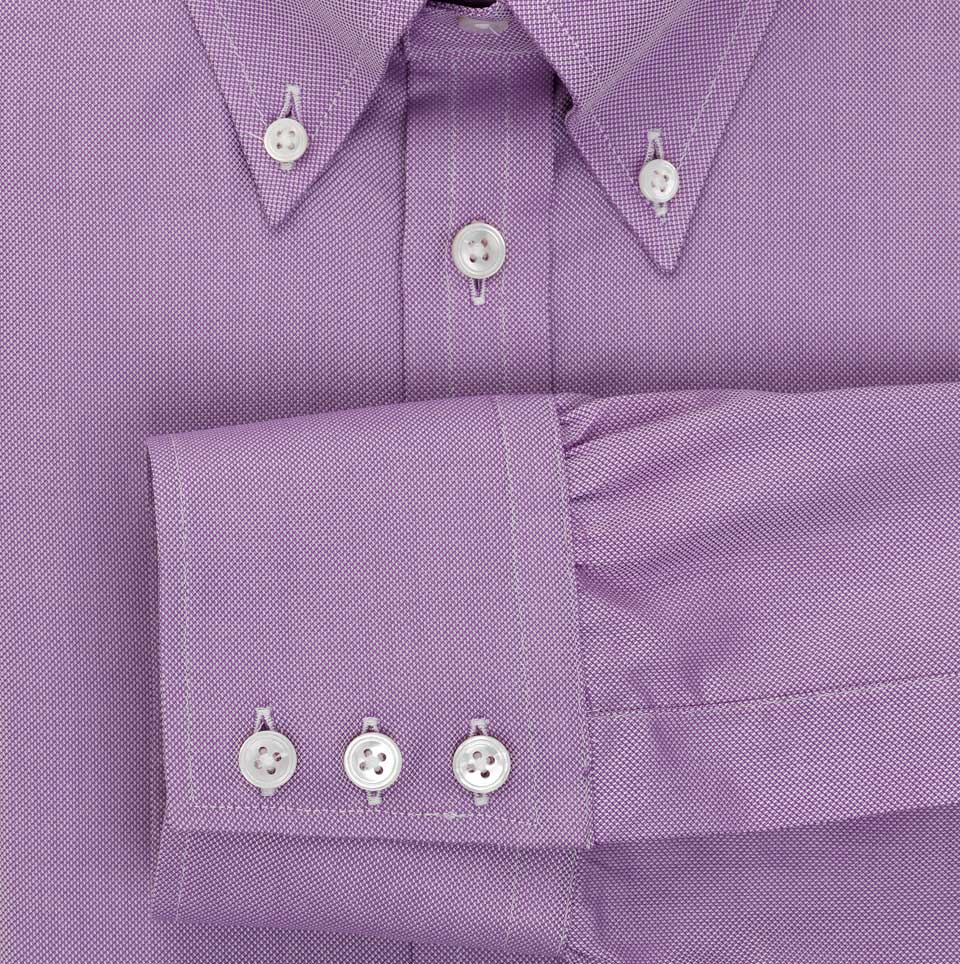 Royal oxford cotton
The following mills can be relied on to offer the greatest quality fabrics: Alumo, Carlo Riva, Thomas Mason, Albini, Acorn of England, David and John Anderson, Tessitura Monti, Somelos, Getzner, Tessuto Teseo, Albiate, Mileta, Leggiuno. I have tried shirtings from some of these, and find the differences small indeed. Further rating I must leave to others for the time being.
Pictures: © Turnbull&Asser
Category Essays, Materials, Shirts
Copyright © 2013 Ville Raivio