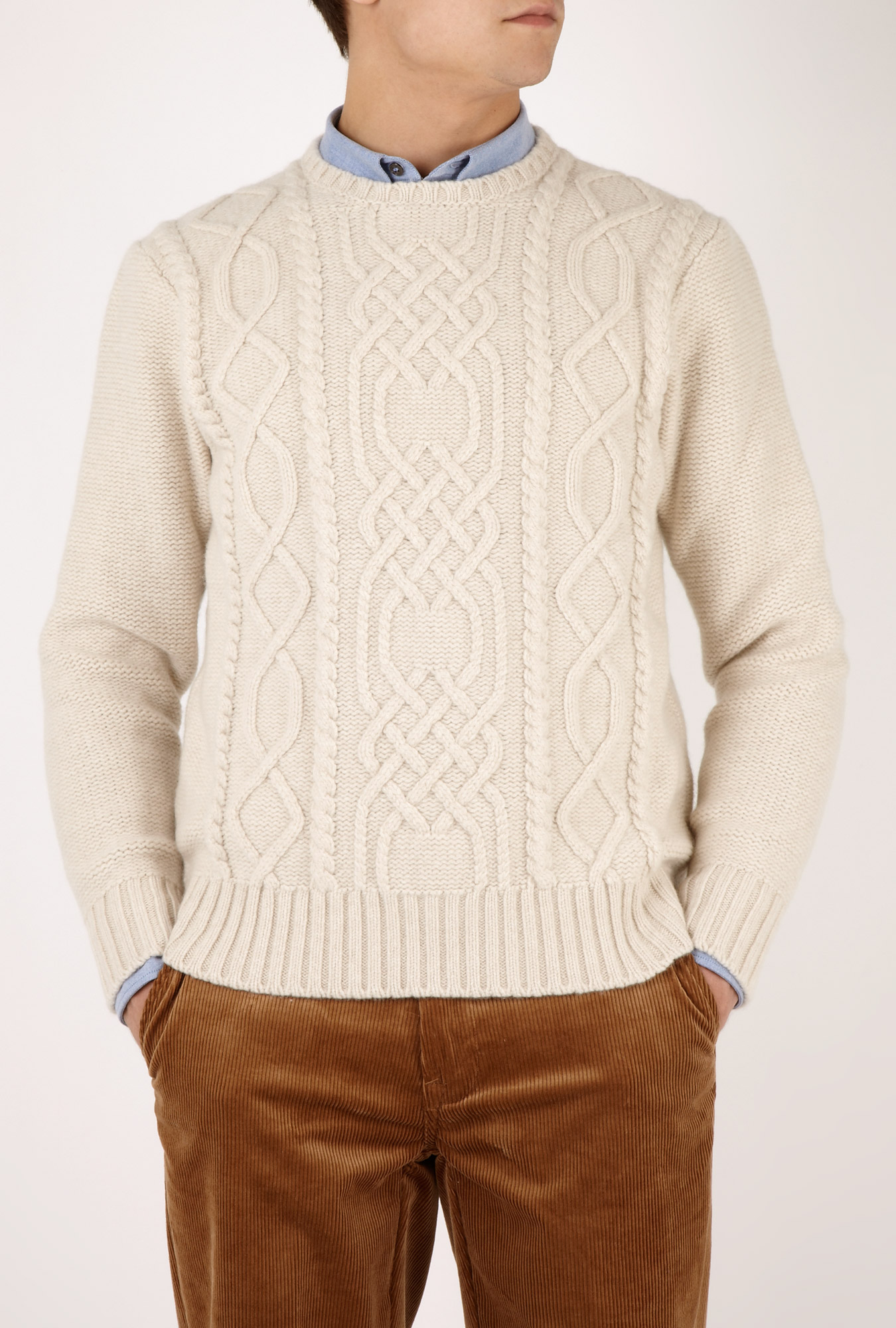
The Aran Jumper
0August 21, 2013 by Ville Raivio
The Aran jumper, also know as a fisherman’s jumper, is a knitwear model characterised by its off-white colour, large-scale woven patterns and heavy weight. Its name comes from the Aran Islands close to Ireland’s western coast. The jumper was first knitted from unfinished local wool, laden with sheepish lanolin which guaranteed great water resistance, and each jumper had the owner’s initials at the bottom. These, rather than any unique woven pattern, helped identify those lost at sea and later regurgitated by the unrelenting waves. While it is also romantic to think that fishermen kept calm and carried on in Aran jumpers, even if their knitwear might suck in some water, traditional Arans are stiff and thick. Guernsey jumpers were likely much more popular and handy among the fishermen of the islands.
The Anglo-Irish playwright John Millington Synge lived on the Aran Islands for some periods between 1898 and 1902. His notes on the inhabitants were recorded in The Aran Islands, published in 1907, which offers the following: ‘In Aranmor many of the younger men have adopted the usual fisherman’s jersey, but I have only seen one on this island.’ By jerseys Synge meant Guernsey jumpers. Aran jumpers differ from Guernseys in their flat construction. They must be seamed, unlike Guernseys, which are knitted in the round. Thick seams won’t make for a very comfortable garments for active fishermen — there’s less freedom of movement, and the seams may split open under strain. This strongly indicates that Aran sweaters were not originally meant for fishermen, despite the many contrary claims on magazines and online sources.
The Aran model is an intricate combination of various patterns with symbolism. Honeycombs for industrious bees, anchors for safety on troubled waters, diamonds remind for the riches below the surface, basket weaves for full baskets of fish. These pictures run in vertical columns on the front, back and sleeves, while the main panel on the front is as wide as the neck. In 1891, the local goverment of the Aran Islands established The Congested Districts Board to look after troubled families with unemployment and a shortage of food due to lack of potatoes. The Board advised fishing families to weave and create knitwear for sale, teaching the locals intricate patterns. Before this time, the islanders favoured dark and oily wool for its ease and warmth. The Board introduced them to softer, undyed fabrics, along with improving their fishing methods.
The choice of heavy threads allowed the jumpers to be finished sooner and brought decorative weaves to the fore. The results were more than satisfactory. Kenneth McNally has shared the following in his historical perspective, Achill: ‘Instruction in various kinds of knitting was given to classes held at Keel, and in one year (to March 31, 1914) earnings from this single source totalled £510. Over the same period income from lacemaking was £102 at Achill Sound, and £34 at Keel.’ One century ago five hundred pounds had quite a bit more buying and staying power than today.
The eccentric Aran proved popular even in faraway America, and this woven revenue helped fishing families during times of trouble. Dozens of new weavers were trained to meet high-piling order lists before machines met the challenge and shrunk the demand for artisanal models. The Aran jumper is still one chunky, cosy, warm and detailed piece of casual knitwear, offered by most retailers worth their salt. Models knit from unfinished wool have become a rarity as the lanolin oils do have an eccentric smell some noses may find unpalatable. Wool-nylon blends make for cheap and sweaty alternatives, while hand-knit models offer a tight weave along with a hefty pricetag. The Aran model is still a bit like the odd man out. Its off-white colour is far from practical in hunting, trawler fishing, gardening, so on, and the thick fabric may just wear too hot indoors. Aran jumpers, then, may just work best in dark colours instead of the creamy original for the centuries to come.
Picture: © Inis Meáin
Category Knitwear
Interview with Jeffery Diduch
0August 20, 2013 by Ville Raivio
‘I am 38 years old and am in charge of the technical design department at Hart Schaffner & Marx. I went to a private vocational college to study haute couture. I had been sewing since childhood and started making my own patterns as a teen; I also made my first tuxedo around sixteen years old. I am currently engaged to be married, with no children. Clothing and fashion was something I came to at a very early age — my mother taught me to sew, and she also taught us about quality garment construction and fabrics; it was not uncommon for us to turn garments inside out in stores to look at the finishing when shopping. My sister was a model for a time, and my brother is a jewelery designer. I studied music for many years, played piano until my accident, sang in an opera chorus, recorded with an early-music ensemble, and DJ-ed at parties and night clubs (I’m glad to see a resurgence in interest in vinyl — I still love my Technics 1210s).
 Mr Diduch (right) with Karen Alberg-Grossman and Lodovico Zandegu
I don’t believe in the distinction between “classic” and “fashion”. Things that are supposedly timeless still have contemporary details which will look dated ten years on. Things which many consider “classic” today are still current interpretations of those particular styles. As a designer, even if I were to take a style right out of a 1930s illustration of Apparel Arts, I will still interpret it with an eye to current details instead of doing a very literal version of it, which would look costumey.
I became interested in tailored clothing from a very early age, which I suppose could be considered more classic, because of the sculptural elements of it, taking a flat piece of cloth and shaping it into a three-dimensional garment with shape and life. Only in tailoring do you find this kind of craftsmanship. I was obsessed with sleeves, which are probably the most challenging part of the coat to get right, and when done well, are, to me, an absolute thing of beauty.
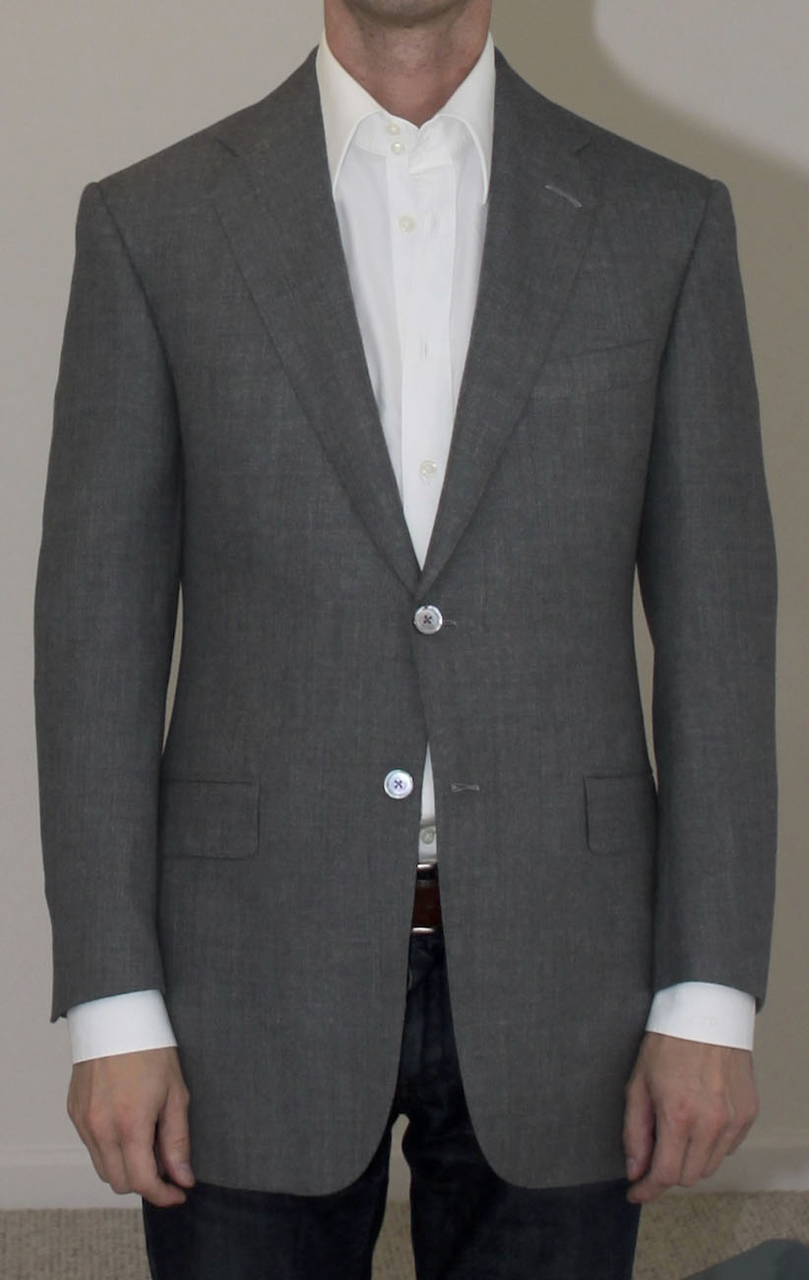 In self-made Holland&Sherry Vendon cloth jacket
I have gathered my knowledge of clothing from every imaginable source; from people under whom I studied but also from the multitude of books that I have collected over the years, but also, more recently, from the internet. I also belong to a trade organization for tailored clothing designers, which put me in contact with the industry’s top people from all over the world and which holds a convention every year in a different part of the world. Exposure to, and exchanges with, other people just as passionate about the trade as I has been one of the most valuable resources in my career.
I would describe my personal style as experimental. I’m not afraid to try new things and to push the envelope a little; sometimes I fail, sometimes it works, but at least I’m not just always wearing the same things day in and day out. When you work in an industry and are surrounded by it every day, even a beautiful, classic navy suit can begin to look awfully boring and you want to try out new things (this is what can lead to the Pitti-Peacock Syndrome). There are days when my mood is such that I will play it safe and stick to something more conservative, and other days my mood is more playful. I suppose my style can also be said to be an extension of my mood that particular day.
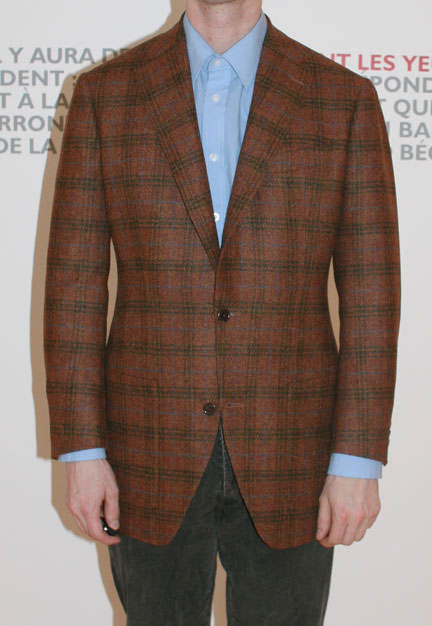 Drape jacket experiment using A.A. Whife’s pattern from the
legendary The Modern Tailor Outfitter And Clothier
The [HS&M] company has been through a number of big changes over the last few years. I came on just as we were shaking things up at Hickey Freeman, which is about to be sold to Samuelsohn, the company where I started my industrial career. Once things were heading in a new direction at Hickey Freeman, our attention was turned toward Hart Schaffner & Marx. The company is over 125 years old and had begun to show its age. For Spring 2014 I completely revised all the silhouettes and details in the product offering. Our core consumer is still a fairly conservative American who is looking for a decent value, no-fuss business suit and I have to keep that in mind when designing the core offering. My main focus was comfort and ease of wearing for that customer; we named that range of garments after Chicago, the city where it’s all manufactured.
We have another range of garments which we named after New York, a slightly edgier, more fast-paced city. Things are a little trimmer, with a slightly higher armhole. This range is for the guy who was wearing Chicago but may want something a little more updated without feeling like he is being squeezed into a skinny suit.
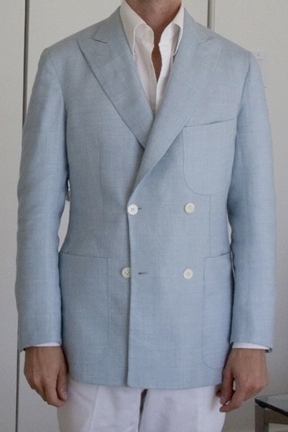 In self-made structureless summer jacket
The most directional line is named after Los Angeles. Readers of my blog may be familiar with my personal style of cutting coats, which is pretty close to the body with a higher armhole and trim, contoured sleeve. The Los Angeles is very much in this style, but is quite a bit shorter than our more conservative cuts, since the current trend is for a very much shorter garment. I did a quick shot of one of the samples which we had made in something close to my size — you can see the kind of shaping I built into this silhouette.
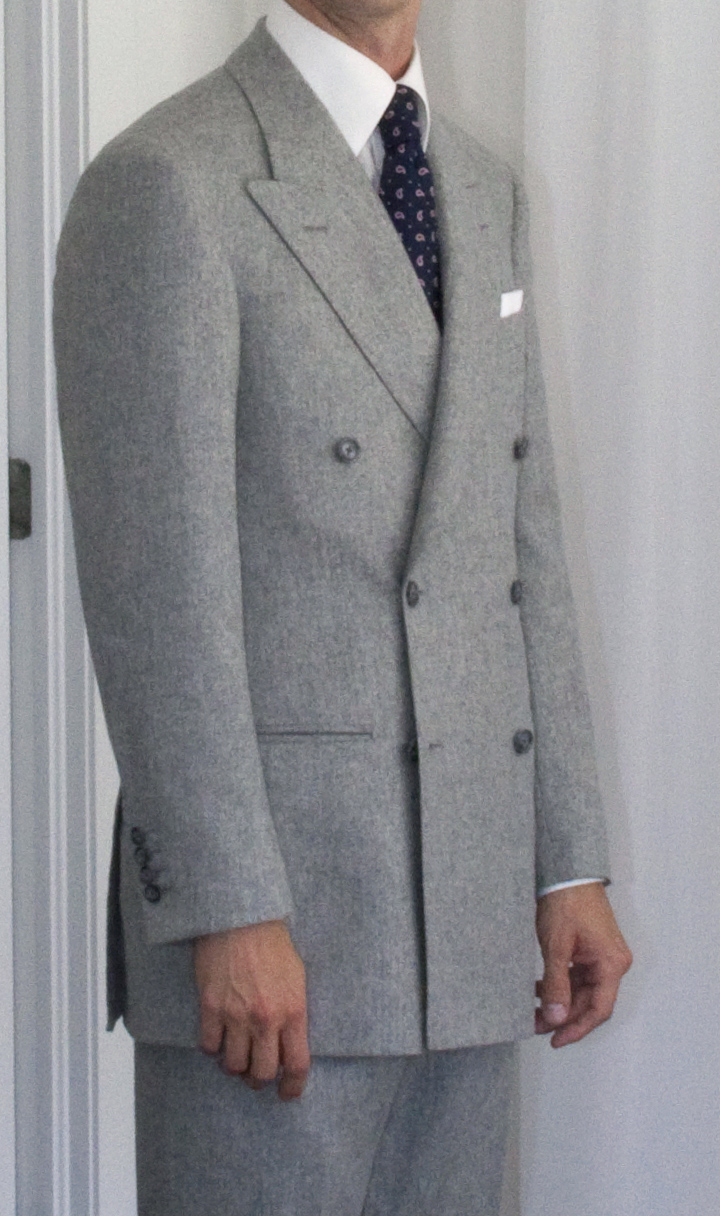
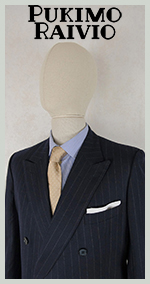
Double-breasted flannel suit from J.&J. Minnis’ 0300 cloth
Since my day job pays well, and the days are long, the only time I would take on any private work is if I was doing it for enjoyment. I would make my own clothing, and occasionally do a garment for someone else, but that was not limited to tailored clothing; I have made a number of wedding dresses and similar things as well. I can’t say that I have a “house style” but if someone had come to me to make them something, it was because they knew my work and it appealed to them. I would have them bring me tear sheets (or these days, downloaded images) of things that they like so I could get a bit of a fix on what they were looking for, and from there would produce a few sketches. The conversation would progress from there. I had an accident last fall that severed several nerves in my hand and that surgery failed to repair so I have had to stop sewing for a while, until I learn to sew without being able to feel the needle. My first few attempts had me piercing my numb fingers without knowing it, and I bled on my work so for now, I am out of commission.
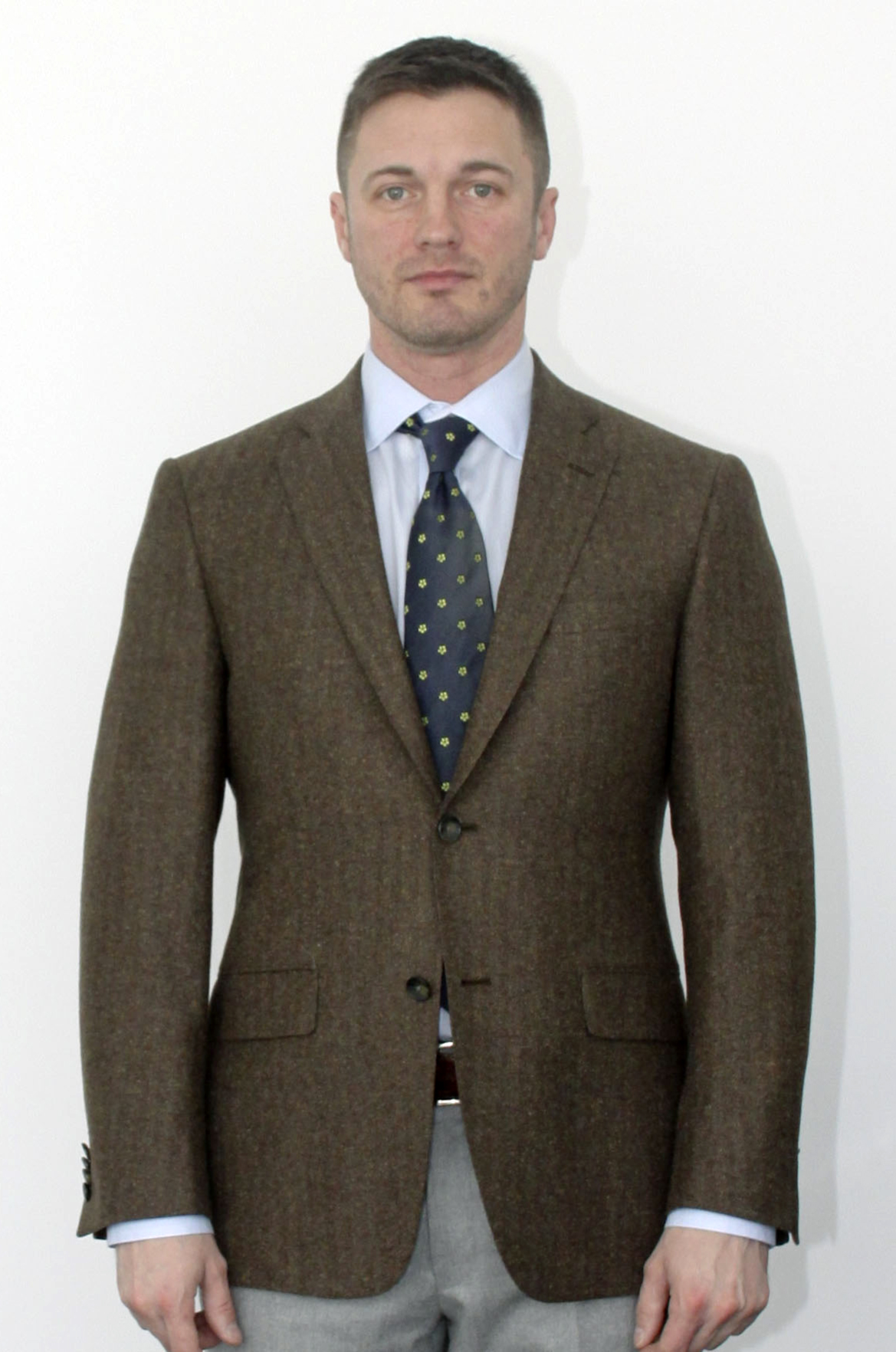 Modelling Hart, Schaffner&Marx’s updated readymade jacket pattern
I initially found the online fora when googling something, and at the time there was a lot of misinformation about tailored clothing, and especially some of the basics such as what canvas and half-canvas meant; I realized that there was a lack of information available so I took it upon myself to provide some of it. I had to be able to remain completely impartial when discussing construction techniques, or when studying interesting clothing, so at first I remained completely anonymous. I did not want to seem like I may be shilling any particular product or hyping my own stuff. Over time, however, I had to “come out”. The reaction to Tuttofattoamano was beyond surprising — I never imagined there would be the level of interest that there was, and was even more surprised and humbled to learn how many industry people were reading.
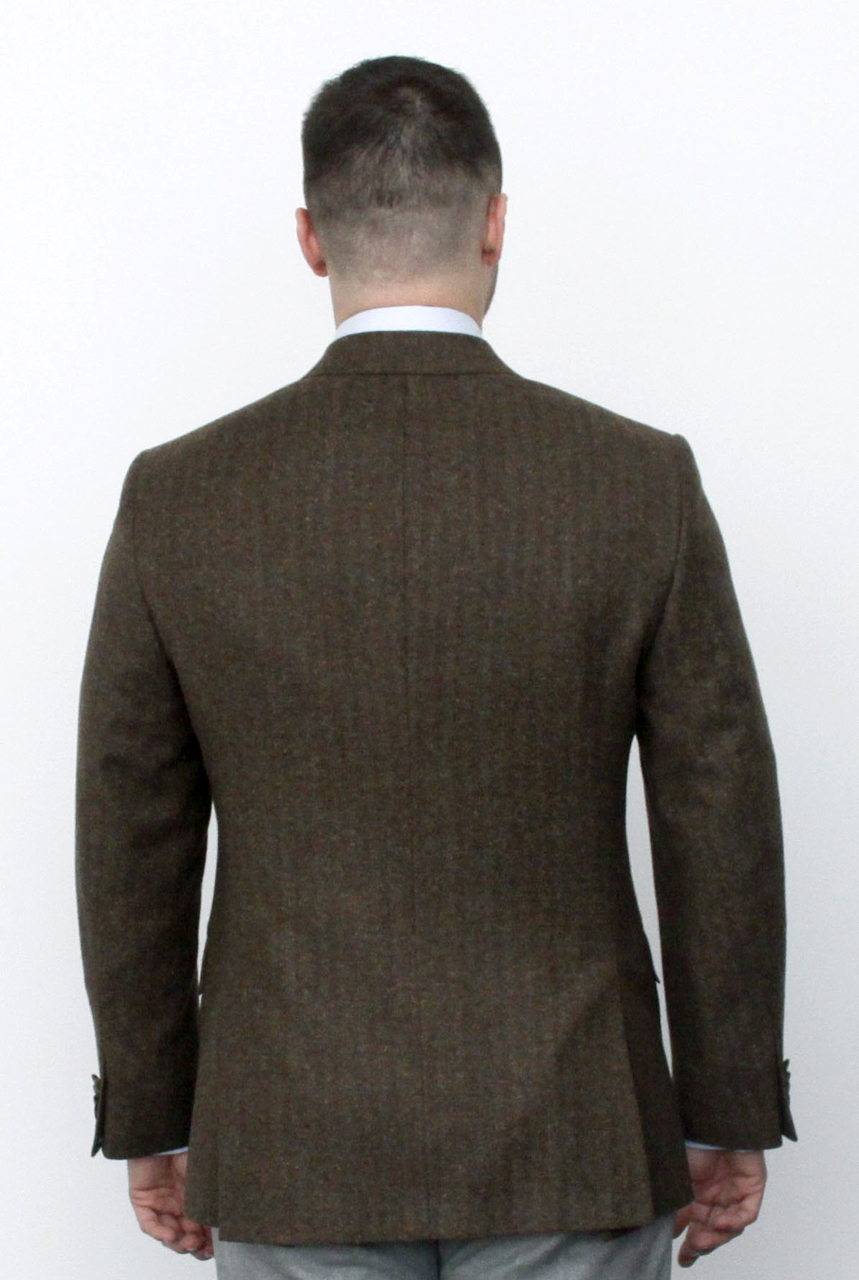 View from the back
I think many jump off the deep end in search of bargains, which is a mistake. Whether it is thrifting or online Made to Measure, I think novices are prone to mistakes. These sources can be wonderful for the more experienced shopper, but until you have a firm grip on what you like, what looks good on you, and what the various details mean, I think it is much safer to stick with more traditional sources who can usually guide and inform the shopper. When you are just starting out with tailored clothing, try on as much as you can — even if it is out of your price range, you will get an idea of what cuts and styles and colors and textures work best for you. Once you have a fix on what works for you, you can start to narrow your selection to something closer to your budget. Clothing can be an investment and shouldn’t be rushed, and a great eBay bargain isn’t really such a bargain if it doesn’t look or fit right once you get it.’
http://www.hartschaffnermarx.com/
http://tuttofattoamano.blogspot.com
http://www.styleforum.net/u/30798/jefferyd
Pictures: © Jeffery Diduch
Category Bloggers, Interviews, Styleforum, Tailors
Factory Tour at Shirtmakers Rayner&Sturges
0August 20, 2013 by Ville Raivio
Today’s link leads to Spitalfieldslife, a site concerning itself with the wonders of life in Spitalfields at the heart of London. Its Gentle Author visited the Kent-based Rayner&Sturges, the last independent British shirt factory, in 2011 and brought back a full pile of pictures of the premises and workers. If the reader owns a few (dozen) British-made shirts, chances are they were born at R&S.
http://spitalfieldslife.com/2011/07/11/at-rayner-sturges-shirtmakers/
Category British Style, Links, Shirtmakers
The Cycle of Fashion by James Laver
0August 20, 2013 by Ville Raivio
Indecent: 10 years before its time
Shameless: 5 years before its time
Outré: 1 year before its time
Smart: —
Dowdy: 1 year after its time
Hideous: 10 years after its time
Ridiculous: 20 years after its time
Amusing: 30 years after its time
Quaint: 50 years after its time
Charming: 70 years after its time
Romantic: 100 years after its time
Beautiful: 150 years after its time
~ James Laver in Taste and Fashion, 1945
Category Quotations
My Gucci Addiction by Buzz Bissinger
2August 16, 2013 by Ville Raivio
Buzz has a solemn given name, Harry Gerard “H.G.” Bissinger III, but is known professionally as Buzz Bissinger. He has also developed a stringent addiction to high fashion clothes which has, over the course of a few years, left him with 115 pairs of gloves and 81 leather jackets along with a total bill of close to $700 000. My Gucci Addiction, published among GQ’s pages on April this year, details his obsessions, demons, twisted sexual landscapes, leathery inclinations as well as one binge-filled trip to Gucci’s Fall/Winter 2013-2014 Men’s Collection fashion show held on January. Those familiar with style fora lingo and the circle of instakops will find Bissinger’s thoughts familiar, even if menswear might be closer to one’s tastes than fashion. One question remains best answered by each man alone: why do you keep on buying?
Copyright © 2013 Ville Raivio