
Gentlemen of Style: Men’s Fashion Illustrations in the US in the Thirties
0April 2, 2013 by Ville Raivio
I have been ogling my copy for the past few days, and have nothing but praise for this virtual style book. It really should come with a price, and yet GG offers it for no charge to their email subscribers.
“Over the past weeks, we have published fewer articles because we were working on our very first eBook – Gentlemen of Style. This book focuses on men’s clothing in the US in the 1930′s as worn by elegant Gentleman using Apparel Arts Fashion Illustrations from Fellows, Saalburg, Oxner, Hurd etc.
The goal of this book was to show the degree of elegance in men’s clothing at the time, and to point out things that you may improve in your very own outfits. Overall, I discussed more than 30 fashion illustrations from the early 1930′s Apparel Arts magazines, most of which have never appeared online anywhere.
Moreover, these illustrations are large unlike the tiny pics you usually see. In combination with the commentary, it is more details than the book Men in Style and features considerably more information about the golden age of menswear the 1930′s.
Best of all, instead of spending $200 – 600 on Men in Style, my book will be available exclusively to subscribers to the Gentleman’s Gazette Newsletter for a limited time for free. All you have to do to claim your copy is to sign up here – enjoy the read!”
http://www.gentlemansgazette.com/gentlemen-style-men-fashion/
Category American style, Links, Reading
Interview with Christian Chensvold
0April 2, 2013 by Ville Raivio


VR: Your age and occupation?
CC: I’m 43 and a freelance writer.
VR: Your educational background?
CC: Alas, my education is not in line with my IQ. I suppose I’m a classic underachiever. The primary distinction of my alma mater is its close proximity to Disneyland. I did, however, attend on a fencing scholarship and trained under a Hall of Fame coach, and was the conference champion my senior year. After graduation I spent the summer in a French intensive at Cal Berkeley, then enrolled in the master’s program in Comparative Literature at San Francisco State. But after one semester I was bored, disillusioned with academia, and restless to move on.
VR: How did you first become interested in clothing, and when did you turn your eyes towards classic style? Why classics instead of fashion?
CC: I was definitely born with the gene for enjoying clothes and was sensitive to which items felt right on me even as a young boy. In my senior year of high school I saw several films that made a big impression on me, including “Wall Street” and “The Untouchables,” and I started buying fashion magazines and Flusser’s “Clothes And The Man.” By the time I left high school I was already deeply interested in tailored clothing and taking most of my style cues from the past.
VR: How have you gathered your knowledge of clothing– from books, in-house training, workshops or somewhere else?
CC: That first interest was sparked 25 years ago, and I’ve never stopped being interested in clothes. Since about 2004 I’ve been writing about style and the apparel industry for a wide range of trade and consumer publications.
VR: A career in menswear journalism is a rare thing. How were you lead to this path?
CC: Certainly not the direct route. I became interested in the history of dandyism while in college, and some of my first articles were dandy-related. But in my ’20s I mostly was a general features writer, and also worked at a couple of business and finance magazines. After moving from San Francisco to Los Angeles that business experience enabled me to start taking assignments from an apparel industry trade newspaper, which led to other work writing about menswear and related lifestyle topics.
Most of the media outlets are very trend-driven, however, and I’m not a fashion guy. The Rake has enabled me to do articles and essays that are more tied to the social history of clothing, or even what you might call style theory, and those have been more enjoyable.
VR: How would you describe your own dress?
CC: I’ve had certain preferences since the very beginning, but there’s certainly been a lot of change over the years, the curse of those with dynamic personalities and wide-ranging tastes. So my dress is always evolving, though within more fixed parameters lately.
I started out a kind of Anglophile traditionalist, then had to get a lot of other experimentation out of my system. I’ve returned to that taste for classic dress, though with a much more American bent. In the Ivy League Look I found a genre of clothing that is fairly fixed, which perhaps appeals to my sense of order. But it’s also flexible enough to appeal to all the sides of my personality. It can be cool, elegant, sporty, conservative. I also strongly identify with the approach of being relatively dressed up with casual attire and relatively dressed down with formal attire.
I’ve never been a retro-eccentric vintage wearer, though I’ve always taken my inspiration from the past. These days I’m playing with this kind of “beatnik chic” idea, which basically comes down to wearing my Ivy gear with, say, a black corduroy cap, black cable-knit cashmere sweater, and black penny loafers. But ask me next year and I’ll likely be working a different vibe.
VR: Which tailors/RTW makers do you favour?
CC: I have some made-to-measure items from H. Freeman, and the rest comes from the usual suspects in the trad genre: Ralph Lauren, Brooks Brothers, J. Press, O’Connell’s and various others.
VR: You’ve set up several interesting sites. How did they come about and how have these been received? Any ventures ahead my readers should know about?
CC: With Dandyism.net and Ivy-Style.com I took two topics that had great interest for me and rich histories — two centuries for dandyism and one for the Ivy League Look — and combined the presentation of historical documents with dashes of my own personality. It’s a combination I think really works, and I’m not sure there’s another topic out there that would provide the same opportunity.
It started in 2004 when I had a number of writings on dandyism that were lying about, some published and some not, and was aware that there was not a proper central resource for dandyism on the Internet. I began thinking about starting a website that I originally envisioned as a scholarly resource that would primarily be a kind of bibliography. But then I became aware of the rise of blogs, which was happening at the same time, and once I banged out the first couple of posts that combined a sort of personal narrative along with news geared towards a reader with an interest in dandyism, a seemingly endless creative vista opened up.
I think the flexibility that the blog format provides, along with the combination of working a narrow beat for a niche audience while providing personal commentary, is the perfect venue for my particular temperament and talents.
VR: Ivy-style, the exhibition and its accompanying book seem like the perfect success story. Please describe how they came to be.
CC: I was very glad that my website and its posts from many contributing writers provided the chief inspiration for the Museum at the Fashion Institute of Technology, and was pleased to have them use my Q&A with Richard Press in the accompanying book.
VR: What other hobbies or passions do you have besides clothing and writing?
CC: I’ve played many sports in my life, and taken on other pursuits such as swing and ballroom dancing, billiards, chess, and so forth. I’m always up for learning something new. These days I’m playing a lot of tennis and piano, and am deeply obsessed with golf, which I consider the most difficult activity mankind has ever created.
VR: Over the years you must have learned quite a bit about apparel. Is there something you wish more men would know?
CC: I don’t particularly care about what other men know or don’t know. I’m not a style evangelist, though some of my busywork involves educational pieces that point out the traditions of menswear or make style suggestions. Over the past couple of years I’ve realized I have almost no interest in what other men are wearing, how much they spent or where they got their clothes, or if they take a medal and knock me off the podium. Since moving to New York I’ve really enjoyed the company of the friends and colleagues I have in menswear, but let’s just say when talking shop with them I lost all compulsion to evaluate what they’re wearing and whether or not I approve. Let others do what they want; the only person whose clothes I’m interested in are my own.
VR: Many of my readers are young or have only recently opted for a more formal style. What tips would you give to those who have only recently become interested in more or less tailored clothing? This is an extremely useful chance to have a lasting effect on many young men.
CC: Looking back on my more impoverished and less enlightened youth, I’d say I made sacrifices in the fit department in the interest of having something I liked or could afford.
Today I’d say quality is less of a concern and would advise a young man to devote his resources to tailoring alterations and to choose his items carefully in regards to fit, and to not be overly concerned with quality, which he can become a connoisseur of later when it’s not so financially punitive. If you’re young and healthy and charismatic and radiant with life’s possibilities, you’ll probably make a great impression in just about anything you wear as long as they fit you.
Pictures: © The Rake, Free&Easy
Category Arbiter Elegantiae, Bloggers, Interviews
Oxxford Clothes Factory Visit
0March 31, 2013 by Ville Raivio
Today’s link leads to Allplaidout, whose writer-at-large has shared some snaps from his visit to Oxxford.
http://allplaidout.com/2010/04/factory-visit-oxxford-clothes/
Category American style, Links
Shoe Gemming Construction
7March 31, 2013 by Ville Raivio
Gemming is a construction method widely used by shoe factories since the 1950’s. In fully handmade shoes the cordwainer pierces a channel through the insole, and stitches the welt through the insole to the upper. The outer sole, in turn, is attached to the welt with lock-stitching. With this method completed, the outer sole — subject to most wear and abrasion — is ultimately kept in place by the insole. Gemming is a different animal entirely. Instead of piercing the insole, the outer sole is simply attached to a strip of canvas glued and cemented to the insole. In place of stitches to the insole, the shoemaker has placed a gluejob. Its benefits are manifold. Instead of using hours to carefully pierce and stitch the insole, gluing is fast and effective. The factory production is expedited as less shoemakers are tied to the slow manufacturing phase, and the customer receives his pair faster and with a cheaper end price.
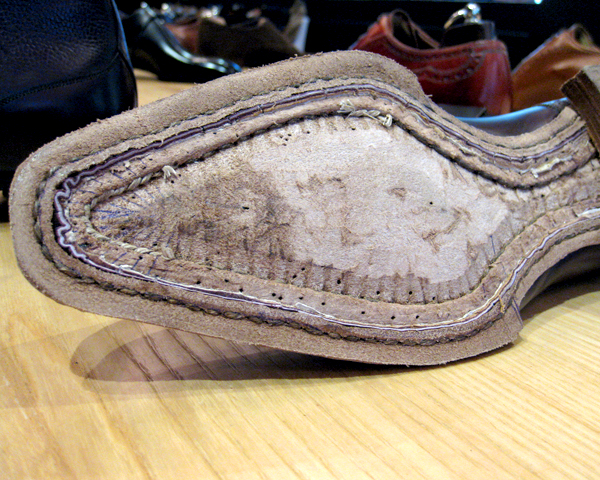
Hand-welted bespoke shoes by Gaziano&Girling
Cordwainer D.W. Frommer II defines the method as follows: “Gemming is a process that involves laying down a canvas rib around the perimeter of the under-surface of the insole. The rib is called gemming. And its purpose is to substitute for the leather holdfast…and to do it cheaply and quickly. It can be recognized by the white strip you see in most photos…sometimes ‘pinked’ sometimes not. The gemming is cemented to the insole. That is the only thing holding it (and the shape of the shoe) in place. The welt is machine stitched to the gemming and the resultant insole cavity is filled with cork.
Now, it bears repeating…in almost all instances, the gemming is held in place solely by cement. And that is its first weak spot. The cement will fail, probably even before the shoe is in need of a resole. When the cement fails the gemming slips and the shoe will walk out of shape. And anyone attempting to resole without the original last, faces the nearly impossible task of trying to re-position the gemming.” In short, gemming is a substitute for hand-welting, used to hasten production and profits, while guaranteeing a certain level of attachment — and yet Janne Melkersson, a third-generation cordwainer from Sweden, has repaired gemmed shoes for several decades without a single failed gemming experience. Millions of gemmed pairs have been produced since the 1950s; factories would have surely abandoned the method if failures were wide-spread.
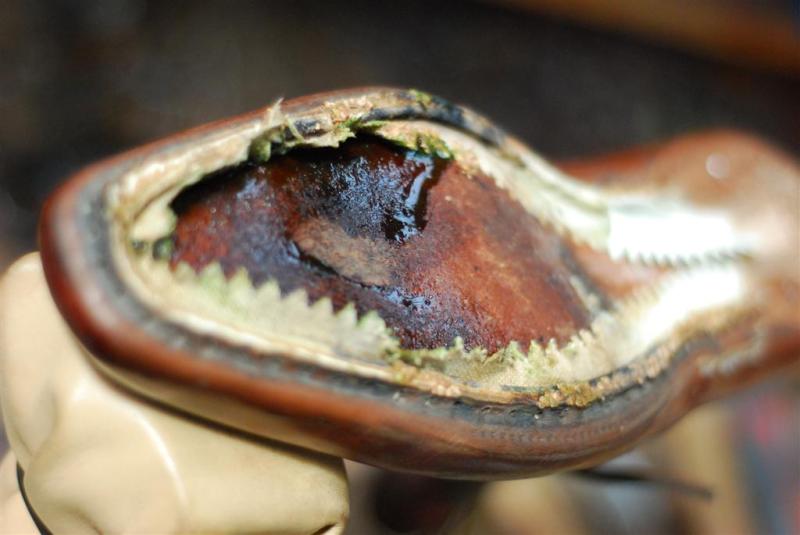
Gemmed pair with white canvas rib by Edward Green
Gemming is the go-to method of shoe factories and price alone is no proof of quality welting. Factories like Alfred Sargent, Gaziano&Girling, Edward Green, Ludwig Reiter, John Lobb Paris, Alden and Carmina use gemming. All cheaper footwear, like Loake, Allen-Edmonds or Barker, all either gemmed or entirely glued. Instead of listing the makers using gemming, it is much easier to simply mention some hand-welters. These can be found below, though the list is far from quintessential. British factories have opted for gemming due to high labour costs, while Italian and Hungarian makers still benefit from cheaper labour, which allows them to offer true handmade shoes for lower prices. Some makers based in higher-wage countries have their production elsewhere. The German firm of Heinrich Dinkelacker has its pairs made in Hungary, Saint Crispin’s in Romania. Meermin is the odd man out: while the factory is based in Spain, its labour-intense workphases are outsourced all the way to China. I wager more makers will choose this model in the future.
The question remains whether gemmed footwear can be recommended. Based on my experiences and what I’ve read of the construction method, I can, yet I must remind the reader of the benefits of hand-welting. These pairs have no glue strip subject to rot, wear or random entropy. They are held in place by waxed linen thread, first on the welt, then — and ultimately — on the insole. The attachement is strong and guaranteed by a few thousand years of shoemaking experience. Still, the glues used by current factories are strong gunks, and I’ve never managed to destroy a gemmed shoe with walking alone. Most likely gemming will not fail, but it just might, and this possibility alone is enough to mark it inferior in the eyes of shoe nerds. For everyone else, gemming is the most useful tried and tested method available.
Some true hand-welters:
- all cordwainers
- László Vass
- Rozsnyai
- Buday
- Koronya
- Heinrich Dinkelacker
- Zonkey Boot
- Meermin
- Saint Crispin’s
- Silvano Lattanzi
- Kiton
- Lidfort
- Antonio Meccariello
- Sutor Mantellassi
- Bontoni
- Borgioli
- Mannina
- Stefanobi
Further reading:
- http://www.styleforum.net/t/153269/deconstructed-fashion-plate/0_100
- http://www.depiedencap.eu/spip.php?rubrique50
- http://www.styleforum.net/t/153448/gemming-the-shoe-devils-work/0_100
- http://www.askandyaboutclothes.com/forum/showthread.php?100133-What-seperates-Crocket-amp-Jones-from-Edward-Green/page2
- http://forums.filmnoirbuff.com/viewtopic.php?id=6446
Photos: original uploaders
Copyright © 2013 Ville Raivio