Interview with Richard Press
1April 8, 2013 by Ville Raivio
‘I am 75 and currently a man for all seasons engaged in a symphony of endeavors. In 1986, as President and CEO of J. Press Inc., upon the sale of the family business to Onward Kashiyama of Japan, I was remaindered as Vice President of the J. Press, U.S.A. division of the parent company. Left 1991 to become President and CEO of F.R. Tripler, 115 year-old retail store owned by the Hartmarx Retail Group. The Hartmarx Retail Group was liquidated in 1995 and I departed retail.
 Mr Press in New York, 2012, picture: © Rose Callahan
I am currently Featured Columnist at ivy-style.com, menswear consultant, until past January, co-curator at Museum of the Fashion Institute of Technology Ivy Style Exhibit. Lectured at Yale University, participate in signings of Yale University Press book, Ivy Style. Regularly interviewed and featured in Japanese magazine Free and Easy, other menswear blogs and journals, labeled by Tablet Magazine, “the premier historian of the Ivy Look.”

Mr Press with wife Vida at Isle St. Louis, 1998
Prep school graduate of The Loomis School (now called Loomis-Chaffee), Dartmouth College, the American Academy of Dramatic Arts and Master’s Degree from the New York Institute of Technology. My wife Vida graduated Smith College in my same year and managed a Park Avenue surgeon’s office for many years. Daughter Jennifer inherited Press family genes, was host on a popular radio show A Fashionable Life on WGCH, Greenwich, Connecticut.
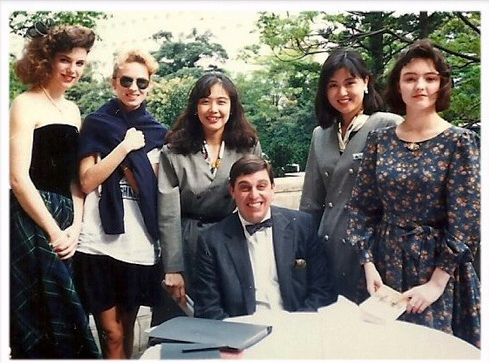
Mr Press at a J. Press Convention in Tokyo, 1989
Son Benjamin J. Press co-heads DBA-Fortitude Associates, a talent agency in Beverly Hills, California. He wore his grandfather’s inherited 1968 tuxedo last year at an Oscar party when a Hollywood star, his client, complimented him that, “he was the best dressed guy there.” The London Daily Mail agreed and headlined him “best dressed” in their report of the event. Vida appeared with me last year at a Yale seminar where I was speaking on The Heyday of Ivy. She stole the show answering student questions regarding the impact of Ivy Style on her fellow Smithies.
I have no siblings and my parents and immediate family showered and spoiled me with undeserved attention. My father and his brother sustained the unremitting love for menswear tailoring and furnishings that motivated their father Jacobi founding the business bearing his name. I followed the family tradition unswervingly even doodling and dreaming about Ivy League culture in my earliest years in school. I grew up in New Haven, Connecticut not far from the Yale campus.
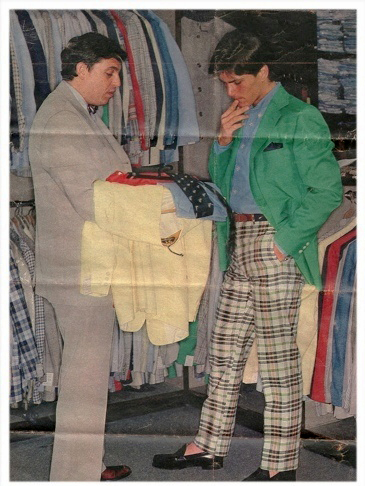
Mr Press amid the pastel glory that was the 80s, 1982
I loved and deeply respected my grandfather, a vigorous and charismatic man who became a celebrity among legions of Yale men and leader in the local community. Many of my earliest days were spent in the portals of the J. Press store in New Haven until I went away to boarding school. My grand father proudly introduced me to his customers, many of whom were stars in the Yale scene. I studied what was hip and “shoe” among the upper-class and recognized my future at J. Press to maintain the ethos of trade exellence originated years ago by my beloved grandfather and perpetuated by his sons.”
I assumed the junior reins upon my graduation from Dartmouth after serving six months as private the U.S. Army Reserves. I was fortunate, becoming head of the company in 1982 when they were still alive, each becoming Co-Chairman, Emeritus. President and CEO was a dream I coveted beyond the cradle. My knowledge was ingested as milk from a mother’s breast. During prep school and college vacations I worked in the tailor shop labeling cloth bolts, shipping room, even occasionally as a bench player on the sales floor.
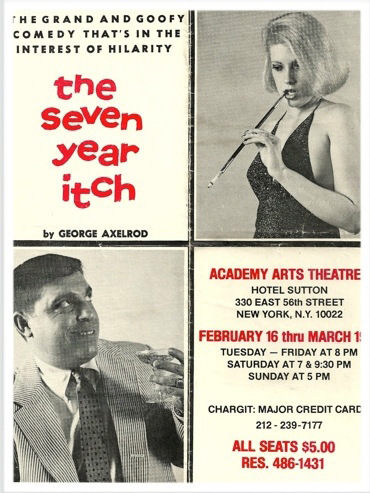
Mr Press as the dramatic brunette in an off-Broadway production, 1976
I was taught to fit and pin suits and learned all areas of the business tutored by personnel and my father. I wrote advertising copy, printed price tags and dressed the clothing dummies in the window. There were no hidden orifices that were allowed by my father to escape my attention. I remain a voracious reader of F.Scott Fitzgerald, John O’Hara, Tom Wolfe, Geoffrey Wolff with their keen portrayals of Ivy League characters so illustrative of the defining era.
My own style of dress evolved in the same way J. Press customers thrived enlarging the dimensions of their wardrobe. Prep school days I wore tweed sport jackets, cotton Oxford button-down shirts, three inch foulard, rep stripe, emblematic, challis wool, Irish poplin ties, grey flannel or corduroy trousers, argyle hosiery with garters, weejun loafers or dirty white buck shoes. Coats and ties had to be worn to all classes and mandatory chapel. Dressier requirements on trips to New York City usually meant a grey flannel suit. Dartmouth is a rural campus with less formality than Yale, Princeton or Harvard. My uniform was khaki or corduroy pants, usually messed up button-down shirt, shetland sweater. I was an ardent skier and often sported turtleneck shirts or sweaters to fight the New Hampshire cold, not unlike Finland.
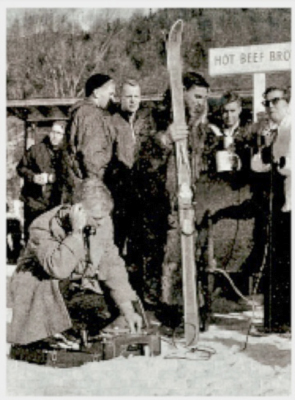
Mr Press (armed with skis) at Dartmouth Winter Carnival, 1956
My “Mad Men” years in New York, beginning in the 1960s, featured grey chalk stripe suits with equivalent haberdashery of my youth. Summertime in New York meant seersucker, cotton linen, tropical wool chalk stripe suits. I favored the Gucci-styled loafer shoes sold by Barrie Ltd. next door to J. Press in New Haven. Ready-to-wear clothing of the time was tailored especially for J. Press by Franklin Clothes, Linett, Hertling in our natural shoulder, three button model with center-hook vent, plain front trousers with twenty inch knee and seventeen inch bottom. Trousers were worn cuffed. Today I slob around New York in khakis, OCBD, blue blazer, winter turtlenecks, sloppier than I would dare to be in the Heyday when I ran a company. I believe a gentleman never discloses either his mistress or his tailor and I adhere to that personal requirement regarding where I purchase the contents of my closet today.
I have not been associated with J. Press since 1991 therefore any changes that have occurred with the company’s product occurred without any help from me. Time marches on and I am not averse to change as long as it is intelligently and tastefully accomplished. The evolution (or revolution) of J. Press, Brooks Brothers, Paul Stuart, Ralph Lauren, other shops of the genre is best told in their profit or loss statements. I hope the short length of most of their suits and blazers together with the low rise, length and width of their trousers doesn’t suggest a short sale of their stock.
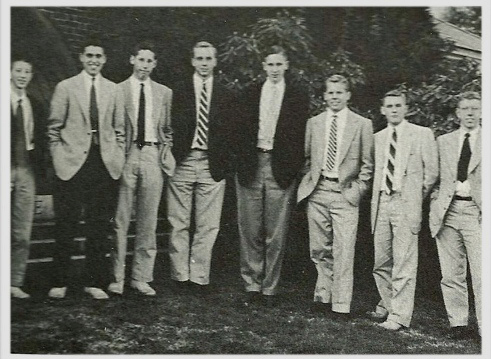
Mr Press (second from left, position not pertaining to political views) with singing group at Loomis School, 1953
A Gershwin song lyric might have well been composed representing my work philosophy.”‘I’ll build a stairway to Paradise with a new step every day.” I enjoyed introducing myself to as many customers as possible and encouraged my managers and staff always to be respectful, friendly and professional. The customer profile of J. Press included American leaders in all walks from Frank Sinatra to Robert Frost. Enough said.
I co-curated the recent Ivy Style Exhibit at the Museum of the Fashion Institute of Technology garnering many tours conducted (available on You Tube), talks, seminars and signings for a book dedicated to me, Ivy Style, published by Yale University Press, featuring an interview conducted by Ivy blog founder Christian Chensvold with me. Henry Luce, the oligarch of Time, Life, Fortune and Sports Illustrated Magazines, characterized the twentieth century as the American Century. Culture of that knighted era was dominated by the Ivy League and as years pass the public awareness of its tragedies and triumphs stand in poignant contrast with the 21st Century of ragged decadence in the arts, literature and fashion. Cheap goods with limited shelf life. The Ivy League was America’s Land of Oz. Unlike in the Wizard of Oz, the curtain of reality was pulled, not by Toto the dog as in the movie, but by Viet Nam, assassination, civil and financial disorder. Menswear has been jerking around since and I am optimistic we shall see a new sun up in a new sky.
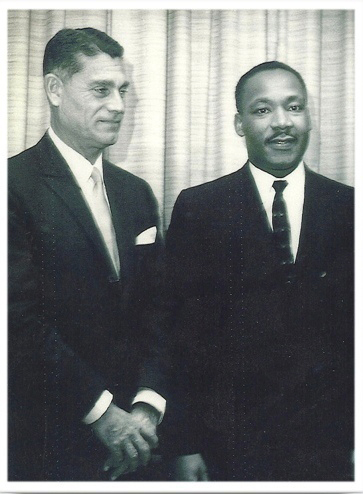
Mr Press’ father Paul Press with one Martin Luther King, Jr., 1961
My appetite for lobster and cherrystone clams remains undiminished together with my addiction to literature, history, politics, the New York Yankees, Broadway musicals, dogs and the lusty sophistication of New York City. My wife and I treasure the joy of our children and grandchildren. When my orthopedic surgeon told me to forget skiing, I survived the disappointment with nary a tear. After completing drama school evening classes, I performed as an actor in a dozen off-Broadway productions during slow seasons at J. Press. I completed the circle producing two plays on Broadway, one nominated for a Tony. The wonders of Apple assist my endeavors as Featured Columnist for the Ivy Style blog (ivy-style.com) and have submitted a manuscript to
my literary agent for a book currently titled pre-publication, “Cut From The Cloth: The Heyday of Ivy League Style and the Life and Times of One Man and the Family Who Made It Happen.” Maybe a Finnish edition [someday]!
I wish more men (and women) would learn history, become familiar with at least a smattering of the arts. Since we are talking Menswear, young men should find out what kind of clothing enhance the quality of their life. What represents sensible economic value, well-made, priced fairly, au courant enough to endure as a gift for the next generation. I mentioned earlier that my son flaunted his grandfather’s forty year old wardrobe in Hollywood! Find mentors from times past. The Duke of Windsor was a cad, a best dressed one. If you are unable to recognized the sheer genius of his clothes, then I am talking into a hat. Presidents John F. Kennedy, Franklin D. Roosevelt, author F. Scott Fitzgerald, composers Cole Porter and George Gershwin, movie stars Fred Astaire, Cary Grant, Clark Gable, the list goes on and on and every one of them had glorious style. Learn from the past. This article is a mere outline. Perhaps many of you can digest my Ivy history reading The Golden Years columns of the sidebar at ivy- style.com.’
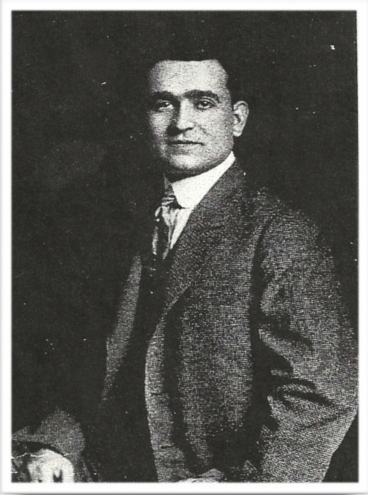
Jacobi Press, the founding father of J. Press, 1908
http://www.jpressonline.com/j-press/
Pictures: © Richard Press
Category American style, Arbiter Elegantiae, Interviews, Tradesmen
Ralph Waldo Emerson
0April 8, 2013 by Ville Raivio
‘Being perfectly well-dressed gives one a tranquility that no religion can bestow.’
~ Ralph Waldo Emerson
Category Aphorisms
Interview with ‘Mantic59’
0April 6, 2013 by Ville Raivio
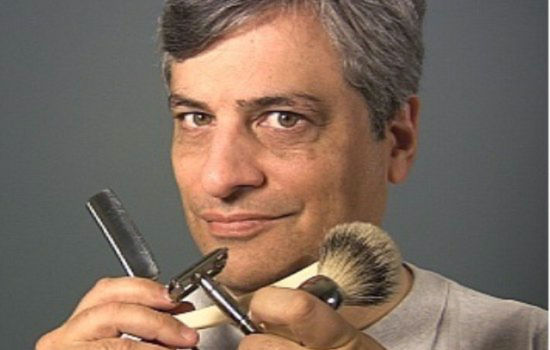
“I am in my mid-50’s and I work in the telecommunications department of a large university. My job has nothing to do with shaving! I have a college degree in the engineering part of radio and TV broadcasting, though I left that field many years ago when I moved into the telecommunications field (the two industries are similar in many respects). I have been married to a wonderful woman for almost 10 years now. We do not have children (unless you count our two cats!). My wife not only supports my shaving enthusiasm, she is responsible for it! I used an electric shaver for many years until one day she bought me a barber shave. The results were so dramatic that I had to find out more about this type of shaving! The full story is at http://sharpologist.com/about-
I have many, many razors, brushes, soaps, and creams. Pictures attached! However I would say my favorite products include a Merkur Progress razor and a Simpsons Rover brush. My favorite soaps and creams include Speick, Castle Forbes Limes, Truefitt & Hill Trafalgar, and DR Harris Arlington. [My knowledge is] mostly a combination of self-taught with advice from long-time wet shaving enthusiasts on the discussion forums. Wet shaving is a skill, like riding a bike or playing a musical instrument. It takes some time, patience, the right skills, and the proper equipment. Take the time to do it right and you will be rewarded!
[My style is] very casual. I live in a small city dominated by a very large university so very few people dress formally. Something about the way I present the material seems to attract people, so I must be doing something right! I am considering creating a DVD but since almost everything is available for free from multiple video sites it has not been a priority. [My hobbies include] computers, amateur radio, and gambling!”
http://www.youtube.com/user/mantic59

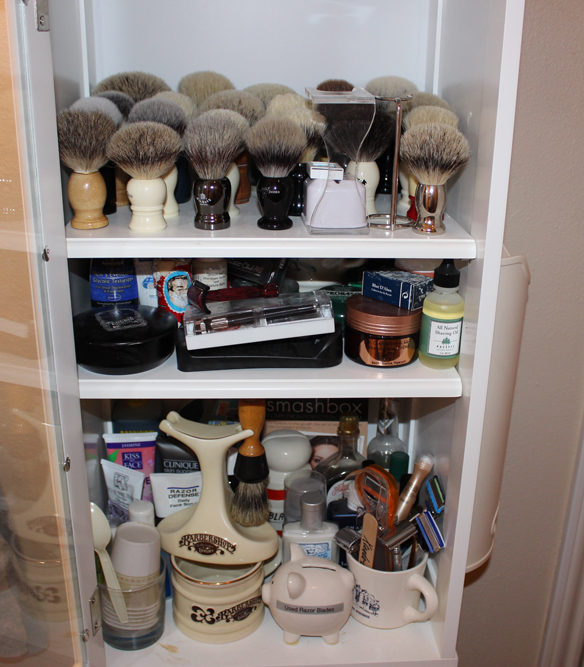
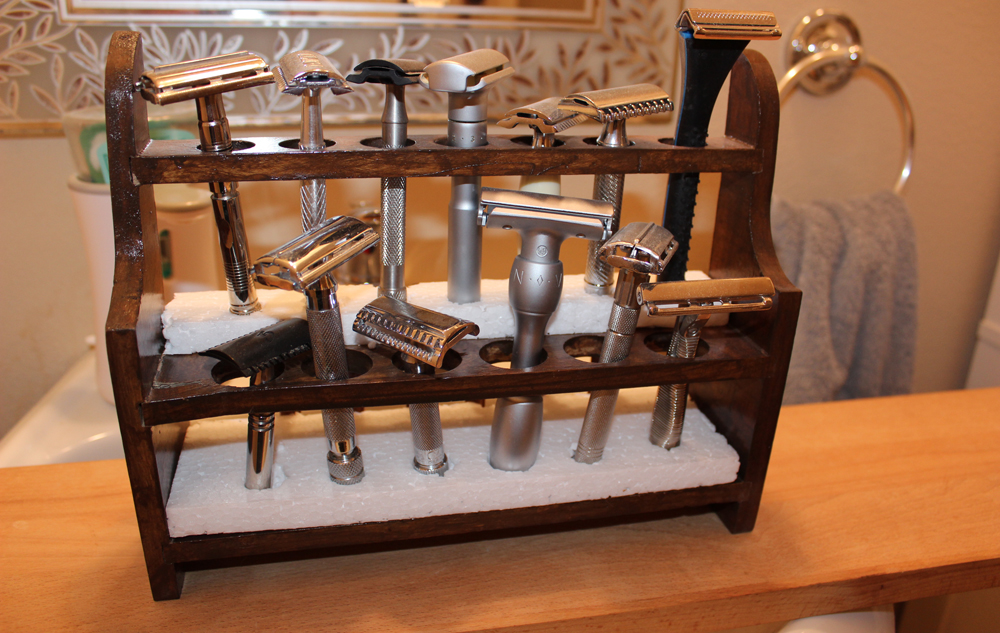
Pictures: © Mantic59
Category Bloggers, Interviews
Sinatra’s Black Tie Rules
0April 6, 2013 by Ville Raivio
“For me, a tuxedo is a way of life. When an invitation says black tie optional, it is always safer to wear black tie. My basic rules are to have shirt cuffs extended half an inch from the jacket sleeve. Trousers should break just above the shoe. Try not to sit down because it wrinkles the pants. If you have to sit, don’t cross your legs. Pocket handkerchiefs are optional, but I always wear one, usually orange, since orange is my favorite color. Shine your Mary Janes [Sinatra’s nickname for opera pumps] on the underside of a couch cushion.”
THE RULES
1. It takes two hands to put on a hat the right way: Back brim curled up, front tugged down to a couple of inches above the right brow.
2. Never wear brown at night. Never.
3. There’s no excuse for brown shoes past sundown…. Or white shoes. Or anything gray, unless it’s deep charcoal. Or blue, unless it’s midnight blue. In fact, let’s keep it simple: after dark, men should wear black.
4. Ties should be silk. And conservative.
5. Cuff links always. But leave the fancy jewelry to Sammy.
6. When dressing formally, a vest is better than a cummerbund.
7. Don’t wear a tuxedo on Sunday.
8. Having messy closets is like putting on clean clothes over dirty underwear.
9. The shower is a great place to steam out the wrinkles in your dinner jacket.
10. Orange is the happiest color.
11. Don’t hide your scars. They make you who you are.
12. When it comes to pockets, everything should have its own place.
13. A pocket handkerchief is essential, but it needs to be perfectly folded.
14. Shine your shoes.
15. Trim. Buff. Clean.
16. Take your hand off the suit, creep.”
~ Frank Sinatra
Category Quotations
Interview with John Tinseth from the Trad
0April 5, 2013 by Ville Raivio
‘I’m 55 and work as a commercial property-casualty insurance broker. This alone keeps most people away from me. I was an Army Brat and moved around a lot. I went to four high schools, most of them in the south, which accounts for my lousy education. After four years in the Army at Ft Bragg, NC, I went to Flagler College in St Augustine, FL. College was like a four year vacation compared to the Army and I consider it one of the best times of my life. I’m divorced without children. I’ve been in a relationship with a woman my readers know as the Golf Foxtrot for 10 years. I try to stay out of her style and she returns the favor.

My father, who just passed away last year, was an avid reader of my blog. As an Army officer who was a Green Beret in Vietnam, he thought men obsessing about clothing was “Tutti Frutti.” But he liked my writing. Whether it was a Khaki Tasting or a wine tasting. I’m the oldest with two sisters. One is a big fan. The other, not so much. My mother prefers to stay out of it. My paternal grandfather was an amazing clothes horse so I assume the gene skips a generation.
[I became first interested in style through] what the PX sold — The Post Exchange was the military version of a department store but with subsidized pricing and no tax. As a kid growing up, I wore Gant buttondowns, Pendleton sweaters and French Shriner monk straps. Later, when I joined the Army, I discovered the power of a little tailoring –uniform trousers pegged for about $5 a pair made a huge difference. My field jacket (M-65) had the lining ripped out when it belonged to my father — I had it tailored at the waist so there was a flare to the coat below the belt line. I froze my ass off in the winter but it sure did look good.
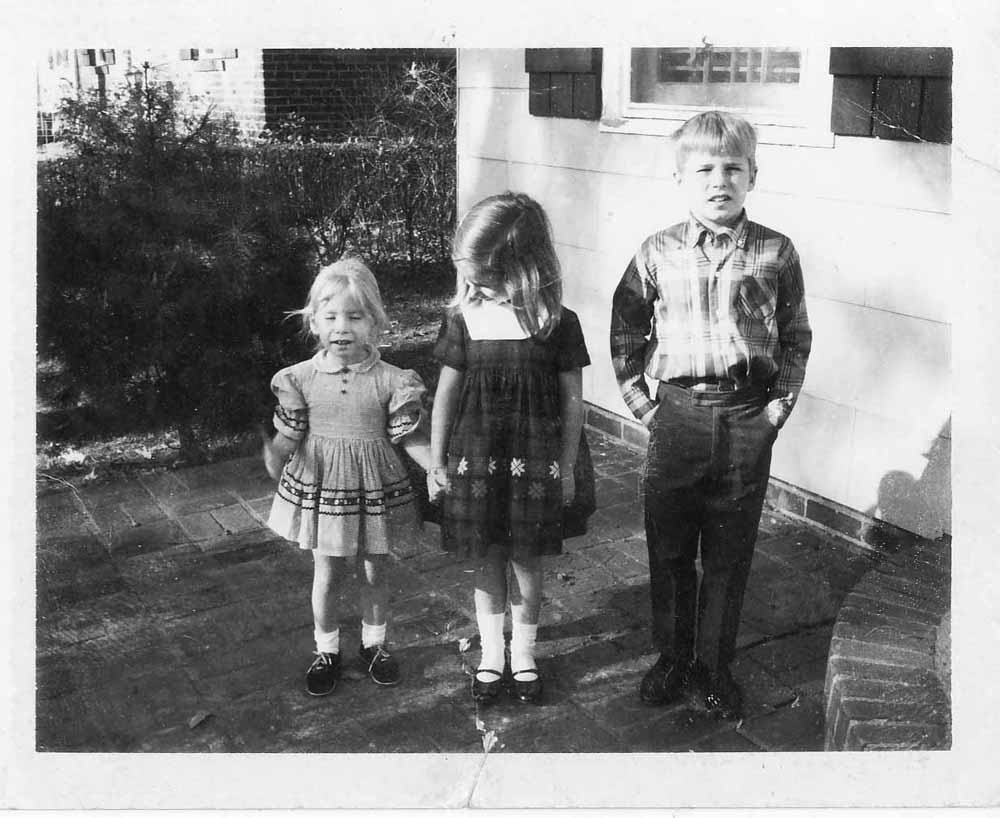
With sisters in 1966, kitted out by PX
In college, I spent half a month’s GI Bill on Ralph Lauren madras trousers. Polo button-downs were insanely expensive back then but as a short guy I was able to fit into a boy’s size 20. They were a third the cost of the men’s shirts. I was crazy for University Stripes. Pink, blue, grey, yellow, maroon… Duck Head khakis were also big in the ’80s. Cheap, long lasting, but I never wore them with a Polo button-down. Even then, I had a thing about mixing logos. Tennis wear was huge as well. Fred Perry and Boast. La Coq Sportif and Adidas Stan Smith shoes. Never Fila. Far too trendy.
There was a crazy old woman who had a men’s shop in my college town. Buried under new stuff was old stock from the early to mid ’60s. Amazing madras shirts, popover short sleeve button-downs…I found a pair of swim trunks in a Gauguin-like Polynesia print. She usually missed most of her lips with lipstick. She’d yell at me for digging up her old stuff and I remember looking at her bright red lipstick veering off her lip. That place would be gold mine today.

Certainly the army taught me much about fit but not so much about color or mixing pattern unless you count camouflage. I was still in the Army when I saw Animal House and was impressed with Otter and his Ivy wardrobe. I’d hang out at UNC-Chapel Hill with two objectives. To get laid and to duplicate Otter’s wardrobe. One out of two isn’t bad.
I worked at Brooks Brothers in the ’80s and hoovered all the Flusser and Boyer I could get, not to mention the aerial POV by the sales people I worked with. They taught me any idiot with money could dress well. The challenge was to create the Brooks Brothers look on a budget. There was a lotta of competition among the folks who worked there since nobody had any money. I learned a lot. Invest in good shoes since they last a lifetime and despite how fat you get over the years your shoes will still fit. Also, it’s hard to leave your shoes behind, like an umbrella, gloves or raincoat, which is why all that stuff should be bought with eventual loss in mind. Ties are always on sale and over the years I have managed to acquire almost 300. They also can’t be outgrown and while you shouldn’t be able to lose ’em, I managed to due primarily to a fascination in my 30s with strip clubs and strippers who appreciated silk.
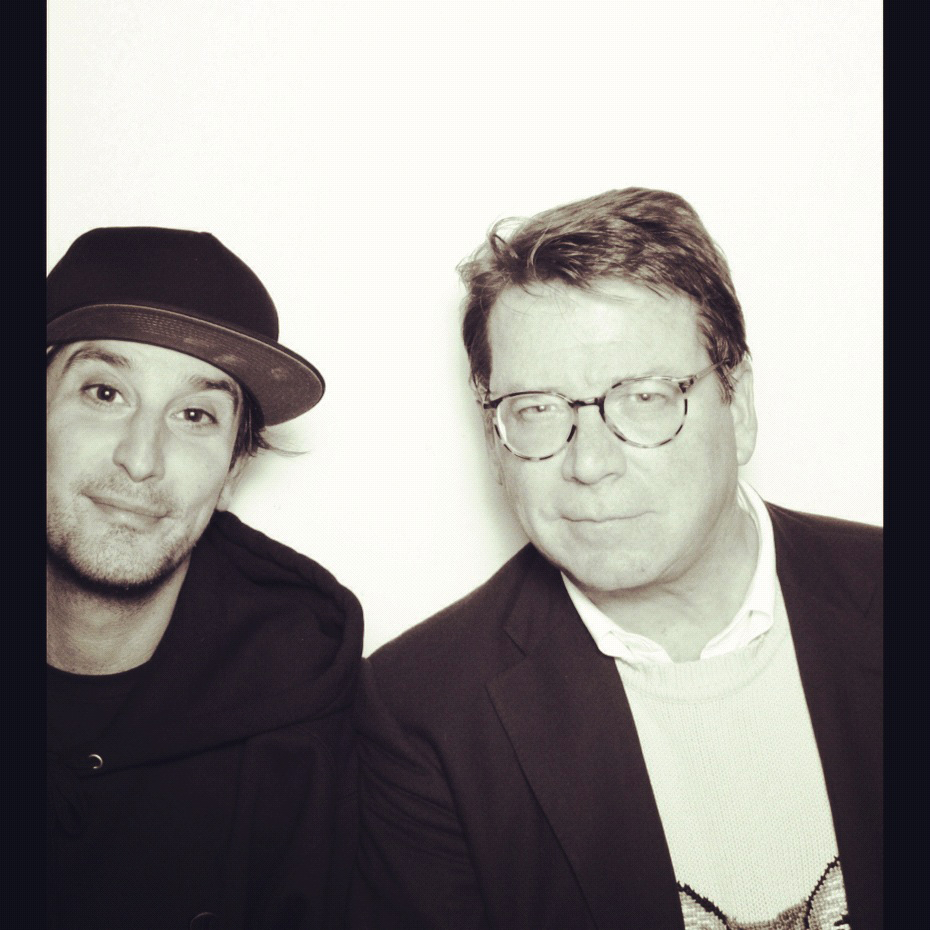
Fashion, for me, was always the purview of assholes. People who try too hard. There’s a lot I’m guilty of but I’m pretty much over trying to impress. I prefer understated. Paul Stuart’s solid navy suit I bought 15 yrs ago has no bells or whistles. It’s a simple Samuelsohn made suit that has another 15 yrs in it. It will never go out of style because it was never in style. I love J. Press Tweed jackets and their black flat front flannels with deep 2″ cuffs. Ancient Madder or rep ties speak to a low key elegance. But I love loud resort wear. Go-To-Hell trousers like the pair Charlie Davidson of the Andover Shop made out of a discontinued Marimekko print. Charlie even ran the selvedge down the out seam. Obnoxious but that’s the point.
I’ve heard style versus fashion ad nauseam. Classics, as we speak, are back in fashion. If you read my blog, you’ll see my taste is pretty catholic. I like a Brioni sport coat with J. Press trousers and Lobb monks (not double) with a butcher stripe Turnbull & Asser shirt and a thrifted Charvet tie. It’s the mixing that’s fun. I mean why be monogamous with your clothes?
The Trad had given me access to many sartorial heroes. I count G. Bruce Boyer as a good friend. I love Charlie Davidson of the Andover Shop. Avery Lucas, one of the most erudite and sophisticated designers of the ’80s and ’90s, and now sadly forgotten by many in menswear. Jay Kos, utterly crazy, but in a good way. Robert Bryan, fashion editor of the old M Magazine…I’m editing a best of M with powerHouse Publishing, and Bryan took what seems so trivial about clothing and gave it guts, insight and gravitas.
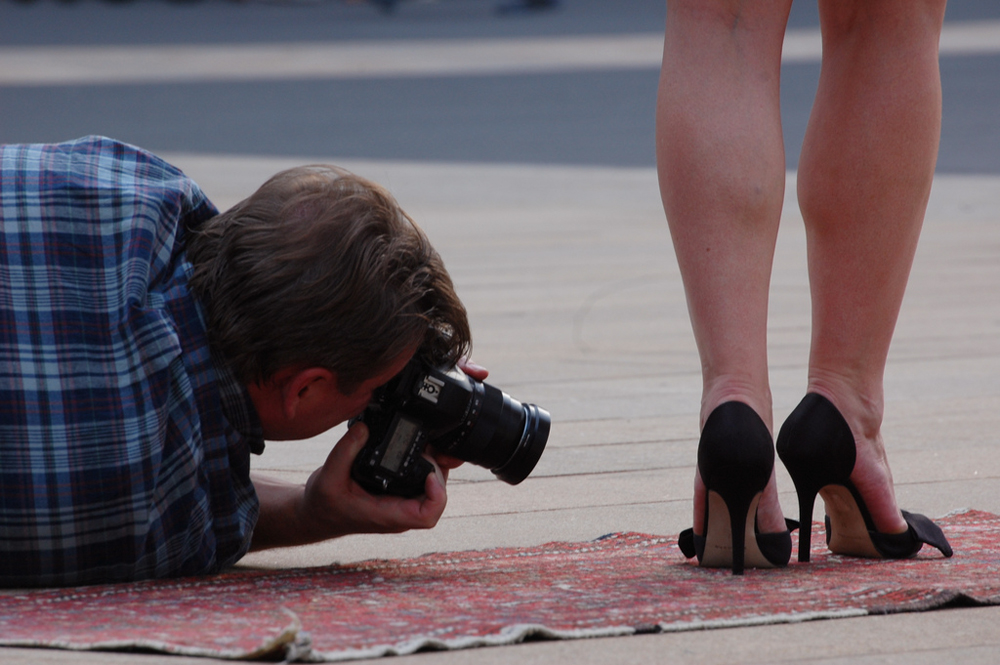
Antonio Ciongoli of Rugby, Michael Bastian and now of Isaia’s new entry level line, Eidos Napoli. Julie Hertling, trouser maker extraordinaire. Peter Kaplan, editor of the new M Magazine. Aaron Levine of Club Monaco, Foster Huntington of Polo, I’ve learned from all of them. Writing about menswear can get tedious. It’s the people who make it interesting.
Under all, but the most enthusiastic of radar, are the men who will make something just for you. Chris Despos in Chicago is one of the best bespoke tailors out there no one ever talks about. Tom Davis at Brooks Brothers & David Mercer of Mercer & Sons for shirts and remarkable conversation. Mark Rykken of Paul Stuart is one of the best when it comes to advice and both his bespoke and MTM are relative steals.
I always intended The Trad to be more of a street style blog but with a diverse geography. Problem was, I didn’t have the nerve to ask strangers on the street for a photo. So, it became the sum of its subtitle, “Not as good as it was. Better than it will be.” I try not to be a pretentious asshole and focus on giving my readers the sources for hard to find stuff. Restaurants, a cheap but fantastic scotch. A good shirt. A good value. A good story. So far it has only cost me my job and possibly my career. Insurance is a conservative business and more than one potential employer asked what I was doing with a blog. An old friend who interviewed me for a job said about the blog, “I don’t get it.” I told him, “You’re not supposed to.”

People in insurance live for golf. I hate golf. My passions are London, jumbo lump crab, dry gin martinis and writing.
Which reminds me, what looks good on one man doesn’t necessarily look good on another. Finding your personal style, like developing character, will take time. And it probably will change from time to time but your individuality is all you have. Like Charlie Davidson told me, “Who wants to look like a fucking Polo window?”‘
Pictures: © John Tinseth
Category American style, Bloggers, Interviews
Copyright © 2013 Ville Raivio