The Last Tailors by Tom Junod
0April 27, 2013 by Ville Raivio
Tom Junod’s article ‘The Last Tailors’ was published on the pages of Esquire’s September issue in 2005. Junod, the ten-time finalist and two-time recipient of National Magazine Awards from the American Society of Magazine Editors, the most prestigious award in American magazine writing, has written for Esquire since 1997. Well-known for his profiles, the article below depicts the peculiar inner vistas of two New York master tailors, Vincent Nicolosi and Salvatore Ragusa, who embodied this old-world profession in the age of mechanized apparel.
The Last Tailors
Tom Junod
‘The men I go to see do not lie. But I have to tell a lie in order to see them. Which just goes to show: What a man expects of himself has very little to do with what he expects of other men. The most honest men expect to be lied to.
The men I go to see are tailors, which means they are very old men. There are no young tailors. They work at 510 Madison Avenue, a building of tailors, in New York City, which used to be a city of tailors. Not anymore. There is talk that 510 is being sold and that it will be knocked down to make way for a bigger building, one not intended for the work of human hands. The tailors who work inside 510 will have to move on, or else retire, knowing either way that the day will come when no one will do the work they do.
The tailors I go to see are Salvatore Ragusa, who works on the sixth floor of 510 Madison Avenue, and Vincent Nicolosi, who works on the third. Although they each make a living with their hands, they are formal men whom I address formally, as Mr. Ragusa and Mr. Nicolosi. I never think of addressing them any other way. The lie I tell them, however, is not a lie often spoken to other men. It is a lie one tells women, namely, that there are no others. To Mr. Ragusa, I never say that there is a Mr. Nicolosi. To Mr. Nicolosi, I never say that there is a Mr. Ragusa. They are each of them men, each of them formidable and proud, but they are tailors, in the business of feeding male vanities, so they are as suspicious as women.
They are, in some ways, the same man. They are both Sicilian. They are both nearly eighty. They have both been tailors all their lives, since they were little boys. Mr. Nicolosi started when he was five years old. A master tailor made his father a masterful suit. The father wanted his son to work indoors, so he asked the tailor, Can you make my son a tailor? The same thing happened to Mr. Ragusa. His father was a shoemaker. The tailor in the town was a figure of great respect, a big man with a great dark mustache; indeed, a man afforded more respect than the shoemaker. Mr. Ragusa’s father wanted his son to enjoy that kind of respect.
“I have no choice,” Mr. Ragusa says of the decision that determined the course of his life. “My father make a me a tailor. I am a tailor. That is my life. I put my heart in it, my passion, because it is my life, because I want to be better than the other tailors. But it is not my choice.”
Mr. Ragusa started his apprenticeship when he was six. Before school he went to the tailor shop and put the irons in the fire. He is old enough to have worked with irons that had to be filled with hot coal. He is old enough to have lived in a time when men, if they owned a suit, had the suit made by a tailor. A man, if he was a man, owned two suits, one for summer and one for winter, and each suit had two pairs of pants. A man could not buy a suit in a store, off the rack. “I don’t know sizes until I come to America,” Mr. Ragusa says. “No such thing. Small, medium, large: no. Each man his own size where I learn to be tailor.”
They are not the kind of tailors who make alterations to clothes bought off the rack. “I refuse,” says Mr. Nicolosi. “I do not touch these things. It is insult.” Some people would call them bespoke tailors, after the tailors of London’s Savile Row, who are famous for making suits to fit the English gentry. Really, though, they are bench tailors, who need nothing more than that–the table they rent, the old cloth-covered pressboard they prop on top of the table, the needle, the thread, the thimble, the hot iron–to make a suit in the same way suits were made when they first started, which is the same way suits were made in the Renaissance, with exceptions for fashion. Ask them what they do and they will both answer, “I make a suit.” Ask them what they know and they will say that making suits is all they know how to do. What distinguishes them, what makes them the last of their kind, is the belief that this knowledge is sufficient, that a suit is a vessel capacious enough to accommodate a man’s highest aspirations, that everything in a man’s heart and head can find its way into his tailor’s hands, which have the knowledge, which do the work.
You cannot hide from these men. They take your measure without ever producing a tape. At a glance, they know if your neck is short, if your arms are uneven, if your shoulders stoop, if your back lists, if you are, in your posture, only semi-erect. Tailoring, true tailoring, is remedial: It makes you look better. These men who make your clothes are in the habit of seeing what’s underneath, so that slight shoulders can be padded, a sunken chest bowed, a defeated back given definitive shape. They are also in the habit of seeing what’s on the surface: the clothes on your back, what you like. They are intimate, if not with you, then with your jacket. The first time I rode an elevator with Mr. Ragusa, his hand shot out and fingered the lapels of my sport coat. “Okay,” he said after a second. “Okay?” I asked, for the coat was silk and linen, and I’d paid a lot of money for it. “Okay,” Mr. Ragusa said definitively, though with a note of forgiveness.
Not that it really matters what you like when you go to see Mr. Ragusa. When he says, “I make a suit,” he means exactly that, an elaboration of the male ideal, an augmentation, a thing that retains its shape like a suit of armor. “I like a full lining in a suit,” he says. “I like a double vent. I like a pleat in the pants. It gives a man room to sit down.”
He is a craftsman, and therefore a fatalist. His hands are beholden to the succession of hands that have done the same work, long before he was born; he aspires to nothing more than to live up to their example. A pattern is made, a die cast, a fate fixed, all in the dimensions of a suit.
This is where Mr. Ragusa and Mr. Nicolosi diverge, for all the similarities in their history. Mr. Nicolosi aspires to more. He aspires, indeed, to art; says, indeed, what Mr. Ragusa would never say, that he is an artist, that when a customer comes to see Nicolosi, he comes for more than what Nicolosi’s hands can make–he comes for what Nicolosi’s eyes can see, his imagination. He cultivates the allegiance of famous men and sees tailoring in terms of the world rather than the world in terms of tailoring. He is temperamental, whereas Mr. Ragusa is simply stubborn, standing on a fixed point of principle. It’s one of the things you learn hanging around with tailors: that every man has a characteristic gesture to which his body returns for comfort. Mr. Ragusa’s is a shrug of the shoulders, a gesture of acceptance to the choice that was made for him when he was six years old, and all the responsibilities that choice entails. Mr. Nicolosi’s is different: an appeal, grand and somewhat operatic, made with upturned palms, a plea for understanding. When either man crosses his arms, however, the gesture is final, and the arms are likely to stay crossed for a long time, a tape measure looped over their shoulders.
I went to see Mr. Ragusa first, and so it was to him that I told the lie. He asked, after all. He asked if I planned to visit any other tailors, and as I started to answer, another tailor, Frank Shattuck, mouthed the word no–shook his head no, cringing in emphatic pantomime. Frank Shattuck works at a table next to Mr. Ragusa. He sublets the table from him but is equally conversant–like a diplomat or a spy–with all the tailors at 510 Madison Avenue, including Mr. Nicolosi. He is a young tailor, which is to say he is a middle-aged tailor, forty-five years old. He is Irish and appears to have apprenticed himself to the methods and the example of Italian tailors as an act of existential will, but he has not yet decided if tailoring is sufficient–for he is also a boxer and an actor and a poet. Frank–he is not yet “Mr. Shattuck” and knows he may never be–goes to work in a T-shirt and a driving cap; all the other tailors go to work in the suits their own hands have made. Frank collects–and sometimes purchases, at considerable price–tailoring antiquities, such as 150-year-old German shears; such as bolts of old tweeds, runic in their arcane symbolism; such as a twenty-five-pound iron, collected from a tailor at a building around the corner–another doomed building of tailors–who lost his lease. Mr. Ragusa looks tolerantly but askance at such tokens of sentiment: “Believe a me,” he says after he picks up Frank’s prized iron, “you don’t need a that to make a suit.”
You take an elevator, operated by an elevator operator in a navy blazer, to get to the sixth floor of 510 Madison Avenue. You walk into the shop shared by Mr. Ragusa and–all right, all right–Mr. Shattuck, and through the open windows you hear the squealing brakes of the buses trawling Madison Avenue. It is the same elevator tailors have used to go to work since tailors started renting space in the building, and the same sound they have heard once they got there. Mr. Ragusa does not play a radio when he works. He sews and cuts, standing at his wooden table, at least eight hours a day, listening to the music of the buses, occasionally teaching his Irish apprentice a Sicilian curse word, such as rompicoglioni, for ball breaker. The shears he uses are not antique, but they are the same shears he has used since his arrival in the States. They bear the scars of a terrible wound. Years ago, he had an accident at his sewing machine, and he had to use his shears to cut the electrical cord. The cord took a bite of steel off the honed edge of the shears, and though a tinker repaired them–for seventy-five dollars–they emit a faint grinding noise when Mr. Ragusa cuts fabric, a discordance to which his ears are tuned. “Not as good as before,” he says, “never as good”–but still he insists on using them, as though in expiation for the ancient sin of doing them harm.
Like all tailor’s shears, they are seemingly out of scale–massive and heavy in the hand–but this is the paradox of tailoring: the most enormous shears, the tiniest of cuts. “Why so big?” Mr. Ragusa says, snipping a piece of thread. “So they don’t a move. You cut what you want to cut, no more.” Of course, he doesn’t have to use the wounded shears; he has another set at home. But the shears in his hands have become partners in his own affronted dignity. Of the unblemished set at home he speaks dismissively: “You know what a my wife a use them for? To cut a chicken.”
He came to the United States in 1966 with his wife and his three children. He had gone from Sicily to North Africa, where at the age of fourteen he worked for Mussolini’s army, tailoring the uniforms of preening soldiers; then he had gone to Rome, and from there to Naples, where he opened his own shop. He was very successful in Naples, a master in a city known for its master tailors. But he had to leave. In the primal wound of his life, he was ordered to leave by the Mafia. “I make a mistake” is all he says in explanation. He was thirty-nine when he had to start over in New York City, with his germinal English. Still, on the wall between him and Frank, there is a black-and-white photograph of him from 1972, at a fashion show, receiving the attentions of two models–a man and a woman–wearing clothes he made, and his lips are clasped in an attitude not simply of dignity but of pride, even vanity: In the photograph, he is very much il maestro. Now the shock of silver crossing his black hair in the picture has grown pervasive, and the dark, unforgiving eyes are magnified by reading glasses to such an extent that they make his body look small. He used to be able to cut a suit freehand, without a pattern, and “never make mistake.” Now he struggles to see, even with his glasses, and even the elementary act of threading a needle becomes a drama acted out under a spotlight. The eye is so very small, and after he pokes at the needle for a while, he wets the end of the thread and tries again, with an exacting and mortified patience. Finally, he says, “Now you make a me nervous,” and I have to go to the open window to watch the buses.
He is in the middle of making a customer a pair of pants. Or, more accurately, cutting a pair of pants, with shears, from a pattern described in chalk on a bolt of worsted wool–black, with a pinstripe–so that he can send the cut and measured fabric to a pants maker for sewing. Mr. Ragusa doesn’t generally sew pants–no bench tailor does. It takes too much time, and the long seams are better handled by a specialist with a sewing machine. He doesn’t make buttonholes, either; his wife does. The suit, for him, is the jacket, that assemblage of body, basting, sleeve, lapel, facing, lining, and pocket that gains in complication once you see its inner workings. Mr. Ragusa is down to six or seven customers, but, as in any tailor’s shop, there are pieces of suit jackets, in various stages, strewn everywhere. Most are missing sleeves, so that the padding in the shoulder–its puffery–is visible, as is the stitching, the insane expenditure of thread, which is as lavish as footprints on a crowded beach. Tailored suits are meant to cover imperfections, so there is something terribly exposed about them in their unfinished state. Suits made by Mr. Ragusa start at $3,000 and often cost considerably more, depending on the price of the fabric, but there is nothing grand about seeing a suit being made by hand: Indeed, because hands have been all over them, the suits look sort of grubby until they come together and assume their final and–if Mr. Ragusa has done his job–nearly permanent shape. He will sew a label into the lining–DESIGNED BY SALVATORE RAGUSA–but his real signature is in the stitching, in the traces of his fantastic labor, which will still be visible to the eye in the finished product and could be counted by those accustomed to buying suits off the rack as imperfections. Which is just fine with Frank Shattuck: “One day,” he says, “you will have to pay a million dollars for a suit with human imperfections, and you still won’t be able to get it.”
The customer for whom Mr. Ragusa is cutting the pants is the only person who calls Mr. Ragusa “Sal,” who treats Mr. Ragusa as a servant. Not that Mr. Ragusa complains: “He good customer. He buy a lot of suit.” Indeed, the relationship between tailor and customer is a complicated one. On the one hand, a tailor needs a customer the way an artist needs a patron. On the other, the customer is a ball breaker. A heartbreaker, ultimately. “I see a lot of crazy guy in this business,” Mr. Ragusa says. “One man, he own a lot of buildings in New York. Very rich man. He always buying buildings. But when he come to me, he ask fordiscount. I say, Why you want a discount? You very rich man. I very poor. You come here because you want a suit. I make a suit. You understand. You pay me. He get mad at this. He want discount. Finally I say, Okay, no more suit for you.” It is the last line of many of Mr. Ragusa’s stories about his customers and an indication of why he is at the end of the line, as a tailor: “No more suit for you.”
He has not passed his trade on to his son; he wouldn’t, because he doesn’t want his son to suffer the indignities he has and because, in his words, “With a stitch, you never get rich.” Mr. Ragusa’s son is rich, and Mr. Ragusa has made many suits for him. A few years ago, however, Mr. Ragusa’s son grew out of his house on Staten Island, just as he had grown out of the suits that Mr. Ragusa made him. “He buy bigger house in New Jersey. But when he move, he have . . . yard sale. He sell my suit. Five, ten dollar. A man come, he buy them all. Because he know the work. Ten, fifteen suits. Now my son, he want me to make him more suit. He beg me. ‘C’mon, Dad, make me suit.’ No more suit.”
He does not keep a lot of finished suits in his shop. “You see tailor with a lot of suit, get another tailor,” Mr. Ragusa says. “It mean he can’t sell them.” On one of his hangers, though, there is an overcoat made of wool, in black-and-white herringbone. “This one I don’t finish,” he says. “I make a mistake. See? Pockets too high. I don’t go back, correct mistake.” Why does he leave it in the shop? “I make for my son. Now I don’t finish.”
I tell Mr. Ragusa that I have to leave in order to attend to other business, and then I take the elevator down to the third floor, where I visit Mr. Nicolosi. His shop, in comparison to Mr. Ragusa’s, is like the Smithsonian: On one mannequin is a tweed topcoat for Eddie Hayes, the noted attorney; on another is a white suit, single-button, with turned lapels that open like the petals of a flower, for Tom Wolfe. Signed copies of Wolfe’s books stand in racks; portraits of Wolfe and Hayes and Nicolosi, by the painter Richard Merkin, hang on the wall. Mr. Nicolosi is wearing glasses of the same magnification as Mr. Ragusa’s, so that he is dwarfed by his own appraising eyes. But his deeply colored lips fit together like an elaborate seam, and in them there still survives what is now missing from Mr. Ragusa’s: the sustaining sneer of an artist’s vanity. He shows me something on the wall, a framed sketch called “Art and Fashion,” signed by Vincent Nicolosi. He drew it more than thirty years ago, after a lifetime of contemplation. It is a study of a man in a suit, with concentric circles radiating out from the man’s head to the peak of the lapel, to the shoulder, and then along the sleeve to the cuff, and then out into the world–and because it is clearly meant to establish some universal proportion, it is reminiscent of da Vinci. It is also completely inscrutable. Many men, including tailors, have studied the sketch, trying to understand it. None has succeeded, though for Mr. Nicolosi the sketch holds the key to all of tailoring, and life itself.
I wind up trying on several suits at Mr. Nicolosi’s, wearing the clothes he has made for other men. The life of a man is in his suit when the suit has been cut and sewn for him and for him alone, and so there is something terribly invasive–and revelatory–about putting your body where another man’s body is supposed to be. It is like trying on his wife. When I put on Eddie Hayes’s long green tweed topcoat, I want to dance a jig of tragic Irish vanity, and when I put on Tom Wolfe’s trademark white jacket, I understand, maybe for the first time, how bulldoggy the man is beneath the veneer of dandyish effrontery–that his back is bigger than his chest, that he works out, that his suits have absorbed his own bantam resilience. Then I try on a floor-length topcoat, belted and elaborately sewn, made for a man taller than me, out of pure cashmere, camel hair in color. It is transforming; not only do I feel taller, I feel, well, seigneurial, as though I should be wearing it to a duel.
Now, Mr. Nicolosi does not like to talk about the specifics of his trade any more than the pope likes to advertise the cost of indulgences. He does not like to talk about price; he does not like to talk about the time it takes to bring a suit into being; he especially does not like to talk about the difference between a suit he has made and a suit bought off the rack–anyone who asks such a question risks dismissal, for he believes that anyone who asks such a question cannot possibly understand him or his life’s work. “I have good customer,” he says with a kind of Sicilian drawl, pronouncing the word so that it sounds like costume. “They come here because they want something. They see something. They have dream. They want something just for them. I make just for them. I make them happy. My customers, a lot of rich people. They understand. Poor people, they don’t understand nothing. Poor people, they come in, they say, I like a color. That’s what poor people understand. Color. Rich people, they understand the work.” While the camel-hair topcoat hangs from my shoulders, however, Mr. Nicolosi lets slip that it costs $11,000.
“Believe me, is not too much,” he says, taking the shoulders of the coat in his hands and relieving my body of its liquid embrace. “I have limitation, in a business. I do not charge what it cost me to make. Because it cost a me my life. You understand? I lose my life in this business. I bust a my ass. You see the work? You understand. I don’t lie. I take responsibility. You buy suit off a rack, it not made for you. Why do you want something not made for you? I make suit for you. You say, Too much bother. No. Life is bother. You say, Take a too much time. No. Life take a time. So I make a suit. I bother. I take a time. I make you happy. You not happy, maybe it is me. Maybe it is you. Maybe it is fabric. No matter. What good for me if you not happy? I try to cheat you on fabric, what I save in fabric I lose in sleep at night. So I don’t lie, and I sleep at night. You understand? Don’t listen to what I say. Look at what I make.”
The next day, I went back to Mr. Ragusa. Mr. Nicolosi had not been worried about the sale of 510 Madison because a customer had told him, “You go to the Bowery, I will find you,” and also because he could not contemplate an ending: “I no make a suit, I am nobody.” Mr. Ragusa had reached the same conclusion but, in his way, had accepted the edict. In the event he lost his space in 510 Madison, he had already decided: no more suit. He would go live with his wife in their home in Bensonhurst, Brooklyn, he would go to his Sicilian social club, he would add a few careful miles to the thirty thousand he has put on the Cadillac he bought new in 1989, and he would, he says, “pray I die quickly. Because I no make a suit, I don’t know how to do nothing. I sit around a house. This is end of story.”
But it was not the end of the story, because I went back down to Mr. Nicolosi’s. He had already talked to me about suits, and now he wanted to talk to me about what went into them and what they represented. He took me back into the fitting room, past Eddie Hayes’s topcoat and Tom Wolfe’s white jacket and vest. “I want to show you something,” he said, and showed me about ten suits hanging on hangers, in many styles, many colors and kinds of fabric. He explained to me that the man who ordered them had dropped dead. He explained that he had called the man’s wife, looking to be paid, because, after all, he had done the work. He’d known the man for a long time, he said, and had watched him leave one beautiful family and beautiful wife for another wife, and then another. Now the man was finished, he said. “You know finished? He finished because he change. A man always stay same. I know, I am tailor. Only when he lie, then he change. His face change. He can’t look at you like before. Then he finished. One, two, three: It happen like that. A man drive down to Atlantic City, he lose all his money: He finished. A man get a girlfriend, lose his wife, lose his family: He finished.
“Stay with your wife. She make a mistake? A small mistake, not a serious mistake? What are you going to do? Divorce her? No, you stay with your wife. Your family brings you great joy. You lose your family, you are finished. Listen to me, I am telling you. Stay with your wife. A woman can make mistake; a man: no.”
I thanked Mr. Nicolosi and went into the hallway to wait for the elevator. The elevator door opened, and I saw a man with white hair standing behind the elevator operator. It was Mr. Ragusa. I got in. We went one floor in silence, then he glanced at me and said, “You see Nicolosi?”
“Yes, I see Mr. Nicolosi.”
“You write about Nicolosi?”
“Yes, I write about Nicolosi.”
“You write about two? Not one?”
“I write about two,” I said.
We were standing on Madison Avenue now. He was wearing a faint smile, that of a man whose bitterest suspicions had been confirmed to his satisfaction. “Okay,” he said. “I go now.” I followed him to the subway, but he didn’t say anything, even after I said goodbye, even after he shook my hand, measured me with a courtly and resigned nod of his head, and disappeared down the stairs of the subway station, on his way to Bensonhurst and the end of the story.’
Interview with Florian S. Küblbeck
1April 27, 2013 by Ville Raivio
‘I am 25 and I am working as a freelance journalist with a focus on fashion and lifestyle. I have studied linguistics and theology in Münich, Germany, and made my first foray into writing while still at university. I have been into classic menswear since high school, so writing about menswear was a natural fit for me. I am living together with my longtime girlfriend, who, although working in a totally different field, definitely shares my passion for style and has a very keen eye for details of a good suit, for instance. She also enjoys wearing quality clothing. My parents never had a thing for quality clothing. My grandfather was very keen on buying only the best he could afford, though, so maybe that has influenced me more than I would care to admit.
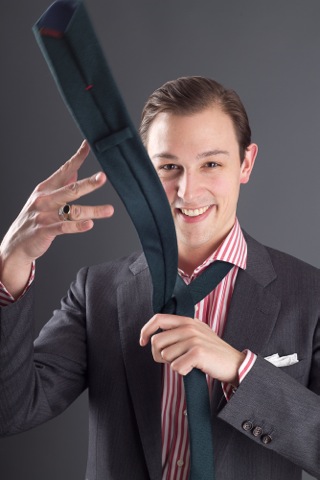
I have always liked fashion and clothing. At one point, however, I decided for myself that fashion, as the great designers nowadays are exemplifying it, is not something I can totally identify with. I became fascinated with the idea of clothes made for the individual, to his own need and taste –- clothes which are made to last and age beautifully. Apart from its handwork, the grace of age which a well-made bespoke suit exudes is still the thing that interests me the most in menswear. I tend to suck up knowledge wherever I can get a hold of it, so, naturally, I tried to gather every bit of information on the topic I could find – and I still do. However, what helped me understand menswear the most was, and still is, talking to tailors, shirtmakers and shoemakers worldwide, watching them do their work, asking questions whenever possible. This way, I can see how the things one reads in books, magazines and on the internet translate to the real world.
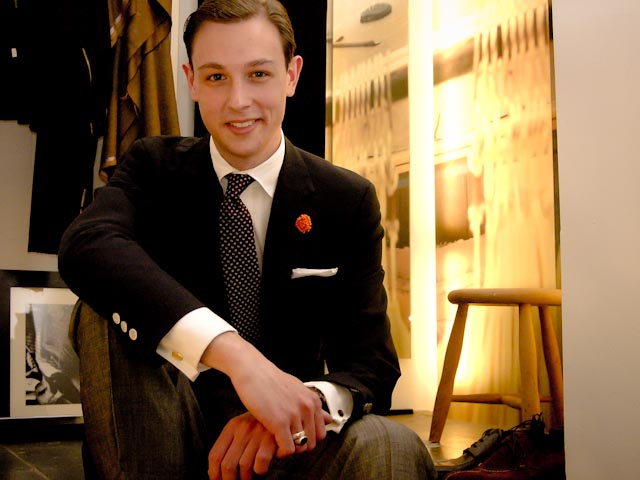
I would describe my own style as eclectic, yet subtle. I like to mix vintage accessories with clothes which were made for me. I also tend to wear iterations of a similar look or combination over and over again, varying the overall colour scheme or degree of formality of certain details. Every piece in my wardrobe gets worn, I am not a collector of clothing for exhibition’s sake. When it comes to tailors, there are simply too many to name a favourite. Some of the best artisans I know are not as well-known as the great names in the business, yet produce outstanding quality. Among the more known names I admire for their overall style and silhouette are Liverano & Liverano in Florence, Anderson & Sheppard in London and Rudolf Scheer in Vienna. I honestly don’t buy a lot of RTW clothing, so many of my favourite makers specialize in accessories. I like Drake’s for their no-nonsense ties, Jungmann & Neffe for their exhaustive selection of bow-ties and Prantl for their fine leather goods.
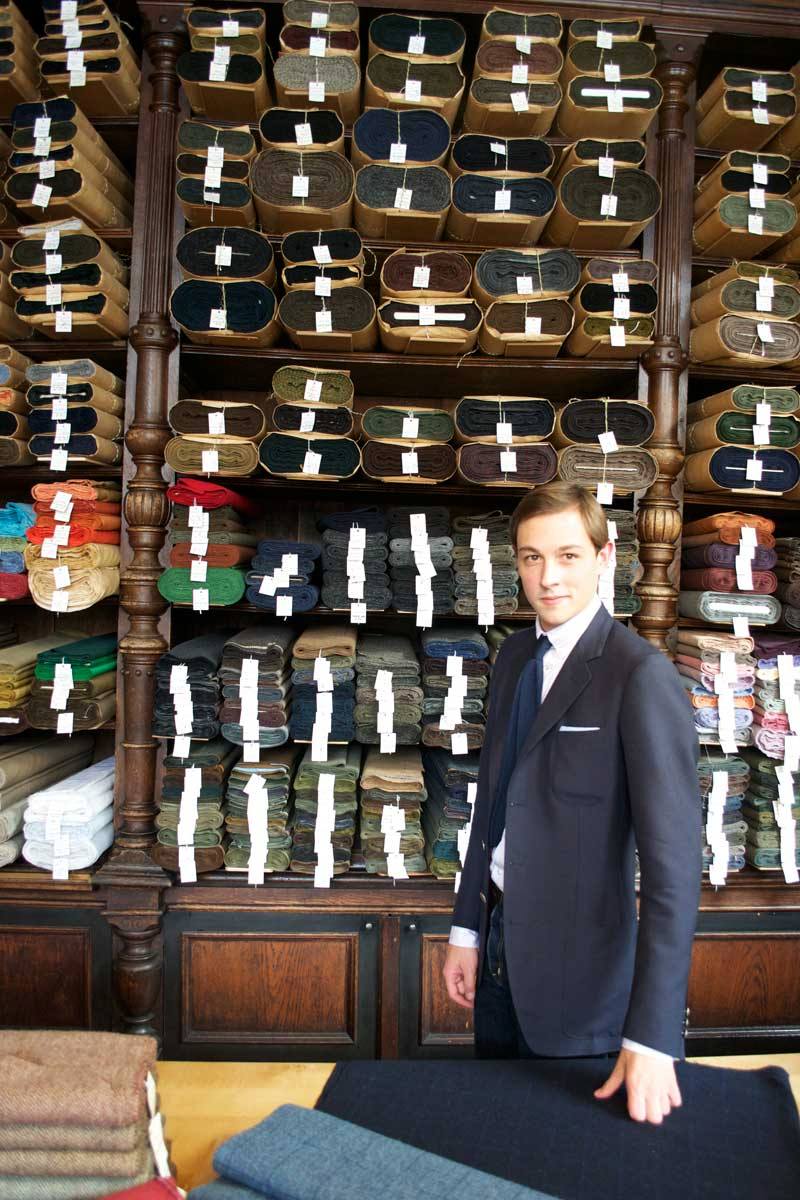
The idea of a practical and actually useful guide to menswear had been stuck in my head for a few years now. In 2011, I discussed my plans with my publishers, C.H. Beck, who were very supportive right from the beginning. I want to offer a simple approach to clothing, even for guys who are really not that into these matters. We all need to dress, after all – how we do it is up the the individual. My book focuses on a number of classic pieces as the foundation of great style, explaining their historical background, construction and fit guidelines all at once, without over-explaining and trying to bring across everything there is to know about the matter. For many men, knowing only so much is really all they need in order to dress consistently well.
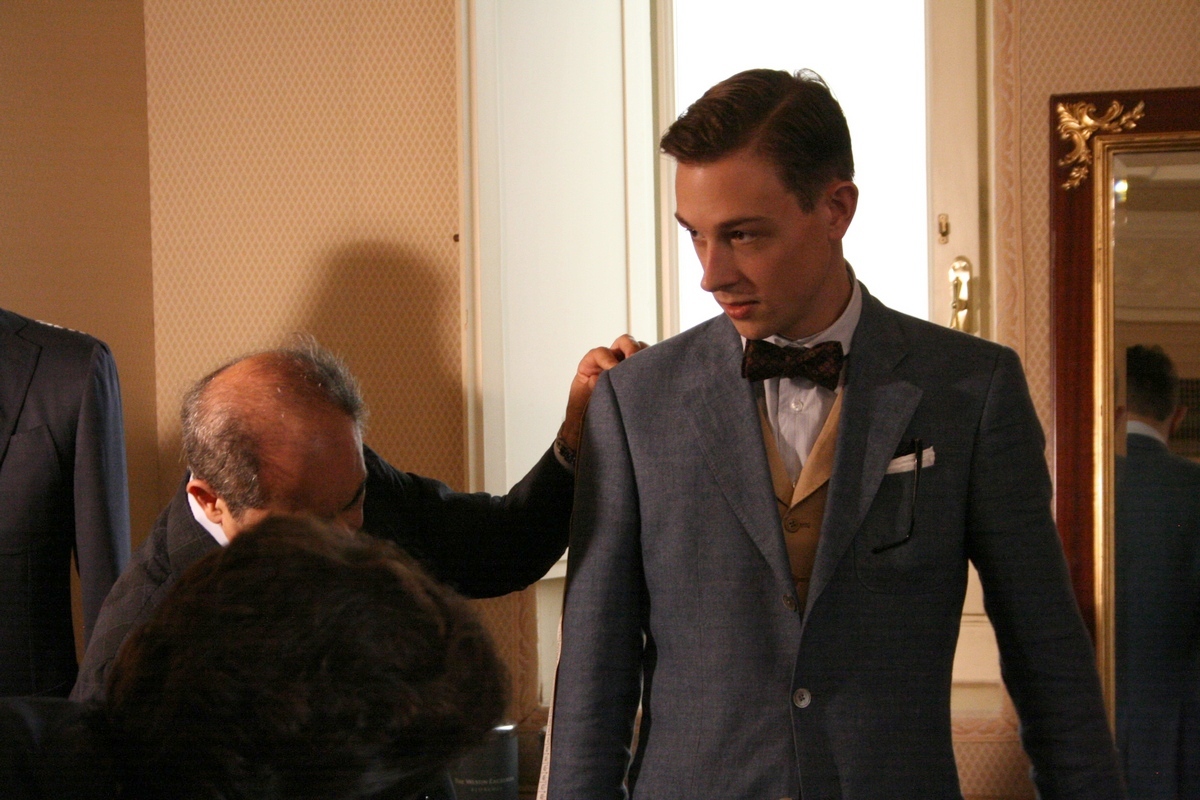
[As for my hobbies] there are many, (un)fortunately. As I already said, I tend to do things whole-heartedly no matter the subject, so many of my hobbies have grown into everyday habits. For instance, I am a passionate tea drinker. I have a vast selection of japanese green tea, chinese oolong and many different pieces of tea ware to accompany the respective tea styles. I also love writing with pen and paper and have gathered a small collection of fountain pens, mostly from the german manufacturer Pelikan. Don’t even get me started on inks, paper or even wine, music, fine dining…
I wish more men would realise that quality is much, much more important than quantity. I’d rather have only one good suit, one piece of well-made knitwear, one pair of quality denim instead of amassing endless racks filled with inferior clothing. At the same time, good taste is not a matter of money. Do your research, know the details, then go out and buy the best you can afford and you are well set. Don’t fall into the trap of collecting heaps of clothing only for your viewing pleasure – use your clothes, buy wisely, know your subject. Also, dress, but don’t play dress up. Wear what suits your needs, mind and surroundings, not what people expect you to wear.’
Pictures: © Florian S. Küblbeck
Category Bloggers, German Style, Interviews, Men of style, Writers
Michael Drake in the Wall Street Journal
0April 27, 2013 by Ville Raivio
A few years ago, WSJ had a chat with Michael Drake, one of the founders of Drake’s and its leading man. In this short interview, Mr Drake shares his thoughts on details, the business and style.
http://blogs.wsj.com/scene/2011/08/08/drakes-co-founder-men-should-be-stylish-not-fashionable/
Category Links
Charles Ryder
0April 26, 2013 by Ville Raivio
‘It seemed as though I was being given a brief spell of what I had never known, a happy childhood, and though its toys were silk shirts and liqueurs and cigars and its naughtiness high in the catalogue of grave sins, there was something of nursery freshness about us that fell little short of the joy of innocence.’
~ Charles Ryder in ‘Brideshead Revisited’
Category Quotations
The Secret Vice by Tom Wolfe
1April 26, 2013 by Ville Raivio
Tom Wolfe, that ravenous white-clad journalist dandy, had a peculiar essay of his published on the pages of New York Herald Tribune in 1966. This fierce stream of narrative consciousness was penned nearly two decades before yuppie was decreed a word, four decades before metrosexuals were invented and some five years before one Hunter S. Thompson wrote about Bat Country. Wolfe’s discerning eye and quill were truly ahead of his time.
The Secret Vice traces the eccentric sartorial phenomenon of handmade buttonholes, which Wolfe has named the Secret Vice, aptly knowing how any social phenomenon given a name will ring true to his audience. Another coinage of Wolfe’s is the Boston Cracked-shoe Look, which will be featured later on Keikari. Although discretion is key on the highest steps of wealth and power, the yearning for individualism, The Right Stuff, cannot be repressed. Here is where buttonholes raise their clean-struck heads, bewitching Lyndon B. Johnson among so many others.
The Secret Vice
Tom Wolfe
Real buttonholes. That’s it! A man can take his thumb and forefinger and unbutton his sleeve at the wrist because this kind of suit has real buttonholes there. Tom, boy, it’s terrible. Once you know about it, you start seeing it. All the time! There are just two classes of men in the world, men with suits whose buttons are just sewn onto the sleeve, just some kind of cheapie decoration, or—yes!—men who can unbutton the sleeve at the wrist because they have real buttonholes and the sleeve really buttons up. Fascinating! My friend Ross, a Good Guy, thirty-two years old, a lawyer Downtown with a good head of Scotch-Irish hair, the kind that grows right, unlike lower-class hair, is sitting in his corner on East 81st St., in his Thonet chair, with the Flemish brocade cushion on it, amid his books, sets of Thackeray, Hazlitt, Lamb, Walter Savage Landor, Cardinal Newman, and other studs of the rhetoric game, amid his prints, which are mostly Gavarni, since all the other young lawyers have Daumiers or these cute muvvas by “Spy,” or whatever it is, which everybody keeps laying on thatchy-haired young lawyers at Christmas—Ross is sitting among all these good tawny, smoke-cured props drinking the latest thing somebody put him onto, port, and beginning to talk about coats with real buttonholes at the sleeves. What a taboo smirk on his face!
It’s the kind of look two eleven-year-old kids get when they are riding the Ferris wheel at the state fair, and every time they reach the top and start down they are staring right into an old midway banner in front of a sideshow, saying, “THE MYSTERIES OF SEX REVEALED! SIXTEEN NUDE GIRLS! THE BARE TRUTH! EXCITING! EDUCATIONAL!” In the sideshow they get to see 16 female foetuses in jars of alcohol, studiously arranged by age, but—that initial taboo smirk!
Ross, thirty-two years old, in New York City—the same taboo smirk.
“I want to tell you a funny thing,” he says. “The first time I had any idea about this whole business of the buttonholes was a couple of Christmases ago, one Saturday, when I ran into Sturges at Dunhill’s.” Dunhill the tobacco shop. Sturges is a young partner in Ross’s firm on Wall Street. Ross idealizes Sturges. Ross stopped carrying an attaché case, for example, because Sturges kept referring to attaché cases as leather lunch pails. Sturges is always saying something like “You know who I saw yesterday? Stolz. There he was, walking along Exchange Place with his leather lunch pail, the poor bastard.” Anyway, Ross says he ran into Sturges in Dunhill’s. “He was trying to get some girl a briar pipe for Christmas or some damn thing.” That Sturges! “Anyway, I had just bought a cheviot tweed suit, kind of Lovat-colored—you know, off the rack—actually it was a pretty good-looking suit. So Sturges comes over and he says, ‘Well, old Ross has some new togs,’ or something like that. Then he says, ‘Let me see something,’ and he takes the sleeve and starts monkeying around with the buttons. Then he says, ‘Nice suit,’ but he says it in a very half-hearted way. Then he goes off to talk to one of those scientific slenderellas he always has hanging around. So I went over to him and said, ‘What was all that business with the buttons?’ And he said, ‘Well, I thought maybe you had it custom made.’ He said it in a way like it was now pretty goddamned clear it wasn’t custom made. Then he showed me his suit—it was a window-pane check, have you ever seen one of those?—he showed me his suit, the sleeve, and his suit had buttonholes on the sleeve. It was custom made. He showed me how he could unbutton it. Just like this. The girl wondered what the hell was going on. She stood there with one hip cocked, watching him undo a button on his sleeve. Then I looked at mine and the buttons were just sewn on. You know?” And you want to know something? That really got to old Ross. He practically couldn’t wearthat suit anymore. All right, it’s ridiculous. He probably shouldn’t even be confessing all this. It’s embarrassing. And—the taboo smirk!
Yes! The lid was off, and poor old Ross was already hooked on the secret vice of the Big men in New York: custom tailoring and the mania for the marginal differences that go into it. Practically all the most powerful men in New York, especially on Wall Street, the people in investment houses, banks and law firms, the politicians, especially Brooklyn Democrats, for some reason, outstanding dandies, those fellows, the blue-chip culturati, the major museum directors and publishers, the kind who sit in offices with antique textile shades—practically all of these men are fanatical about the marginal differences that go into custom tailoring. They are almost like a secret club insignia for them. And yet it is a taboo subject. They won’t talk about it. They don’t want it known that they even care about it. But all the time they have this fanatical eye, more fanatical than a woman’s, about the whole thing and even grade men by it. The worst jerks, as far as they are concerned—and people can lose out on jobs, promotions, the whole can of worms, because of this—are men who have dumped a lot of money, time and care into buying ready-made clothes from some Englishy dry goods shop on Madison Avenue with the belief that they are really “building fine wardrobes.” Such men are considered to be bush leaguers, turkeys and wet smacks, the kind of men who tote the leather lunch pail home at night and look forward to having a drink and playing with the baby.
God, it’s painful to hear old Ross talk about all this. It’s taboo! Sex, well, all right, talk your head off. But this, these men’s clothes—a man must have to have beady eyes to even see these things. But these are Big men! But—all right!
It’s the secret vice! In Europe, all over England, in France, the mass ready-made suit industry is a new thing. All men, great and small, have had tailors make their suits for years, and they tend to talk a little more with each other about what they’re getting. But in America it’s the secret vice. At Yale and Harvard, boys think nothing of going over and picking up a copy of Leer, Poke, Feel, Prod, Tickle, Hot Whips, Modern Mammaries, and other such magazines, and reading them right out in the open. Sex is not taboo. But when the catalogue comes from Brooks Brothers or J. Press, that’s something they whip out only in private. And they can hardly wait. They’re in the old room there poring over all that tweedy, thatchy language about “Our Exclusive Shirtings,” the “Finest Lairdsmoor Heather Hopsacking,” “Clearspun Rocking Druid Worsteds,” and searching like detectives for the marginal differences, the shirt with a flap over the breast pocket (J. Press), the shirt with no breast pocket (Brooks), the pants with military pockets, the polo coat with welted seams—and so on and on, through study and disastrous miscalculations, until they learn, at last, the business of marginal differentiations almost as perfectly as those teen-agers who make their mothers buy them button-down shirts and then make the poor old weepies sit up all night punching a buttonhole and sewing on a button in the back of the collar because they bought the wrong damn shirt, one of those hinkty ones without the button in the back.
And after four years of Daddy bleeding to pay the tabs, Yale, Harvard, and the rest of these schools turn out young gentlemen who are confident that they have at last mastered the secret vice, marginal differentiations, and they go right down to Wall Street or wherever and—blam!—they get it like old Ross, right between the eyes. A whole new universe to learn! Buttonholes! A whole new set of clothing firms to know about—places like Bernard Weatherill, probably the New York custom tailor with the biggest reputation, very English, Frank Brothers and Dunhill’s, Dunhill’s the tailor, which are slightly more—how can one say it?—flamboyant?—places like that, or the even more esoteric world of London tailors, Poole, Hicks, Wells, and God knows how many more, and people knock themselves out to get to London to get to these places, or else they order straight from the men these firms send through New York on regular circuits and put up in hotels, like the Biltmore, with big books of swatches, samples of cloths, piled up on the desk-table.
The secret vice! A whole new universe! Buttonholes! The manufacturers can’t make ready-made suits with permanent buttonholes on the sleeves. The principle of ready-made clothes is that each suit on the rack can be made to fit about four different shapes of men. They make the sleeves long and then the store has a tailor, an unintelligible little man who does alterations, chop them off to fit men with shorter arms and move the buttons up.
And suddenly Ross found that as soon as you noticed this much, you started noticing the rest of it. Yes! The scyes, for example. The scyes! Imagine somebody like Ross knowing all this esoteric terminology. Ross is a good old boy, for godsake. The scyes! The scyes are the armholes in a coat. In ready-made clothes, they make the armholes about the size of the Holland Tunnel. Anybody can get in these coats. Jim Bradford, the former heavyweight weight-lifting champion, who has arms the size of a Chapman Valve fire hydrant, can put on the same coat as some poor bastard who is mooning away the afternoon at IBM shuffling memos and dreaming of going home and having a drink and playing with the baby. Naturally, for everybody but Jim Bradford, this coat is loose and looks sloppy, as you can imagine. That’s why custom-made suits have high armholes; because they fit them to a man’s own particular shoulder and arm. And then all these other little details. In Ross’s league, Wall Street, practically all of these details follow the lead of English tailoring. The waist: the suits go in at the waist, they’re fitted, instead of having a straight line, like the Ivy League look. This Ivy League look was great for the ready-made manufacturers. They just turned out simple bags and everybody was wearing them. The lapels: in the custom-made suits they’re wider and have more “belly,” meaning more of a curve or flared-out look along the outer edge. The collar: the collar of the coat fits close to the neck—half the time in ready-made suits it sits away from the neck, because it was made big to fit all kinds. The tailor-made suit fits closer and the collar itself will have a curve in it where it comes up to the notch. The sleeves: the sleeves are narrower and are slightly tapered down to the wrists. Usually, there are four buttons, sometimes three, and they really button and unbutton. The shoulders are padded to give the coat shape; “natural shoulders” are for turkeys and wet smacks. The vents: often the coat will have side vents or no vents, instead of center vents, and the vents will be deeper than in a ready-made suit. Well, hell, Ross could go on about all this—but there, you can already see what the whole thing is like.
Ross even knows what somebody is likely to say to this. You walk into a room and you can’t tell whether somebody has real buttonholes on his sleeves or not. All of these marginal differences are like that. They’re so small, they’re practically invisible. All right! That’s what’s so maniacal about it. In women’s clothes, whole styles change from year to year. They have new “silhouettes,” waists and hems go up and down, collars go in and out, breasts blossom out and disappear; you can follow it. But in men’s clothes there have only been two style changes in this century, and one of them was so esoteric, it’s hard for a tailor to explain it without a diagram. It had to do with eliminating a breast seam and substituting something called a “dart.” That happened about 1913. The other thing was the introduction of pleats in pants about 1922. Lapels and pants leg widths have been cut down some, but most of the flashy stuff in lapels and pants goes on in ready-made suits, because the manufacturers are naturally hustling to promote style changes and make a buck. In custom-made suits, at least among tailors in the English tradition, there have really been no changes for fifty years. The whole thing is in the marginal differences—things that show that you spent more money and had servitors in there cutting and sewing like madmen and working away just for you. Status! Yes!
Yes, and how can these so-called Big men really get obsessed with something like this? God only knows. Maybe these things happen the way they happened to Lyndon Johnson, Our President. Mr. Johnson was campaigning with John Kennedy in 1960, and he had to look at Kennedy’s clothes and then look at his own clothes, and then he must have said to himself, in his winning, pastoral way, Great Hairy Ned on the mountaintop, my clothes look like Iron Boy overalls. Yus, muh cluths look luk Irun Bouy uvverulls. Now this Kennedy, he had most of his clothes made by tailors in England. Anyway, however it came about, one day in December, 1960, after the election, if one need edit, Lyndon Johnson, the salt of the good earth of Austin, Texas, turned up on Savile Row in London, England, and walked into the firm of Carr, Son & Woor. He said he wanted six suits, and the instructions he gave were: “I want to look like a British diplomat.” Lyndon Johnson! Like a British diplomat! You can look it up. Lyndon Johnson, President of the United States, Benefactor of the Po’, Lion of NATO, Defender of the Faith of Our Fathers, Steward of Peace in Our Times, Falconer of Our Sly Asiatic Enemies, Leader of the Free World—is soft on real buttonholes! And I had wondered about Ross.
Category Reading
Copyright © 2013 Ville Raivio