The clothes and style of Pep Guardiola
0November 22, 2018 by Ville Raivio
Pep Guardiola, the current manager of Manchester City, has become a sort of a style influencer for the football crowd. Most often seen in dark, slim and tonal outfits of black and grey or blue, Guardiola occasionally comes up with some strong colours in bright knit pieces. This form-fitting clothing favours an athletic build, though his choice may just be down to preference. A favourite mixture seems to be dark, smart trousers with a V-neck jumper and a knee-length coat made from a technical cloth.
Fabric-wise, Guardiola is rarely seen in strong patterns like plaids or stripes, even small-scale ones. Balder men often sport headwear to protect or cover the pate, but this sportsman avoids them. Instead we have extra large scarves that cover and protect the neck. While most dapper managers favour collared shirts, P.G. is also friendly with high-collared polo knits. His sportswear, likely from sponsors, comes with large logos but his tailored pieces lack them.
While tending to Bayern Münich, the manager had enough pep to wear traditional tracht clothing in celebration of Oktoberfest. Guardiola’s leather trouser look has been making the click rounds online ever since. Thus, I cannot fault him for lack of brazenness in clothing. Apart from laced smart shoes, he usually goes for low retro style sneakers. His neckwear is usually slim and knitwear thin. Pep’s favourite sportswear maker was formerly Stone Island, with its eponymous and large-scale logo, but these days he is mostly wearing Dsquared² because the company has a sponsorship deal with his team. Apart from this sponsorship, there is scarce info to be found about the companies that supply Guardiola’s style.
One influece, however, has flown mostly under the radar. He has been much influenced by his companion of 27 years, Cristina Serra. The coach first met his match and wife in her family’s clothing store Serra Claret and likely the Serras have adviced the manager to continue dressing for the part. More than likely they have supplied him as well. His newest move is a uniform for the players and team, very similar to what the manager himself has been wearing. Now the team represents in black, slim trousers and white sneakers along with a black-grey track jacket plus a grey jumper. Whether this move merits any psychological benefits is yet to be seen. To make a bet on the success of his mentoring style, have a look at the odds that Unibet is offering.
Finally, to see the full range of Pep Guardiola’s style, it’s useful to head over to Getty as they have over 20 000 images of the Spaniard who’s known for his style both on and off the field.
Category Inspiration
An interview with the Bespoke Addict, Lee Morrison
1November 15, 2018 by Ville Raivio
V.R. Your age and occupation?
L.M. I’m Lee Morrison, I am 50 years old, I live in Brighton, UK.
***
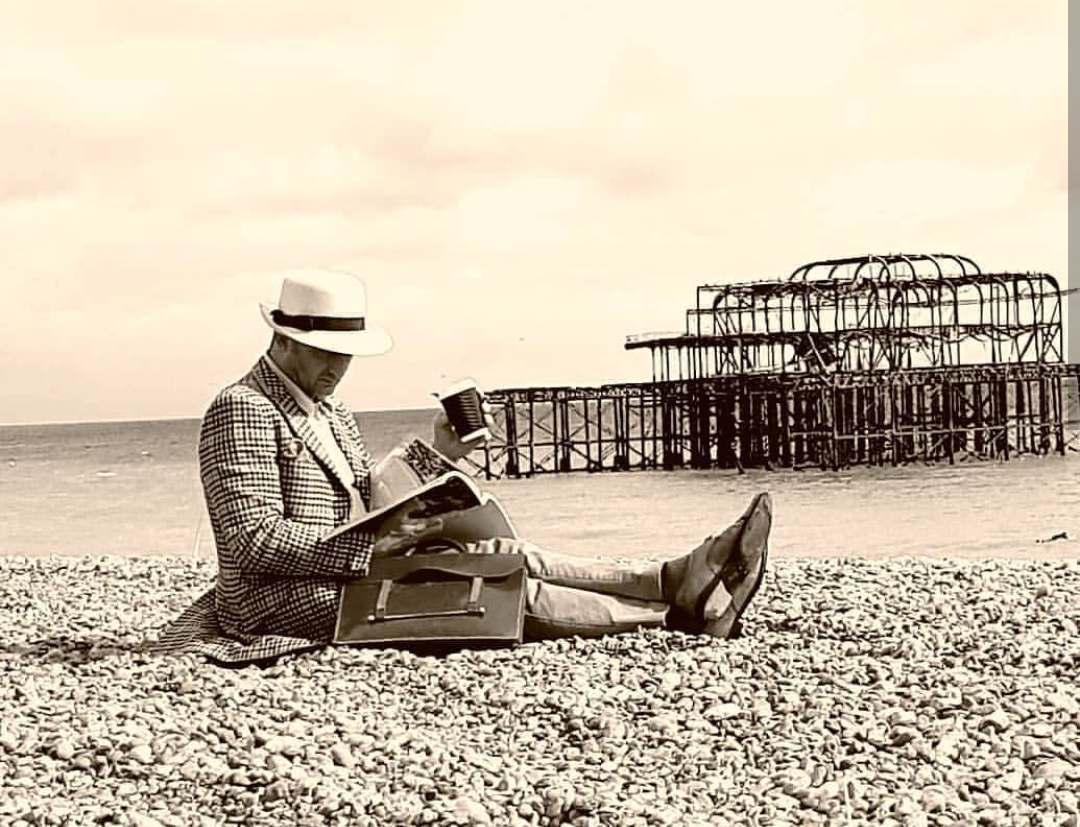
Enjoying regular Sunday morning coffee & newspaper on Brighton Beach.
***
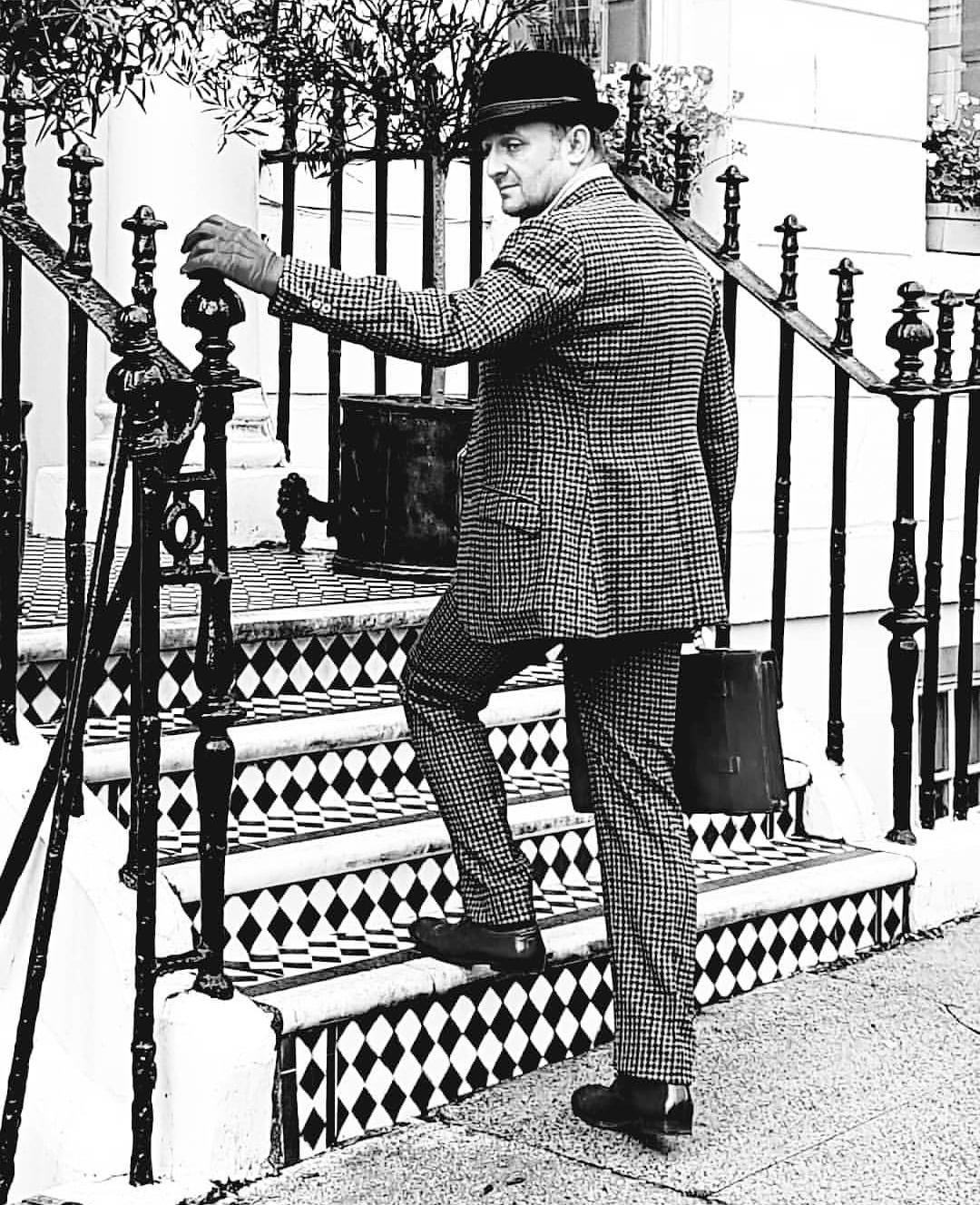
Outside Brighton home, wearing a 1961 Hawkes suit with 1978 Foster & Son shoes.
A hairstylist since the mid ‘80s, I own a salon in Nottingham some two hundred miles from Brighton, travelling around one thousand miles per week between the two cities. I do have a house in Nottingham, where I stay a few nights each week, but this is not my family home, my wife & daughter rarely visit, this is where my collection of bespoke & vintage shoes, suits & luggage are stored. I try to spare my wife & daughter being overwhelmed by the collection, nothing of the collection is stored at our Brighton home, different outfits, shoes and luggage travel with me on each journey back to Brighton.
***
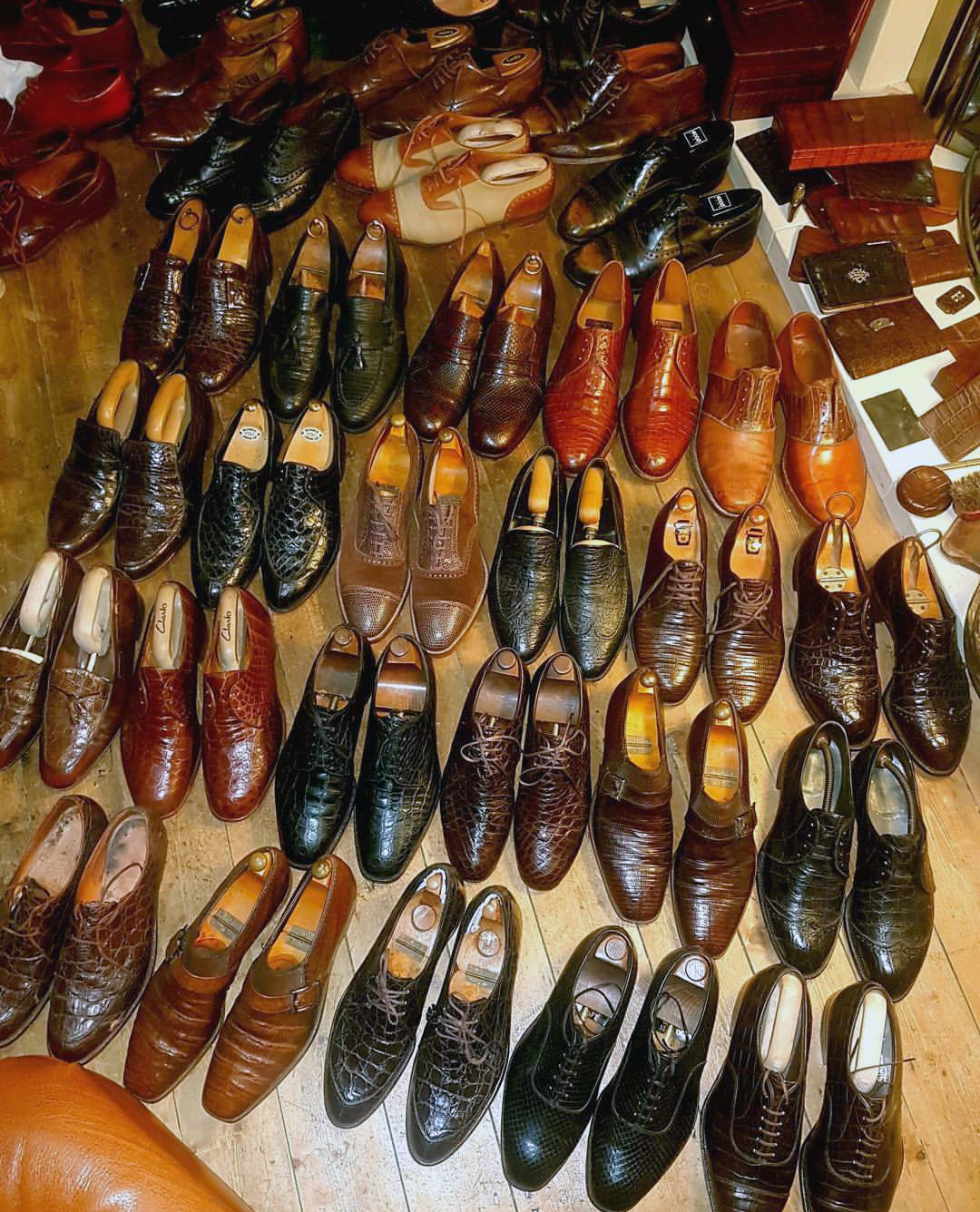
Exotic skin shoes in Nottingham town house
***
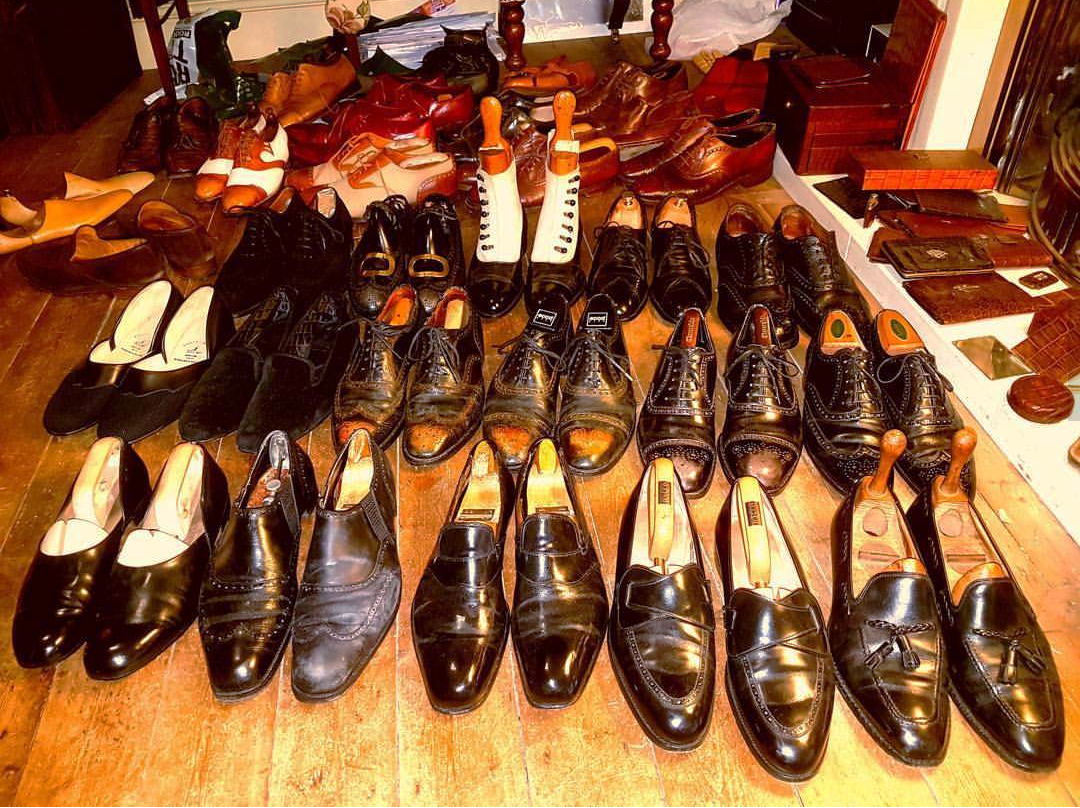
Black bespoke pairs in varying stages of repair or restoration.
***
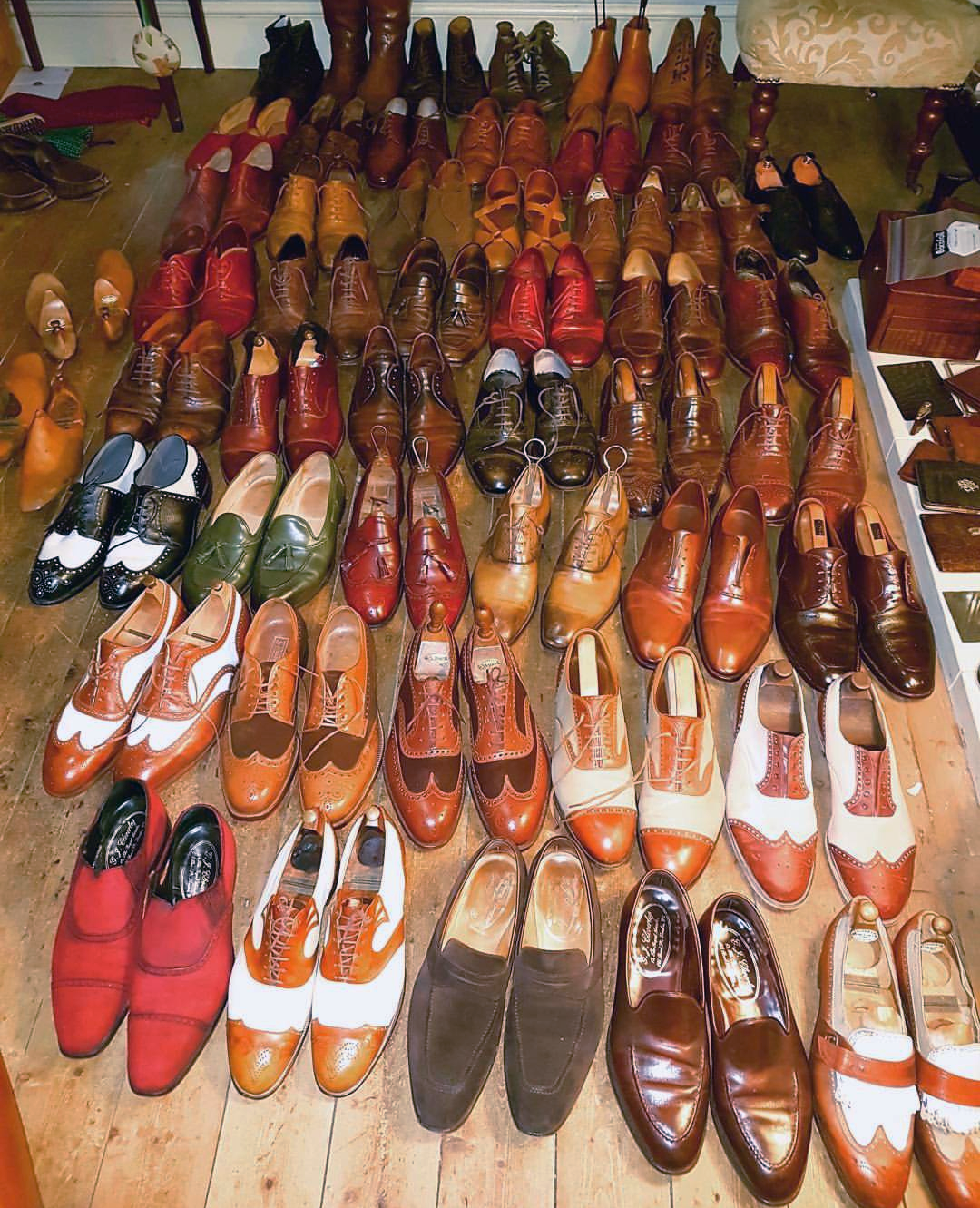
A few more pairs, most of my Nottingham town house looks like this.
These items, despite rarity and value, are my everyday attire, not museum pieces. I did not set out with the idea of building and amassing a vast collection, it is difficult to explain, I have just become carried away over the years.
V.R. Your educational background?
L.M. Following many years of working as a hairstylist in the West End of London, in my early thirties I studied for a Bachelors’ degree at the University of Brighton.
V.R. Have you any children or spouse (& how do they relate to your shoe enthusiasm)?
L.M. I have a wife of thirty years, and a daughter of thirteen living permanently in Brighton, they are both rather keen on image, style & fashion; because these items are my everyday attire, I think they have become almost oblivious to my collections. They are both very supportive & offer a lot of encouragement with the Bespoke Addict social media accounts.
V.R…and your parents and siblings reactions back when you got serious about style?
L.M. I do have quite a large family of which I am the oldest of six, with the exception of my youngest sister, the family have no interest in style, fashion or clothing, I suspect they think I am completely ridiculous & vain.
V.R. What hobbies or passions do you have besides collecting and restoring old pairs?
L.M. I collect, restore and wear all aspects of bespoke & vintage menswear & accessories, not just shoes; I concentrate on vintage Savile Row suiting & overcoats, mostly heavy tweeds, I probably have around thirty suits & overcoats. I also have dozens of pairs of gloves, hats, scarves, umbrellas & probably around one thousand ties & cravats, most of which are French. I also have quite a collection of vintage exotic skin luggage, much of which is used daily, I am continuously travelling between two homes, because I travel by car, the extreme weight of this luggage is less of an issue than it would be if travelling by rail or plane. I never count my items, I would guess the number of pairs of shoes to be around one hundred & fifty.
Another big passion is vintage Jaguar cars, I bought my first aged nineteen, & have driven ancient Jaguar or Daimler as daily transport since; they do require a lot of maintenance, repair and restoration, over the years, I have learned how to do all restoration, and continue to undertake all restoration and routine maintenance works myself.
I learned my shoe and luggage restoration techniques whilst restoring old Jaguars. Leather upholstery stretches, cracks, dries out and generally falls to pieces, as do shoes & luggage, the skills are easily transferrable to other leather items.
Preparing leather skins prior to colouring and polishing is very similar to preparing vintage car bodywork prior to painting, the more effort which goes into preparing natural or bare surface, the easier and more successful paint or polish will be. It is not possible to hide rough metalwork with paint, or rough leather with polish. I approach restoration of shoes or luggage in exactly the same way I would an old Jaguar.
V.R. How did you first become interested in shoes, and when did you turn your eyes towards artisanal pairs? Why classic models instead of fashion?
L.M. My interest in shoes and clothing began as early as I can remember in childhood, by my very early teenage years, it had become rather entrenched, and was always going to be part of my lifestyle going forward.
My interest in bespoke items happened rather by accident, going back to the 1980s, I always bought high end ready to wear, clothes and shoes, these ‘designer’ garment are definitely fashion led, not traditional ‘classics’, and as such do not age well, they go out of fashion rather quickly.
I still have many of the ‘designer’ pieces purchased since the ‘80s, they were very important to me at the time; ridiculously dated and old fashioned now, despite still fitting into some pieces, they will never be worn again, I am rather attached to these items from another time in my life.
***
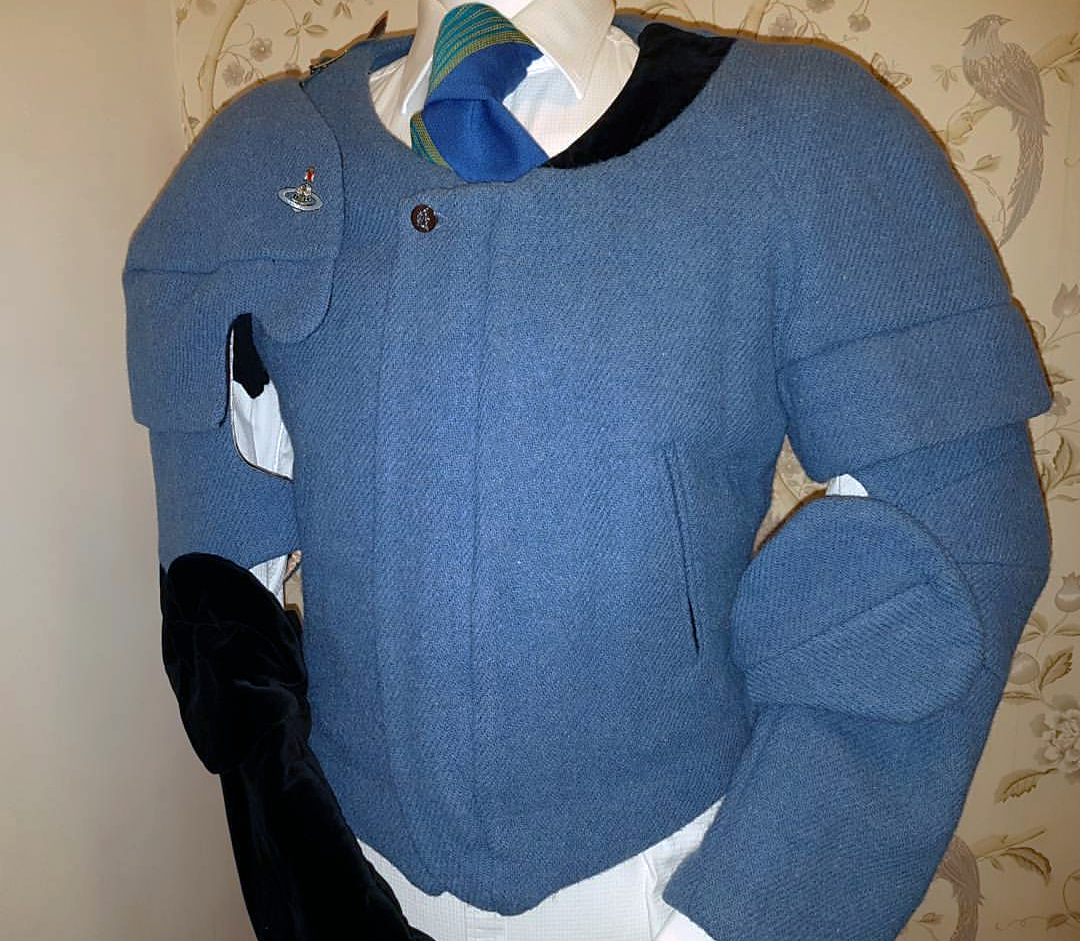
1987 Vivienne Westwood from the ‘Armour Plate’ collection, I enjoyed wearing this in the ‘80s, it still fits, however, due to extreme period styling, I will not wear seriously again. I did wear it a couple of years ago to a 1980s themed party. I can’t bear to part with it.
***
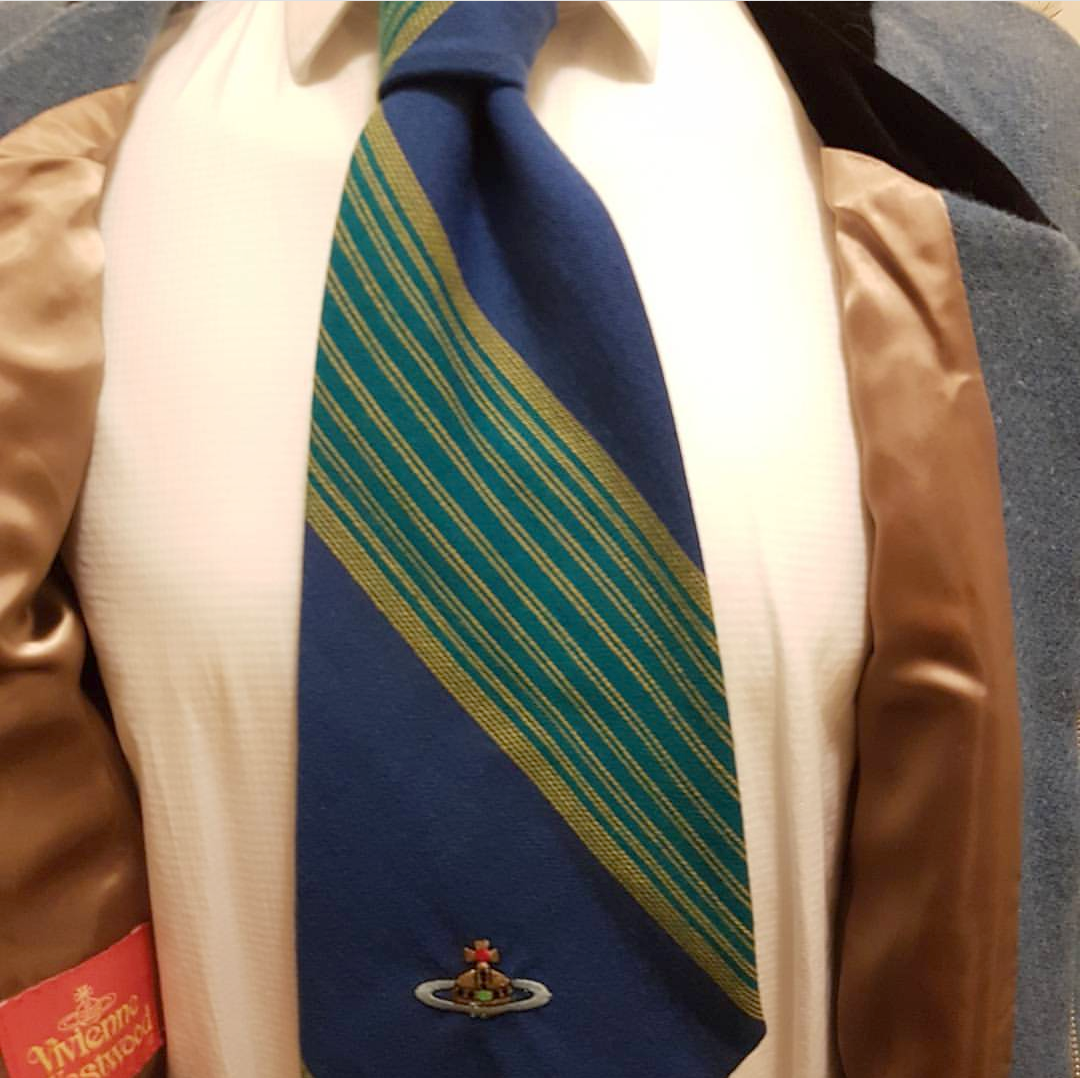
Six inch wide 1987 Vivienne Westwood tie, this too was worn at the party.
About ten years ago, we made the decision to send our daughter to a private school, suddenly, my ‘designer’ clothing budget became consumed by school fees.
I began at this point to search for quality second hand ‘designer’ garments & shoes, this search proved fruitless, anything which became available, because they are essentially fashion items, were out of date, and are no longer wearable.
***

1986 Jean Paul Gaultier suede square toe boots, I loved this pair, as can be seen by condition, they enjoyed a lot of use. In fact, a pair are worn by ‘The Lover’ in Peter Greenaway’s film: The Cook, The Thief, His Wife & Her Lover. I did not notice at the time, but was pleased to see them when I watched the film again recently.
***
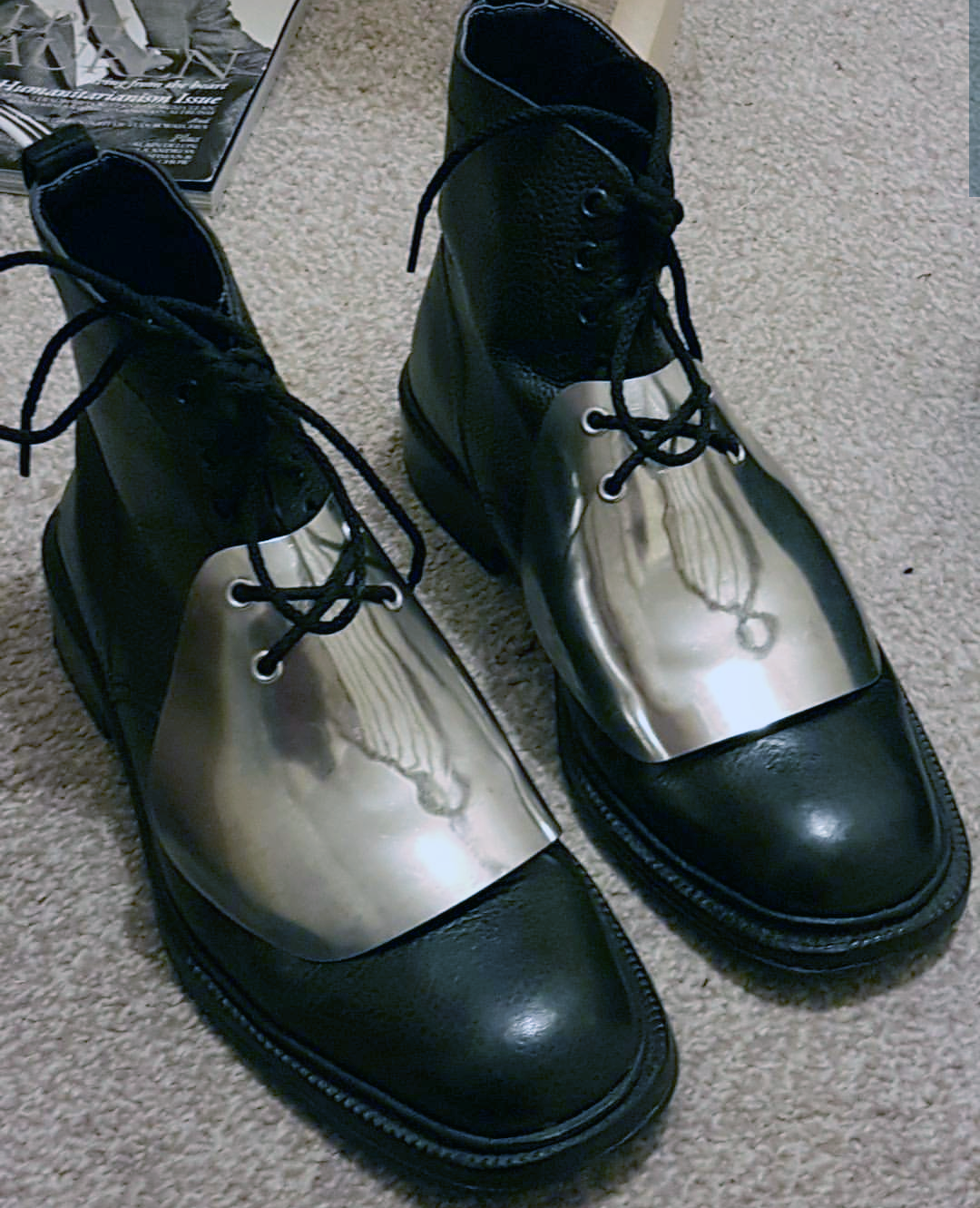
Another pair of 1987 Jean Paul Gaultier boots, another favourite at the time, these were also worn again recently at the 1980s themed party, they caused quite a fuss amongst guests who remember these from the time.
By chance, I discovered a rather beautiful full bespoke three- piece tweed from 1982, still in almost new condition, and of English classic styling, it did not appear old fashioned, I bought it, had a few alterations carried out to improve the fit, & became immediately hooked.
The workmanship & quality differences between genuine bespoke and high end ready to wear are enormous, I simply knew no better before.
Similar things happened with shoes, searching for good second-hand Northampton made shoes, by chance I came across a pair of bespoke Foster & Son ‘Chaves’ Brogues; to be honest, I did not know what they were, but they looked stunning if not a little dry, I bought them, & did a little research later. Thrilled by my chance discovery, my focus changed immediately.
V.R. How have you gathered your knowledge of the topic – from books, in house training, workshops or somewhere else?
L.M. My knowledge of bespoke & bespoke makers initially came from the Internet, various web sites & blogs, including Keikari.com, also, a few books; my knowledge deepened later, when through initially making contact via Instagram with many makers, authors and commentators, strong friendships have been formed with many extremely knowledgeable and influential individuals.
V.R. Which pairs are most dear to you amongst your many?
L.M. I do find it difficult to place my shoes in order of favourites, I have many wonderful pairs, each having its own unique character. If pushed to choose a single pair from the collection, it would be a 1974 pair of bespoke Foster & Son ‘Chaves’ Brogues in black with a classic Foster & Son antique patina, with lasts made by the legendary Mr. Terry Moore, this pair are simply stunning in every way, are in amazing original condition, & are just so usable, they are perfection for most occasions: formal, business or casual, moreover, they work with so many items within my wardrobe: formal suits, tweed suits, casual wear like moleskin or cords, even jeans.
***
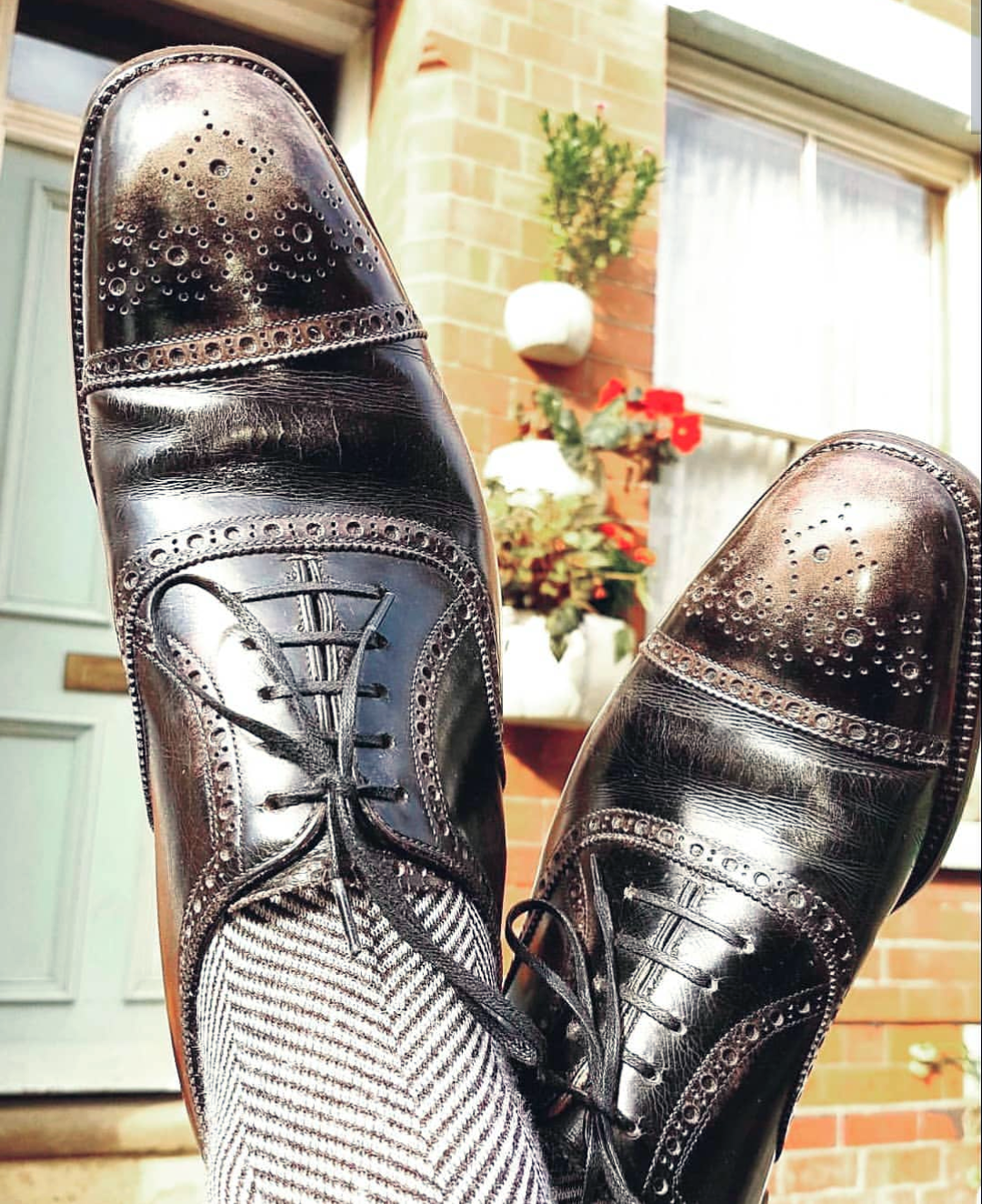
1974 Bespoke ‘Chaves’ Brogues by Foster & Son photographed with my feet hanging out of car window, outside my Nottingham townhouse.
Another pair high on my list of favourites are a pair of 2007 bespoke George Cleverley wholecuts, with lasts made by Mr. Teemu-Pekka Leppänen before his move to John Lobb, achingly beautiful with an unmistakable Cleverley Chisel silhouette, a truly wonderful pair of shoes, being light tan in colour, they are not so discrete as the 1974 Foster & Son, and have limitations which garments they can be paired with due to the colour.
***
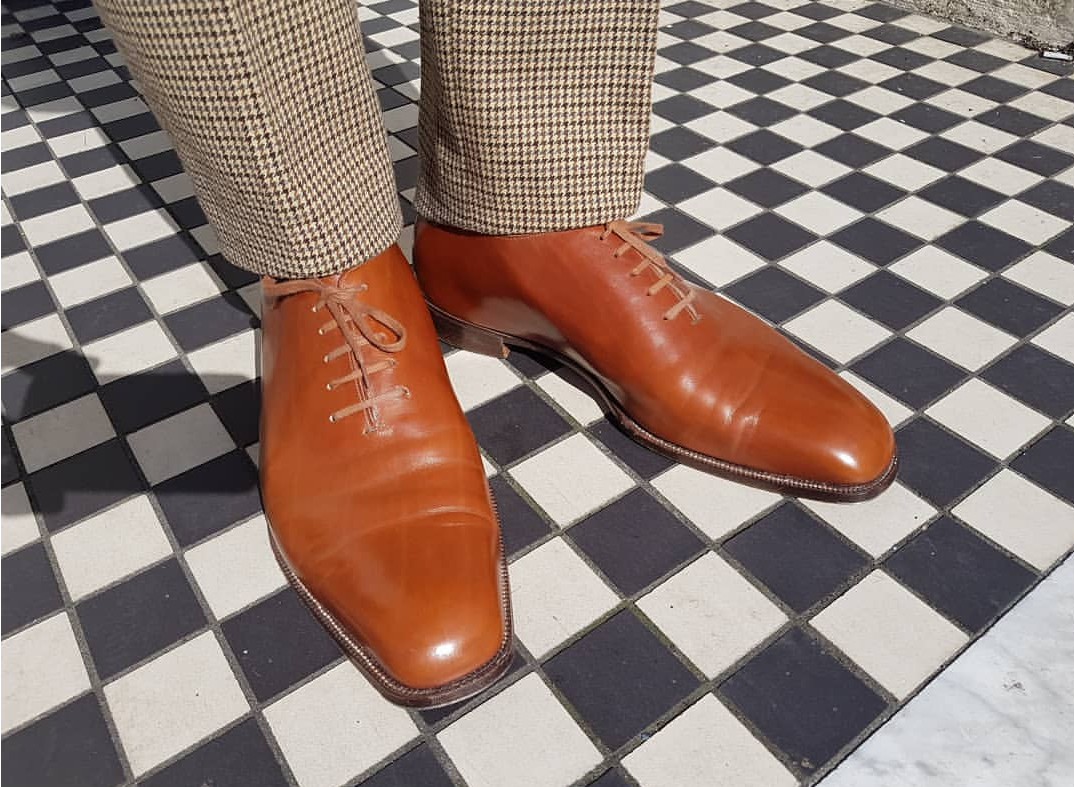
2007 Bespoke George Cleverley Wholecut, this pair have not been polished since leaving George Cleverley workshop, they are definitely due a thorough moisturising & polishing, perhaps new flat laces too.
One more pair high on list of favourites are 1940s bespoke Correspondents by Alan McAfee, in mid brown box calf & dark brown buck skin, more subtle than many correspondents, I find them to be particularly elegant. The condition of this pair is staggering, despite being over seventy years old, they actually look new, some of the stitching around the ankles is beginning to fail, before wearing again, I will carefully remove original stitching & using well matched linen thread, carefully re-stitch by hand through makers original stitch holes in skin. With enough care, when complete, the new stitching will be indistinguishable from original.
***

1940s bespoke box calf & buck skin Correspondents by Alan McAfee. Simply staggering original condition, this pair still look new, moreover, the fit on myself is uncanny, bespoke made for somebody else over seventy years ago, they could have been made for me this year.
V.R. Do you have a favourite shoe model (eg. Monk, Derby, Oxford, Balmoral boot) and leather type?
L.M. Oxfords are my favourite classic shoe style, in particular an Adelaide, I prefer the minimalism, and slim silhouette and contouring this styling offers, also, I enjoy the versatility the Oxford offers, working equally well paired with a casual outfit, as it does formal.
Regarding skin type, I prefer Box Calf for simple understated elegance and refinement, also, calf, if treated with care and attention ages beautifully, it gets more beautiful with age and time. Calf also affords a lot of flexibility to those more experienced with polishing, shading & patination. I am a fan of exotic skins, & have many within collection, however, they generally do not offer the flexibility & subtlety enjoyed by regular calf.
V.R. You’ve recently opened up your own channel on YouTube, what can we expect from your videos and why should we have a look?
L.M. The Bespoke Addict YouTube Channel was set up due to demand for help, advise & information from followers’ of my Instagram @bespokeaddict , many of the items within my collection are restored or modified by myself, I post daily photographs on Instagram of progress of various projects as they develop, however, it is rather difficult to give a true sense of what is actually involved with photographs and written text; close up videos with detailed explanation & commentary in real time are proving far more useful.
Most vintage & bespoke shoes I buy are not my size, or if they are indeed close to my own size, the fit is more often than not, not agreeable, bespoke shoes are made it fit unique features of original wearers feet, and as such, are usually a poor fit on anybody else.
I have taught myself, through trial & error, to resize and reshape these shoes, gradually becoming more dramatic with practice.
***
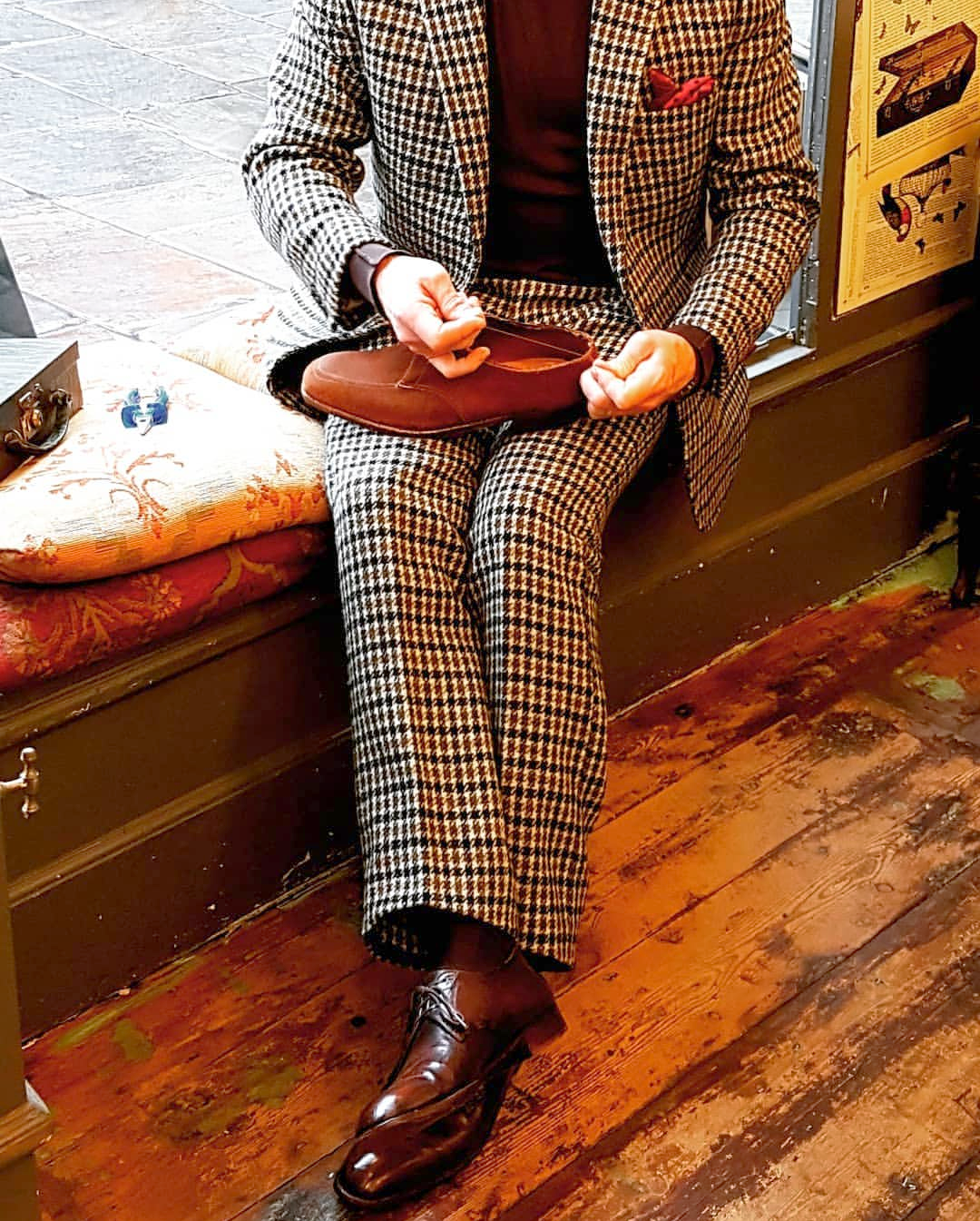
Photographed sitting in strong light of Nottingham Salon window, re-stitching by hand original failing stitching on pair of 1976 bespoke George Cleverley. The suit I am wearing here was made for Hollywood actor Robert Horton in October 1968, two months before I was born, I bought several pieces from Hortons wardrobe about six months before he died aged 91.
Series 1 on Bespoke Addict – The Brighton Gentleman YouTube Channel, begins with an overhaul of a heavily used pair, skins had stretched & cracked with use, this Series demonstrates shrinking skins back to their original size, followed by resurfacing of skin to remove cracking and cuts to skin, before moisturising, colouring and polishing.
***

One of my more involved restorations, this pair of 1968 bespoke George Cleverley were made for Prince Rupert Lowenstein, around 70 hours were spent over a period of weeks on this restoration. The shoe on right shows the condition when purchased, skins were extremely stretched & misshapen, dry, creased, cracked, cut & scratched, one shoe even had a 5mm round hole in centre of vamp.
***
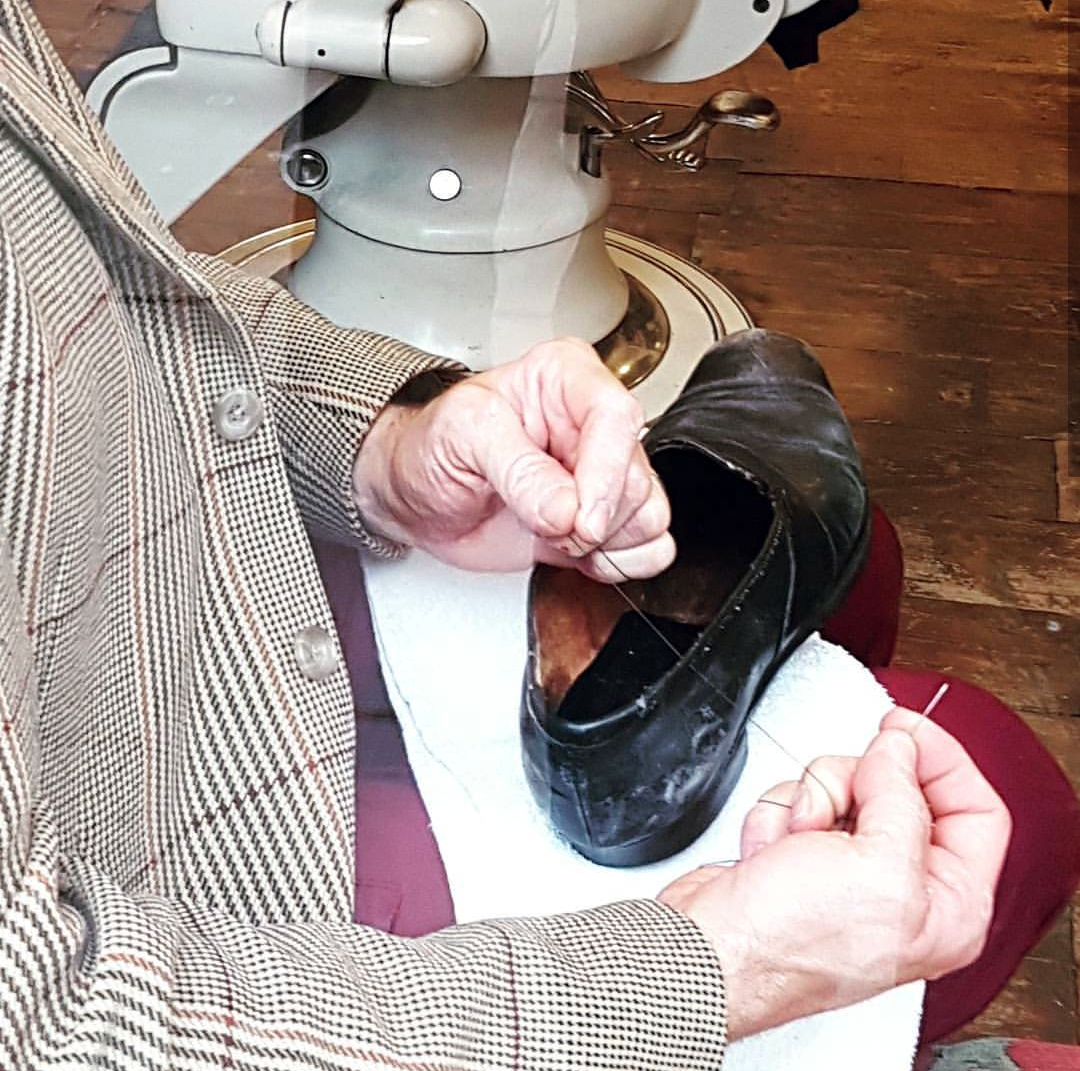
Carefully re-stitching by hand through makers original stitch holes in skin, all stitching was weak, rotten & failing & was replaced in sections before attempting to reshape & shrink skins.
***
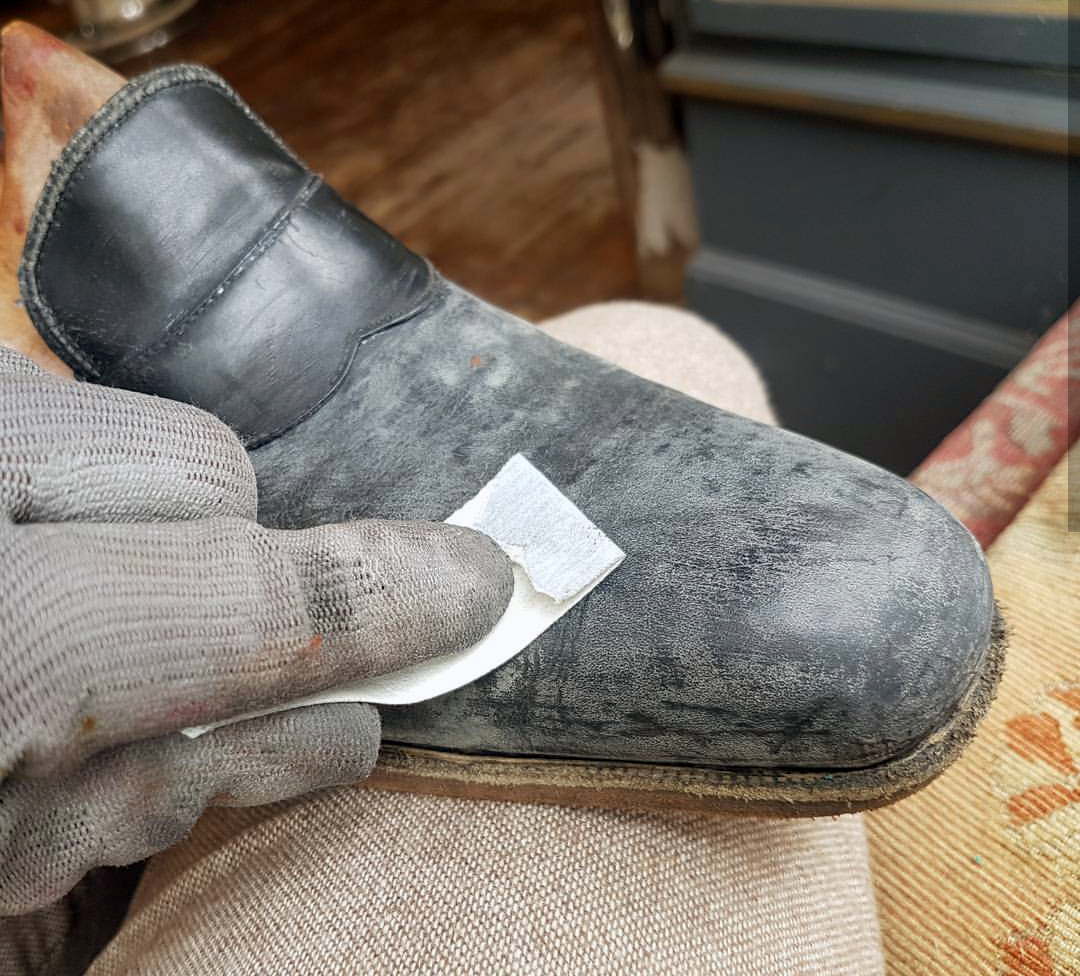
At this stage, skins are halfway through careful resurfacing using various grades of abrasive, a lot more time & effort was spent preparing skin surface prior to dying.
***
Result following many hours resurfacing, colouring, moisturising & polishing, a reasonable fit on me too.
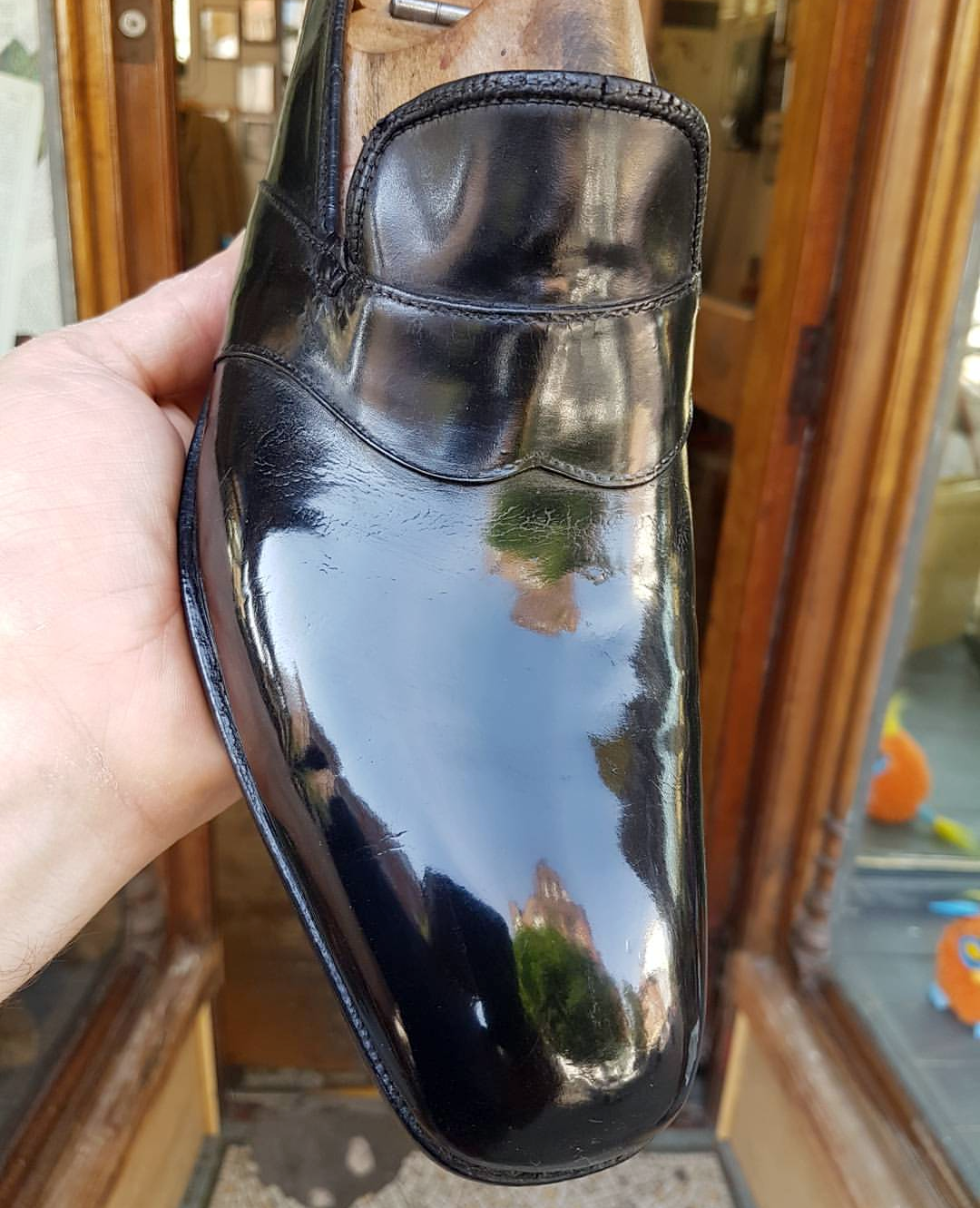
Recently, I have been ‘shrinking’ several pairs, down from about size 11, to my size, which is 9.5; it is quite an involved & physical task, but if carried out with enough patience, when completed, other than being radically smaller, no evidence of this brutal treatment is visible.
***
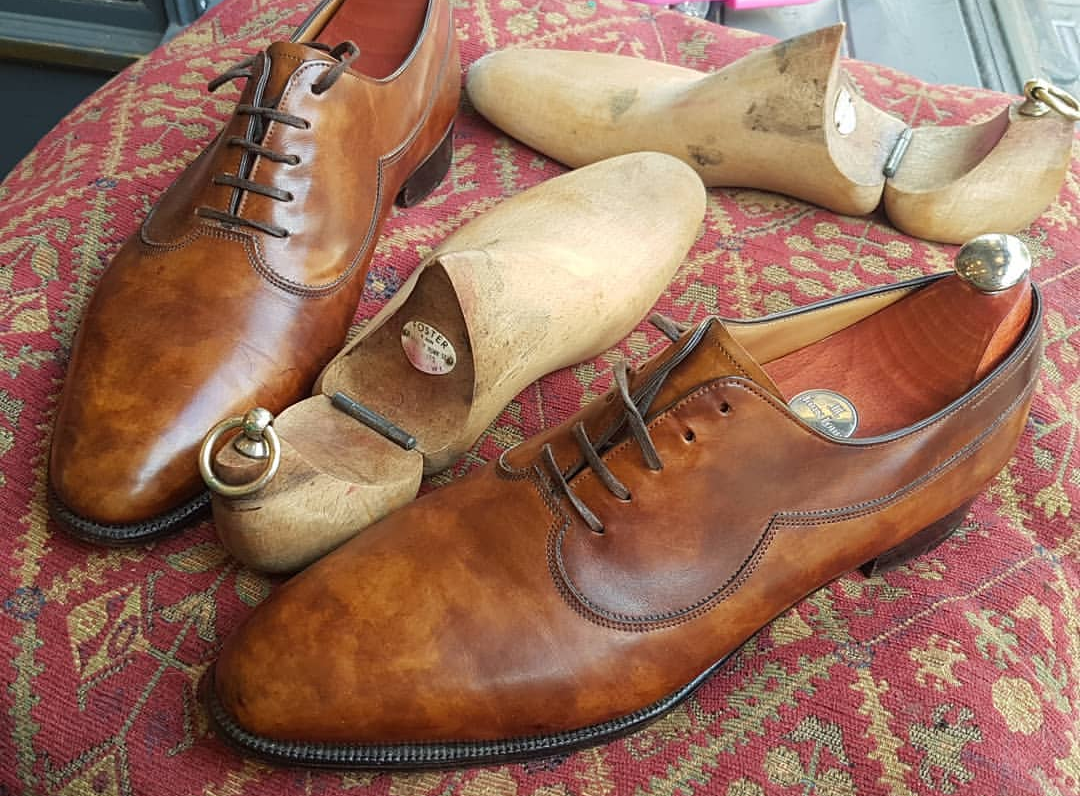
2007 John Lobb in original size & condition. A beautiful pair, & of stunning workmanship as one would expect of Lobb, this pair were enormous on me being around size 11, I wear 9.5. The bespoke Foster & Son trees in the photo are of the desired size; this pair were dramatically shrunken onto the Foster trees with steam, before careful resurfacing of skins, colouring, moisturising, patination & final polishing; a time consuming & physical task.
***
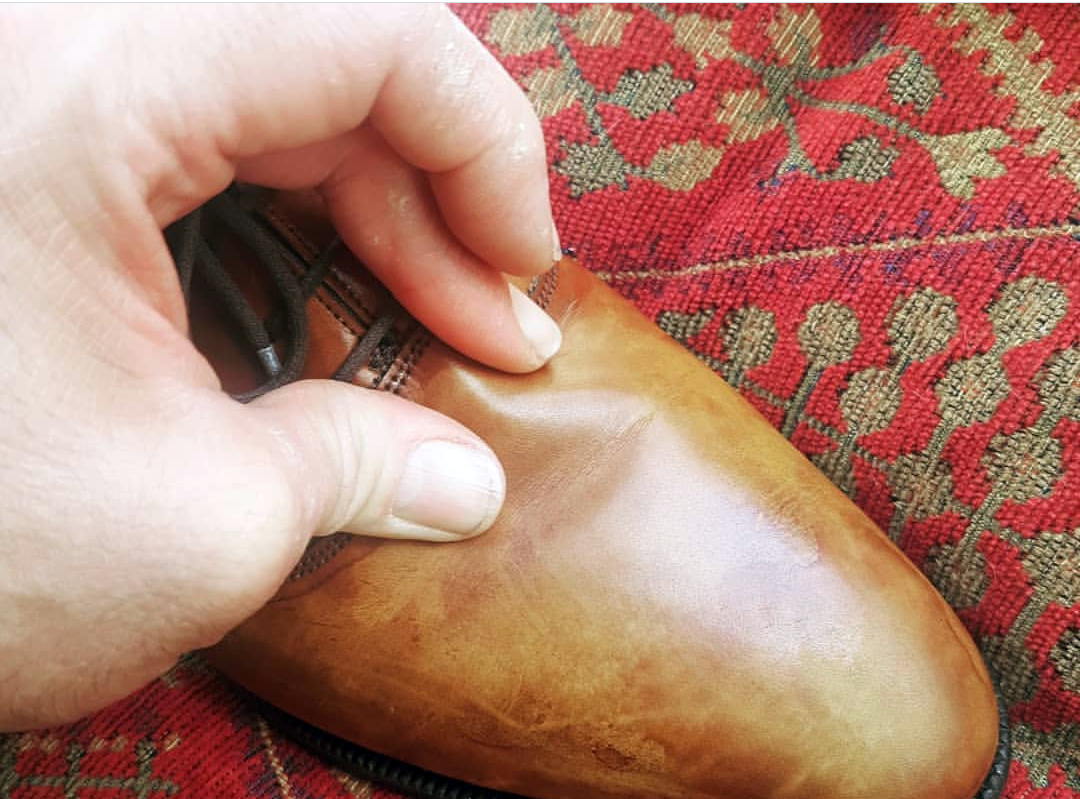
With Foster & Son fixed bespoke trees of desired smaller size inserted, the areas of excess are clearly visible, approximately 20 – 30 mm over whole shoe.
***
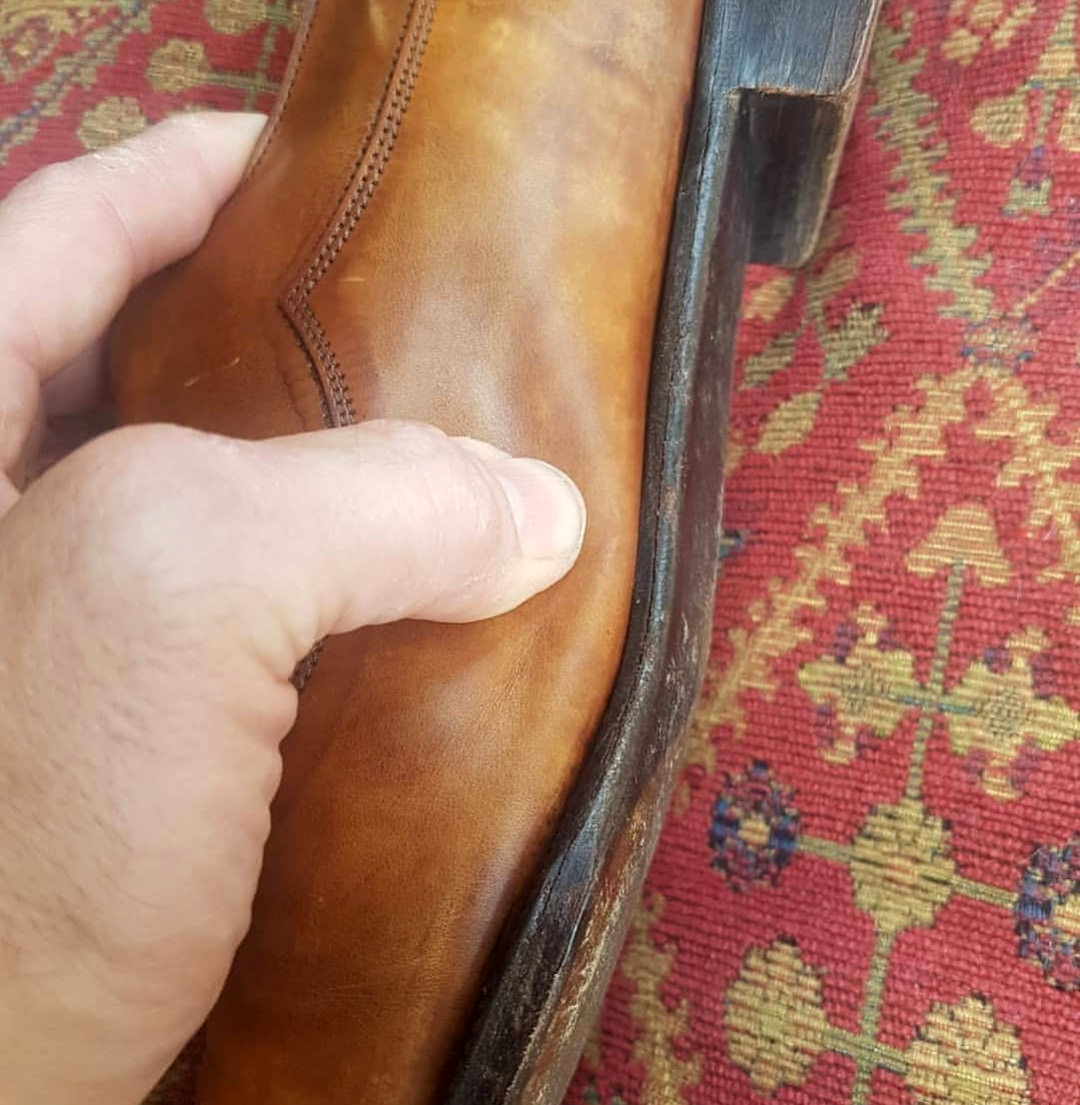
Excess into welting at ball of foot, in fact this amount of excess continued around complete perimeter of shoe into welting.
***
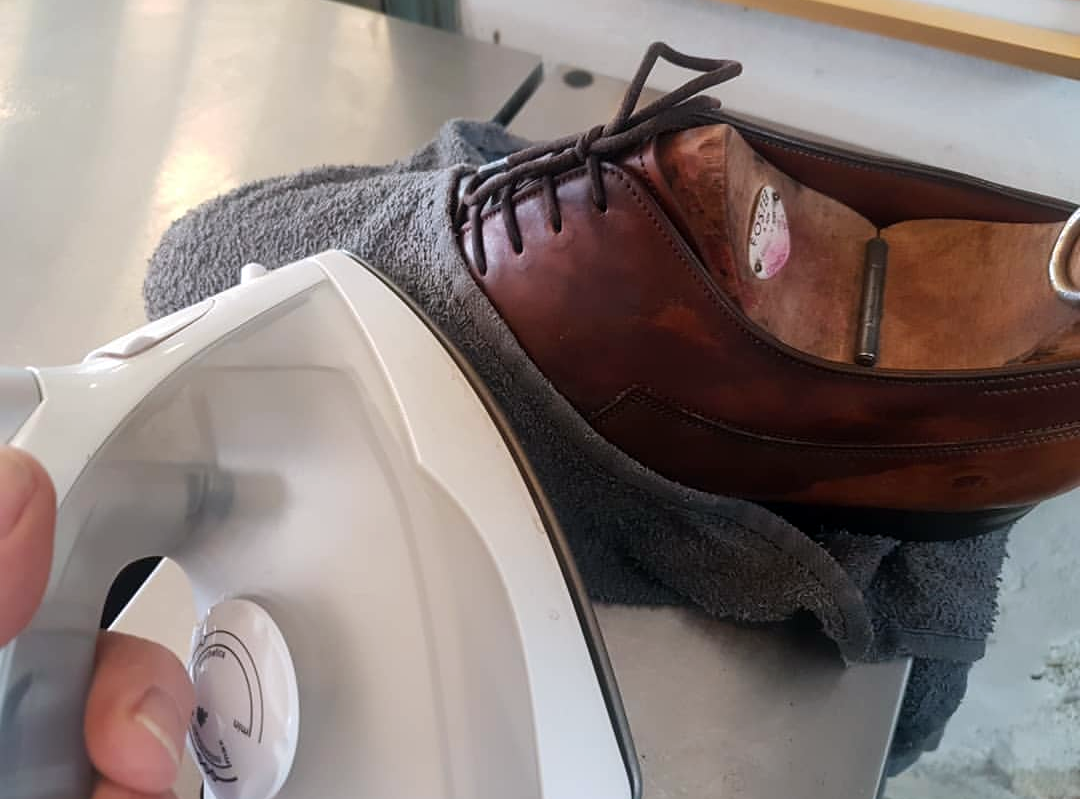
Undergoing brutal re-sizing & shrinking process, very wet skins are steamed using domestic steam iron & wet towel, this process takes around half hour per shoe, & needs to be repeated several times, allowing to fully dry overnight between treatments. Soles are also shrunken, being so thick, soles are more difficult, but with enough heat, steam & effort, soles do shrink.
***
 When desired size & fit is eventually achieved, skins need to be carefully resurfaced using various grades of abrasive.
***
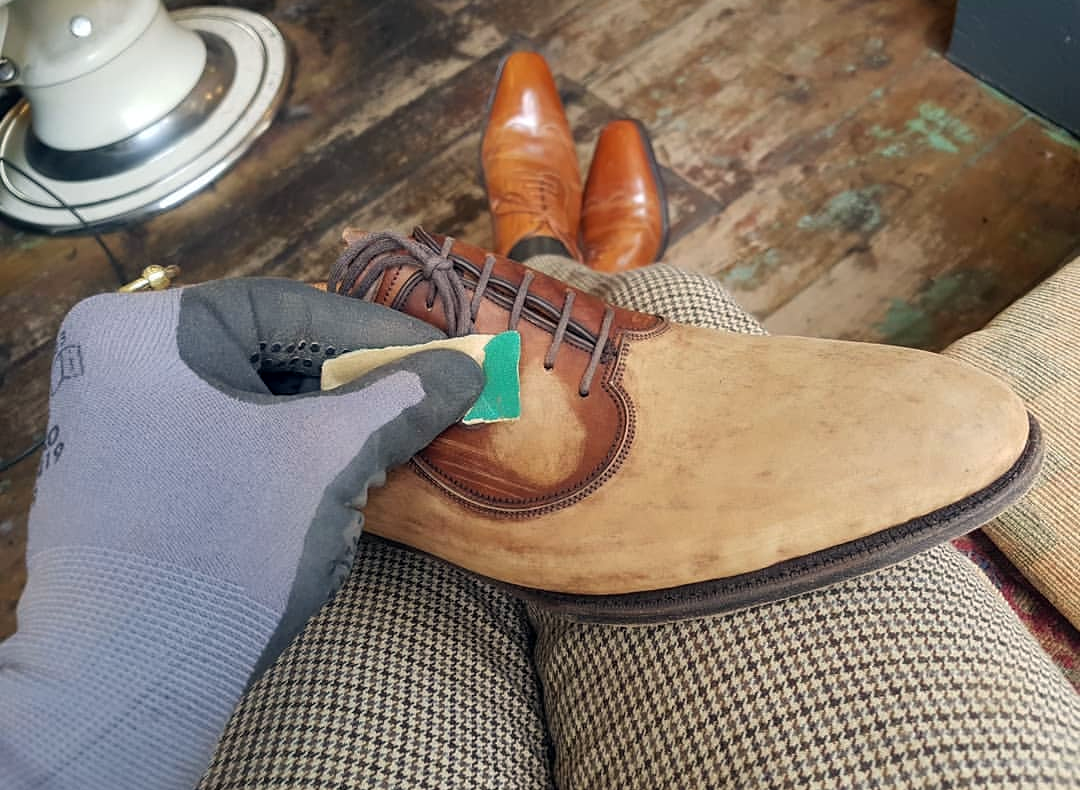
Following resizing & resurfacing, skins become rather dry, however it revives easily with moisturiser. Various coloured moisturisers are used here to achieve desired patina; around twelve hours were spent over several days on colouring, patination & final polishing.
***
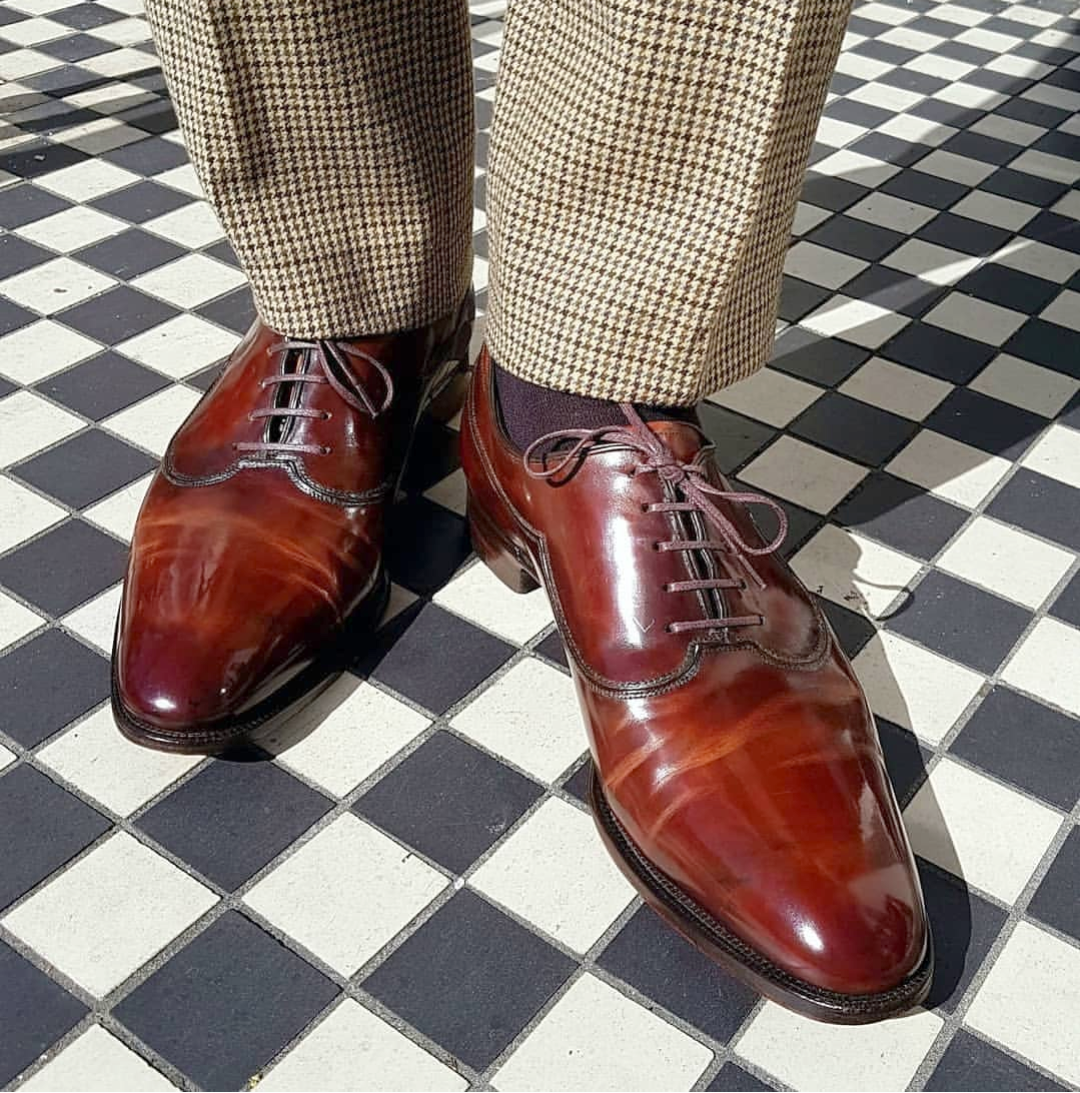
2007 John Lobb following brutal resizing treatment, the Foster & Son trees inside are much smaller than original Lobb trees, it is now not possible to insert original trees. When refinishing, a different colour & patination was decided upon, I was not terribly keen on the original patina, however, this is something of a moot point, the original patina would have been lost during treatments regardless. Wearing for the first time following lengthy and brutal resizing treatment.
Restoration & general maintenance of exotic skin luggage will also be featured in detail, and will include identification of various skin types and species, moreover, much emphasis will be placed on identifying genuine exotic from ‘fake’.
I will also be demonstrating ‘transplanting’ skin; vintage crocodile and alligator skins often loose scales over time, many of my items have undergone restorations which have required transplanting scales from donor skins, it can be quite difficult to identify transplanted areas when successfully completed, beautiful items which initially appear beyond restoration are usually easily restorable with a few transplants.
***
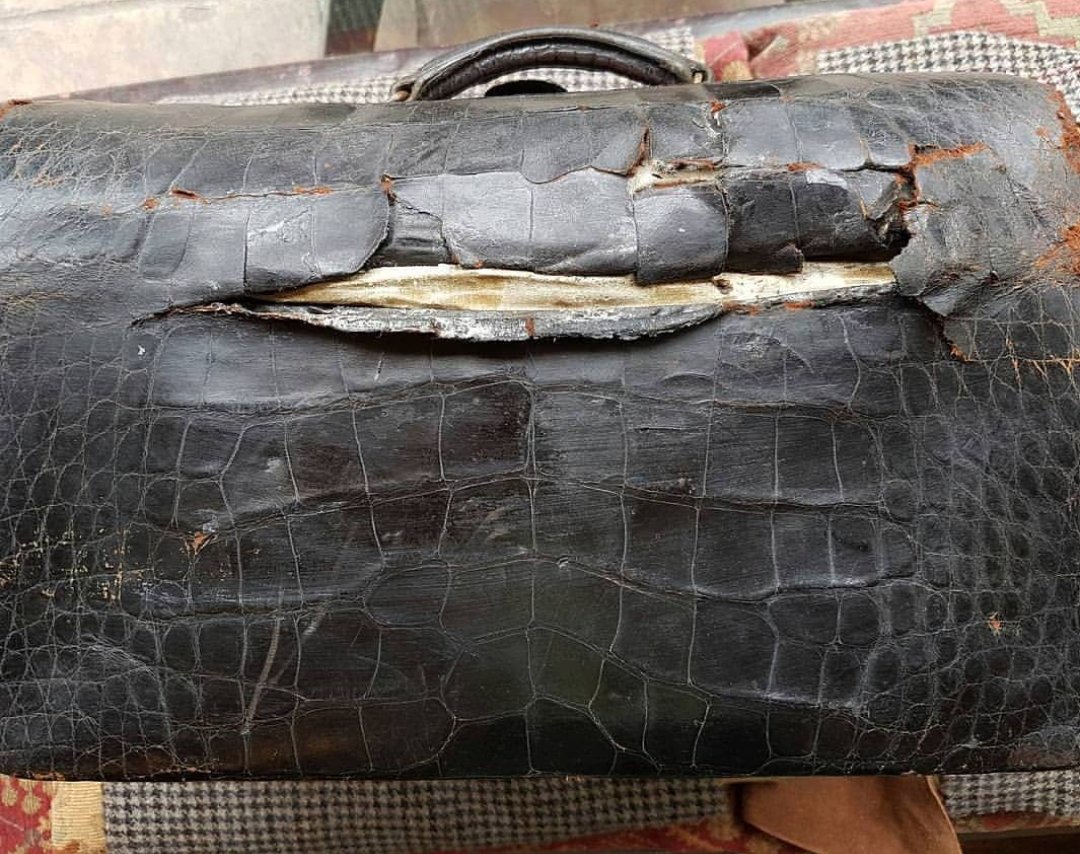
One of my more challenging & involved restorations: this 1880s Alligator skin Gladstone really did look to be beyond hope.
***

The same bag following weeks of attention, at this stage, one or two ‘donor’ scales were still to be transplanted.
***
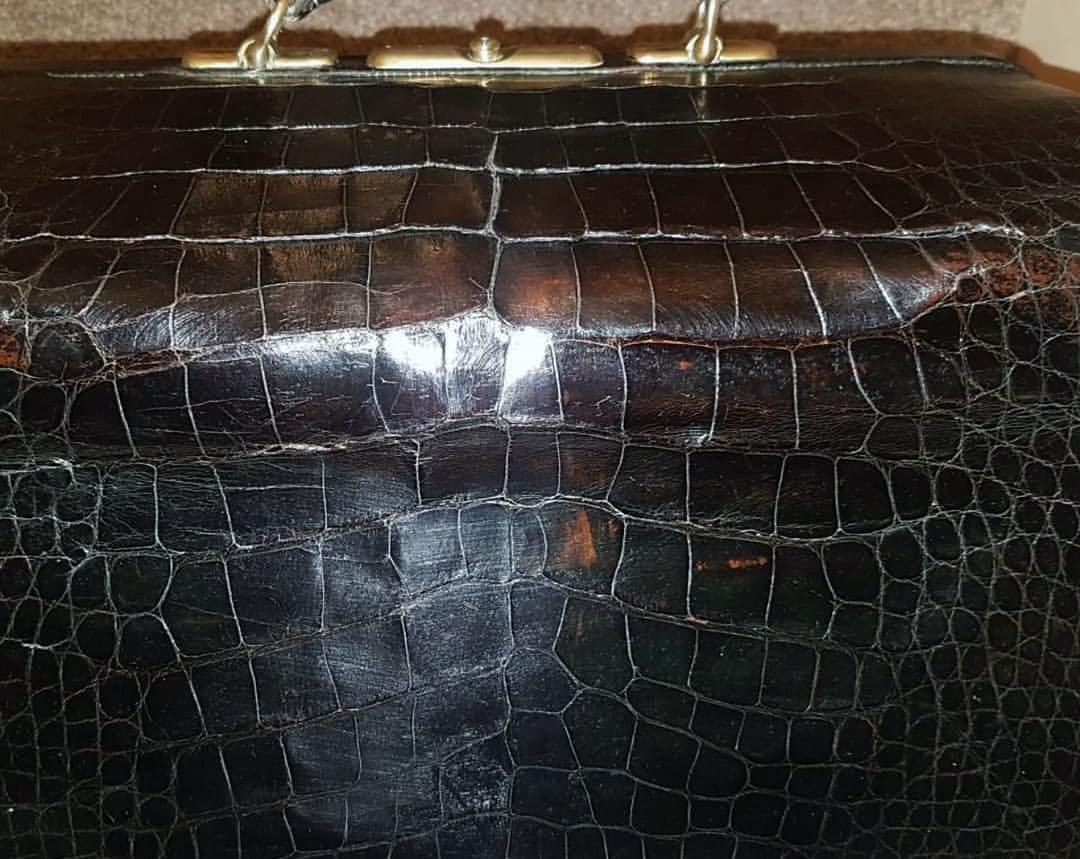
The other side of the bag, one or two scales have been transplanted from ‘donor skin’, can you identify which?
***
It will take around a year to film everything planned, not everything will be quite so involved, more routine maintenance and care, alongside simple repairs will also be featured.
V.R. What is your definition of a well-made shoe?
L.M. A well made shoe is not necessarily a bespoke shoe, for me, it has to be leather sole, preferably with narrow elegant waist & ‘fiddle-back’, not only are fiddle-back waists fiendishly elegant, they are supremely comfortable and supportive of arch of foot when standing or walking for long periods of time, we do not usually have flat feet, however, many ready to wear shoes have almost flat soles, and are flat inside too, the fiddle-back construction, in addition to being extremely elegant, contoured & slim, due to its construction, allows for more contoured shaping, whilst offering greater support to arch of foot.
Many shoes appear upon casual glance to be fantastic, however, closer inspection leads to disappointment when examining soles and inside, often having flat, wide and clumsy soles. Gaziano & Girling produce sublime bespoke shoes as one would expect, however, their ready to wear range is another level altogether, their ready to wear soles are of a level only usually found produced by the very finest bespoke makers’, this level is standard at Gaziano & Girling, not an extra cost option.
One or two Japanese bespoke makers’ have recently introduced ready to wear ranges, of which I have not yet had the opportunity to see, however, I strongly suspect they will have many of the qualities of Gaziano & Girling.
V.R. Who or what inspires you?
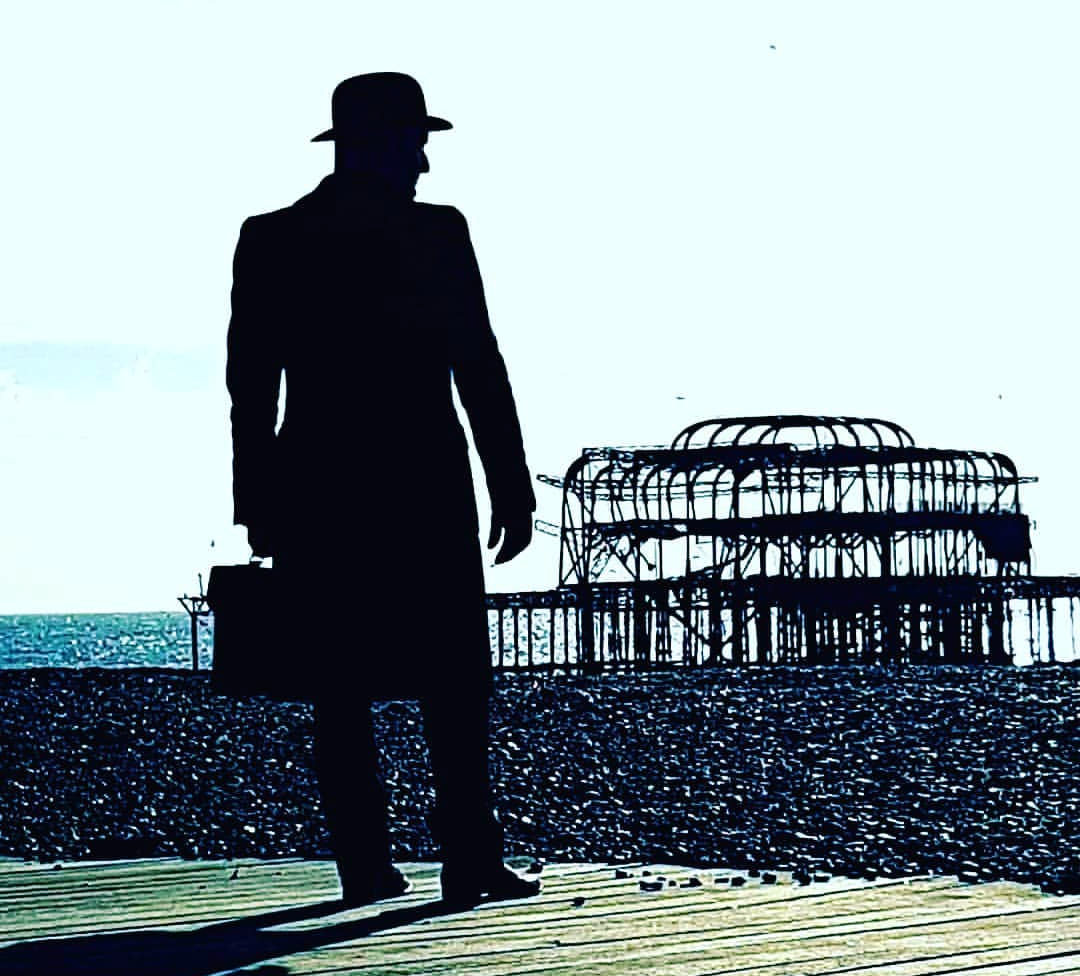
L.M. Major Metropolitan Cities inspire me, I adore the energy & vibrancy of busy Cities; the architecture, history & heritage are obvious attractions, however, the noise, crowds & chaos I find strangely reassuring.
Living in Brighton is particularly agreeable, I do have a lot of commitments which keep me away from Brighton several days a week, immediately I return to Brighton I feel energised, inspired & happy, all manner of humanity live here, it is actually quite a small place, with a huge number of local residents, tourists and visitors, space is definitely in short supply, just the way I like it.
V.R. Finally, what with the British EU exit looming on the horizon, how do you see the future of British shoe making?
L.M. Talking specifically about British Shoemaking, following the British exit from The EU, I do not foresee long-term problems for the industry as a whole, certainly not the traditional quality British Makers. It should be remembered, the British shoe industry was hugely successful, established & revered long before joining The EU; it was the industry itself which earned this much deserved success and reputation, it did not come about due to membership of The EU since the early 1970s. The quality British shoe market was successful long before membership of The EU, I strongly believe it will continue to thrive long after Exit from EU.
Traditional British made shoes, due to their relatively high purchase cost, have always been considered as an investment long term, they are not disposable items. As such, traditional buyers are unlikely to be put off continuing to buy British shoes, if indeed the Exit from The EU does result in slightly increased purchase price.
Without wishing to sound flippant or dismissive, we do face considerable challenges, it is likely many mass market, low purchase cost industries will indeed struggle if political complexities force price rises. However, high end and bespoke shoe & garment industries, though not immune to political complexities, are unlikely to suffer due to Exit from EU. Buyers of quality fully accept the purchase cost associated with such purchases, a small percentage increase is unlikely to change traditional buying habits and desires.
https://www.instagram.com/bespokeaddict/
https://www.youtube.com/channel/UCFkrQbvPDXMoYZMrtG4lFKw/videos
Category Bloggers, British Style, Interviews, Men of style, Videos, Vintage
The world according to Edward Sexton
0November 14, 2018 by Ville Raivio
Category Savile Row, Tailors, Videos
Dandyism in Oscar Wilde’s Plays Lady Windermere’s Fan and The Importance of Being Earnest
2November 1, 2018 by Ville Raivio
I have a thing for dandyism. I cannot explain why, but I believe each man has a passion or few. This one is among mine and I’m happy to have found it in the tender high school age. Because this topic will surely bring me manifold riches, girls, and job offers as well, I decided to write my Bachelor of Arts degree for English Philology about it. To avoid the piece being entirely lost in Helsinki University’s archives, I’m sharing it here. Who knows, maybe there are a few souls left somewhere who’ve taken a liking to historical dandies, and those who draw inspiration from the well they are.
In this B.A. work, I analyse dandyism in two of Oscar Wilde’s plays. He could have created characters without traits associated with dandyism, but instead we have two main dandy men. This piece first presents the concept of dandyism, then tells the story of George Bryan “Beau” Brummell as he served as the archetype for real-life and imaginary dandies. Then I have a look at the ways dandyism is shown in Lady Windermere’s Fan and The Importance of Being Earnest. The essay also analyses what function dandyism serves in the plays and in the main characters of Algernon Moncrieff as well as Lord Darlington.
The essay’s theoretical background lies in studies that deal with dandyism or its role in Wilde’s works. My references consist of biographies, academic essays, non-fiction books, M.A. works and one doctorate piece. The most important references are Alfred L. Recoulley III’s Oscar Wilde, the Dandy-Artist: A Study of Dandyism in the Life and Works of Oscar Wilde, With Particular Attention Given to the Intellectual Bases of Wilde’s Dandyism, Ellen Moers’s The Dandy: Brummell to Beerbohm, Stephen Calloway’s Wilde and the Dandyism of the Senses as well as William Jesse’s The Life of George Brummell, ESQ., Commonly Called Beau Brummell.
In my analysis, Lord Darlington and Algernon Moncrieff fill the role of an amusing and analytical character, but they have significant differences. Darlington, for one, is conscious of his superficiality while Moncrieff does not take notice of himself. Darlington is ready to abandon his stature and status for the woman he loves, while Moncrieff is ready to abandon his first name. Darlington falls in love with the persona, Moncrieff with the looks.
My study’s finding is that Wilde chose dandyism into his plays as part of his artistic image. His works tell about the upper class life of Britain and poke fun at it. From behind the veil of stylishness and discretion, Wilde’s dandy characters are able to present social critique that Wilde as well launched at his contemporaries. These dandy characters, like Wilde, do this so charmingly that the other characters don’t take offence. To generalise, Wilde’s dandies are akin to Middle Age court jesters, from whose mouths the truth is heard, this truth brings amusement but nothing changes. Omnia mutantur, nihil interit!
My B.A. work can be found through this link:
Dandyism in Oscar Wilde’s Plays Lady Windermere’s Fan and The Importance of Being Earnest
An interview with shoemaker Dominic Casey
0October 24, 2018 by Ville Raivio
VR: Your age and occupation?
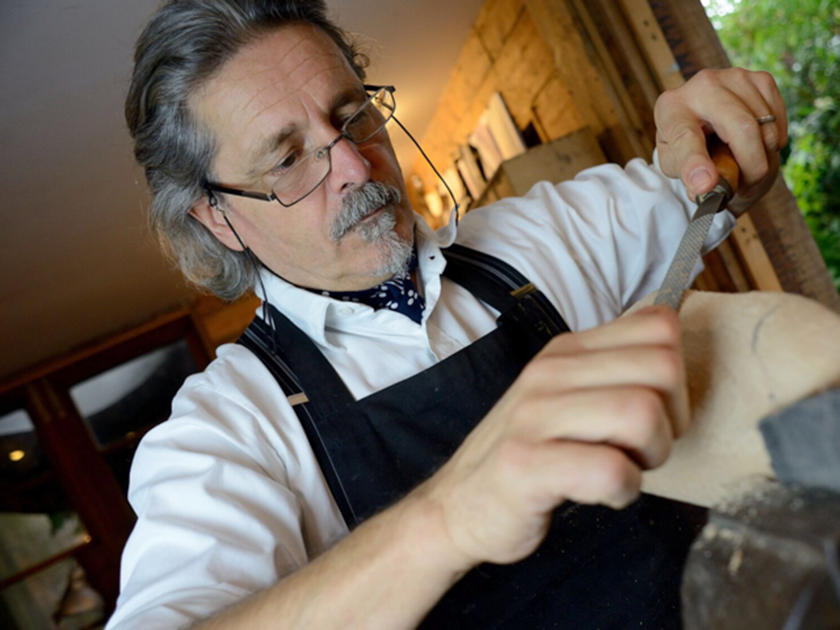
DC: I am 59 and work as a bespoke shoemaker.
VR: Your educational background?
DC: I have a degree in Geography and a Diploma in Footwear Design.
VR: Have you any children or spouse (and how do they relate to your shoe enthusiasm)?
DC: I’m married to a Specialist Community Midwife who works with teenagers but we have no children of our own.
VR: …and your parent’s and siblings’ reactions back when you decided to become a shoemaker?
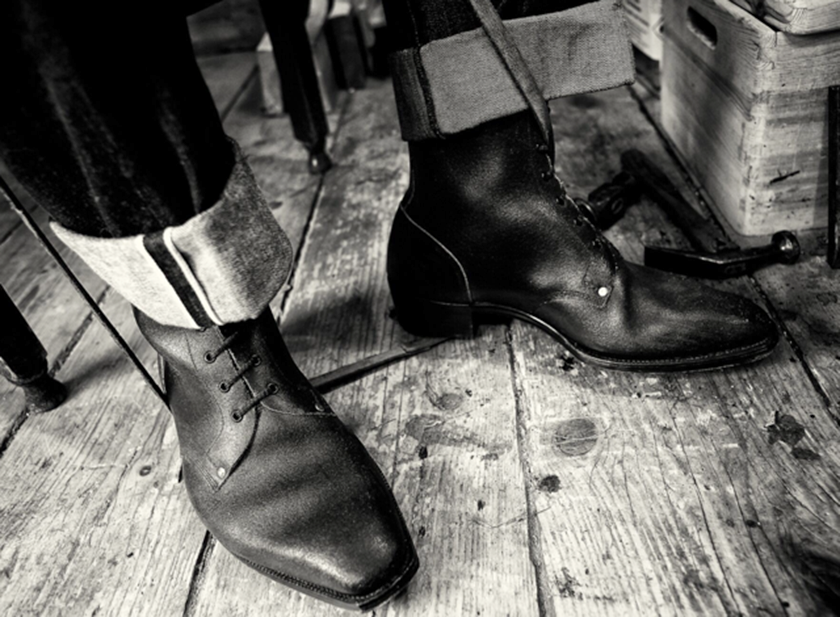
DC: I was in my early 20’s when I decided to change career and become a shoemaker. My family’s view was that if it was going to make me happy, then it was a good thing.
VR: What other hobbies or passions do you have besides footwear?
DC: I love the opera and luckily live on the Glyndebourne estate in East Sussex, so I have world class opera on my doorstep. I have practiced tai chi for over 35 years. I fought until my 30s but now just practice for fun. I still get on the mats with the young men but after a full minute of scraping I’m beginning to puff. I also enjoy gardening, cycling and cooking.
VR: How did you first become interested in shoes, and when did you turn your eyes towards artisanal shoemaking? Why classic models instead of fashion?
DC: I first became interested in shoes and shoemaking when I was working as a management consultant for Birmingham Museum and Art Gallery and they had an exhibition organised by the Crafts Council on shoemakers. I was really interested in training as a craftsperson, making something in a workshop. That something turned out to be shoes. I wanted the best craft training I could get, so I wrote to John Lobb in St James’s and started from there. Even though my styling is classical in nature, I taught at the MA in Footwear Design at the Royal College of Art for 15 years in the fashion department. I always tried to impress on the students that good Design was permanent and Fashion was just a passing concept. At the Royal College the strength was always to do fashion with a solid foundation of craft and technical skill borrowed from artisanal shoemaking.
VR: How have you gathered your knowledge of the craft — from books, in-house training, workshops or somewhere else?
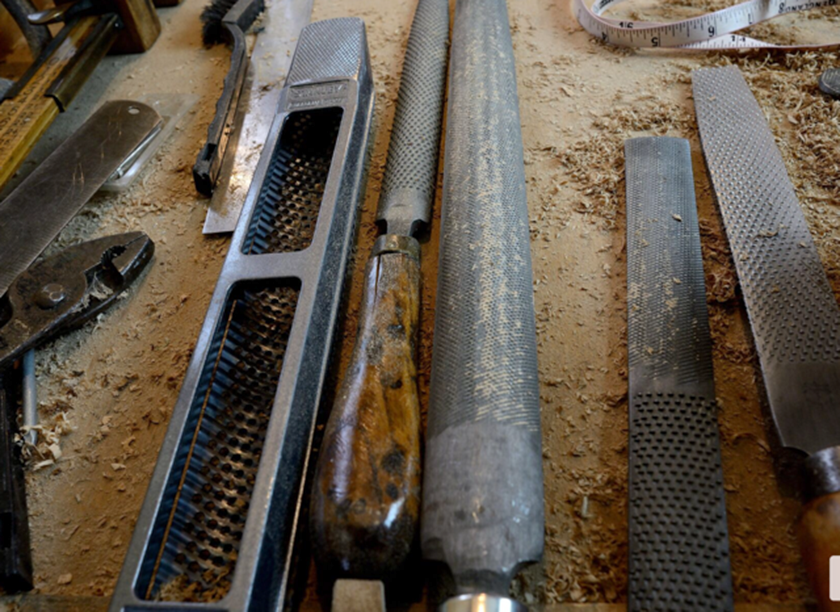
DC: I never understood it at the time, but I was blessed to be trained by the last of the great working Shoemakers that came to England as a result of the Second World War. All Eastern European, many Jewish, all unheard of and all dead now, but those lucky enough to have known them were humbled by their skill and speed. I started off as a closer making uppers and at the interview this wonderful Hungarian shoemaker took one look at me and told me to go away and make myself a skiving knife — with no Internet, few books on shoemaking and no idea what “skiving” was. I still have the knife I made.
VR: How would you describe the House Style of the Dominic shoes?
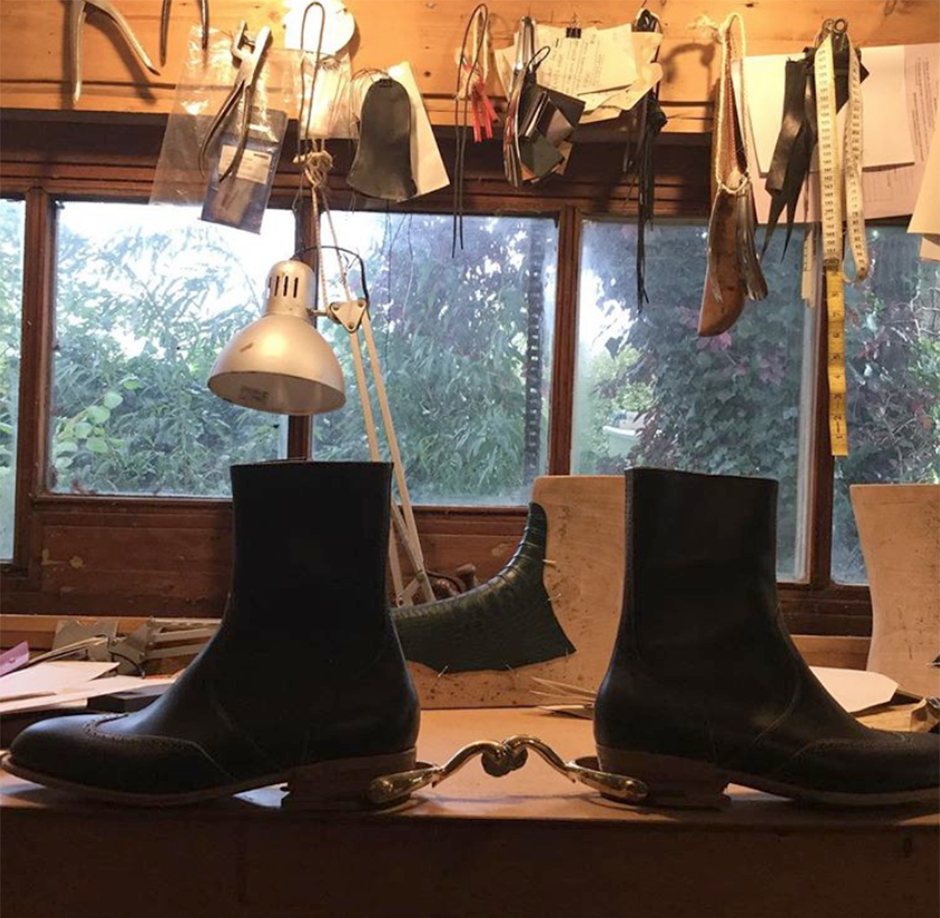
DC: I like to think of myself as a modern version of a classic English shoemaker. My last lengths are classical, not elongated, and my proportions traditional. My design style is asymmetric, using classical pattern structures, and my bottom making is deeply rooted in the traditional welted construction. However, I am proud to call myself a bespoke maker, so ultimately I make what the client requests. I’m more interested in the client’s style rather than imposing my house style.
VR: Do you have a favourite shoe model (eg. monk, derby, oxford, balmoral boot) and leather type?
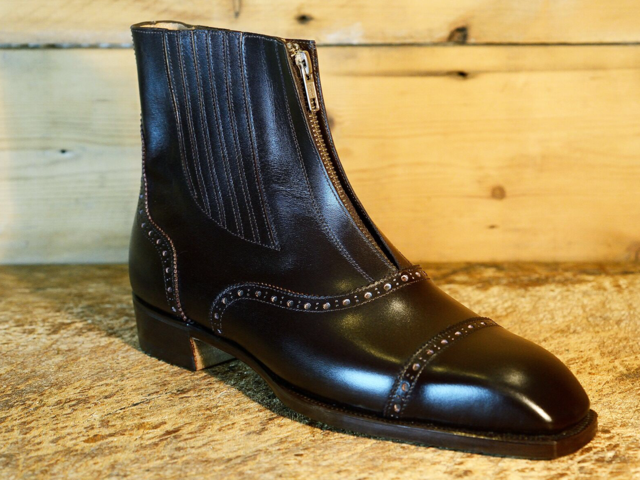
DC: My favourite model is the English Wellington boot, now sadly only worn by army officers as part of their mess uniform. I keep an old bespoke pair in the workshop to remind me of the simplistic beauty of this style of Footwear and was overjoyed to see both Princes William and Harry get married wearing them.
VR: There are several fine shoemakers in Britain — why should my readers try you?
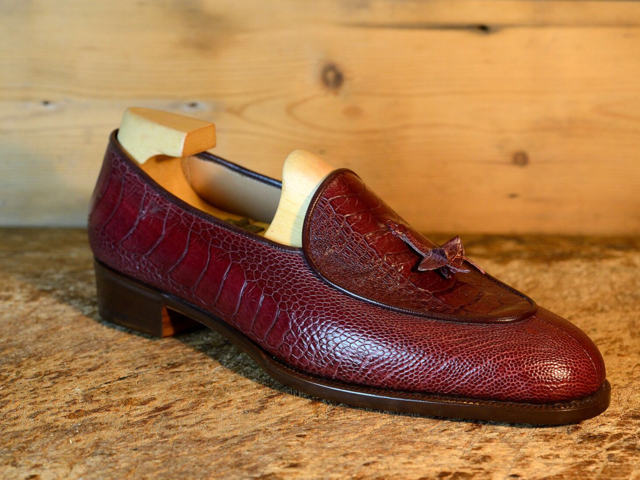
DC: Shoemaking has changed remarkably in the past few years in Britain. You still have the big firms and now, as a result of the Internet and social media, clients can track down many smaller independent craftsmen. In London we have Jim McCormack, Nick Templeman, Sebastian Tarek and Mariano Crespo all making good shoes, but bespoke is not about the shoes, it’s about the relationship between the client and the maker. A client has to feel he can sit down and talk to his shoemaker and the maker has to listen. If this relationship works then the shoes will take care of themselves.
VR: What is your definition of a well-made shoe?
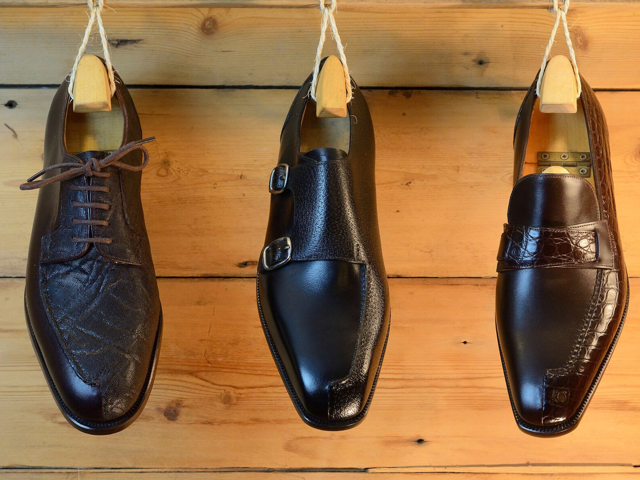
DC: A shoe made with care, consideration and a depth of beauty.
VR: Who or what inspires you?
DC: Young people and people willing to train as shoemakers. I recently set up a business with Steven Lowe, an ex-Lobb lastmaker teaching lastmaking. We had the facilities at Lastmaker House and wanted to pass on some of our skills and experience to other people. I always feel honoured to have young and old come and study with us and see such enthusiasm, drive and skill, very humbling. Thankfully, I always learn more from the students than I ever seem to teach them.
VR: Finally, how would you say British artisanal shoemaking differs from Italian shoemaking?
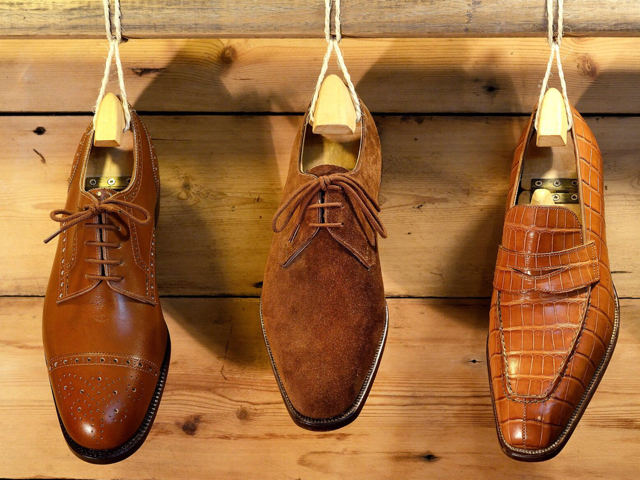
DC: Language, character and temperament.
Category Cordwainers, Interviews
Copyright © 2013 Ville Raivio