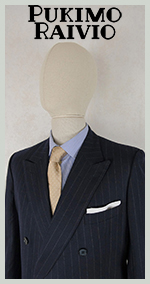
The Beau of Our Times
0June 5, 2013 by Ville Raivio
The following piece of menswear praise was first published by Apparel Arts in 1933. The writer’s name is undisclosed and the text far from neutral: AA was well-known for its fascination with the Duke of Windsor and his wardrobe, both of which were shared as luminary examples in style. Several garments, like the ever-violent Far Isle jumper, quickly sold out once the press caught a glimpse of HRH on camera and disseminated his vision to across the pond or wherever he roamed at the time. Fortunes and fashion victims were readily made on the whims of the dapper duke, whose eye was far more exacting than the legion of copycats that followed.
The Beau of Our Times
by unknown writer
“If there were no God,” said Voltaire some little time before he embraced Catholicism, “it would be necessary to invent Him.” Today the apparel industry echoes with religious fervor, “If there were no Prince of Wales, it would be necessary to invent him.” The National Association of Clothiers and Furnishers, during their meeting in Atlantic City in February of 1932, unanimously agreed that, of all the men in the world, England’s gallant Edward Albert alone deserved the title “Beau Brummel.” The one other male, it was naively recorded, who approached the Prince even remotely in the matter of influence was insouciant Mayor James Walker. And their report neglected to state whether the power exerted by this blithe individual should be praised as beneficial or condemned as corrupting and evil because of its jazzy sausage-causing lines and Broadway eccentricities.
It was the Prince who brought the derby — or, as the English would say, the bowler — back to popularity after the War. Appearing in a bowler, he brought the reign of the soft hat to a sudden and timely end: derby sales in Piccadilly doubled overnight.
It was the Prince who, when he donned a brilliantly hued Fair Isle Sweater knitted for him in the Shetlands, led the weavers of that locale out of the darkness into international limelight. Though he wore the sensational sweater for only a single hour on the links at St. Andrews, Shetland weaving trade jumped over a million dollars a year. University undergraduates at Nebraska and Illinois subscribed, without a second thought, to monastic diets to corral funds enabling the purchase of these rather gaudy pullovers.
It was the Prince who, at Le Touquet, golfed in black and white plus fours, bright blue shirt, and a salmon pink sleeveless jumper… sent outfitters scurrying madly. That very night an airplane, loaded with salmon pink jumpers, nosed out of London for Paris.
It was the Princely predilection for pith helmets that caused Rio de Janeiro shops to move 5000 of them in short order during his Brazilian visit… a Princely sojourn in Buenos Aires that caused local clothiers to market more evening clothes in one week than ordinarily they sell in a year.
So rigorous in fact is this Walesian influence that it is fascinating to conjecture just how far his followers would go. Until Edward Albert vetoed the custom, it was considered de rigueur to wear gloves with formal evening dress. Once when the Heir Apparent rose with a cigarette between his lips, everyone thought the move signaled the introduction of a modern fashion. But it was merely an oversight: the Prince apologized, and males relinquished the prerogative of shrouding their dancing partners in tobacco some to Apache exponents.
But when Prince walked down the gangplank on his return from South America sporting a boater, London haberdashers, caught completely off guard, sent frenzied wires to wondering suppliers demanding posthaste delivery of stiff straws.
HRH initiated the combination of the white waistcoat, and though Alfonso, formerly King of Spain, is accredited with its creation, the double breasted dinner jacket worn over a soft shirt constituted no fashion actuality until Wales took it up.
He made of every Parisian florist a devoted slave by wearing a boutonniere, a deep red carnation (a whimsy in keeping with gay night club peregrinations) to add a suitable fillip to informal evening dress.
When in 1924 all America favored the narrow brim hat turned up all the way round, Edward of Wales’ wide brim snapped down… shaded his royal eyes from the sun as he witnessed the International Polo matches at Meadowbrook. The American fashion pendulum reversed its direction the moment he took his place among the spectators: within a year narrow brims had become museum pieces.
On the memorable visit in ‘24 his repeated choice of a red and blue Guards stripe necktie worn always with a blue shirt sent this fashion quirk from his own solitary perch on its apex downwards through the stratas of the fashion pyramid to the broad base made up of the cut-price customers of Lennox Avenue.
HRH may be held responsible for the second to last revival of Glen Urquhart Plaid clothing. By favoring double breasted suits in chalk stripes over a blue flannel ground, he sent woolen designers into epoch-making conferences. The most important note in London Spring woolens is provided by flannels with chalk stripes, reddish Havana brown with white chalk stripes, grey flannels in many tones with pale blue chalk stripes. Edward Albert revolutionized the fur coat, transformed it from an unsightly amorphous thing into well-cut garment with as much swagger and smart good look as any form fitting cloth contemporary. He even set the style for the Boy Scouts by appearing, after the War, in shorts.
Today retailers can thank the Prince for the popularity of the hacking scarf, the backless dress waistcoat, the wide spread collar with its accompanying big knot necktie, the tab-collar shirt, and the polka dot foulard muffler. The fact that he is at present favoring a cap (of his own introduction) with one piece top sewn on to the brim in patterns of bold brown and white houndstooth check, and in his own Rothsey plaid, that he wears flannel shirts, cream colored ground with Tattersall pattern checks of yellow and black, blue and black, and brown and yellow, and that his fur trimmed coat flaunts a black Persian lamb collar carries as much weight with acute members of the apparel industry (from manufacturers to retailers) as do car loading figures to Stock Market Statisticians. It has become an automatic procedure for manufacturers to “put the Prince into their line.” It has become axiomatic for clothiers’ salesmen from the finest metropolitan shop down to the street hawker who vends his wares with a weather eye peeled for the cop on the corner — to use as a weighty closing argument: “The Prince of Wales is wearing it.”
On every selling trip this royal traveling salesman has been dogged by newsreel photographers and reporters. His moments of privacy, out of eyeshot of the entire civilized world, are few and far between. Of consequence, as prime ambassador of the Empire, it is absolutely vital that he should appear at all times royal in manner, in attire.
Now good taste in selecting clothes is not an invariable adjunct to royal blood. King Edward, for all his reputation for bonhomerie, leaned toward bizarre in dress. London will never forget his trousers, creased at the sides. Today Queen Mary’s hats have given many a Paris couturier the migraine. And though David has exhibited his impatience with convention by appearing in a dinner jacket with a pullover sweater for a waistcoat, and is rumored to have donned (at view of the London Police in Hyde Park) with formal black coat and silk topper, a pair of rough tweed trousers with rolled cuffs, his natural interest in detail usually makes him the best turned out man in an assemblage.
It may be true that he appeared at a luncheon given in his honor in Copenhagen on the occasion of the opening of the British Trade Convention in a cutaway coat with a soft collar, but as a rule his sense of responsibility throttles these youthful uprisings in the face of tradition. He may be interested in countless affairs from aviation to socialism, from re-forestation problems to welfare of England’s unemployed, but he still finds time to select his own clothes. And he has a fine flair for pattern, color and cut. In fact, while examining swatches, he may even say, “I like this, but I would like to see it with a yellow over plaid.” The tailor passes this information to the mills: “His Royal Highness likes this piece, but wishes to see it with a yellow over plaid.” The mill cooperates and the Prince has created a new design.
Only the most deserving firm receives the royal warrant. And though they receive the greatest part of his trade, shops other than those he has honored in this fashion, get some of his business. After a store has served him well for some years and has also earned an enviable record with the Prince’s acquaintances, it is granted the privilege of displaying the crown with the three plumes and the legend “Ich Dien” over the words “By Appointment to HRH The Prince of Wales.” Should the appointed, through some unforeseen catastrophe, fail, the management automatically loses the royal warrant.
The Prince’s wardrobe comprises what may be labeled without fear of refutation, the largest single collection of male attire in the modern world. There are the ceremonial robes, the accessories to the court dress, the ancient tartans of the Lord of the Isles which HRH wears in Scotland, his Guard’s dress, army and navy uniforms, the magnificent robes prerogative to the title Wales, Boy Scout uniforms, university robes, together with all the accoutrements incidental to formal day and evening, informal and sports wear. Unfortunately the inquisitive reporter cannot gain entrance into the wardrobe chambers of York House to make a detailed accounting of what would be found there. Nor are there extant press agent accounts of its treasures as there might be if Wales were a cinema star. None but the royal valets, who find year round employment caring or the princely habiliments, know just how many hats, and ties, just how many pairs of shoes, just how many overcoats and pairs of gaiters Edward Windsor owns.
British biographers grow a bit self-conscious when they discuss their Prince’s fame as the well dressed man. Somehow or another they seem to think this sort of distinction might be interpreted as a slur against his manliness. For example, “He follows his own tastes to a large extent, but a feature of his garments is their masculinity. Although the Prince requires the services of two valets, he personally superintends his own wardrobe and regularly inspects his clothes in order to see that they are well preserved and that his stock is not too extensive. He does not believe in purchasing clothes above his ordinary requirements. As a rule HRH has a horror of appearing different from other men, but in the matter of dress he can carry uncommon fashions (before they are imitated) with perfect ease and shows no embarrassment on those occasions when he happens to be dressed differently form his companions. On one occasion when he was attending a banquet with his father and brothers, the Prince of Wales was the only person present who wore a flower in his buttonhole. It would have been an easy matter for him to remove it without notice, but the Prince preferred to follow his own fancy and the blossom graced his lapel throughout the function.”
That the Prince possesses fifty suits is regarded by the biographer a canard — nevertheless, a recent press dispatch from London reveals that when HRH left the capital for a week’s sojourn in the country, his luggage included eight suitcases, two hat cases, and three trunks, all tightly packed. No one has ever accurately reported the impedimenta necessary to a major Walesian journey.
Any competent analysis of the royal wardrobe must take into consideration at the very outset the fact that this charming citizen of the world is ever playing a dual role. For in his official capacity as prime figure in all Court ceremonies, as the Prince of Wales at a garden party at Buckingham Palace, or as the Great Steward of Scotland at some age old function, he is himself dictated to by the potent forces of tradition and convention. On such occasions, as also in the matter of formal and afternoon wear (where the only variations possible affect the placing of the buttons on the jacket sleeve or binding of braid), his dress approximates that which other holders of the title have worn before him. Only when he becomes the diplomat at large and salesman extraordinary has he a genuine opportunity to dictate the fashions in men’s apparel. Even then his choice of clothing may be determined by affairs of state: he wears Irish tweeds in Belfast, Scotch woolens at St. Andrews.
Fashion reporters will tell you that, in reality, clothes to the Prince of Wales are a bore. That he dresses merely for the trade. And that the limelight really belongs to Prince George, and to the Duke of Westmoreland, who is responsible for the recent revivals of both the two-vented jacket and of the Glen Plaid.
In contradicting these contentions, one refutes the reference to the Prince’s apathy by alluding to the fact that he still sees to it, at times, that one tailor makes his coat, a second, the trousers, and a third, the waistcoat, because HRH feels some experts make certain parts better than others… answers the charge of waning influence by quoting a recent Belfast report which states that on the latest Irish trip hats stores were completely cleaned out of toppers by citizens eager to meet their Prince suitably attired.
Text courtesy of the fantastic Dandyism.net.
Category Arbiter Elegantiae, Reading
Duke of Bedford
0June 5, 2013 by Ville Raivio
1) To be dressed too well is, perhaps, even worse than to be dressed shabbily.
2) Clothes should be obviously good, but they must not scream: ‘Look at me, how elegant I am!’ The wearer’s personality should always be stronger than his clothes. You should wear your clothes; never allow your clothes to wear you.
3) There are a few people who can wear anything they choose and will always look exquisitely dressed whatever they put on. They may don a sack or convict garb and will still look better dressed than many others in the most expensive Savile Row suits. This, however, cannot be learned. A good figure is not enough. One also needs the right amount of self-assurance mixed with a sense of complete relaxation and a great deal of personality. If you happen to be one of these exceptional men, do not worry about clothing. Just buy some of the late Duke of Norfolk’s cast-offs and you will still be one of the best dressed men in town.
~ John Ian Robert Russell, 13th Duke of Bedford
Category Quotations
Interview with Sándor Rozsnyai
0June 5, 2013 by Ville Raivio
“I am 61-years-old and the CEO of Rozsnyai (pronounce ROASH-gnaw-yee) Shoes. My education is industrial engineer of leather-processing from the Technical College of Budapest in 1975, and a cordwainer. I have a wife of almost 40 years and 2 sons. They all support me and both of the sons help with the family business. I was the fourth child from a total of 5, and several of my siblings were attached to leather industry, so it wasn’t suprising that I became interested in shoes. My father was working as a belt-maker, and my brothers and a sister worked in the leather industry as well, but I saw the opportunity and art of shoes. The start of the hungarian socialism was a little bit suprising, beause in those times not many men were brave enough to become entrepreneurs. I started my first company in 1980 after many years of working for other shoemakers. I received success as my products were nice and comfortable, and I had to work a double shift to satisfy the demand.
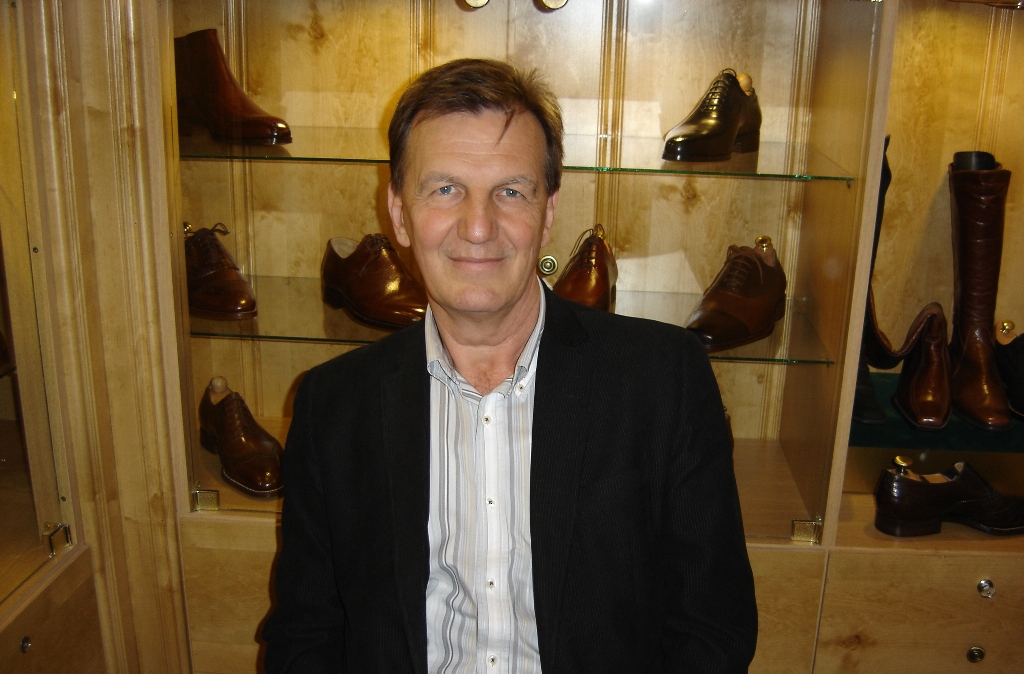
I made classic shoes from the beginning, but I started the Rozsnyai brand with top-quality materials and finishing about 10 years ago. We still produce the traditional, classic models, complemented with more modern and exotic leather ones. I have always wanted to make timeless shoes that are wearable anytime. I’ve gathered my knowledge first through my family, later in school, and got the highest available degree in the Hungarian shoe industry. Our models are a little bit mixed: besides the traditional, classic, well-known models, we produce many pointed italian styles, modern pairs and special leather shoes. With Rozsnyai, classic meets contemporary. I am a maximalist: the pursuit of perfection motivates me.
In our shop the customer isn’t restricted to the display models, we also make MTM and bespoke shoes. You can come in from the street with a prior shoe or a drawing, with an idea, and we make it reality. Instead of well-known shoemakers, we don’t make shoes in bulk amounts; we have preserved the guild-like company form, so we can pay as much attention to every pair of shoes as they require. Our shoes are not just nice, they are comfortable as well. We also produce orthopedic shoes, all made to measure, so we have a lot of experience making shoes for all kinds of feet. We know what’s good and healthy for them. I always wear our own footwear, my style is a bit sporty with an elegant manner. I’m not a brand-dependant man, but I enjoy quality and comfort. I also like gardening and spend as much time with my grandchildren as I can.
Most people don’t know why truly handmade shoes are special. They think the handcraft makes them more valuable, but it’s just a part of the truth. These kinds of shoes are made from the finest quality materials, so they will be much more durable than any other shoes. The handsewing of the sole guarantees that it will never come off, even if some stitches break. All of the stitches live their own life, contrarily to machine-sewn shoes, where, if a stitch breaks, you can pull out the whole yarn. With leather soles and handsewing, the foot gets more air, so it won’t sweat as much as in rubber soles. The custom innersole made to your feet provides the healthiest walk possible.”
http://www.rozsnyaishoes.com/index.php/en/
Picture: © Rozsnyai
Category Cordwainers, Interviews
Well-striped
0June 5, 2013 by Ville Raivio
Today’s inspiration: brown suit with red pinstripes, brown derbies, sky-blue gingham shirt, navy grenadine tie, botanical ‘kerchief.
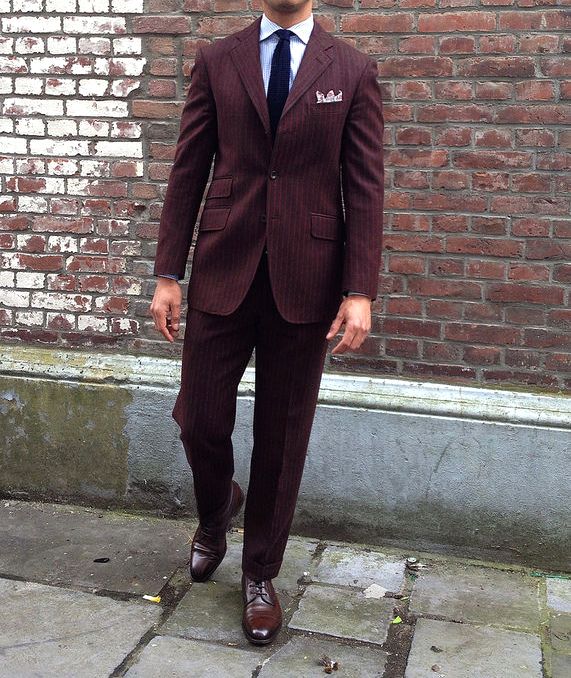
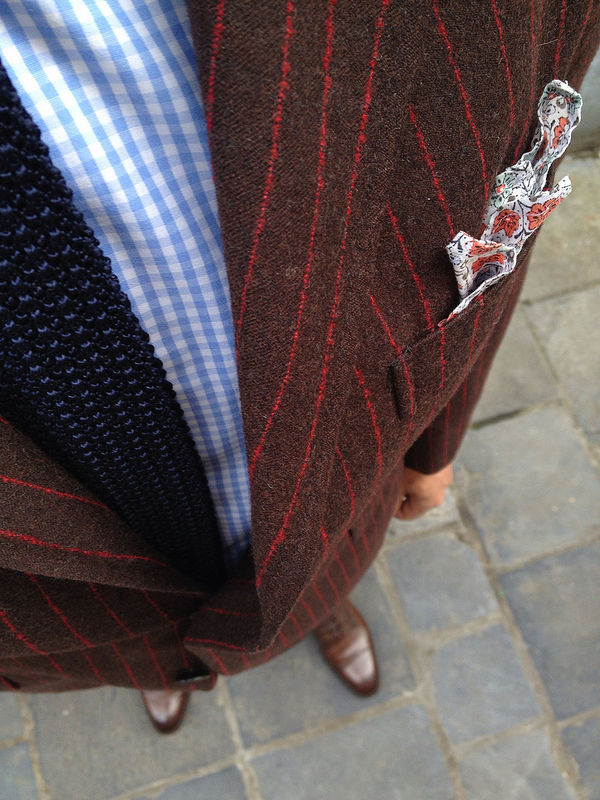
Pictures: © Crat
Category Inspiration
Peal&Co. Shoes in 1959
0June 4, 2013 by Ville Raivio
Around a half an hour’s worth of rare footage inside the once-renowned, long since-gone Peal&Co. shoe factory, shot in 1959. The original sound has been removed, but the reader may indulge in the roaring commentary offered by members of the Peal family.
Category Northampton, Videos, Vintage
Copyright © 2013 Ville Raivio