Interview with Yosel Tiefenbrun
1September 1, 2013 by Ville Raivio
VR: Your age and occupation?
YT: I am 24 years old and a Religious Orthodox Rabbi and apprentice Tailor at Maurice Sedwell, Savile Row.
VR: Your educational background?
YT: I was born in Brooklyn and raised in London, I went to private Jewish schools till the age of 16 when I left home to study in Brunoy, a lovely, quiet city in the south-eastern suburbs of Paris, where I continued my studies for a year. One year was enough for me, it was a little too quiet so I moved on to study in Israel for 2 years and then to Brooklyn, New York, back to where it all started for my final year of what we call Yeshiva. From there I went to volunteer work for the Jewish community in Singapore for 2 years. I met many people from many walks of life from whom I learned a tremendous amount. My work included Organizing festival events, teens and student activity, giving classes, Koshering hotel kitchens for community functions and much, much more. Over the 2 years I continued my rabbinical studies and was ordained as a Rabbi along with my peers. Singapore for me is home away from home; I admire the fascinating people and cherish the years I spent there.
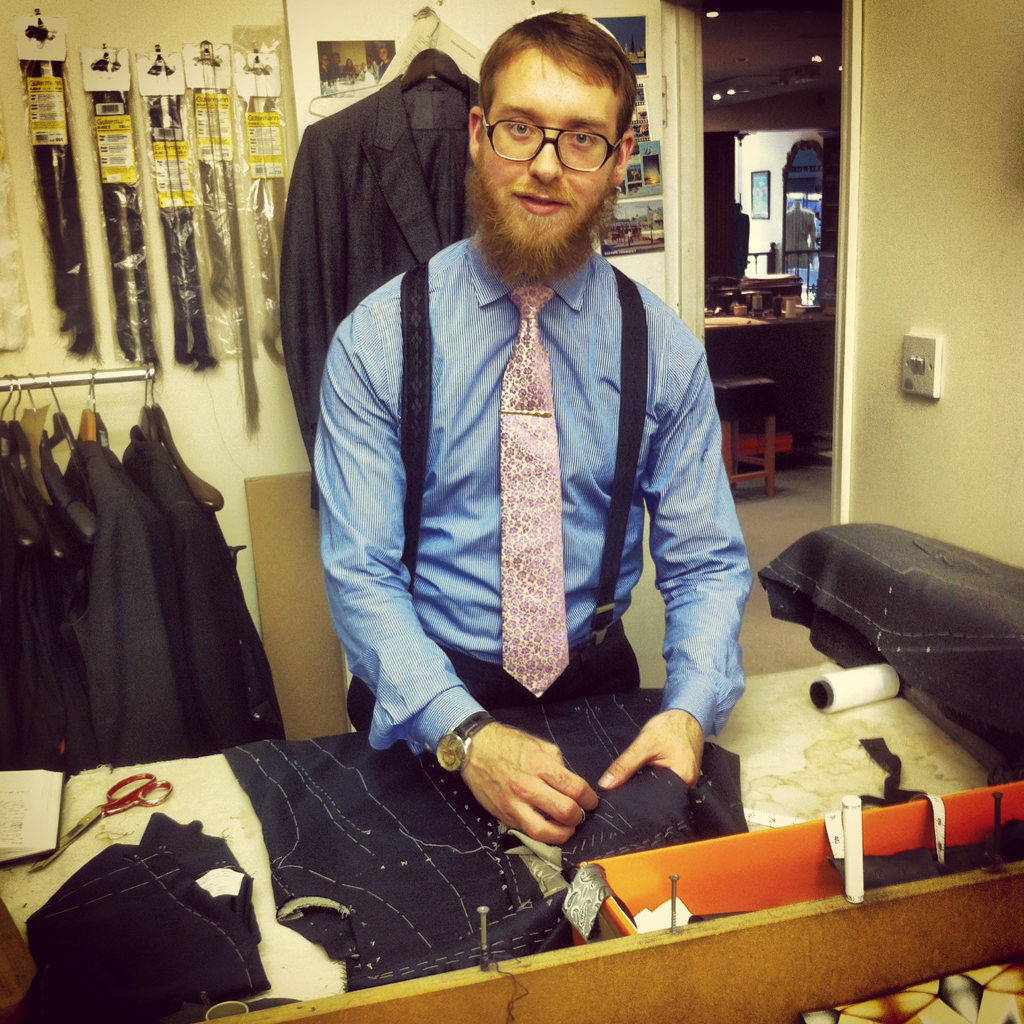 At the Maurice Sedwell premises
VR: Have you any children or spouse (and how do they relate to your style enthusiasm)?
YT: I am single.
VR: …and your parents and siblings’ reactions back when you were younger?
YT: I am the oldest of a very talented artistic family. As a child I was always very particular with what I wore, growing up in a religious home we would obviously go to synagogue every Saturday and all the holidays. It’s very important when we pray to the master of the universe to dress as though we are standing in front of a king, not just a king but the king of all kings. Therefore dressing well and looking your best was always encouraged and should always be that way.
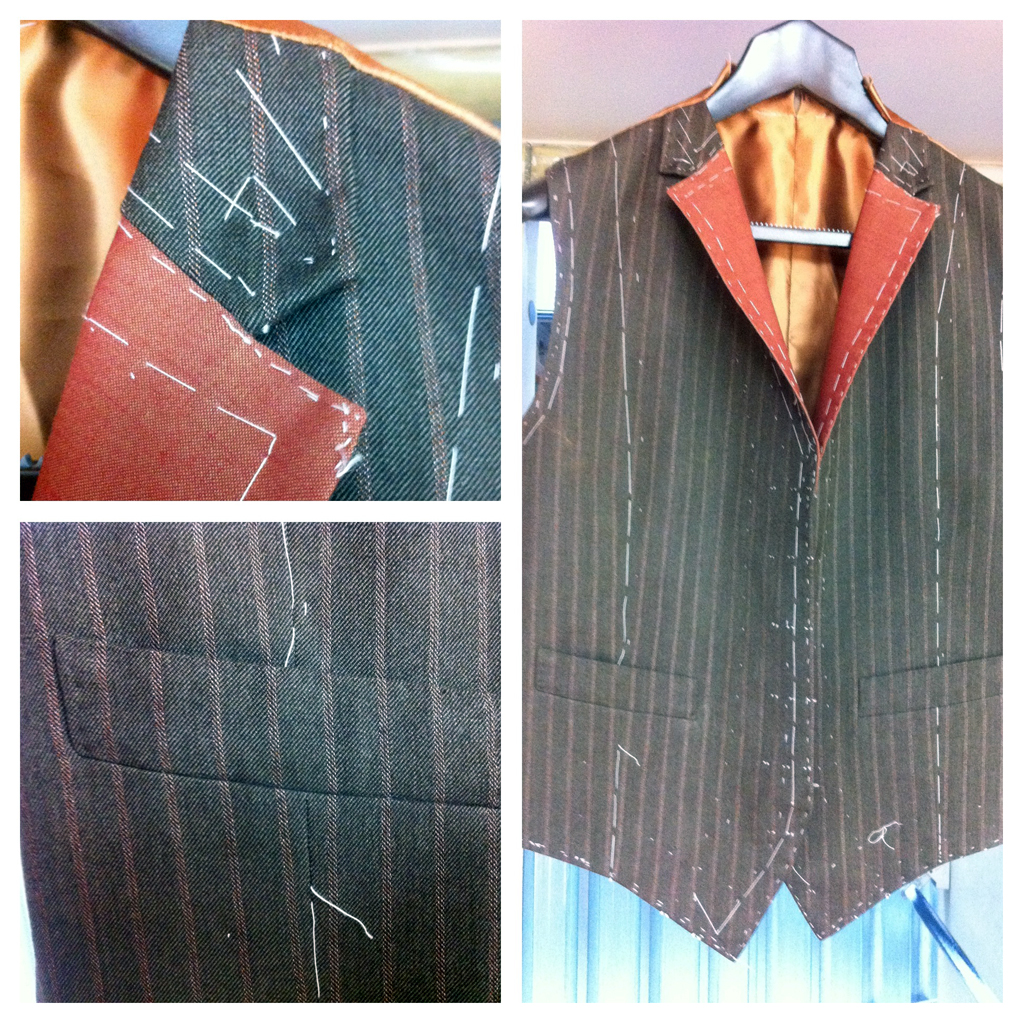 Waistcoat management business
VR: What other hobbies or passions do you have besides apparel?
YT: I like drawing and photography but they both come to me at certain times, I can’t decide whether tomorrow I’m drawing or taking pictures. I love traveling, I like to see the way other people live and get inspired. I spent a little while in Bali; I will never forget the smile on the faces of one family, a mother and 4 children, all on one motorbike, it was obvious they didn’t have much but at the same time they had everything. I like a good game of tennis, too.
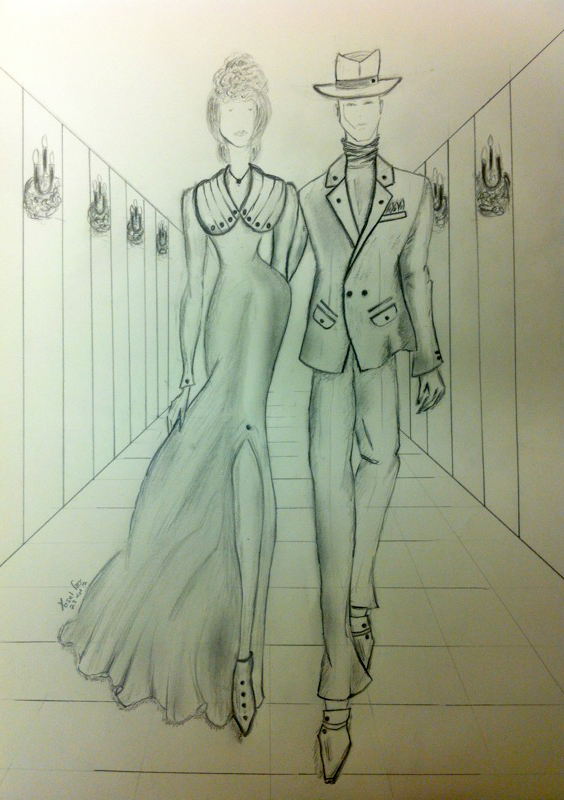 Illustration from pre-academy days
VR: How did you first become interested in clothing, and when did you turn your eyes to more or less tailored pieces? Why classics instead of fashion?
YT: While in Singapore I took night classes at Nanyang Academy of Fine Arts, studying interior design. I always wanted to design and create my own clothes and eventually have my own company from very young, but I never knew how. Being religious would mean going to synagogue every (Shabbat) Saturday, my mother would buy me suits from the age of 6 – 7 but I think I really started being a little fussy from 11 years old on. I loved my suits and I would try to convince my mother to get me a new one twice a year; one for the high holidays and then one in April for Passover. I was very careful and always took great care of them; in fact I’m sure that if I went digging, I would find them still in good condition. I remember that I would never dare play in my suit, in fact I would change when I came home so it wouldn’t get dirty or overly used. I Remember I was a perfectionist with whatever I wore and how it was kept up.
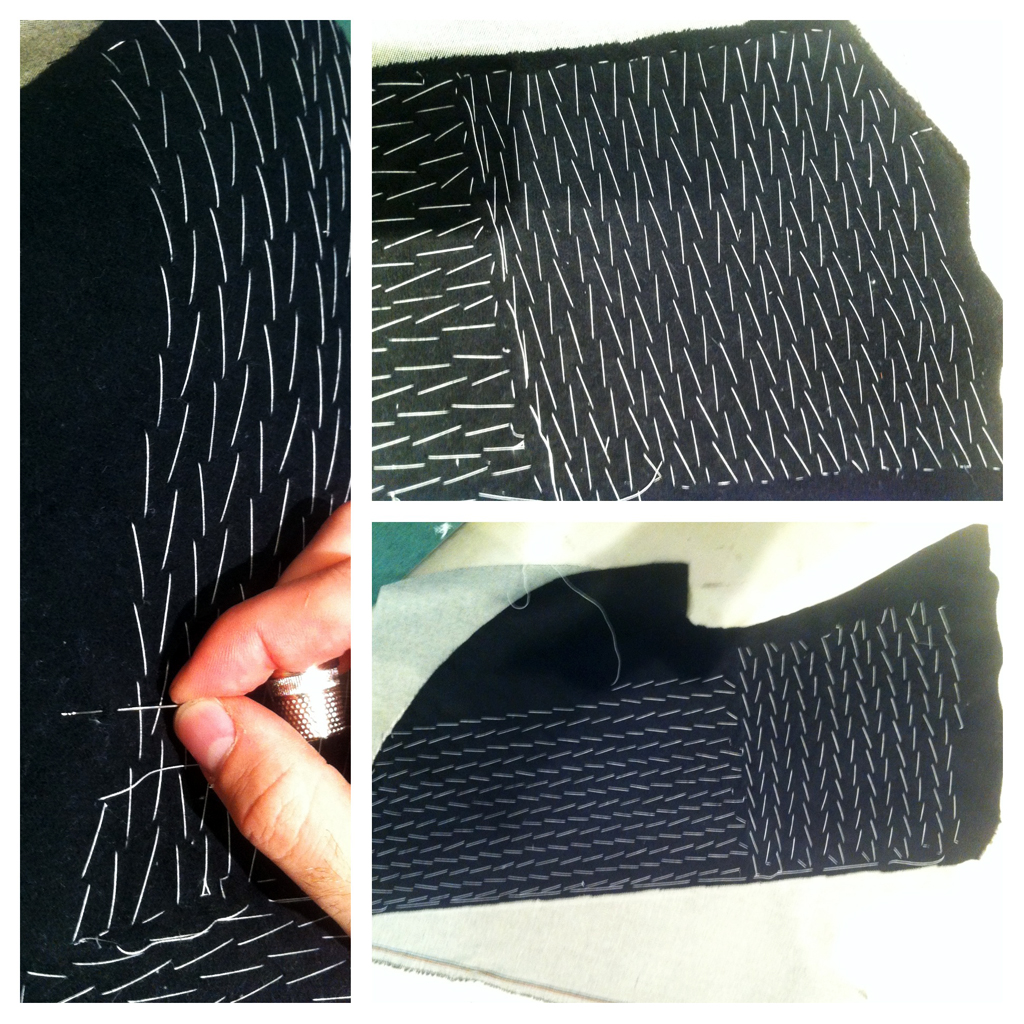 Hand-padded lapels
Being religious, the fashion world is not a industry one is encouraged to pursue, so I thought that perhaps interior design would be good for me since I always liked interior design and furniture. I applied to NAFA Singapore, I had a great time, learned a lot about prospective drawing, technical drawing, layout planning, etc. I also had a module on Furniture design which was my favourite. We had to design a rocking chair out of wood. Using all the machines was pretty scary but the hand work, the carving really stayed with me, I appreciated it very much. Unlike most others, I created something so different that I still plan to bring it out in the future. I realized I was bringing fashion into my drawings on interior projects, so after I finished I decided to apply for some basic modules on fashion illustration and from there my aspiration grew. I would go to some of the shows, particularly Raoul, went to exhibitions, including a beautiful one by Valentino, a designer I admire very much. Over the summer of 2011, my last few months in Singapore, I had the opportunity to intern at Harpers Bazaar for the editor Giselle Go, now Editor in Chief of Style Magazine Singapore. I worked on the men’s shoots and the menswear report for the magazine amongst other jobs. I always liked the quality and beautiful artwork in high-end clothing, in women’s wear I appreciate couture more. I have always been into classics. When I returned to London, I chose to go to Savile Row over fashion schools to peruse my career. I wanted to learn the craft from ground up and from there my passion for men’s tailoring grew and grows every day.
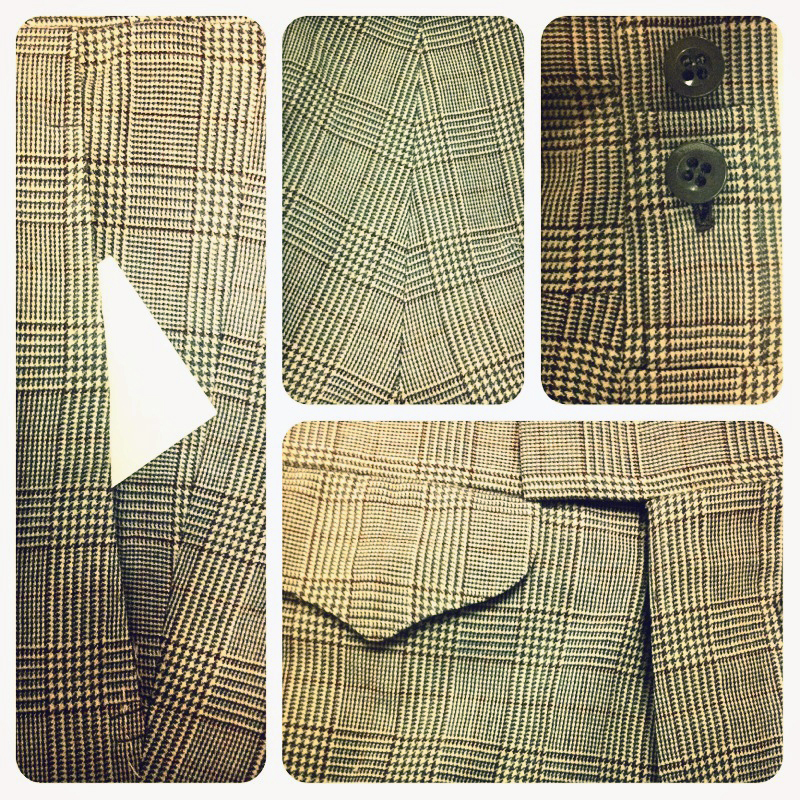 Glen plaid pattern matching
VR: How have you gathered your knowledge of apparel and tailoring — from books, in-house training, workshops or somewhere else?
YT: My knowledge of tailoring came from books and mostly from in house training. I used to open pattern books but close them after getting lost straight away. Only after I learned pattern cutting at the Savile Row Academy, I now understand what’s going on. I think when it comes to a craft like tailoring, it takes years of in house training. Besides the actual stitching, you get to feel all the different types of cloth. When you do alterations, you see the different ways of making too.
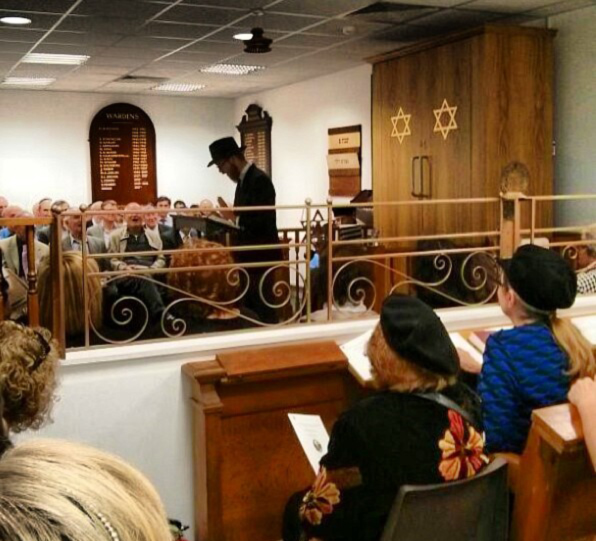 At the local synagogue
VR: How would you describe your own dress? Have you any particular style or cut philosophy?
YT: My style is classic and elegant with my own personal edge, I like to push boundaries with my own creativity wether it’s with colour or a cut. For me, it’s about confidence and expressing one’s image. I change my looks, always creating new combinations for whatever I think works at the time.
VR: Apart from the pieces you’ve made for yourself, which RTW makers or tailors do you favour?
YT: Recently I have been going to vintage stores; I really prefer it since it’s not a collection from a designer as in a regular store, it’s a collection of designers, tailors, people with their own imagination which might be really interesting. I enjoy finding something special amongst the rest; you walk out feeling like you made a real find. My wardrobe contains a real mix, like an interesting tweed suit from Jil Sander, Calvin Klein, a few from Ted Baker, some other brands and many vintage pieces. As my wardrobe grows from clothes I am making, I find myself buying cloth rather than shopping for clothes.
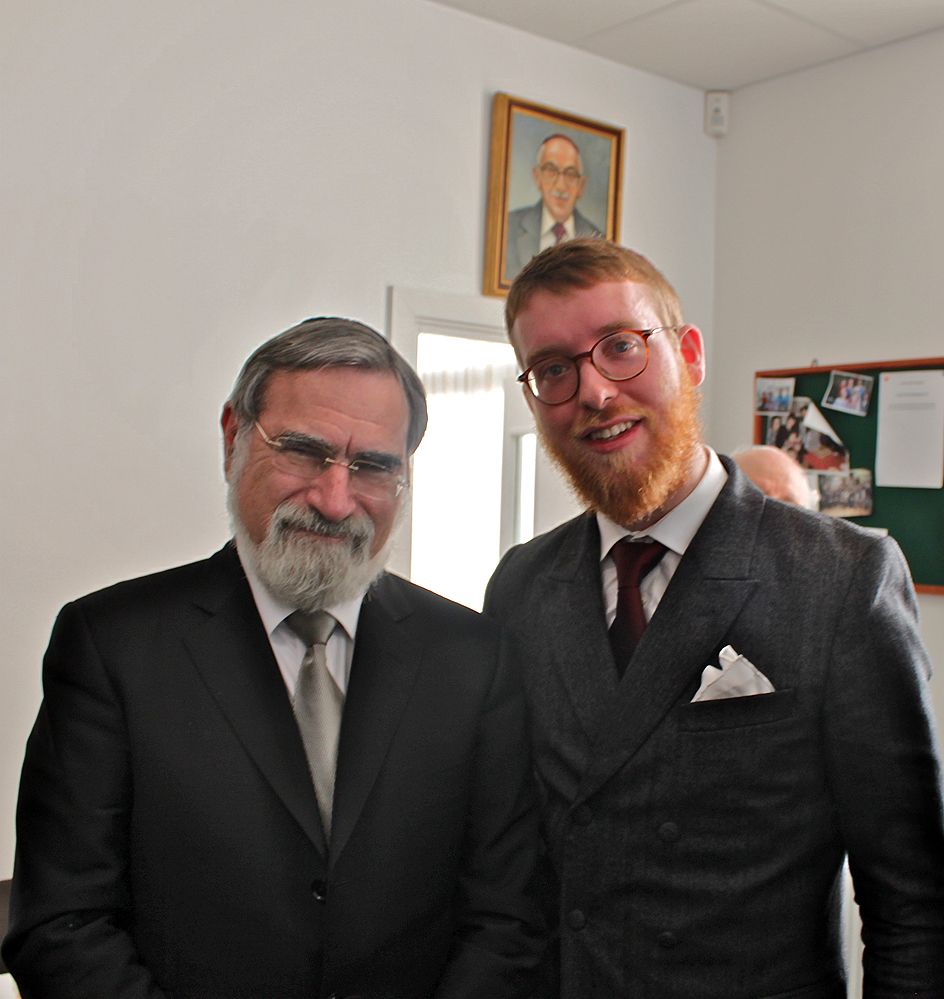 With Jonathan Sacks, Chief Rabbi of the United Hebrew Congregations of
the Commonwealth
VR: How did you end up apprenticing at Maurice Sedwell? Should my readers expect The House of Tiefenbrun one day?
YT: I first stopped by Maurice Sedwell when I returned from Singapore in the end of 2011 and went to all the different houses on Savile Row, asking if they took apprentices and how to go forward with my passion for tailoring. I applied to Newham College as there wasn’t a fee. I figured this will give me a great opening and that I’ll be there for the next 3 years, but as the first course came near to its end I figured that if I want to have the best skills and get into the industry quicker, I should apply to the Savile Row Academy, which I did. I got accepted by Andrew Ramroop, the Professor at the Academy and Head Tailor at Maurice Sedwell. I was wondering how I would pay, when a friend asked if I would join him to work in a winery in upstate NY, which would make a good amount of money. I took the job, causing me to join the academy late, but I was able to catch up and after 3 – 4 weeks I was called in and asked if I wanted to work as an apprentice at front shop — and of course I said yes.
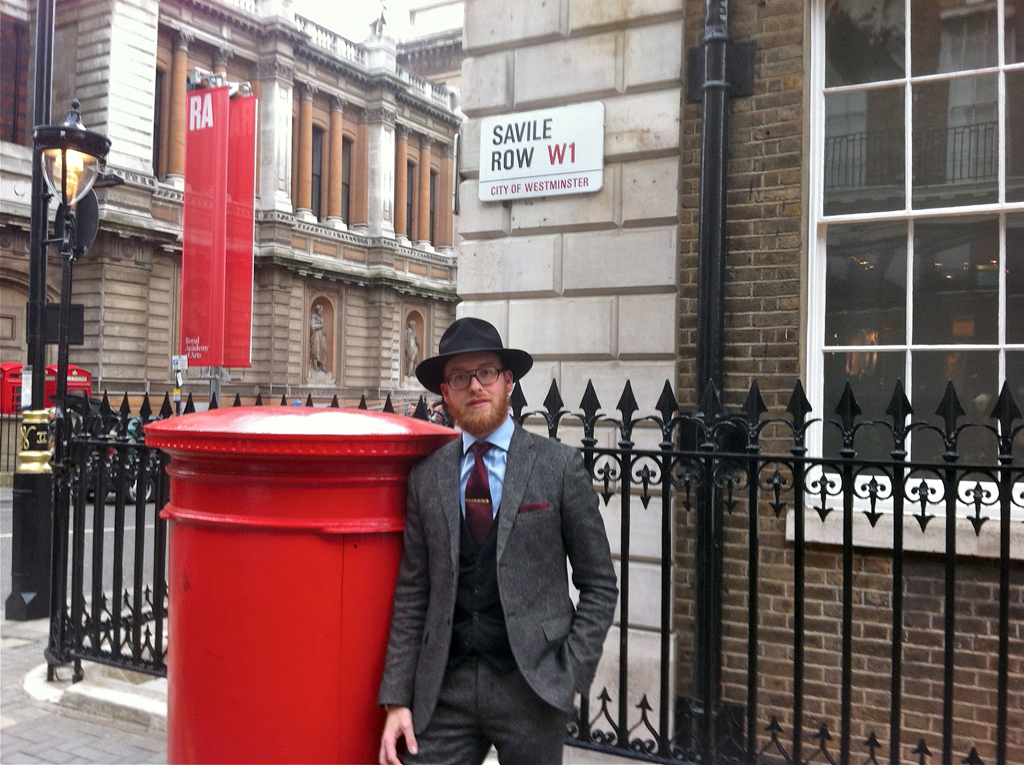
VR: There are dozens of tailors in London alone — why should my readers try Sedwell?
YT: What’s beautiful about walking in to Maurice Sedwell is that one is greeted by a tailor who understands the making of a suit, the cutting and fitting, not a salesman who is trying to push a sale. We focus on personal style, allowing the customer to be creative and innovative while obtaining the most traditionally made suit. This means that we don’t cut any corners in the making as many do today on the Row, everything’s fully Handmade Bespoke to the highest standard, all made on premises by the most skilled tailors with the guidance and direction of Master Tailor Andrew Ramroop.
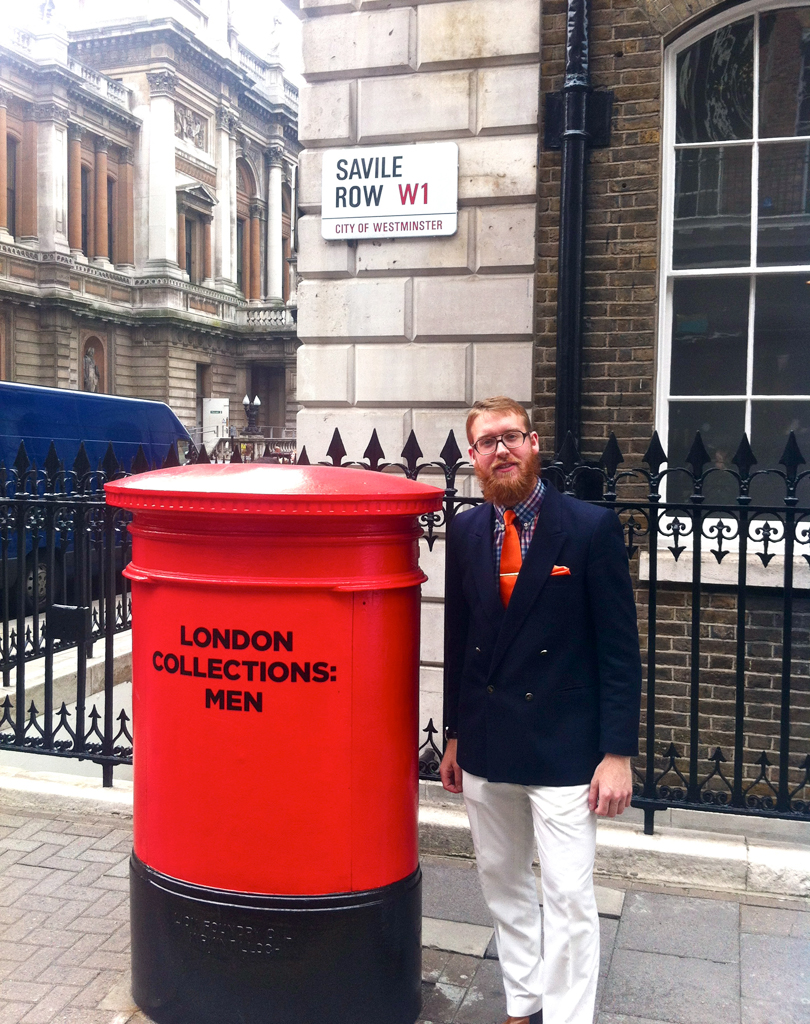
VR: I’ve developed an interest to Judaism over the past year as the accomplishments of your people are, frankly, awe-inspiring. I’ve also taken a look at the many garments, hats and clothes worn by different movements around the world. Dress codes are particular in many settings. Would you say that the average Jewish man is very aware of appearances and the language of clothes? Where would one find the most classically tailored Jewish men?
YT: The Jewish men, especially in the religious Hassidic communities, have particular dress codes, some wear Borsalinos and long coats on the Sabbath, some wear fur hats with beautiful patterned coats, mostly black, but a lot of fine details and different cuts. Within one ultra-religious community you can find many different sects that will dress differently, depending on their origin from either Europe, Russia or even the Sephardic from Spain and Middle East. Judaism has always encouraged wearing beautiful clothing. In fact, clothes represent honor and beauty as one of our great masters in the Talmud (Shabbat, 113a), Rabbi Jochanan, called his clothes ‘my honorers’ (as per the verse in Exodus 28:2: ‘you shall make holy garments for your brother Aaron, for honor and beauty.’) One should treat his clothes with great respect as another great master in the Talmud, (Berachot 62b) Rabbi Yossi, the son of Rabbi Chanina, said: ‘Whoever debases clothing, in the end will not derive benefit from them.’ Because David cut off the corner of Saul’s garment (see I Samual, ch. 24), therefore it came to pass that when ‘King David grew old, and came along in days; they covered him with clothes, but he was not warmed.’ (I Kings 1:1). As for the most stylish Jewish men, it’s difficult to say but I would think they’re either in Brooklyn, NY, or London.
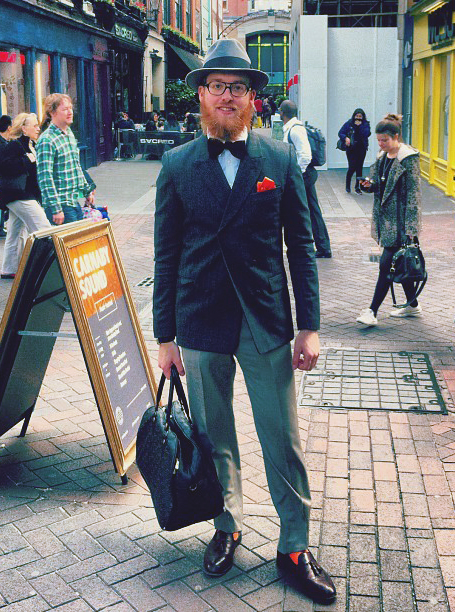
VR: What’s your definition of style?
YT: Style is the way you represent yourself. It’s important to find your comfortable area of clothing; if you are more of the casual type, work within your zone and express your individuality rather than copying someone else’s complete look from a magazine. Your clothing should flow in harmony with your body, it should enhance your image.
VR: Who or what inspires you?
YT: I take inspiration from the great people in my life I have met over so far. My grandfather, who is a mentor to me, great designers as well as beautiful destinations. Perhaps the core inspiration for me in my life is the great leader Rabbi Menachem Mendel Schneerson, who inspired many to live a modest life staying strong to our values, loving mankind. Being a ‘Mentch,’ an elegant person all around.
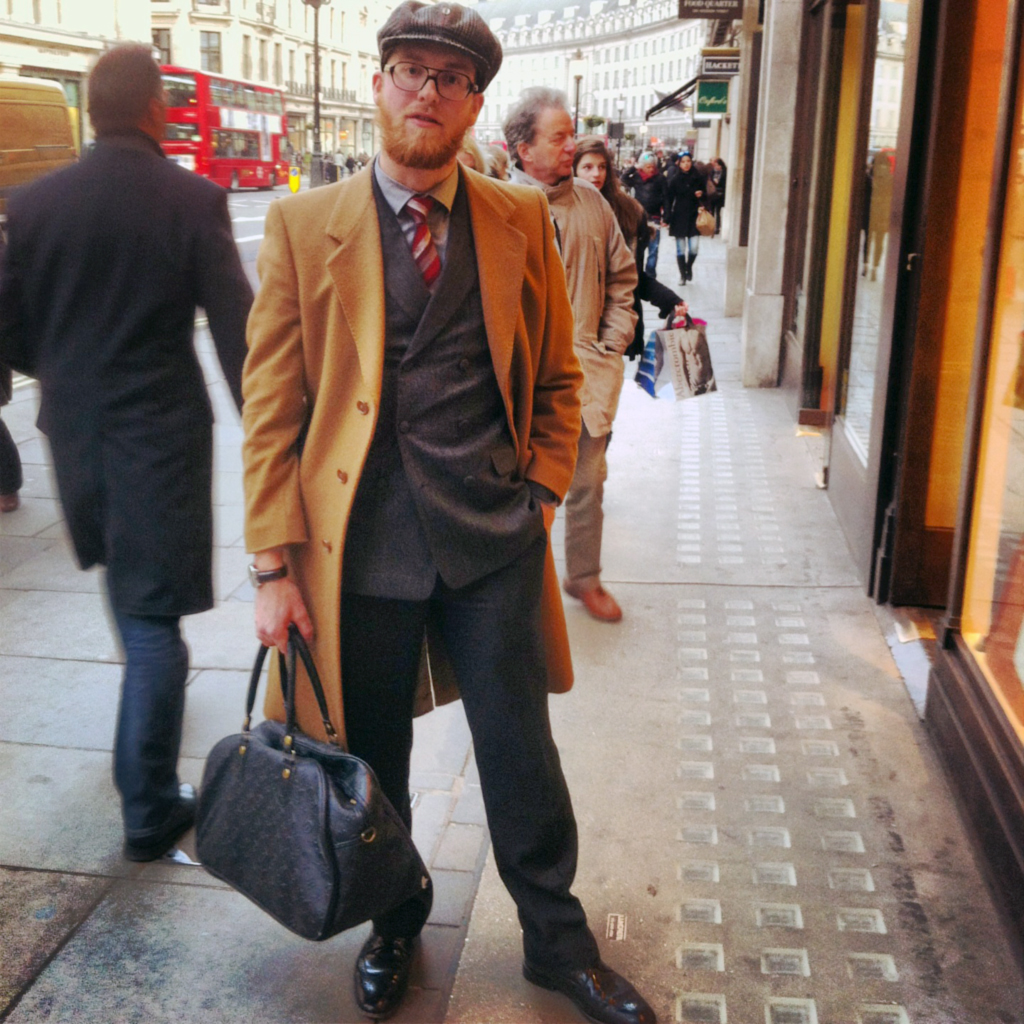
VR: Over the years you must have learned quite a bit about style. Is there something you wish more men would know? This is a great opportunity to make a lasting influence on my younger readers. Most of us aren’t blessed with rakish relatives, which makes learning about style a challenge later in life and yet another trait men are supposed to master. All tips and thoughts are valuable.
YT: Many people tell me ‘That’s a great look, but I would never be able to pull that off.’ My answer to them is; yes, it looks great on him but that’s because of many reasons. Look deeper, why is it that it looks so great on him — is it the cut of the jacket? The style of the pockets or the colour theme, the accessories? Get inspiration from people in real life rather then just magazines. These people can be your friends or strangers on the street, on the train, at the café, and see why it looks so great on them. It’s written in the chapters of our fathers, ‘Who is wise? One who learns from all people.’ I recommend being open to being inspired and letting it have an affect on you for the positive.
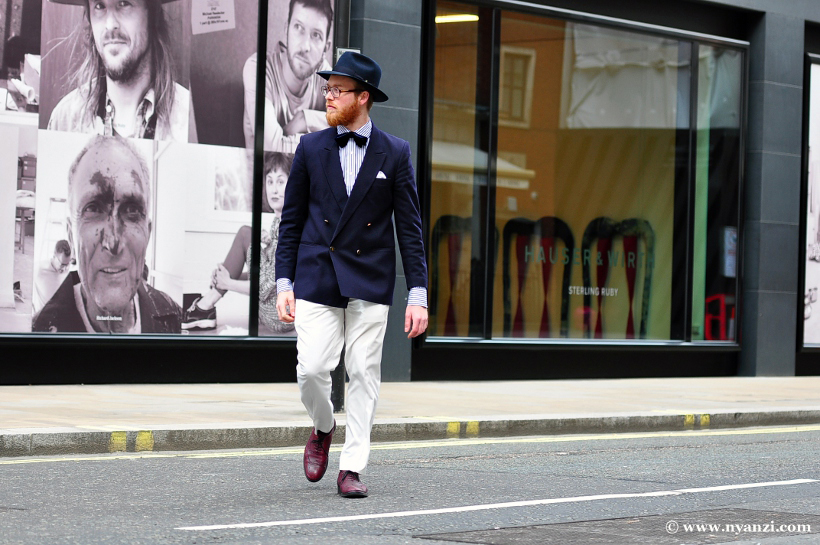
https://twitter.com/RabbiTailor/
Pictures: © Yosel Tiefenbrun, David Nyanzi
Category Interviews, Men of style, Savile Row, Tailors
Depiedencap Shoe Dissections
1September 1, 2013 by Ville Raivio
Shoe lore: the fine French shoe forum, Depiedencap, has dissected several pairs from different makers of repute a few years ago. The findings give most for the man with some knowledge of the French language, the rest of us will have to make due with Google’s translation services. Officina Patina, Edward Green, J.M. Weston, Markowski, Grenson, Septième Largeur, Alfred Sargent, Carlos Santos and Loding are among this helpful collection of footwear taken apart for the full monty. More examples can be found at DPEC’s forum. The French, it seems, do love their shoes.
Interview with Diana Chan and Gerald Shen from Vanda Fine Clothing
0August 28, 2013 by Ville Raivio
VR: Your age and occupation?
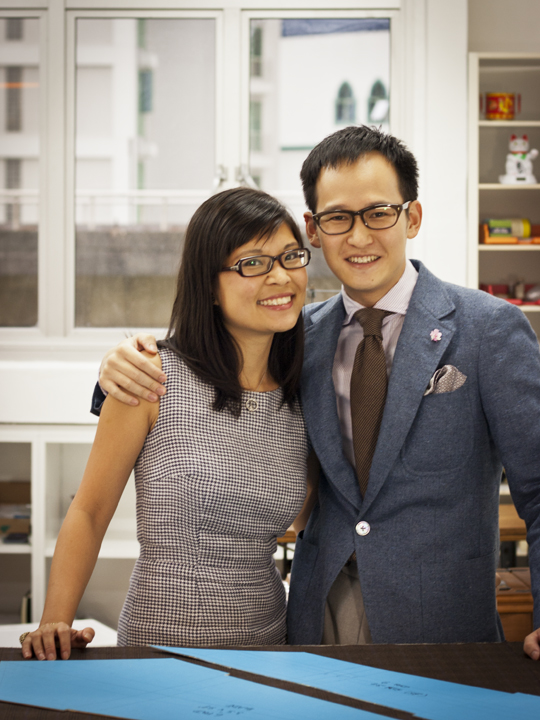
D&G: We are both 27 years old and under our label Vanda Fine Clothing, we sew neckties, pocket squares and soon, shirts for a living.
VR: Your educational background?
Gerald: Double Degree in Economics and Business Management (Finance).
Diana: Degree in Business (Marketing).
What hobbies or passions do you have have besides sewing and apparel?
Gerald: Like every good Singaporean, I enjoy eating tremendously, and I’m often cooking/baking when I’m not making clothes.
Diana: I enjoy sewing clothing for myself, practicing yoga, and learning new languages (I am now learning Japanese).
VR: Have you any children or spouse (and how do they relate to your style enthusiasm)?
…and your parents and siblings’ reactions back when you were younger?
Gerald: I’ve always been interested in clothes, so I don’t think it came as a terrible shock to anyone that I got deeply interested in classic menswear. My father is a businessman as well, so he’s been very supportive of me following my dreams to start Vanda Fine Clothing.
Diana: My family has always been very supportive of me pursuing my interests, and building Vanda Fine Clothing was no different — after all, they get to have new clothing articles every now and then!
VR: How did you first become interested in clothing, and when did you turn your eyes towards classic goods? Why classics instead of fashion?
Gerald: I’ve always had a tendency to get deeply obsessed with things I was interested in. My first interest in clothing was actually in streetwear, and in particular Japanese raw denim. When I enrolled in business school, I started to pay more attention to classic menswear, and it didn’t take long for me to be sucked in to the magical world of menswear.
Diana: My interest lies in the ability to use various materials to create items (not confined to clothing) that I would be happy to own. Since I was schooled in a convent school, my alma mater’s motto, “Simple in Virtue, Steadfast in Duty,” has been imbued into me. My parents are also simple folks, and reinforced that one does not need to be extravagant to lead a happy life. So I guess this has translated into the clothes that I wear and my take on life.
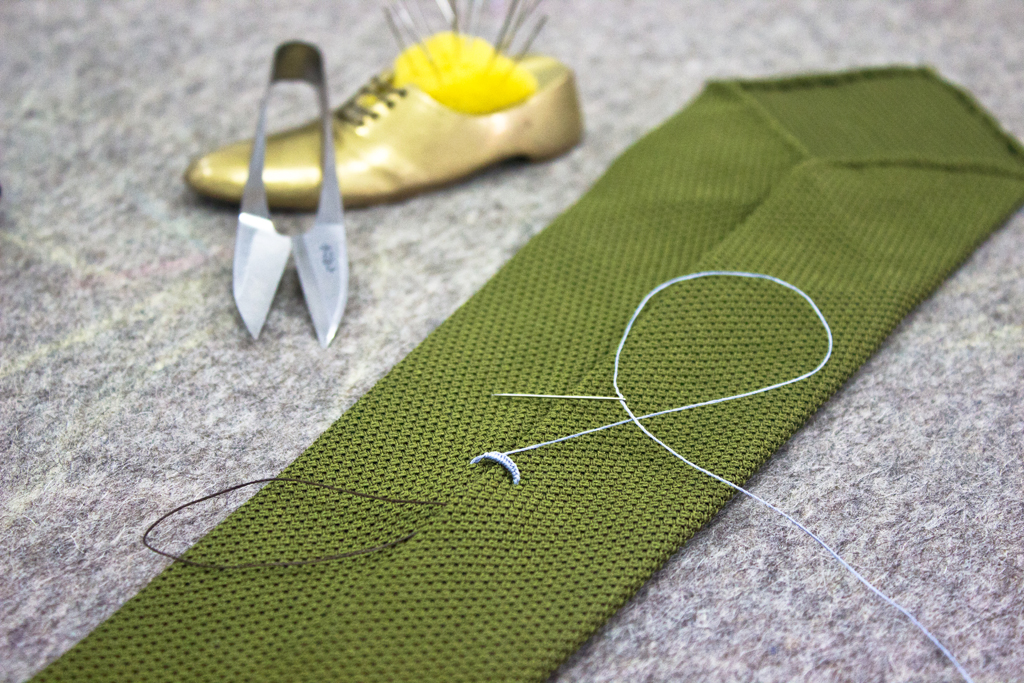
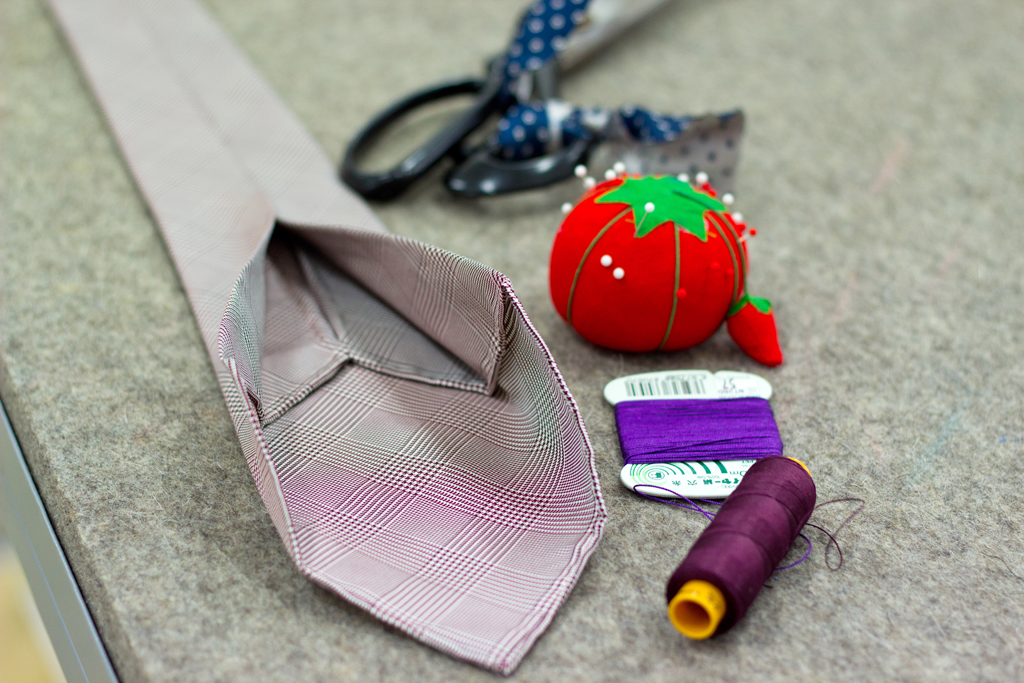 Unlined six-fold construction
VR: How have you gathered your knowledge of apparel and tailoring — from books, in-house training, workshops or somewhere else?
Diana: Since my younger days I have enjoyed taking apart clothes my mom would buy for me, and figuring out how clothes were put together. When Gerald asked me to make a pocket square for him about 5 years ago, I examined his old squares and through trial and error figured out how to hand-roll an edge. The first examples don’t look pretty, but I guess that says we’ve come quite a long way! When we started getting a backlog of pocket square orders from Styleforum, I was unable to handle all the sewing myself doing this and my full time job, so Gerald was given an ultimatum of either giving up the business or learning to sew — he chose the latter and hasn’t looked back since.
Gerald: A year after we started selling pocket squares, as a sort of challenge to ourselves, I wanted to see if we could make a tie. Very little information was available anywhere about tiemaking, so we essentially had to take apart many ties (in the process learning about dirty tricks of the trade) and reverse engineer the make. After literally dozens of failed experiments we finally made a tie I was happy enough to wear — and sell. In 2011, we started taking formal shirtmaking lessons under Mr Thomas Wong, a true artisan who is widely regarded as one of the best tailors in Singapore. His intense curiosity and drive to constantly improve his knowledge and skills despite his age (early 60s) are a constant source of inspiration to the both of us. Having him as a sifu (master) and mentor is one of the luckiest things that has happened to us.
VR: How would you describe your own dress? Have you any particular style or cut philosophy?
Gerald: I think my dress style is actually quite conservative with an occasional touch of fun, and that is reflected in the style of our range of conservative neckties and somewhat playful pocket squares. I enjoy simplicity, and prefer experimenting with texture more than crazy colour combinations. I prefer a soft and natural feel to clothing as it helps one look at ease with his clothes, and again, that’s reflected in our style of very lightly constructed neckties.
Diana: Colours lift my spirit, so I tend to wear many colours. These days, I dress simply in solids with the occasional headscarf just to add a pop of colour. Clothes with breathing room are also much preferred over snug clothing.
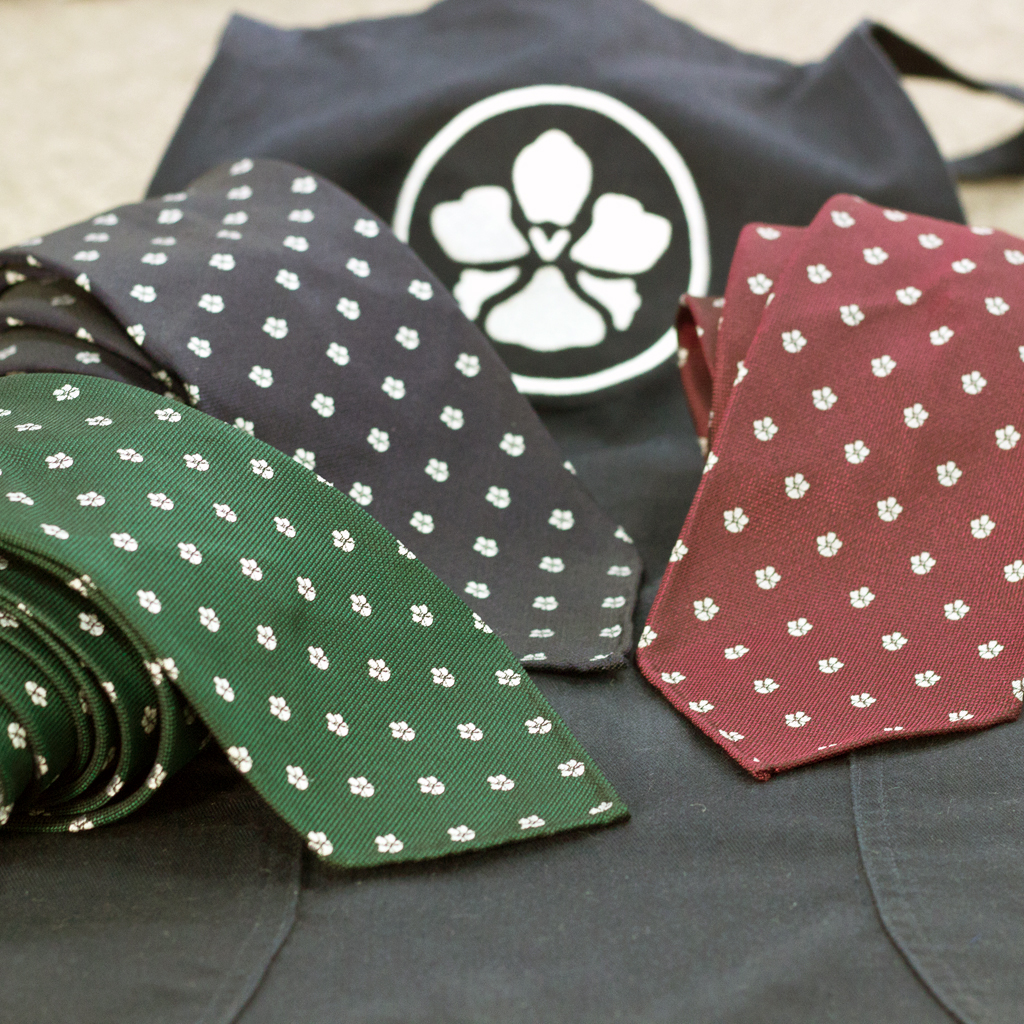 Vanda ‘Miss Joaquim’ orchid crest ties, the VFC signature model
VR: Apart from Vanda’s products, which RTW makers or tailors do you favour today?
G: Most of my clothing is made either by myself or custom made for me, so I haven’t paid attention to RTW clothing. For shoes, Vass is my preferred shoemaker as I enjoy their quality and simple styling, and I think they offer some of the greatest value shoes around. Nomos watches also appeal greatly to me as they have quite a similar philosophy of in-house production, direct distribution, elegant styling, and most importantly a good, honest product.
Diana: I prefer modest cut clothing, so the wrap dresses from Diane von Fürstenberg are always an inspiration for my dressmaking projects.
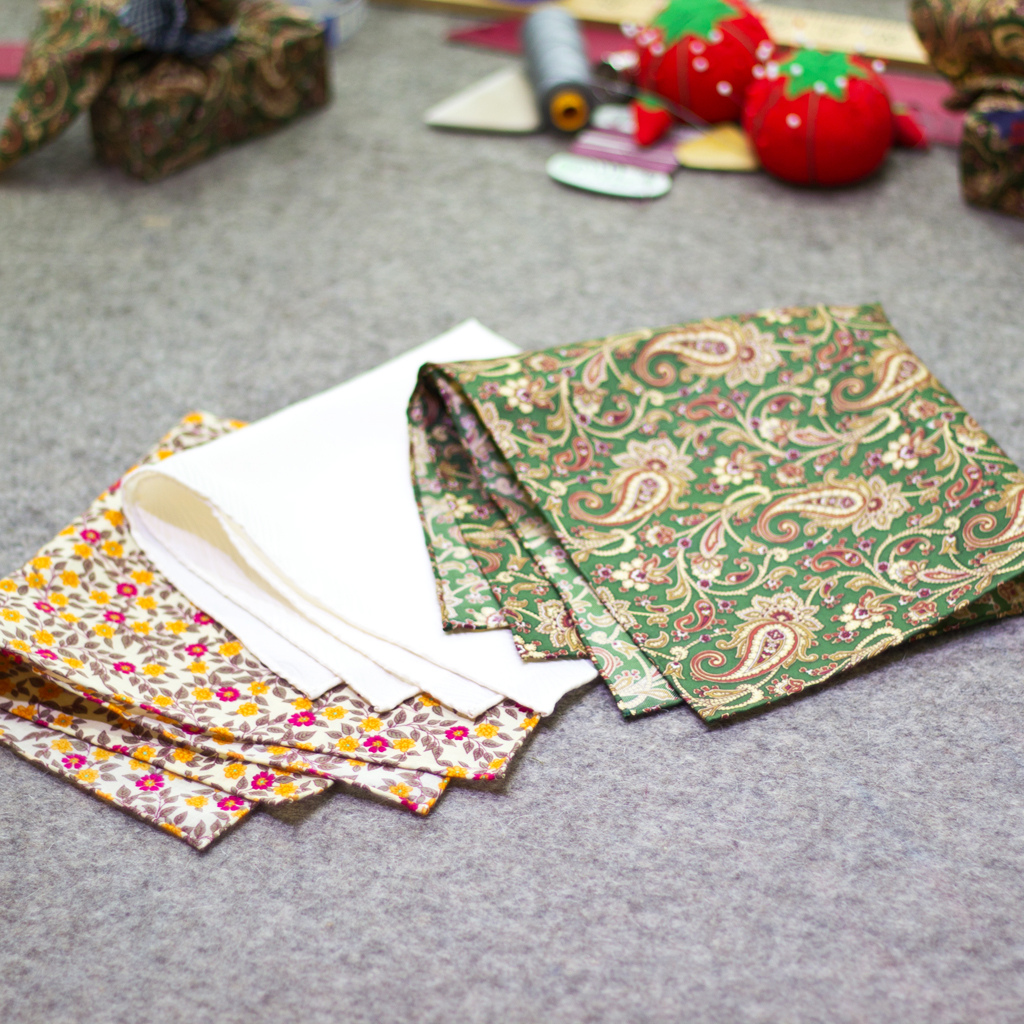 Vintage kimono silk handkerchiefs
VR: Please tell us how Vanda was born and what goals you set in the beginning. How have you been received so far?
Diana: Before we started Vanda Fine Clothing we had been selling handrolled kimono silk pocket squares on Styleforum. That venture was born out of Gerald’s desire to have some interestingly designed pocket squares that were well-made and honestly priced. However, the process of making and selling the pocket squares made us realize how much we enjoyed sitting down and focusing on crafting beautiful things with our hands, and that is why we decided to go into the business full time. So I guess you could say Vanda Fine Clothing was born out of a love for the craft. Our ultimate goal has always been rather simple – to craft our products the best that they can be, and to have our customers enjoy our products as much as we enjoy crafting them. To that end I think we have been rather successful. It always brings a smile to our faces when we get a note, or better yet, a handwritten letter air-mailed from an appreciative customer.
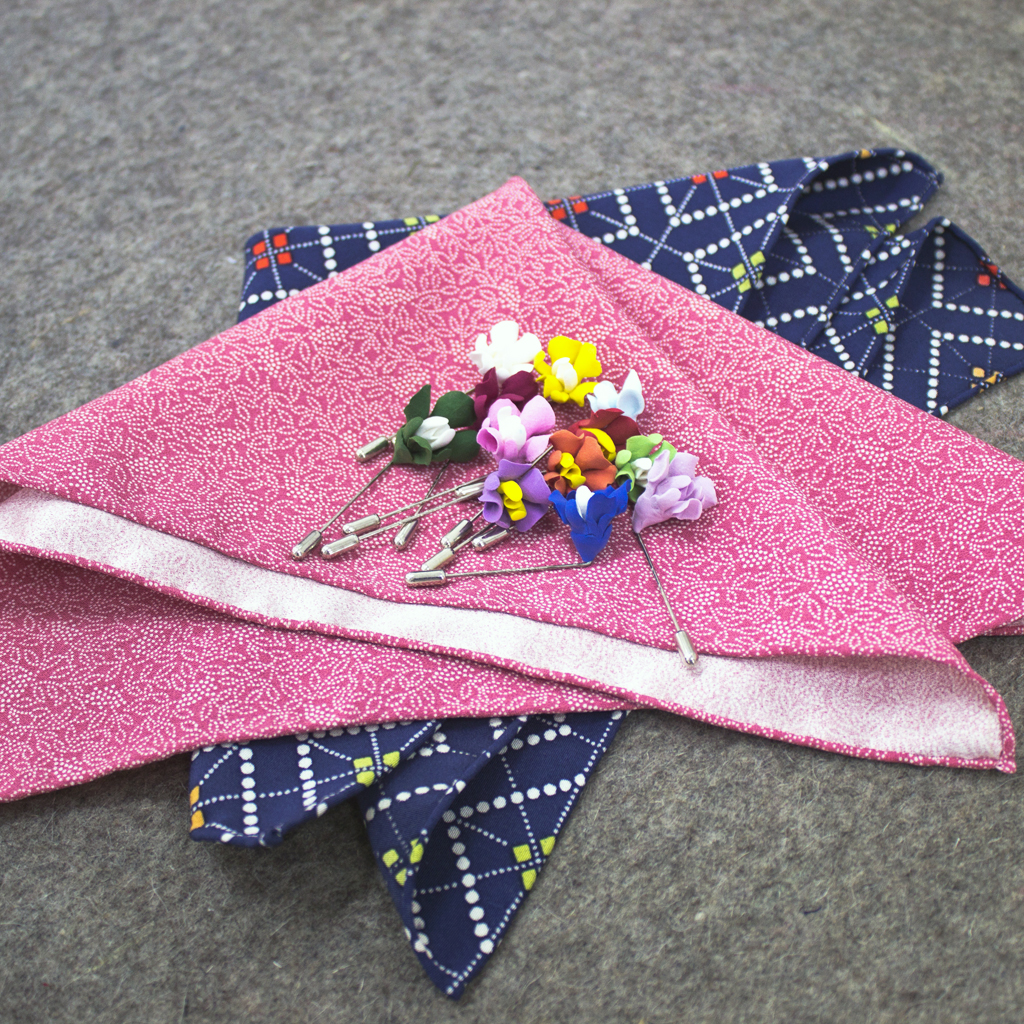 Japanese DECO clay lapel pins
VR: How have you two shared the business responsibilities?
Diana: We always ensure that we’re equally well versed with sewing, so the both of us can and do make everything we sell – shirts, ties, pocket squares, from start to finish. On a day to day basis though, while we’re both generally sewing orders, Gerald ends up doing more cutting work, and as the more OCD one, I tend to deal with the important administrative work such as custom orders, keeping track of inventory, etc.
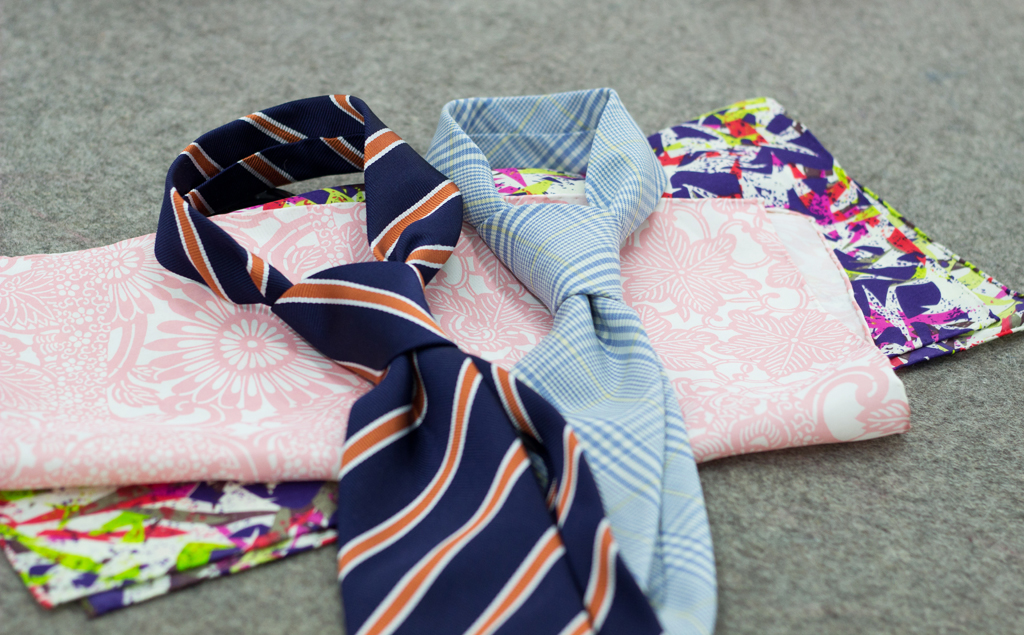
VR: There are hundreds of men’s accessory stores online — why should my readers try you?
VFC: There are so few independent manufacturers these days, which means that even when you buy neckwear from different brands, chances are they were mass-produced in the same factories. Conversely, there is only one Vanda Fine Clothing, where everything is made from scratch in-house. Every single product passes through our hands and eyes. As such, we believe we offer a product that is simply quite unique in both construction and styling. Finally, because we prefer to deal directly with our customers, we have eliminated the middleman markup that inflates prices. We have been often told by our clients that our products represent tremendous value for money, and simply put, we agree.
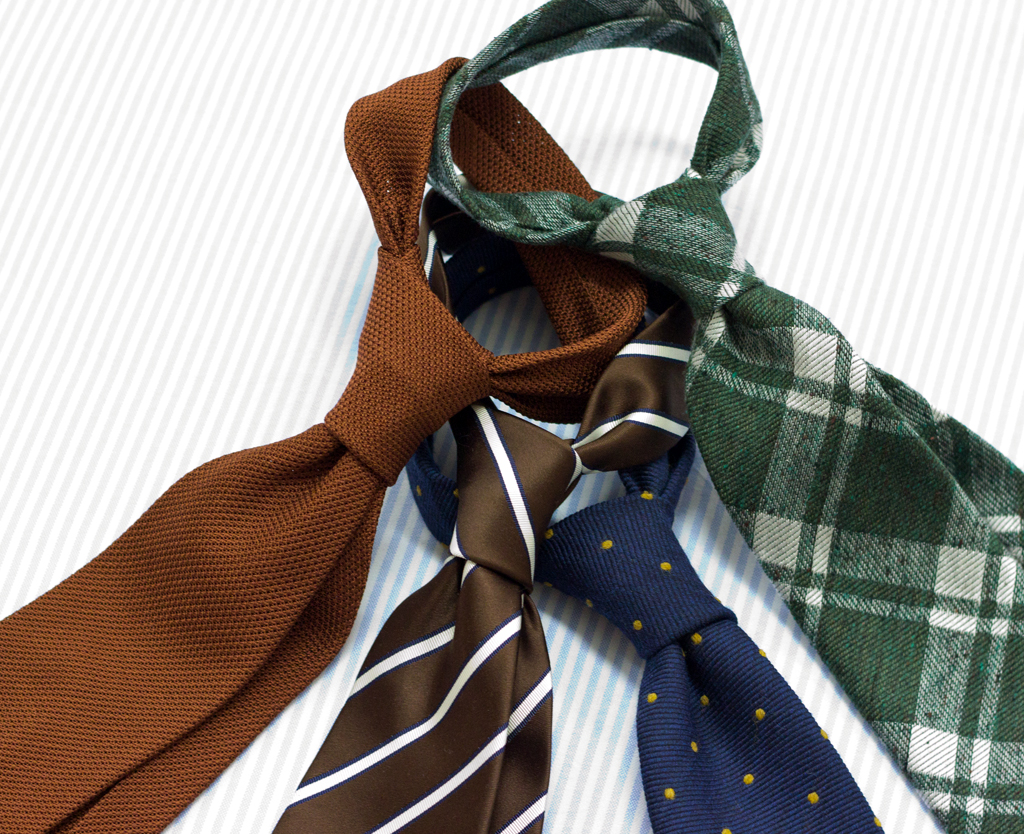
VR: What’s your definition of style?
Gerald: I think a man is stylish if he carries himself with confidence, dresses appropriately for the occasion and has a certain ease about things. Having a nice pocket square puff or dimple on your tie knot is great, but checking every three minutes in every reflective surface really shows a lack of confidence that puts me off.
Diana: A stylish person is always comfortable in his or her own clothes and skin. Clothes that do not make you feel good, cannot possibly make you look good.
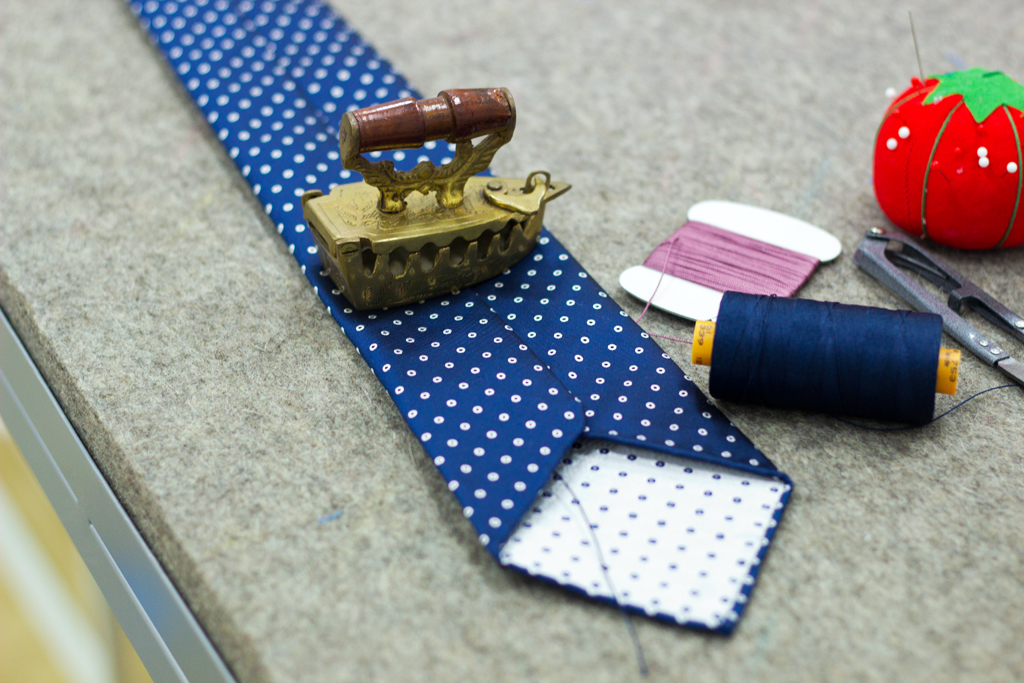
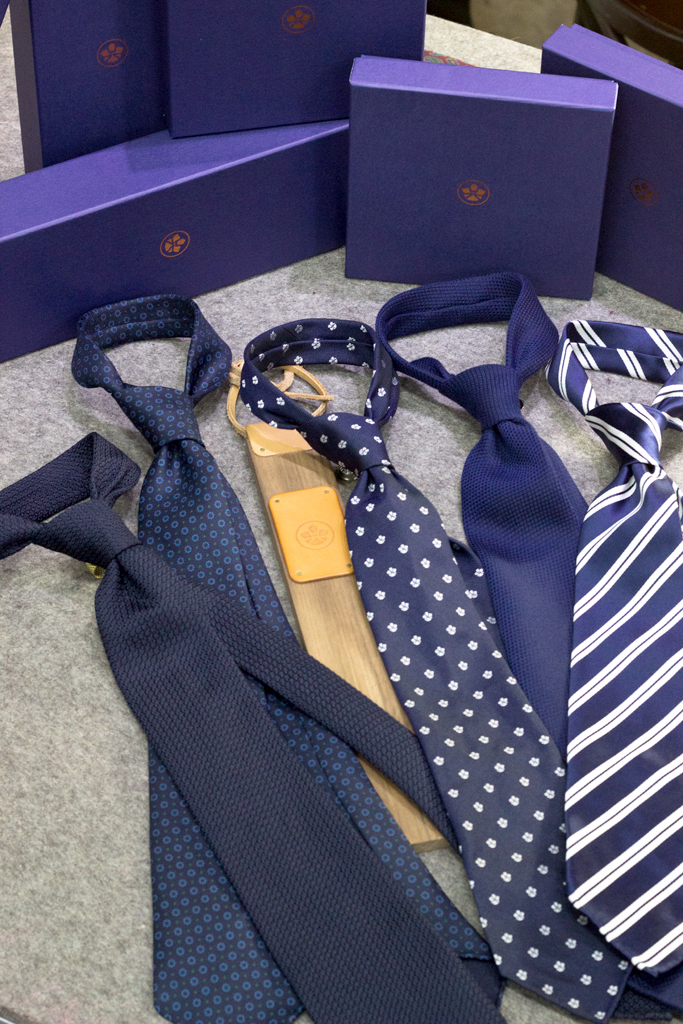 Navy ties, purple orchid boxes
VR: Over the years you must have learned quite a bit about neckties. Is there something you wish more men would know? This is a great opportunity to make a lasting influence on my younger readers. Most of us aren’t blessed with rakish relatives, which makes learning about style a challenge later in life and yet another trait men are supposed to master. All tips and thoughts are valuable.
VFC: While there are many excellent online sources of information on style and clothing, we think it is important to approach the subject in a less academic way than we’ve seen many do these days. When the opportunity presents itself to allow us to learn from someone more well-versed than us in any subject, listen with an open mind and you’ll find yourself learning far more than what strangers on the Internet can teach you. Focus less on magical numbers (3.5” lapels, 2” cuffs, etc.) and more on developing a sense of proportion, and a feel for what suits you.
Respect the rules but don’t take them too seriously, and finally, to quote a very stylish good friend, “wear without care.”
Pictures: © Vanda Fine Clothing
Category Interviews, Quality makers, Styleforum, Tradesmen, Web stores
Factory Tour at Grenson
0August 28, 2013 by Ville Raivio
Once again I’m forwarding the reader to Spitalfieldslife, whose Gentle Author visited Grenson’s in 2011. While the accompanying text does come with a whiff of bias, I don’t recall seeing too many tours at Grenson online and craftsmen are always more interesting than PR faces and marketing bull. The maker’s current website showcases new, high-grade lines with pleasing lasts and neat finishing and I have a feeling we may see some grand creations from the factory in the future.
http://spitalfieldslife.com/2011/10/19/at-grensons-shoe-factory/
Category Footwear, Links, Northampton
Interview with Fabio Attanasio from The Bespoke Dudes
0August 27, 2013 by Ville Raivio
VR: Your age and occupation?
FA: 26. Currently working on my blog www.thebespokedudes.com and as a journalist for a luxury and lifestyle magazine in Milan
VR: Your educational background?
FA: I graduated few months ago from law school at Bocconi University in Milan.
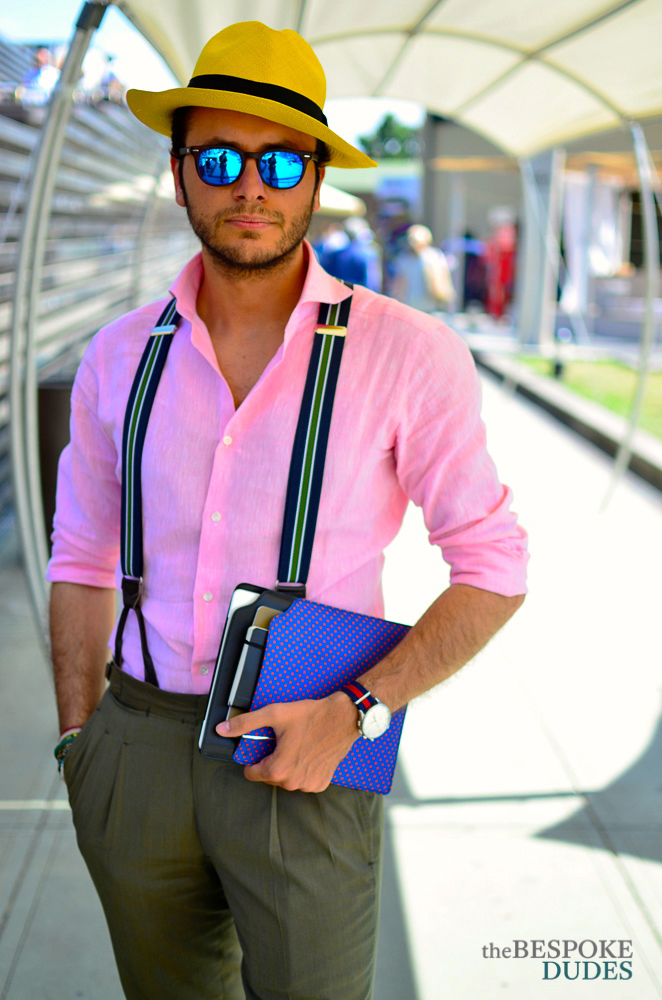
VR: Have you any children or spouse (and how do they relate to your style enthusiasm)?
FA: I am single with no children.
VR: …and your parents and siblings’ reactions back when you were younger?
FA: My parents were and are happy to see me doing things I love.
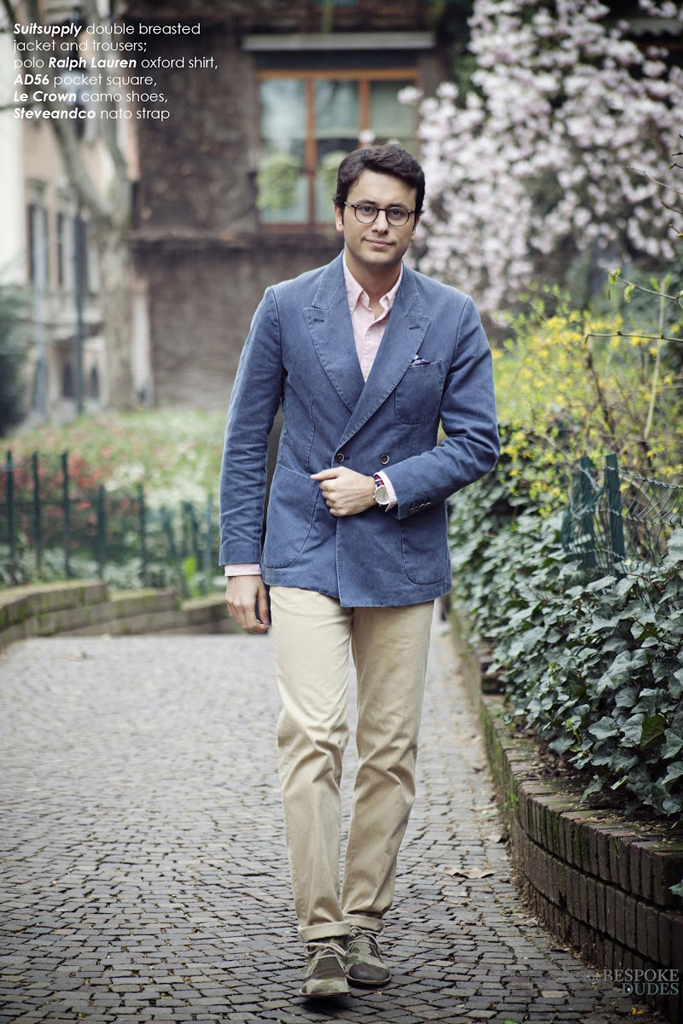

VR: What other hobbies or passions do you have besides style?
I have a lot of passions, but most of all I love travelling, learning new languages, meeting new people, reading books, practicing sports and writing about the Italian tailoring tradition.
VR: How did you first become interested in clothing, and when did you turn your eyes towards classic style? Why classics instead of fashion?
FA: I’ve been loving clothes since I was a child and every evening used to prepare my clothes to go to school the day after; I believe style is something everyone builds everyday as a result of experiences and personal taste. At first I had a penchant for known brands, while now I definitely prefer quality, regardless of the brand, as far as the garment has been done with a criteria; either by hand in a tailor’s shop or with traditional techniques and fine fabrics. I believe in this distinction: as for classic and sartorial menswear, you decide what to wear; on the contrary, as for fashion and RTW industry, you wear something decided by others.
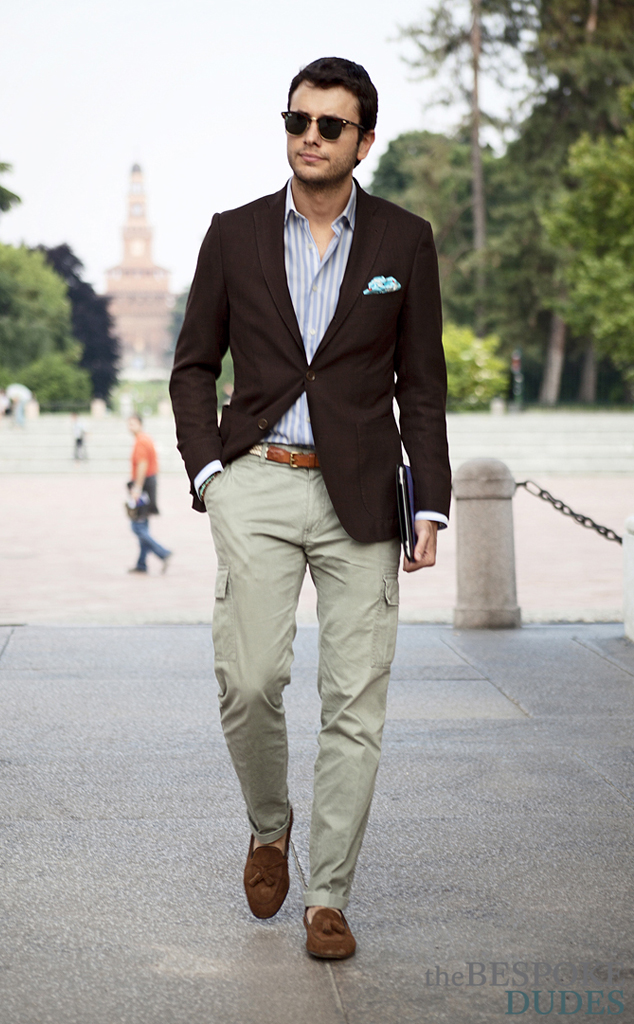

VR: How have you gathered your knowledge of apparel — from books, in-house training, workshops or somewhere else?
FA: I’ve learned a lot from books, blogs and most of all by interviewing tailors, trousermakers and shirtmakers and watching them work.
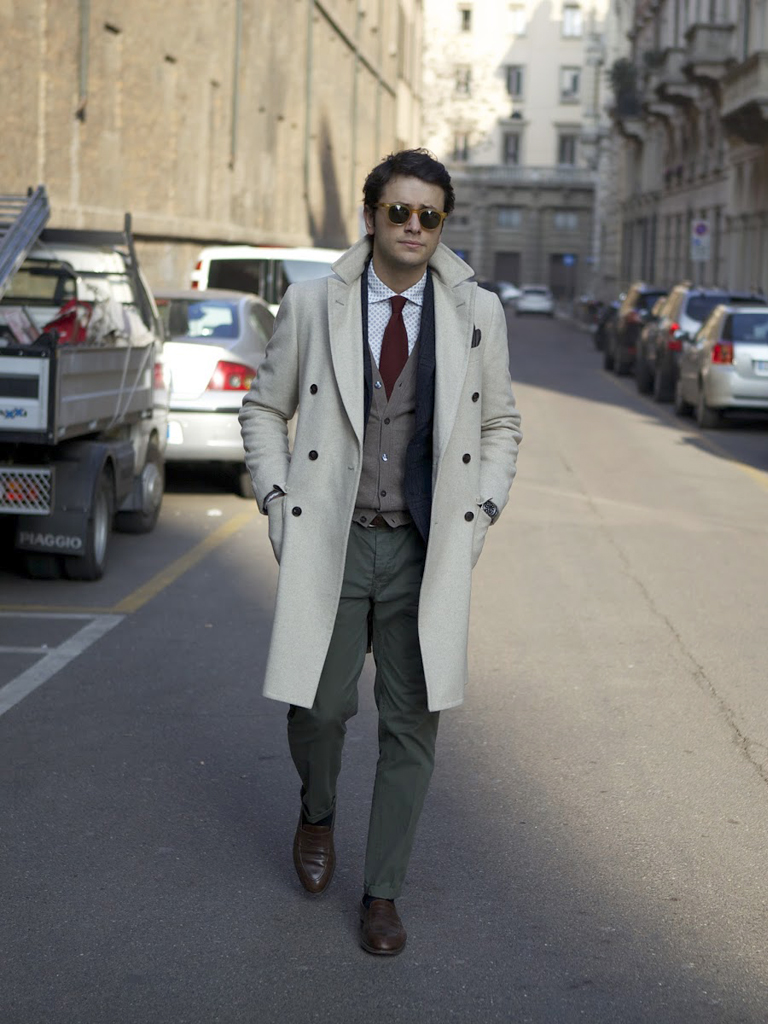
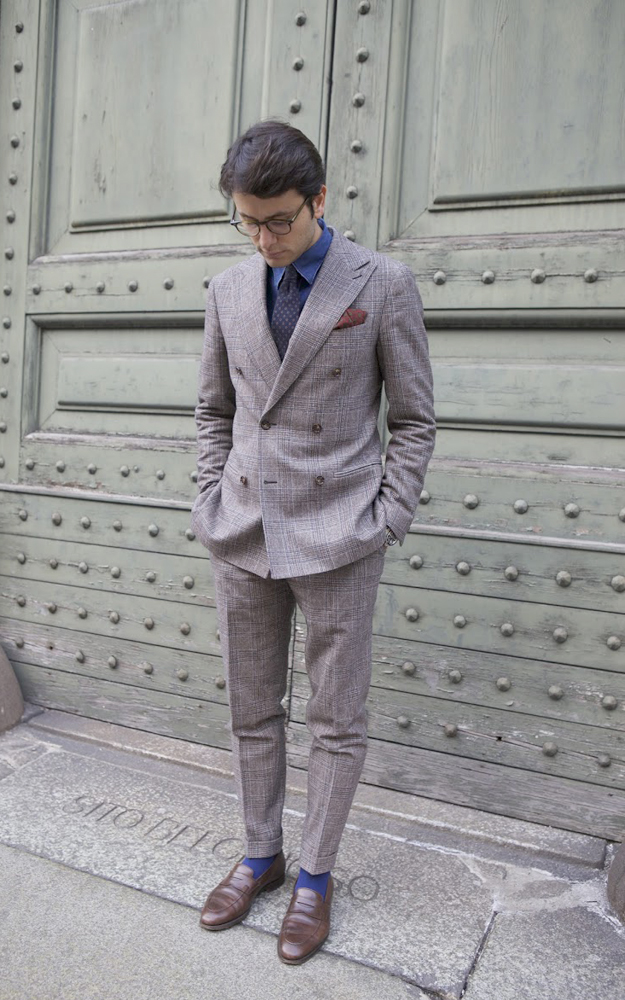
VR: How would you describe your own dress? Have you any particular style or cut philosophy?
FA: I like to describe my style as a continuously evolving classic.
VR: Which RTW makers or tailors do you favour?
FA: As for RTW makers: Boglioli, l.b.m., Lardini and Tonello. As for tailors: Santillo 1970, Sartoria Formosa, Salvatore Ambrosi and Sartoria Chiaia Napoli (by Gennaro Annunziata).
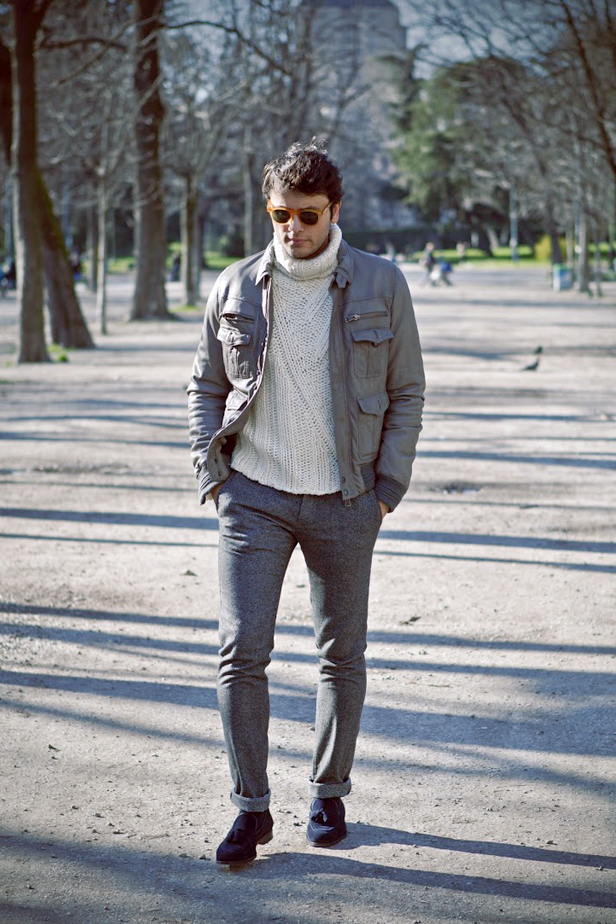

VR: Please describe how The Bespoke Dudes was born and what goals you set for yourself in the beginning. How have you been received so far?
FA: I launched it back in 2012 because I was not feeling [that it’s not] fully represented by any Italian blogger at that time; I wanted to bring young people like me closer to the tailoring industry, inform about italian tailor shops, analyze the differences among the styles of the various sartorie of my Country. I must admit things are going quite well so far, because both brands and tailor shops are recognizing my passion and my desire to learn and spread the word about their charming jobs.
VR: What’s your criteria for the content you choose for your site?
FA: Informative and synthetic content that I like, related to style and menswear.
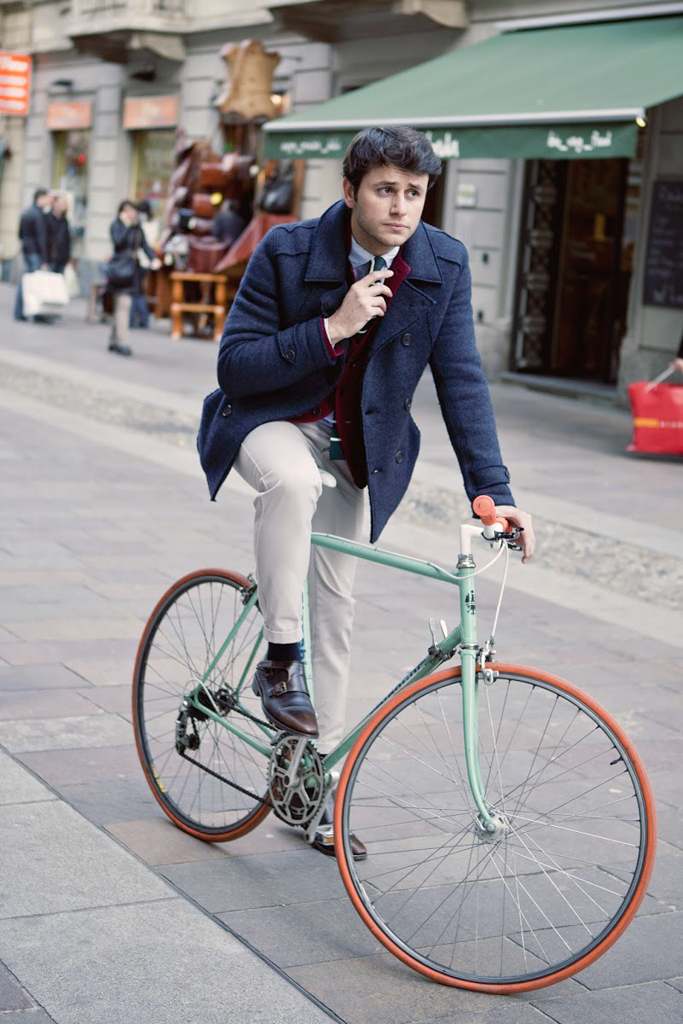
VR: Over the years you must have learned quite a bit about style. Is there something you wish more men would know? This is a great opportunity to make a lasting influence on my younger readers. Most of us aren’t blessed with rakish relatives, which makes learning about style a challenge later in life — and yet another trait men are supposed to master. All tips and thoughts are valuable.
FA: Of course I still have to learn more than a lot, but I insist on saying that the key is to feel comfortable with your clothes, dress for yourself and forget what you’re wearing. It’s not about only what you wear, but how you wear it.
http://www.thebespokedudes.com/
Pictures: © Fabio Attanasio
Category Bloggers, Interviews, Men of style
Copyright © 2013 Ville Raivio