Kirje nuorelle dandylle
0August 8, 2011 by Ville Raivio
Tämän päivän Vieraskynässä amerikkalainen journalisti Michael Mattis kirjoittaa dandyismin olemuksesta ja käytännöstä 2000-luvun nuoren miehen elämässä. Mattis sanailee mietteensä Palmierille, joka tässä tekstissä on todennäköisesti henkilön sijaan vain kirjallinen tehokeino ja viittaus 1400-luvulla eläneen italialaisen humanistin tuotantoon, erityisesti aikansa merkkiteokseen “Della vita civile”. Mattis tiivistää olennaisen tästä sosiaalisesta ilmiöstä erinomaisesti, keskittyen Beaun hahmoon sekä vaikutukseen ja sivuuttaen Wilden, d’Orsayn ja muut keikarit kliseinä.
Michael Mattis
Letter to a Young Dandy, Part I
“My Dear Palmieri:
It is a rare and wonderful gift for a curmudgeon such as myself to receive the praise of youth. It’s nice to know my little column is read at all, but to be solicited for advice is a singular honor.
In your brief e-pistle you mentioned that you are about to start your studies at the University of Pennsylvania and that you will be studying English and perhaps taking a minor degree in psychology. Very well, a solid grounding in literature combined with some understanding of the motives that drive human behavior can be both enlightening and entertaining. Be sure not to take either too seriously, however, but treat each with the skepticism and humor it deserves. Besides, taking anything too seriously can lead to premature laugh lines, and those aren’t funny.
In anticipation of your arrival at university, you tell me that you have, “concocted a grand scheme with a dear Friend… that involves the introduction of the Dandy way of life to that of the University.” Furthermore, you say: “Our manner of aestheticism and dress, we hope, preserves notions of Dandyism… into a frame of mind that promotes refinement of manners and elegance of speech.”
Hmm… a grand scheme? The introduction of the Dandy way of life? My dear Palmieri, while such intent may seem laudable to one so young and full of idealism, your words set this middle-aged dandy’s fop-dar a-beeping. I hope you and your friend’s “grand scheme” does not involve flouncing around the quad in poofy shirts and knee breeches proclaiming the equiprimordiality of Beauty with a peacock feather in one hand and a dime-store quizzing glass in the other in some vain attempt to civilize the unruly, suds-swilling frat rats of U. Penn. You’ll only make a ridiculous spectacle of yourself. And your followers will no doubt be the sort of pencil-necked misfits who work at the local comic-book store, and there’s nothing dandyish about that.
But I react too rashly. Let us take a step back and look first to first principles. Before we can discover how to bring dandyism with us wherever we go, we have to ask first what dandyism is. But even before we do that, let’s discuss what dandyism is not.
Dandyism is not, as has often been claimed, a response to bourgeois, middle class or “mainstream” values, manners or fashions. There is nothing so bourgeois as affecting to despise the bourgeois. Nor is it a reaction to democratic leveling, perceived authoritarian rule, bureaucracy, technology or MTV. It is not a world-altering aesthetic movement that needs to be evangelized among the heathen, the vulgar and the unwashed. It has nothing whatever to do with alienation, angst, transgression, resistance or teenage rebellion.
Nor is dandyism a canvas upon which to paint a portrait of one’s pomposity; it is not some sort of sartorial telegraph for communicating one’s alleged spiritual superiority, supposed aesthetic authority, assumed poetic sensitivity, professed exquisite taste, or fictitious aristocratic lineage. Snobbery can be fun in its place, but it is hardly a credo. Dandyism won’t necessarily make you better that the useful persons around you, like your butcher, your baker, or your mechanic, but it may make you better in some ways than you were before. But then it may also leave you, as the histories suggest, penniless and drooling in a French insane asylum, penniless and on the brink of suicide, or penniless and cursing the wallpaper from your death bed in a cheap right bank hotel.
So what is it then? Simply put, dandyism is the study and practice of personal elegance.
At first blush that may sound a trifle shallow. But the closer you look, the more complexity you will see. And you will also see just how difficult the end is to achieve in real life. Edward Bulwer-Lytton (he of “It was a dark and stormy night” fame), is often remembered as one of the windiest novelists ever to disgrace the English language. Though Bulwer could indeed be a bloviating writer, he was nevertheless a great dandy. And he said it best when he wrote, “He who esteems trifles for themselves, is a trifler. He who esteems them for the conclusions to be drawn from them, or the advantage to which they can be put, is a philosopher.”
It is said that the flapping of a butterfly’s wings in one corner of the globe can cause a hurricane in another. As an aspiring dandy, you will set your mind toward observing and uncovering the meanings hidden in the seemingly insignificant trifles that others may miss: the fall of a coat, the tint of a woman’s hair, the tilt of a hat, the stress of a vowel, the grace of a gesture, the power of a word. The pinnacle of human trifling is, of course, fashion. As an aspiring dandy, you will become a student of fashion and its long and vital story amid human endeavor. Not just fashion in clothes, mind you, though you will watch this closely, but fashion in literature, fashion in advertising, fashion in music, fashion in morals, fashion in entertainment, fashion in art, fashion in thought and even fashion in politics. All of human folly and foible will be to you layered like a great ball of string, wound up with mystery and meaning. And as you unravel the ball the significance of the individual strings will grow more evident, just as their mysteries will deepen.
The exposition of trifles has itself become fashionable in literary circles in recent years, as some historians, grown weary of treating the same weighty events over and over, have taken to exploring the extraordinary influence of apparently incidental things like pepper, coffee, sugar, codfish and even the color mauve. It is a development that has substantiated what the dandy has known since Brummell: that the world is not only made up of trifles but it is governed by triflers, and that to apprehend society one must first comprehend folly. Always remember, as Bulwer also said, “Nothing is superficial to a deep observer!”
But we will speak more about fashion later on.
Whether you plan to write poems about trifles, paint canvases about folly, pen social critiques, or merely hang back and observe Vanity Fair’s foibles with a satirical glint in your eye and a quip on the tip of your tongue is up to you. The choice is also utterly irrelevant to your aspirations to dandyism. Contrary to popular belief, to be successful, a dandy needn’t be anything other than a dandy.
In the 19th century, dandyism became associated with the cult of art and beauty called aestheticism. This was due in no small part to the influence of men like Theophile Gautier, Charles Baudelaire, Oscar Wilde, Robert de Montequiou and others, who straddled the worlds of beau monde and bohemia, celebrity and notoriety, literary salon and opium den, whorehouse and painter’s studio. In the minds of today’s scholars and intellectuals, the two phenomena have become indelibly linked.
To add to the confusion, the aesthete was widely caricatured by popular magazines like Punch and in stage plays like Gilbert and Sullivan’s operetta “Patience”. This snatch from the operetta’s key song, “The Aesthete,” is a parody of the young Oscar Wilde:
… Though the Philistines may jostle,
You will rank as an apostle
In the high aesthetic band
If you walk down Piccadilly with a poppy or a lily
In your mediaeval hand…
It is this cliché of the wilting, flower-waving aesthete in velvet britches and floppy hat, who faints at the sight of a Moreau and gushes paroxysms of joy over a Rossetti, that the contemporary world most associates with the dandy, particularly in the United States.
And the cliché lives on. No doubt you will meet the modern retro-eccentric version of the fin-de-siecle aesthete during your university sojourn. He will be resplendent in his neo-Victorian “Bunthorne” uniform, reminiscent of the costume Albert Finney wore in the film “A Man of No Importance.” You will see him in certain nightclubs and at certain parties, usually hanging around with the black-lipstick-and-eyeliner crowd, complaining in antiquated language about flip-flop-wearers, shabby grammar, reality TV, the Internet (except his own blog), athletes and how he was born into the wrong era.
The more contemporary — and to my mind the more authentic — aesthete often wears a uniform, too, but one that reflects the anger and revolt endemic to today’s art. Instead of waxing eloquent about a Whistler, our aesthete will proclaim the transgressive glories of Andres Serrano’s “Piss Christ” or Damian Hirst’s “Prodigal Son (Divided).” Oversized boots, paint-spattered jeans, an unruly mop and a crappy attitude are the likely accoutrements of his attire.
Both of these are costumes, of course, and neither has much to do with elegance (although the retro-eccentric will often confuse his effeminate extravagance for it). Dandies don’t wear costumes, but carefully chosen attire. You’re probably asking yourself, “But can’t a contemporary dandy be a contemporary aesthete?” And the answer is: “Absolutely.” But in the dandy alphabet, the “D” always comes before the “A.”
Well-known contemporary dandies that also happen to be aesthetes include the late, post-modern architect, Phillip Johnson, Barnaby Conrad III, the author of books like “Absinthe: History in a Bottle” and a painter in his own right, and, perhaps, the pop-star fashion plate Andre3000. Others have put the famed artist David Hockney in this category, but he is a bit too noisy and unkempt for my taste.
But the fact is that there have been many dandies quietly dressing away for the last two centuries or more who could not possibly care less about art for its own sake any more than they care about quantum physics. You rarely hear about them because they are only seen in passing, for they have few pretensions outside their craft. A few have been found dressing up the columns of certain publications. The New Yorker’s Robert Benchley and Vanity Fair’s Dominick Dunne are two of the ink-tinctured men-about-town that spring to mind. Others can be found in the more creative enterprises like marketing, such as Thomas Mastronardi, the branding expert recently pictured on Dandyism.net’s homepage. Still thousands of others dress each morning in splendid obscurity, doing so for no other purpose than to please themselves and the people they enjoy calling on. They may come from any of the more civilized professions, or from no profession at all. This is dandyism in its purest, most Brummellian form.
About now you’re probably thinking, “Well all of this is fine in theory, but what shall I wear?”
But the hour grows late, my dear Palmieri, my fingers are weary and I’m out of claret. You will have to wait until next time, when we discuss the dandy in practice.”
Category Dandyismi, Vieraskynä
Tyylifoorumeista
0August 7, 2011 by Ville Raivio
Tämän päivän Vieraskynässä Christian M. Chensvold kirjoittaa verkon tyylifoorumeista. Yksi haastatelluista on sijoittanut päälle 300 000 dollaria vaatekaappiinsa, toinen taas viettää päivittäin kaksi ja puoli tuntia kirjoitellen vaatteista lukuisille foorumeille. Vaimon nyrpistellessä oudolle päähänpinttymälle mies puolustautuu: “enpä nyt sentään ole millään pornosivulla” – ja vaimo vastaa “sehän olisikin normaalia.” Teksti on vuodelta 2006, mutta yhä ajankohtainen erityisesti kun Suomikin on sittemmin saanut oman tyylifooruminsa. Fiksoitunutta lukijaa kenties lohduttaa tieto siitä, kuinka hän ei ole intonsa kanssa yksin eikä suinkaan pahimmasta päästä.
Christian M. Chensvold
Fop Culture
“Jan Libourel’s wife doesn’t like his clothes. She doesn’t like his two-tone Allen Edmonds shoes, she rolls her eyes over his silk pocket squares, and if he wears an ascot she’s afraid to be seen with him.
But there’s one thing she really hates: The fact that Libourel — a former professor of ancient history and noted gun authority — spends up to 2 1/2 hours a day discussing men’s clothing on the Internet. “She regards it as highly eccentric and time-wasting,” says the 64-year-old Long Beach resident. “I say, ‘It’s not as if I’m on some porn site,’ and she says, ‘That would be normal.”
While some men go online to discuss cars, sports and electronics, a small but growing number are logging on to debate shirt collar styles, the virtues of a Neapolitan shoulder, and whether or not it’s gauche to leave the last button on a custom suit sleeve undone.
This is the often sophisticated and occasionally pathetic world of men’s clothing forums, where guys who are clothes obsessed find sanctuary from a society they say regards them as effeminate poppinjays. Combined, the four best-known men’s clothing forums boast over 10,000 members, plus countless more regular visitors eager to debate whether Brioni suits are superior to Kiton, and whether socks should match shoes or pants.
The forums serve as their information resource, support group and jury of peers. “A lot of people feel they belong here,” says Jeremy Jackson, a 27-year-old Seattle resident who manages his family’s construction business and founded Style Forum in 2002. “If clothes are your major interest, it’s very unlikely you’re going to find a place in the real world to hang out and talk about clothing with other men.”
Style Forum (styleforum.net) caters to fashion-conscious guys in their twenties and thirties. Ask Andy About Clothes (askandyaboutclothes.com/forum), which has the largest number of members, is focused mostly on business attire. The London Lounge (thelondonlounge.net) centers around custom tailoring, and newly launched Film Noir Buff (filmnoirbuff.com/forum) — sometimes called “devil’s island” — has become a refuge for members who’ve been banned from the other sites.
Libourel, who used to post on dog and gun sites before discovering the fashion forums, is a member of all of four. “There’s fairly high level of general knowledge, erudition and certainly civility compared to other Internet fora,” he says.
Film Noir Buff, who prefers to remain anonymous for fear his career would suffer if people knew of his clothing obsession, says discovering fashion forums was therapeutic. “I can’t sit down to lunch with bankers and lawyers and talk about buttons on my sleeve,” says the New York financier, who launched his forum last March. “They’d think I was crazy.”
Forum members are typically educated and successful — they’re also desk jockeys able to shirk work by surfing the Web. “There seems to be a disproportionate number of lawyers and investment bankers and people who are shut in their office and are dreading whatever it is they’re supposed to be doing,” says Jackson. “I’m sure there are a remarkable number of billable hours that are actually on Style Forum,” adds Fok-Yan Leung, one of the site’s moderators.
For the clothes-obsessed man, no sartorial matter is too obscure — or inane — to bring up. Mutant_Hairs, a Style Forum member who lists his location as Southern California, posts the question, “What’s appropriate jury duty attire? I really don’t want to be selected, but I don’t want to look inappropriate either.” One member says a t-shirt and track pants, while another suggests a seersucker suit and bow tie.
Manhattan Beach resident Andy Gilchrist, author of “The Encyclopedia of Men’s Clothes,” launched his wardrobe advice website Ask Andy About Clothes in 2001. A year later he added a forum that today boasts over 7,000 members, countless more regular readers, “and the occasional psychotic.”
“I was trying to create a friendly ground where we could discuss men’s clothing and not feel strange about it,” says Gilchrist, the proud owner of 300 neckties. “It goes back to if you’re a woman in our society you’re expected to look nice and be interested in clothes, but if you’re a guy you’re supposed to be just rugged, and if you’re interested in clothing at all you might be a girly-man.”
Whereas in previous generations fathers would teach their sons how to dress for the business world, Gilchrist says this tradition has all but disappeared, replaced by the surrogate fatherly advice of the clothing forums.
FASHION DICTATORS
Clothing forums have not only made today’s consumer more educated than ever before, thanks to the wealth of opinions available, they have also created a new breed of arbiter elegantiarium whose opinions are solicited by novices and contested by other self-styled savants.
Perhaps the best known forum expert is Michael Anton (“manton” on the various forums), author of the recently released book “The Suit: A Machiavellian Approach to Men’s Style” (written under the pseudonym Nicholas Antongiavanni).
Anton says forums are replacing traditional media — namely men’s fashion magazines — since erudite clothing aficionados can now easily share their knowledge with their peers and build a reputation as an authority. Moreover, men’s magazines like GQ are focused on fleeting looks of the season and are not aimed at a discriminating consumer, says Anton. “When you compare clothing to other products that guys have a connoisseur relationship to — cars, cigars, stereo equipment — there are sources of information that are pretty good. But for high-end clothes you can’t count on GQ and Esquire.”
And while no one person knows everything about clothing history, construction and quality, the totality of information available on the forums is virtually comprehensive. “Everybody has gaps in their knowledge,” says Anton, “but for the forums as a whole there are very few gaps.”
But where there’s information there is opinion, and where there’s opinion there’s contention. Because forums often appear like a microcosm of male behavior, aggression frequently rears its head, however well coifed. The anonymity of the Internet allows people to say things they would never say at a cocktail party. So while you might think that a fellow guest’s pink seersucker jacket is of questionable taste, you would presumably bite your tongue. But on men’s fashion forums, many cannot resist the temptation to type “idiot.” Ill-mannered members and troublemaking “trolls” are banned by forum moderators.
And despite the success, education and maturity of most members, clothing forums also produce their own style tribes that bear a striking similarity to the goths, skaters, punks and preppies we all remember from adolescence. Though membership crossover is common, so is antipathy to competing forums. “It’s very rare you come across a subject where people have no opinion about the people on another forum,” says Jackson.
ANATOMY OF AN ADDICT
When Marc Grayson brought his new girlfriend to his apartment, all she could say was “Oh, my”: Inside Grayson’s two-bedroom New York City pad were two walk-in closets overflowing with clothes, and the extra bedroom was full of commercial garment racks loaded with suits, sportcoats and slacks.
Grayson (his online username, not his real name) is an admittedly extreme example of the kind of clothes-obsessed coxcomb who frequents the men’s fashion forums. A 35-year-old businessman whose father also had a taste for finery, Grayson estimates that over the past 15 years he’s spent over $300,000 on 50 custom-made suits (some running $4,000 each), 50 more custom sportcoats, 40 pairs of high-end shoes, 100 neckties and 15 leather jackets he “bought on sale.”
And he’s not even rich: Some small investments provide him with the discretionary income necessary to indulge his love of bespoke apparel, Grayson says.
Grayson is a regular contributor at Film Noir Buff, having been banned from Style Forum and Ask Andy for what he says was criticizing the work of some well-known New York tailors. “I couldn’t dare talk about clothes with the outside world because I would be looked upon as being way too self-conscious and self-absorbed,” says Grayson, who often stops by his tailor just to touch the fabric swatches and imagine the possibilities.
But indulging his vice is increasingly giving Grayson pause for reflection. “It does bother me,” he says of the expense. “And I’ve been thinking about it with greater intensity, if it’s money that could have been better spent. It is almost an addiction.”
And that is the final function of online men’s clothing forums. For if they are information resources, support groups, surrogate fathers and debating clubs, they are also enablers of addiction. “If you stay on the forums, you stay focused on indulging in clothing,” says Grayson. “It’s like being a gambler and going into chat rooms talking about how you love to gamble. There’s very little discussion about the unattractiveness of being so self-centered.”
Somewhat wistfully, Grayson admits that the conventional view of fastidiously dressed men as vain and superficial may be entirely justified: “It is a completely self-absorbed state of mind we’re in on these forums.””
Category Vieraskynä
Dandyismi käytännössä
0August 5, 2011 by Ville Raivio
Viime viikkojen aikana olen käynyt lävitse Dandyism.netin ilahduttavaa tarjontaa ajatuksen kanssa. Jaan olennaisimmat löytöni Vieraskynän alla lukijoiden iloksi seuraavien päivien aikana, jotta kesän kuumimmat hetket eivät kuluisi epäterveessä ihon paahtamisen merkeissä.
Ensimmäisenä esseenä vuodelta 2005 D.netin Nick Willard muistuttaa lukijaansa dandyn olennaisimmasta olemuksesta. Ilmiöön löivät älyllisen leiman ranskalaiset esseistit ja runoilijat, jotka tulkitsivat näkemäänsä kovin vapaamielisesti ja toivat dandyn käsitteen myös Ranskan bulevardeille sekä salonkeihin. Tämä älyllistäminen muutti ilmiötä, joka puhtaimmillaan ja alun perin oli ainoastaan vaatteiden käyttämistä ja toisten katseiden alla olemista. Beau Brummell ei kirjoittanut, maalannut, musisoinut tai runoillut. Hänen aikansa kului pukeutumisessa, vaatteiden teettämisessä, vaikutuksen tekemisessä sekä näkymisessä. Tästä huolimatta Beauta voisi vapaasti tulkiten luonnehtia filosofiksi, sillä hän käytti huomattavan ajan päivistään pukeutumisen semantiikan analysoimisessa. Brummellin hillitty ja pikkutarkka asu ei ole voinut olla mitään muuta kuin tarkoin harkittu ja tietoinen isku aikakauden puuteroitua miehen kuvaa vasten. Vaatteiden käyttäminen on aina ollut dandyismin ydin, joka sittemmin on Wilden, Baudelairen, d’Orsayn ja muiden keikareiden räikeistä ylilyönneistä taintunut unohduksiin.
Dandyism in Practice
Nick Willard
“What does the dandy do when he wakes up early in the afternoon? Does he moon over beauty and contemplate the eternal verities? Does he jot down a few bons mots? Does he man the barricades to protest our vulgar, bourgeois and consumerist society? Does he pine for the days when men wore knee breeches and silk stockings?
No, the true dandy does none of these things.
The dandy goes to his bath and scrubs himself clean, shaves, brushes his teeth, and arranges any stray hairs. Then he adorns himself, examining each detail in his mirror – the dimple in his tie, the shine on his shoes, the puff of his pocket square, the precision of his trouser crease, the bloom of his boutonniere, the harmony and balance of all the components of his ensemble – until he gets it just right. When he finally departs his home, he is a habitué not of the salon, opera, theatre, museum, concert hall, casino, restaurant or club to which he may or may not arrive, but of his tailor and haberdasher.
For the dandy is a man with visible good taste. Dressing well is his hallmark. Strip a dandy of his clothes and what do you have?
The dandy’s two-hundred-year history can be summarized in just two albeit Proustian sentences: The definitive study of the dandy as a social and literary phenomenon, Ellen Moers’ “The Dandy: Brummell to Beerbohm,” shows how the original, robust, snuff-snorting Regency dandy eschewed the jewel buttons, lace ruffles, silk stockings, gold shoe buckles, perfume and other extravagances of the aristocratic fop, and also the coarse slovenliness, dirt and disarray affected by republican sympathizers, and instead emphasized superb fit, perfection of cut, harmony of color, personal cleanliness and, most famously, the well-tied starched linen cravat, and came to dominate his society through his insolence, then crossed the Channel to France and returned accessorized and sissified in his attire, and became, while remaining a social lion, the more flamboyant “butterfly dandy” who eventually drank too much absinthe, smoked too much hash, raged against the bourgeois, dressed in black, and thus became the decadent dandy, who spiced his personality with wit and aestheticism, was often gay, consciously adopted aesthetic garb, entertained the mass public and thereby became the fin-de-siecle dandy, who floundered in the shallows of his own shallowness and became the extinct dandy when Beerbohm, Brummell’s true heir and most insightful interpreter, retired prematurely to Rapallo. The dandy, others might add, rose again from the dead after the carnage of the Great War and became the Bright Young Thing of the ’20s and the charming personages depicted in “Brideshead Revisited,” transfigured into the Duke of Windsor and Fred Astaire, who fashioned and embodied the guiding principle of men’s attire, nonchalant elegance, that has endured for the past eighty years, and so on to Messrs. 3000 and Bentley and the consummate, though invisible, dandies of Dandyism.net.
But throughout the dandy’s many mutations, one constant has persisted: a dandy distinguishes himself by the way he dresses. Everything else about the dandy has been more or less mutable.
Consider, for example, the dandy as a social phenomenon. His position in, and relationship to, society has changed. The Regency dandy was a leader of society. Likewise, the social butterfly dandy was a lion of the bon ton. The decadent dandy, however, placed himself outside, rather than at the apex of, society; he was a critic of a society that had become bland and conformist. The fin-de-siecle dandy also was a critic, this time of Victorian values.
Indeed, the dandy’s social significance was sometimes contradictory. Take again the Regency dandy. For the common-born Regency dandy such as Brummell, dandyism was a way to join the aristocracy, often while mocking its foibles. For the aristocratic Regency dandy, such as Wellington, it was a way to justify one’s superior position and affirm the legitimacy of the aristocracy when it was under attack.
Either way, the Regency dandy had to assert himself in an exclusive, elitist, stratified society. Today’s society is, in contrast, is mass, consumerist and democratic. We build, as Tom Wolfe has noted, Las Vegas, not Versailles. Therefore, aping the manners of 19th-century dandies would be as inappropriate for a contemporary dandy as dressing up in 19th-century costume.Here Beerbohm’s observation is spot on: “The dandy is the ‘child of his age,’ and his best work must be produced in accord with the age’s natural influence. The true dandy must always love contemporary costume.”
Moreover, the “philosophy” of the dandy attributed to him by most scholars is really no way to go through life. Irony is a literary device, not a way of life, and detachment is a waste of a life. In Proust’s “In Search of Lost Time,” the narrator rhetorically asks of the detached Charles Swann, “For what other lifetime was he reserving the moment when he would at last say seriously what he thought of things, formulate opinions that he did not have to put between quotation marks, and no longer indulge with punctilious politeness in occupations [that] he declared at the time to be ridiculous?”
Indeed, for what other lifetime? These attitudes are simply not worth adopting and there is no need to do so in order to be a dandy. Again, as Beerbohm cautioned, “[T]here is no reason why dandyism should be confused, as it has been by nearly all writers, with mere social life. Its contact with social life is, indeed, but one of the accidents of an art.” That art is wearing clothes artfully and well.
There are those who cannot accept this conclusion. They fear that emphasis on the dandy’s outward appearance reduces him to some vulgar swank. They are not content with the dandy’s own choice of ensemble. They must robe him with a regal mantle. His outward elegance reflects some inner nobility, they say. Romantic twaddle, I say.
I blame, in the words of Sir Percy Blakney, those demmed Frenchies. Instead of being dandies they analyzed dandyism. Barbey, I believe, was a real dandy. Baudelaire, with his black wardrobe, I am not so sure of. Balzac wrote perceptively and wittily about the dandy’s life in his fiction and penned “La Traité de la Vie Elégante,” an ostensibly anti-dandy tract full of valid sartorial epigrams. Yet Balzac was, by all accounts, oily, fat and dirty, and therefore no dandy. The French thereby started the process of disassociating the dandy from his clothes, thus obscuring his essence. Not only that, these hierophants of dandyism provided grist for academic mills to belch wearisome dissertations in comparative literature and gender studies in pursuit of advanced degrees and often in furtherance of certain social and political agendas.
To the feminist, for example, the dandy is revered not for his elegance, but as a subverter of sexual stereotypes and their assumed concomitant repression. The dandy has thus devolved from a singular man with visible good taste to an amorphous, bloodless abstraction. They have so stretched the meaning of the word “dandy” as to render it meaningless.
“The English invented dandyism, the French explained it,” George Walden recently wrote. I say that a dandy needs no explanation, no justification, no interpretation. Instead of analyzing the dandy, we must return to the dandy’s Regency roots and directly experience with our senses the luminosity of dandyism itself.
If you must coat the dandy with some intellectual veneer, then think of him as an existential hero. In response to our mass, abstract, anonymous, and impersonal society, he asserts his singular self. And, in dandyism’s grand tradition, he chooses to assert his superiority in the most frivolous manner possible.
I prefer to think of the dandy as a lily of the field. The Bible reads, “Consider the lilies of the field, how they grow; they toil not, neither do they spin. And yet I say unto you, that even Solomon in all his glory was not arrayed like one of these.”
So, dear reader, purge yourselves of philosophical pretensions, emulate the lilies of the field, and ponder life’s most important question: What will you wear?”
Category Dandyismi, Vieraskynä
Sprezzatura
1July 29, 2011 by Ville Raivio
Sprezzatura on mieluisan esoteerinen termi, joka sai syntynsä renessanssikirjailija Baldassare Castiglionen kirjassa “Il Cortegiano”. Sana on hyvä tuntea, sillä se on laajalti käytössä Suomen ulkopuolella erityisesti vaatteisiin liittyen – ja kelpo käytössä kuvattaessa tietynlaista asennetta pukeutumiseen. Jos haluaisi seurata aikansa retoriikkaa, voisi käyttää termiä cool. Tämä ei tosin olisi yhtä coolia kuin sprezzaturasta puhuminen.
Oma suomennokseni Castiglionen kirjan sivuilta:
Sprezzatura on eräänlaista välinpitämättömyyttä, jolla ikään kuin piilotetaan taituruus sekä harjoittelun tulos ja saadaan kaikki, mitä tekee tai sanookaan, vaikuttamaan täysin tavanomaiselta ja luonnollisesti syntyvältä.
-Baldassare Castiglione, The Book of the Courtier: The Singleton Translation, Ed. Daniel Javitch, (New York: Norton, 2002), sivu 32.
Käytännössä pukeutuja siis piilottaa kaiken tietoisen harkinnan asustaan, puheestaan ja käyttäytymisestään toisilta, kuten jonglööri piilottaa kaikki ne tunnit jotka on käyttänyt kapulapelinsä harjaannuttamiseen. Mies on kenties lukenut etiketistä, käytöstavoista, vaatteiden historiasta ja oikeista yhdistelmistä, mutta ei anna toisten nähdä kaikkea vaivannäköään. Sprezzatura on myös jonkinlainen puolustavan ironian muoto, jossa ajatukset, tunteet ja sisäinen myllerrys salataan vaivattomuuden taakse. Selkosuomeksi: sprezzatura on harjoiteltua, tahallista huolimattomuutta muutoin siistissä asukokonaisuudessa. Kenties napittamaton kalvosin, vinoon solmitut kengännauhat, aivan hitusen liian lyhyenä roikkuva solmio taikka ainoastaan kauluksesta silitetty paita.
Sprezzatura voi syntyä harkitusti tai sitten luonnostaan. Esimerkkinä huolitellusta huolimattomuudesta voi mainita vaikkapa auki jätetyt solkikengän soljet tai napittamattomat kalvosimet, joiden syntysyy on ainoastaan mukavuuden tavoittelu. Maineikas Fiat-omistaja Gianni Agnelli oli aikansa tyyli-ikoneita ja laajalti valokuvattu mies. Hänen kuviensa myötä harkittu sprezzatura levisi ympäri pallon. Agnellilla oli tapana käyttää siroja maihinnousukenkiä puvun kanssa, jättää solmio neuleen ulkopuolelle roikkumaan, kiinnittää rannekello kauluspaidan päälle ja jättää nappikauluspaitansa kaulusnapit auki. Tekojen syynä oli Castiglionen kirjailema sprezzatura. Agnelli ei halunnut näyttää liian sliipatulta mieheltä, joten pienet tahalliset virheet toivat rennompaa ilmettä muutoin vakavamielisen bisnesmiehen olemukseen.
Baldassaren katkelma sprezzaturasta kokonaisuudessaan:
“Therefore, whoever would be a good pupil must not only do things well, but must always make every effort to resemble and, if that be possible, to transform himself into his master. And when he feels that he has made some progress, it is very profitable to observe different men of that profession; and, conducting himself with that good judgment which must always be his guide, go about choosing now this thing from one and that from another. And even as in green meadows the bee flits about among the grasses robbing the flowers, so our Courtier must steal this grace from those who seem to him to have it, taking from each the part that seems most worthy of praise; not doing as a friend of ours whom you all know, who thought he greatly resembled King Ferdinand the Younger of Aragon, but had not tried to imitate him in anything save in the way he had of raising his head and twisting one side of his mouth, which manner the King had contracted through some malady. And there are many such, who think they are doing a great thing if only they can resemble some great man in something; and often they seize upon that which is his only bad point.
But, having thought many times already about how this grace is acquired (leaving aside those who have it from the stars), I have found quite a universal rule which in this matter seems to me valid above all others, and in all human affairs whether in word or deed: and that is to avoid affectation in every way possible as though it were some very rough and dangerous reef; and (to pronounce a new word perhaps) to practice in all things a certain sprezzatura [nonchalance], so as to conceal all art and make whatever is done or said appear to be without effort and almost without any thought about it. And I believe much grace comes of this: because everyone knows the difficulty of things that are rare and well done; wherefore facility in such things causes that greatest wonder; whereas, on the other hand, to labor and, as we say, drag forth by the hair of the head, shows an extreme want of grace, and causes everything, no matter how great it may be, to be held in little account.
Therefore we may call that art true art which does not seem to be art; nor must one be more careful of anything than of concealing it, because if it is discovered, this robs a man of all credit and causes him to be held in slight esteem. And I remember having read of certain most excellent orators in ancient times who, among the other things they did, tried to make everyone believe that they had no knowledge whatever of letters; and, dissembling their knowledge, they made their orations appear to be composed in the simplest manner and according to the dictates of nature and truth rather than of effort and art; which fact, had it been known, would have inspired in the minds of the people the fear that they could be duped by it.
So you see how art, or any intent effort, if it is disclosed, deprives everything of grace. Who among you fails to laugh when our messer Pierpaolo dances after his own fashion, with those capers of his, his legs stiff on tiptoe, never moving his head, as if he were a stick of wood, and all this so studied that he really seems to be counting his steps? What eye is so blind as not to see in this the ungainliness of affectation; and not to see the grace of that cool disinvoltura [ease] (for when it is a matter of bodily movements many call it that) in many of the men and women here present, who seem in words, in laughter, in posture not to care; or seem to be thinking more of everything than of that, so as to cause all who are watching them to believe that they are almost incapable of making a mistake?”
Category Arbiter elegantiarum, Eleganssi, Sanastoa
Alden Shoes
3July 7, 2011 by Ville Raivio
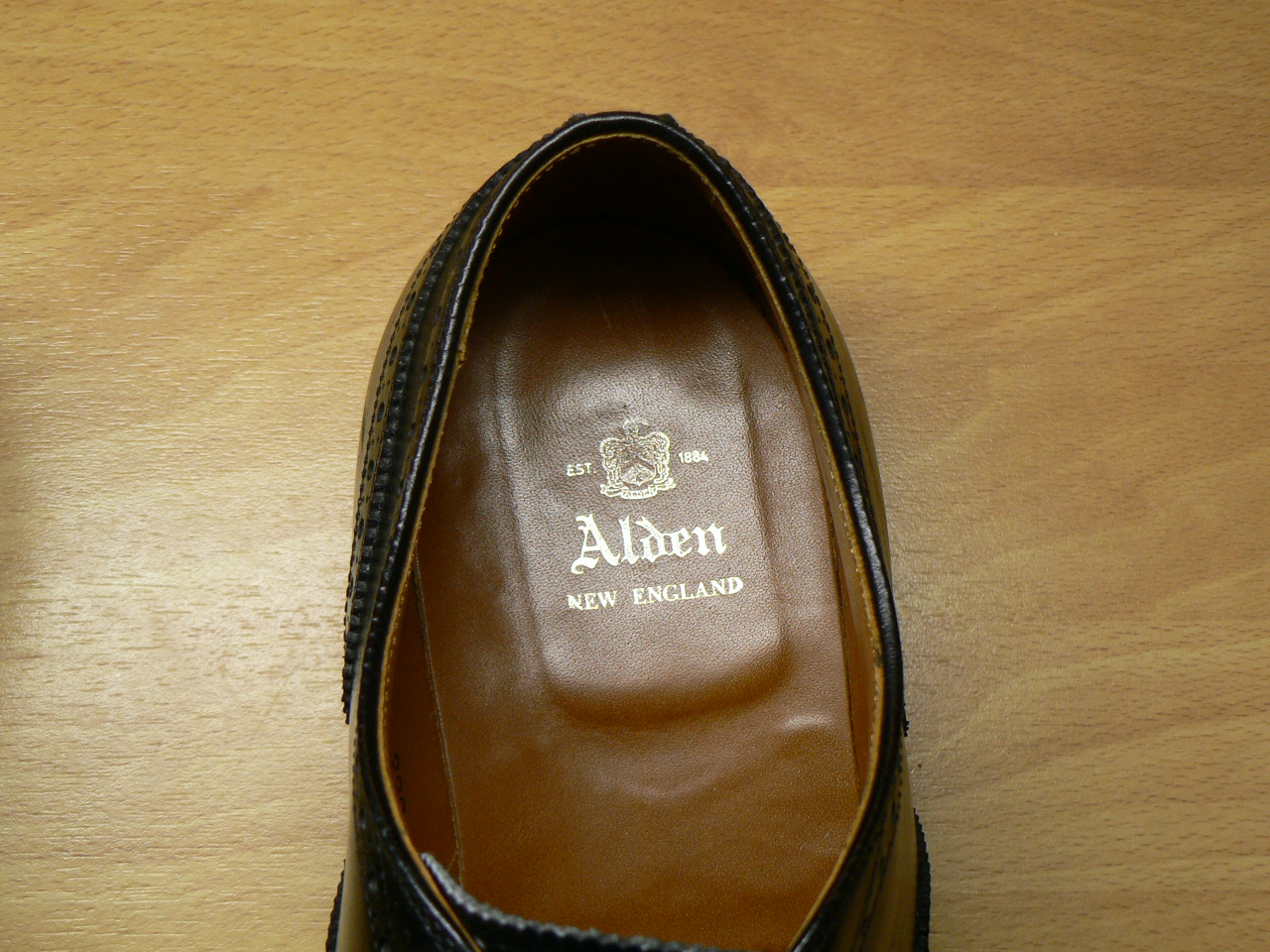
Vuodesta 1884 lähtien amerikkalainen Alden on valmistanut klassista muotokieltä edustavia jalkineita laatutietoisille miehille. Yhtiöllä on peräti kahdeksan erilevyistä lestiä yli kymmenessä kokoluokassa, joten myös hankalajalkaiset löytävät todennäköisesti oman parinsa. Tarkoin valitut nahkalaadut on käsin värjätty ja kiillotettu, jalkineissa on täysi nahkaverhoilu ja Goodyear welt -rakenne. Valmistajan erikoisuutena lenkkirauta on kolminkertaisesti vahvistettu – tämä kaikki alusta loppuun käsintehtynä USA:ssa.
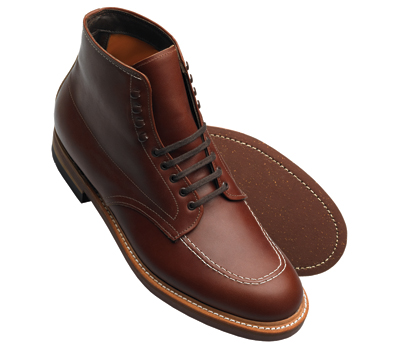
Toisin kuin valtaosa aikoinaan kunniallisista valmistajista, Alden on silkkaa sitkeyttään säilyttänyt koko tuotantonsa Amerikassa, tarkemmin sanottuna Massachusettsin Middleboroughissa. Tehdas on maailman suurin shell cordovan -jalkineiden valmistaja ja tasokkain yhä Atlantin takana toimivista tehtaista. Kuriositeettina mainittakoon allaoleva saapasmalli, joka on saanut Indy bootin nimen Harrison Fordin aikanaan käytettyä sitä Indiana Jones -filmeissä.
Category Laatuvalmistajat
Copyright © 2023 Ville Raivio