Interview with Mansel Fletcher
0October 30, 2013 by Ville Raivio
VR: Your age and occupation?
MF: 39, features editor at Mr Porter.
VR: Your educational background?
MF: British boarding schools, followed by university in London.

VR: Have you any children or spouse (and how do they relate to your style enthusiasm)?
MF: One wife, one daughter, one son, and a cocker spaniel. My wife is very patient with my interest in classic style, but she’s not keen on formality – she’s apt to ask why I’m wearing a tie.
VR: …and your parents and siblings’ reactions back when you were younger?
MF: My interest didn’t develop until I was in my twenties, so my parents never had to ask me to leave the monocle at home.
VR: What other hobbies or passions do you have besides apparel?
MF: Architecture and design, books, music, food, wine, cars, travel, and rural life.
VR: How did you first become interested in clothing, and when did you turn your eyes towards classic style? Why classics instead of fashion?
MF: I chased fashions between the ages of 12 and 27. The results were very rarely satisfying. Then I had some shirts and a suit made, and the idea of classic style began to appeal to me.
VR: How have you gathered your knowledge of clothing — from books, in-house training, workshops or somewhere else?
MF: I owe Christian Chensvold a great debt because Dandyism.net introduced me to the world of #menswear, and I’ve learned a lot from Michael Alden and his London Lounge – the key lesson being to trust my eyes, and seek to express my personality. What I know about products I’ve learned by spending money and wearing my purchases.
VR: Who or what inspires you?
MF: The usual roll-call of dead men (Windsor, Agnelli, Biddle, Grant, Gabin, Cooper, Astaire etc, etc). Among the living I find the Duke of Edinburgh’s clothes very interesting, and I met Massimo Piombo earlier this year – no one possesses as much sprezzatura as he. More abstractly I find the British country house aesthetic both inspirational, and relevant.
VR: How would you describe your own dress? Have you any particular style or cut philosophy?
MF: I like things that are hand-made, durable and will last for years, and I like them in classic colours. My tailored jackets all have soft shoulders – structured shoulders make me feel like an imposter.
VR: Based on your experiences, which shoemakers, RTW clothes makers or tailors do you favour today?
MF: My wonderful (but nameless) tailor is ex-Anderson&Sheppard, I’ve got beautiful and perfectly-fitting shoes from Gaziano&Girling, and Mary Frittolini in Paris is the best shirt-maker I know. I also buy lots of Bresciani socks, and Drake’s ties, and I wear Mister Freedom jeans.
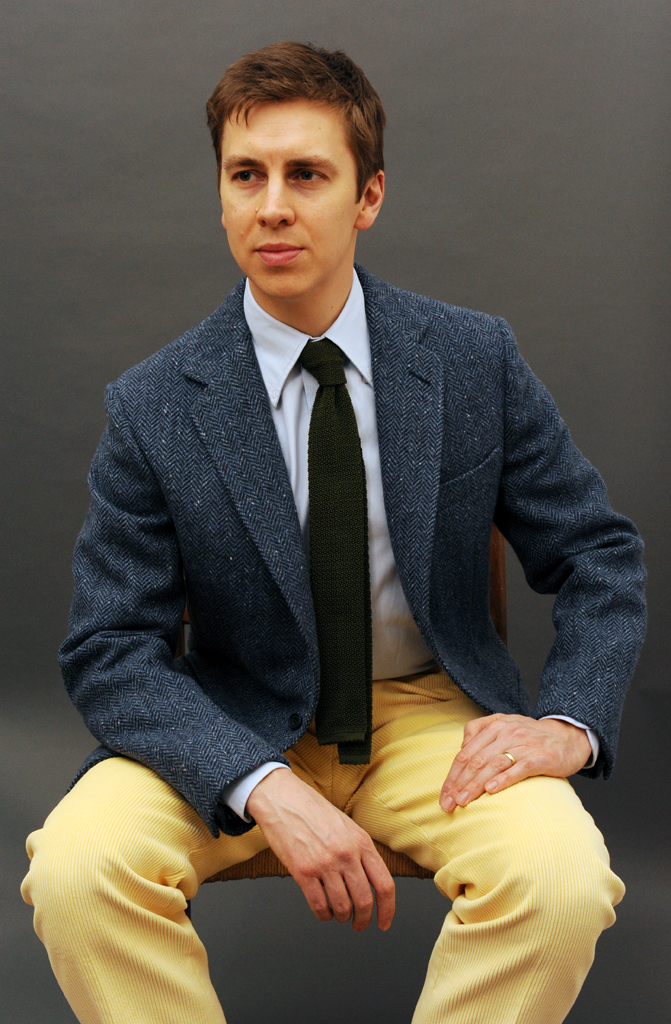 Soft shoulders for being earnest
VR: Please describe how you began writing about style. How did you eventually join the ranks of the British Esquire and then Mr Porter?
MF: My first writing job was on a hip-hop magazine, but I moved to GQ after I became disillusioned with music journalism. That led me to Esquire, and from there I moved to Mr Porter. In between times there were very fallow periods of freelancing.
VR: MP has better coverage on dressing well than most web stores. How do you select the content and topics for Mr Porter?
MF: We publish at least eight stories a week, almost all of which are about style. Naturally some of these are designed to promote the clothes that we sell, but there’s room for a lot of general style coverage. We approach it in a genuinely editorial way, and are freer to choose what we write about than are journalists on ‘style’ magazines, who have to ‘support’ their advertisers every month.
VR: Should we expect new ventures from the boutique anytime soon?
MF: In the last month we’ve added fine watches, and grooming products. Pens are next.
VR: What is your definition of style?
MF: A man should be at ease with himself and that’s hard to achieve if your clothes aren’t both an expression of your character and physically comfortable. Style is about dressing well; leaving dressing up to children and fashion victims.
VR: Over the years you must have learned quite a bit about apparel. Is there something you wish more men would know? This is a great opportunity to make a lasting influence on my younger readers. Most of us aren’t blessed with rakish relatives, which makes learning about style a challenge later in life — and yet another trait men are supposed to master. All tips and thoughts are valuable.
MF: 1 Don’t confuse knowledge of clothes with a sense of style. Lots of good tailors have no idea how to dress.
2 A man’s clothes should tell his, unique, story. You can admire what someone else is wearing, while accepting that it won’t suit you.
3 Try to buy things from the person or company who actually makes them. You’ll save money, and have a better experience.
4 Work out what’s flattering for you. There is a strong element of objectivity about this – ie does a pair of trousers make your legs look longer, or shorter?
5 Buy the best quality that you can afford. This isn’t the same as buying the most expensive that you can afford.
6 Exaggerated proportions are rarely a good idea, and expensive clothes in faddish styles represent very poor value for money.
7 This is all about looking good, which requires exercise, careful eating and no excuses. Given that classic clothes are looser fitting than fashionable ones it’s important to be in good shape to avoid looking dowdy.
8 There are no rules anymore, but there are things that still haven’t been done well – like shirts with epaulettes, or short sleeves, or both.
9 If you’re looking for something different try a new texture, rather than an eye-catching colour. A cashmere tie has a lot to teach a man on this subject.
10 If you’re serious about this stuff you better enjoy ironing shirts, and polishing shoes. Maintenance is important.
11 Most people know absolutely nothing about style, but this doesn’t prevent them from holding and expressing strong opinions. Ignore them!
12 It’s vital to ask yourself if the things you read about clothes hold true, and what has motivated the blogger or editor to produce an article – often money or freebies will have changed hands.
13 A dandy is not the same as a fop.
14 The price of bespoke clothes is the least interesting thing about them.
15 You can’t understand rock music if you haven’t heard The Beatles, the Stones and David Bowie, and you can’t understand style if you don’t look at the classics. You may not like them, but you can still learn from them.
Photos: Chloë Lederman
Category Interviews, Writers
The Truth That Sets You Free
0October 29, 2013 by Ville Raivio
‘Keikari and Gentleman’s Gazette are really what I think a stylish men’s magazine should be.’
~ G. Bruce Boyer in his second interview with Keikari
Category Quotations
Characteristics of the Grenadine Weave and Ties
0October 29, 2013 by Ville Raivio
The grenadine weave is a complex mesh of yarns combined with a leno technique, where two warp yarns twist around the weft yarns. Wooden jacquard looms are used instead of modern industrial-grade ones for their finesse. The regular warp yarns are combined with a skeleton yarn into a twist. In order to make a leno weave, two or more warp threads cross over each other and interlace with one or several weft threads. The weft is woven in and for each weft shuttle the warp yarns are twisted to make a locked figure of eight. This is all very fine and technical, but the end result is more interesting. Grenadine is an open yet strong, sheer fabric with a low yarn count, great stability and low yarn slippage. On men’s apparel it’s mainly used for neckties.
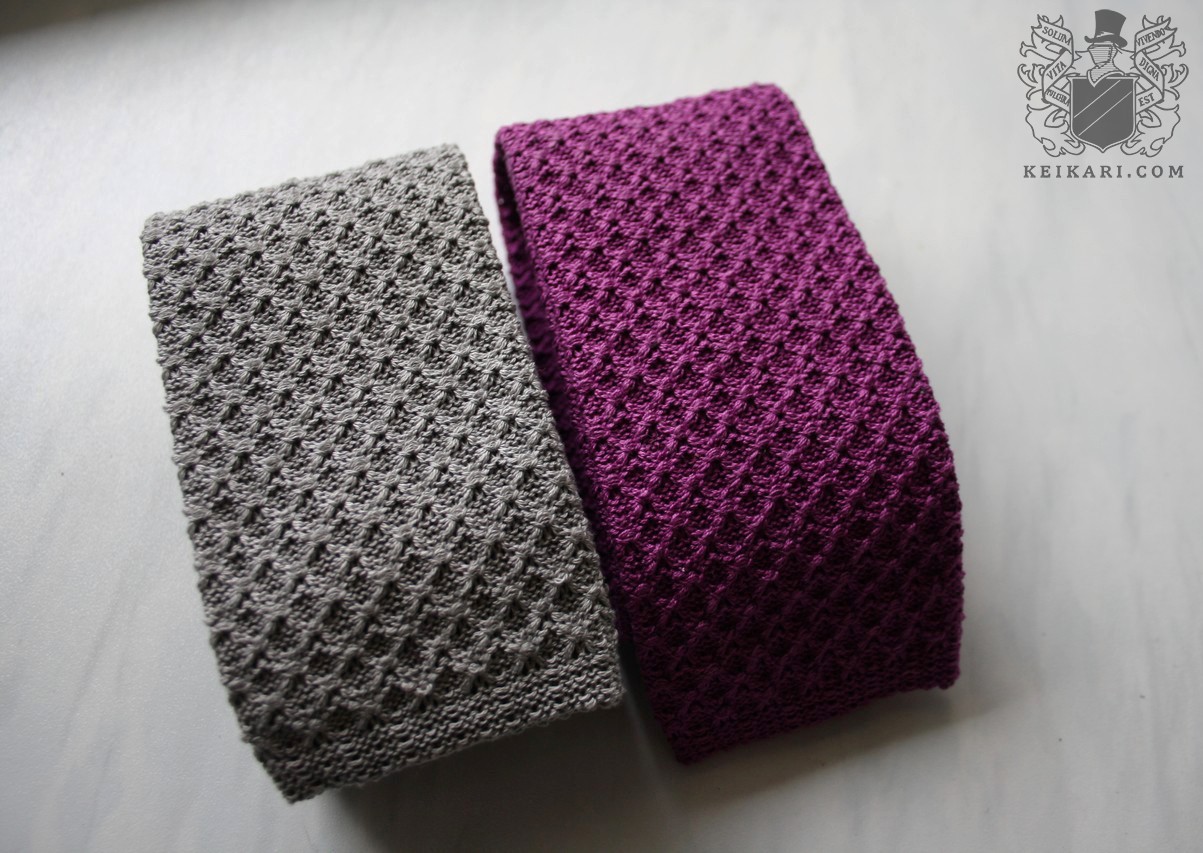
Most leno weaves, as open as they are, leave plenty of room for sunlight, air and casual glances to pass through the fabric’s surface when compared to the tight plain or twill cloths. Ties made from the most open grenadine weaves usually come with lining so that the blade won’t show through the surface. The fabric harks back to the 18th century when it was used for ladies’ black silk lace scarves and dress fabrics, later on in curtains too.
As the finest grenadine weavers are Italian, these being Fermo Fossati and Seteria Bianchi, the different weaving patterns of grenadine are widely known by their Italian names. Garza (as in gauze) fina has a small pattern, garza grossa is a large weave, prometeo resembles honeycombs, garza piccola is miniscule. Grenadine weaving patterns are among the most complex and the process slower, hence the usually higher prices for grenadine ties.

The best-known grenadine man is none other than James Bond. His literary avatar wore black knit ties with nearly everything, while the film versions favoured a navy blue grenadine tie on some of the first films, and a black one for funeral occasions. Mr Bond was in the right. The grenadine tie is a thing of wonder. Instead of screaming neon colours or migraine-raising motifs, the trusty grenadine relies on texture — and what a texture it is. From afar a smooth, ordinary complement for the neck, yet an eccentric, lively silk mesh upon the closer look. It’s certainly among the most eccentric woven tie fabrics; smarter in finer weaves, casual in larger weaves, and holds a knot like no other. Every day is better with some grenadine.
Benedictine
0October 28, 2013 by Ville Raivio
Claymoor: If Heaven exists, what would you like to hear God say when you arrive at the Pearly Gates?
BF: I hope that heaven exists, anything else would really, really scare me. I don’t mind what God will say, as long as he wears a Shibumi tie.
Benedikt Fries in Claymoor’s interview.
Category Quotations
Interview with David Reeves
1October 28, 2013 by Ville Raivio
VR: Your age and occupation?
I’m 34 and a Menswear tailoring designer.
VR: Your educational background?
DR: A level Art and History, Btec Diploma (foundation course) Art and Design. BA Hons Art and Design.
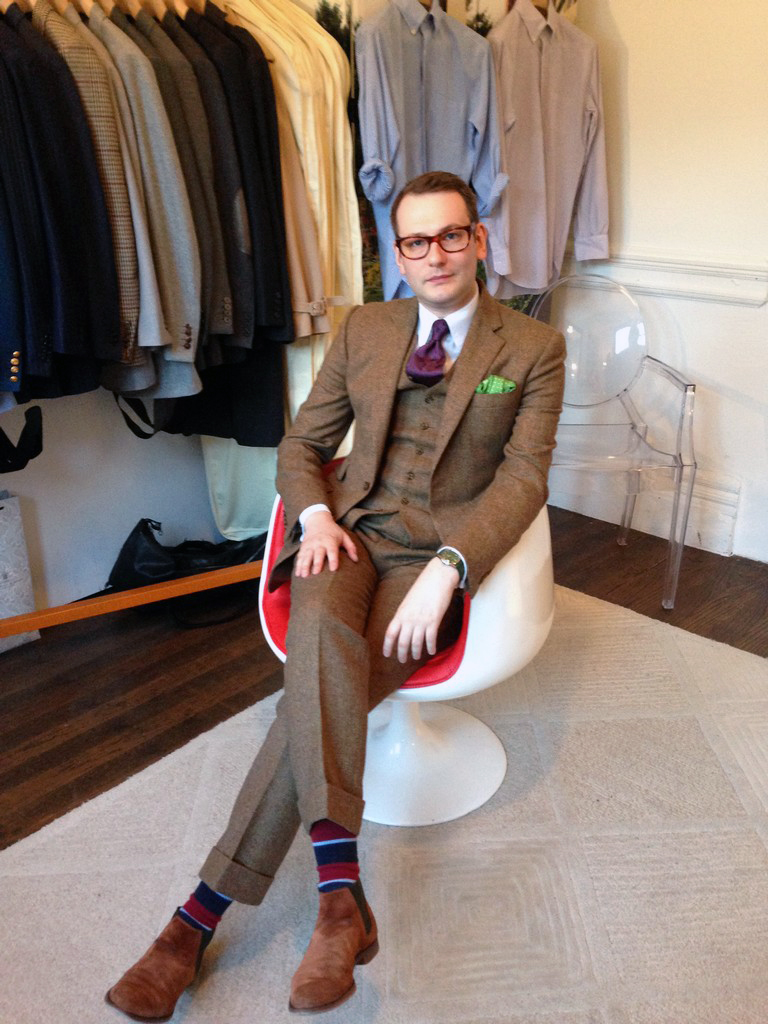
VR: Have you any children or spouse (and how do they relate to your style enthusiasm)?
DR: I am married to my wife Carter and we have two children, a boy and a girl, Fox and Kay. I don’t think they relate to my style enthusiasm but being a business owner and a man with a family I do feel highly motivated to make the business a success not just for me but for my family.
VR: …and your parents and siblings’ reactions back when you were younger?
DR: I think people just didn’t get it—they thought it was weird or pretentious that I had such an interest. I was at that time obsessed with tailoring. I worked two part time jobs in order to get a new suit made every two weeks, get my hair cut every week at Sassoon, and really play with the idea of mod pretension — I was known to show up to indie clubs in a big white limo…ridiculous, but I loved the whole concept of overindulgence and really turning heads. I was wearing purple three piece suits at art school and all my hippy teachers couldn’t stand it. I have still never lost my enthusiasm for clothing and luxury. If I’m not living the lifestyle I offer to my clients, then I may as well be selling anything. I’ve never seen this line of work as a job, but more as an extension of my own aesthetic and those of my inspirations.
VR: What other hobbies or passions do you have besides apparel?
DR: I download a different movie to watch on the subway every day. My dad was one of the first people in the UK to have a video shop, so I grew up with an innate love of film. I especially like watching Kubrick and Ridley Scott films, as well as classics like Scarface, Casino, Clock Work Orange and Death in Venice—most often I find myself watching just for the clothes inspiration.
When I was younger, I was an avid chess player and I liked to go shooting and to paint and draw. I work 6 days a week as standard, and with two young children as well I find little time for hobbies. It sounds cliché but all my hobbies tend to center around my work—I have a passion for the shear business aspect and for running a business, I like problem solving and making things work. I really do enjoy and look forward to going to work. Even after four years here, I still kind of feel like I am on holiday at times.
VR: How did you first become interested in clothing, and when did you turn your eyes towards classic style? Why classics instead of fashion?
DR: I think it began to really take shape once I was in my early 20s simply because I could not get clothes to fit me! I went to a tailor in Leeds and got a pale grey double breasted suit made up with a subtle pink stripe, slanted pockets and a ticket pocket. I’d wear it around with a pink and black Vivienne Westwood umbrella. I’ve always had a natural interest in fashion, but I’ve been much more drawn to a classic, timeless style, even from secondary school. I came from a rough neighborhood in the North of England, we had to wear uniforms to school but the blazer was no longer compulsory, my mum got me a second hand one and I remember first wearing a tie and putting on the blazer. When I showed up I was one of only two kids in a school of 1000 wearing one. I got head butted on the first day but I wore it for three years.
I like “classic style” because of its enduring nature and history. It’s a challenge to work within those classic parameters– you really can’t reinvent the wheel completely in regards to men’s tailoring. That said, I am very interested in fashion, and I find it imperative in my business to stay on top of the ball regarding trends and innovations in order to produce the best mix of classic style with an on-trend focus.
VR: How have you gathered your knowledge of clothing — from books, in-house training, workshops or somewhere else?
DR: I first worked at Gieves and Hawkes when I was studying graphic design at Leeds, and got the brunt of my training through throwing myself into my work. I’ve worked for some great companies under strong managers that were also great retailers. I had one boss, a skin head, 6’6” Yorkshire man who’d just come over and knock all the ties off the table if they weren’t organized and color blocked to perfection. We are still very good friends.
The companies I have worked for have all been very high-end while remaining very small companies, offering much more face-time with clients and with my superiors. At Richard James, we would all eat lunch together with Richard, talking about everything from what we’d got into the night before to our competitors. I’ve also had the pleasure of working with great fashion houses, such as Commes de Garcons and Prada. The fashion world and tailoring world are often dismissive of each other, which is a real shame—I’m lucky to have had the unique experience of maintaining high-level positions in both fields, and can bring both skill sets in when working with my own clients.
VR: How would you describe your own dress? Have you any particular style or cut philosophy?
DR: I like clean lines and high quality. I believe myself to be a modernist—I’ve got a rather simple, modular wardrobe, and I don’t really own anything I wouldn’t wear on the day-to-day. I do, however, like to throw something like a track suit on that’s a bit unusual and eccentric. I prefer one white shirt that I buy in multitudes, as well as a number of similar-looking Chelsea boots.Men’s clothing before all else should be easy and functional, it should do a job and it should work.
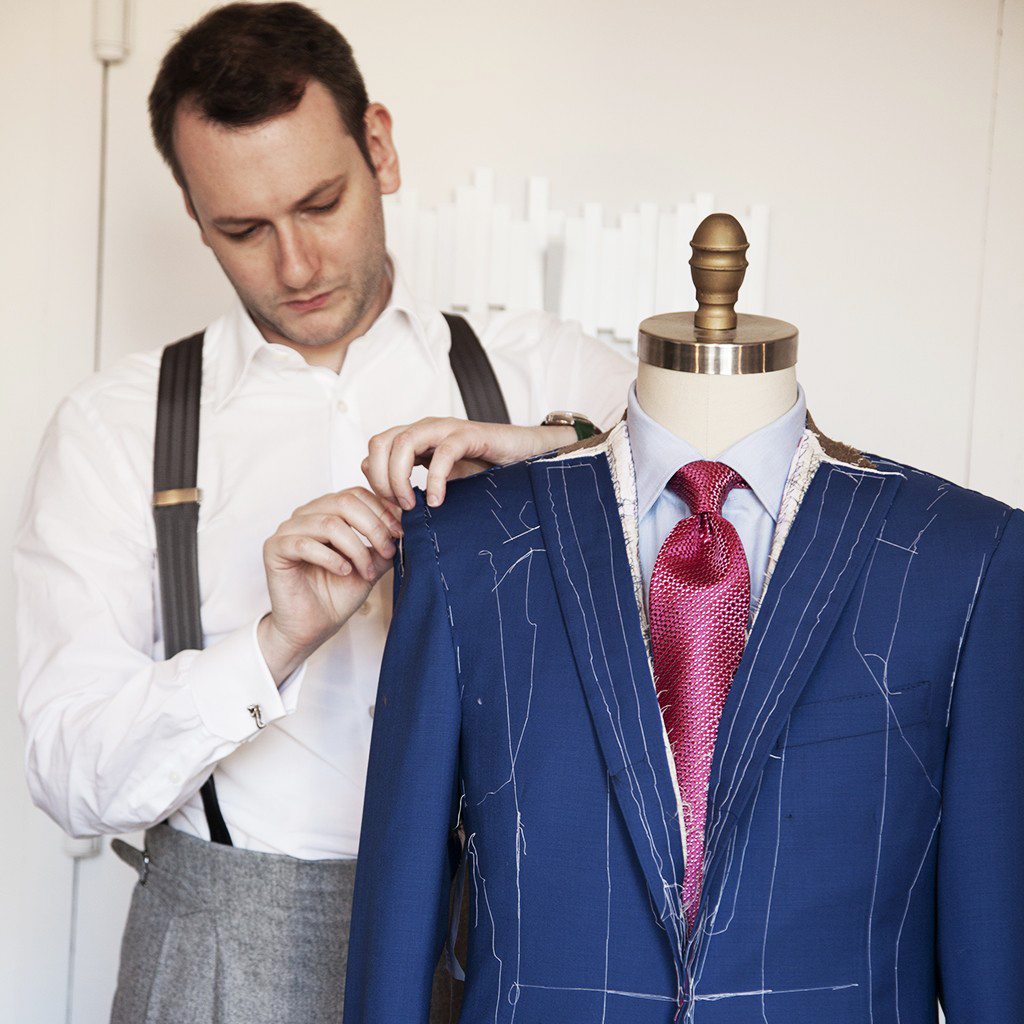
VR: How did you first find Styleforum and what has kept you active over the years?
DR: I moved back to New York in 2008 and discovered the site online. Regardless of whether or not I’d pursued my own tailoring business, I would certainly dress as I do now, and I can imagine I would still find Styleforum in my top sites, simply as a consumer.
Styleforum tends to be a great resource for perspective clients looking for insight into the New York tailoring world. There is always a turn over of posters and guests on the forum and it is often one of the first places people come online to do research on tailoring so it is very useful to engage with potential clients on that platform.
VR: Apart from the clothes you make for yourself, which shoemakers and RTW clothes makers do you favour today?
DR: I like A.P.C because of their color palette and the simple elegance of their clothes. I really like Fred Perry (it’s the only polo I wear), as well as John Smedley and Drake’s. As far as shoes, I have always liked Crockett and Jones although in recent years I have been having my shoes made for me by George Cleverley.
VR: Please describe how your company was born and what goals you set for yourself in the beginning. How have you been received so far?
DR: When I first came back in 2008, a job that was lined up fell through with the economy, I was suddenly unemployed at the worst time and I thought to myself, what can I do? I bought an old suitcase in Bushwick, called up Dormeuil and Loro Piana, got accounts set up and cloth books. Then I contacted makers I had worked with and just set about selling suits. My first objective was to make the rent! In those very early days I was lucky to sell 2-3 suits a month. In many ways I expected to go back to retail as a VP of operations or do something like manage a dept store floor. After about a year, I realized that this was the best thing for me to do. Many of my early clients are still with me and more and more come through my door month by month, I pride myself on my ratings and client feedback which after 4 years is all 5 stars on every review site. Change is inevitable, but as long as you know your strengths and where you stand as a designer and a business owner, you can weather anything.
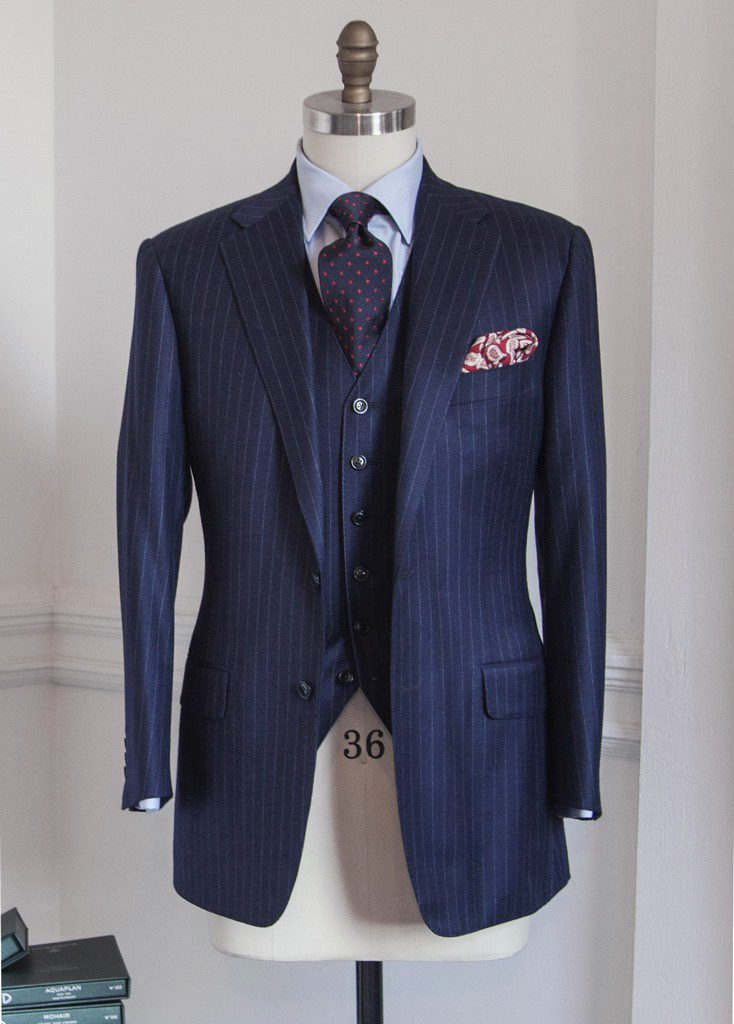
VR: How would you describe the house style of your company?
DR: I would say it is where the classic style of English Savile Row meets an unwavering commitment to high-end quality. Think of the classic Savile Row suit injected with polish through an almost obsessive fitting process and my insistence on utilizing only the best fabrics. There is an element of minimalism to my clothing punctuated by graphic colors, the lines are always sharp and clean. It’s really very much an extension of the clothes I like to wear. There are no gimmicks– just good honest tailoring executed with flare and good taste.
VR: There are many tailors in NY alone — why should my readers visit you?
DR: I uniquely blend my experience in the fashion industry as well as on Savile Row, working only with the best makers and the best cloth houses. I prioritize top-notch quality above all else. I’m not in the business of creating custom suits with sub-par materials—an investment like a good suit shouldn’t be skimped on or you’ll only lose its lasting value.
My good friend and former Richard James colleague Michael Hill is now at Drake’s, and once I asked him what was the secret to designing ties that sell. He gave me the perfect answer: ‘Just make great ties’. I live by this with my own work. I am in the business of making great clothes first and foremost. You can mess around with design gimmicks in detailing or by investing in fancy advertising, but if you don’t make great clothes, then I’d assume at some point people might start catching on. Quality is of the utmost importance, and working with me guarantees long term quality control.
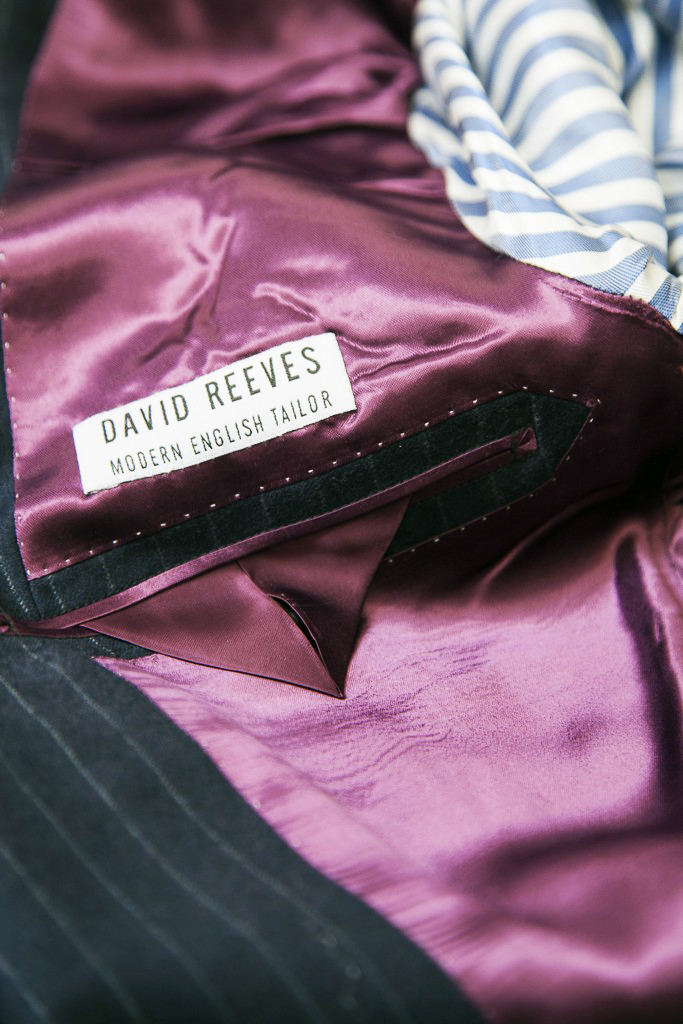
VR: Who or what inspires you?
DR: Fabric and cloth is probably the first inspiration in terms of clothing. Although I suppose I am not known for outlandish patterns and fabrics, the cloth I use is higher-end as standard than what most people use in the industry, this is crucial because using great material can really elevate a piece and this is often overlooked in menswear. Sure, you may be ordering something like a charcoal grey suit but selecting a high-end cloth will make that simple garment stand out for all the right reasons.
When new cloth books come in from places like Dormeuil, Loro Piana and Zegna, I look through them and instantly I am mentally picturing what I would do with the cloth. I will look at a tweed and think that it would make a great jacket, then I look for a corduroy that would go with it, maybe boldly matching the plaid in the tweed. By the end of it there’s almost a collection in my brain just waiting for me to present to clients. Because I do this, my work has a cohesive identity in that I am not just a medium for producing clothes, but I am working more like a designer, anticipating needs and also coming up with solutions and ideas for my clients’ wardrobes.
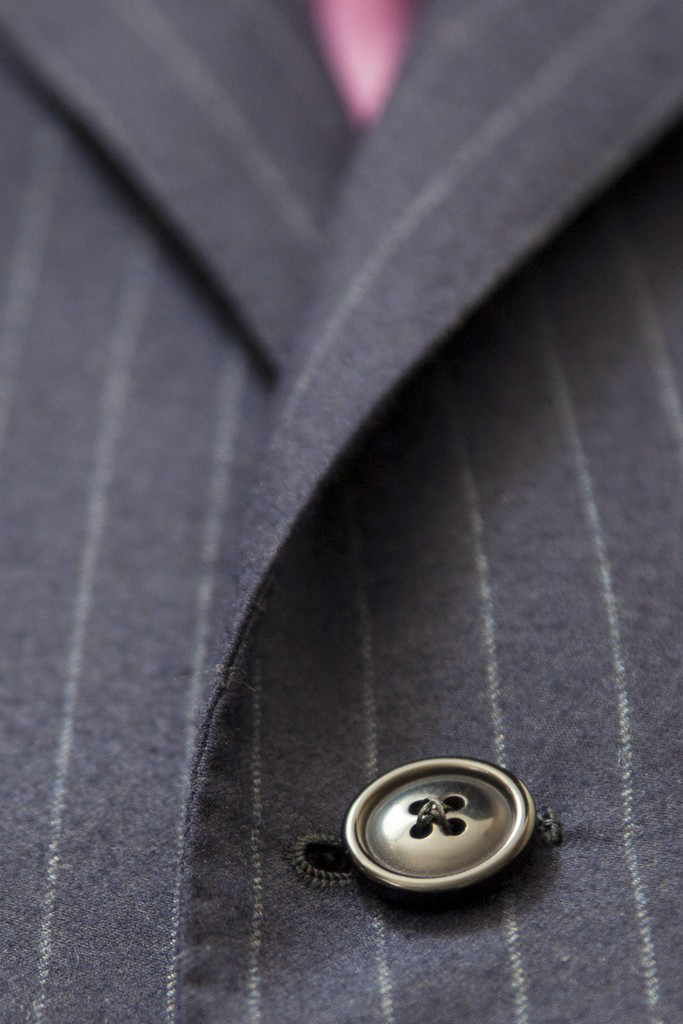
In men’s fashion, history is also very important. You are talking about garments that have stayed quite similar for 100s of years so any good designer or tailor should be looking at vintage fabrics, old fashion plates, photographs and films. The trick is then to take that look and make it appealing and relevant to the modern world. So a client may say to me: I like the suits on Mad Men or Boardwalk Empire, and then I say, well you’re in luck because those makers are going to be making your suit! Now of course those are great costumes but worn today they would just look like costume mostly. I have to finesse that look; slim that lapel here or there, alter that button stance just so, so I keep the spirit and feel of the garment but make it fresh and relevant.
I think this is very important with tailored clothing. Yes, bespoke is an old-fashioned way of producing clothes but to me it’s not ‘fancy dress’ or about living in another time, bespoke tailoring is indispensible for well-dressed men and it is very much about the present and not just the past. In fact, there are new strides being made all the time in tailoring but if you’re a client you may not realize it, or if you’re a tailor that doesn’t keep up to date on things, you may miss out on things like; new luxury cloths that incorporate nanotechnology to make a cloth water-proof without the use of coating or a very new fabric called Tecnik that regulates heat in cold weather and cools the wearer down in hot weather.
VR: What is your definition of style?
DR: Simply doing your own thing. You don’t have to wear clothes that I make to be stylish or spend a lot of money but similarly being thrifty and thinking about your clothes endlessly won’t make you stylish either. It’s more about attitude and a way of carrying yourself and knowing who you are. That said, what I can do is help you find that identity, help you to build a wardrobe strategically in an easy and fun way.
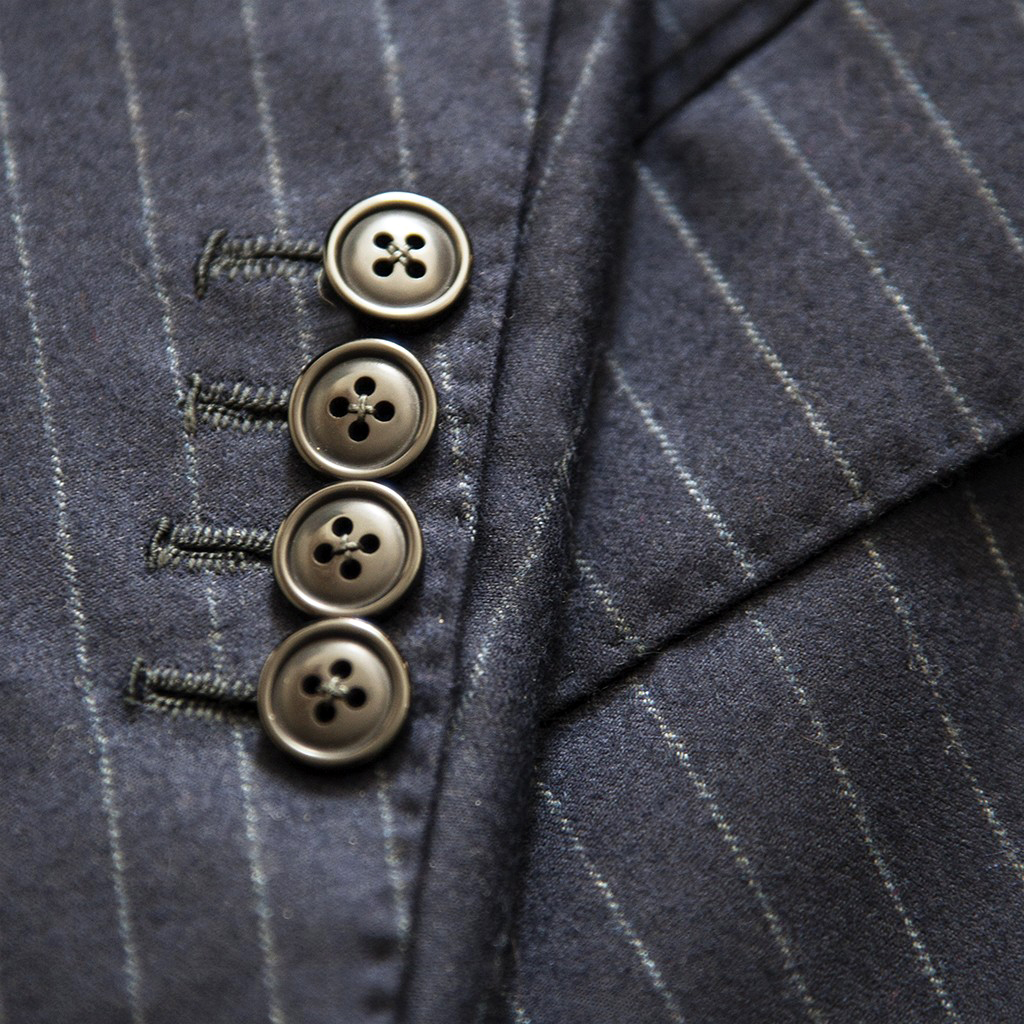
VR: Over the years you must have learned quite a bit about apparel. Is there something you wish more men would know? This is a great opportunity to make a lasting influence on my younger readers. Most of us aren’t blessed with rakish relatives, which makes learning about style a challenge later in life — and yet another trait men are supposed to master. All tips and thoughts are valuable.
DR: I would say start early, as soon as you can without expecting that when the time is right your ideal job or opportunity will be handed to you based off of your past experiences. Experiment a little, have fun, and stay true to your own values and aesthetic. The reality is that buying high-end bespoke clothing is a long-term investment, and a good one. Buying inexpensive suits that begin to pill or fall apart puts you in the frustrating cycle of replacing pieces that don’t have lasting quality. You may be buying cheaper, but most likely, you are really just buying much more. Investing in quality will save you loads of hassle and money in the long run, and you’ll always love your clothes.
http://www.davidreevesbespoke.com
Photos: David Reeves
Category Designers, Interviews, Tradesmen
Copyright © 2013 Ville Raivio