Naples, Romans, and Louis Vuitton
0March 21, 2015 by Ville Raivio
“Like Rome and Istanbul, Naples is a palimpsest, one era of humanity superimposed over another. Construction on the new subway station near the Castel Nuovo (the ‘New Castle’ – completed in 1282 A.D.) proceeds at fits and starts because workers keep discovering ruins of historical importance.
Retracing this history from the very beginning would mean visiting the Greek ruins at Cumae and Paestum – Naples (‘Nea polis’, ‘new city’ in Greek) began as a Greek settlement. But like the rest of the Italian peninsula, eventually it was subsumed into the Roman Empire, the LVMH of its time.”
— The David Isle
Category Naples, Quotations
French back boxer shorts from Brooks Brothers
9March 21, 2015 by Ville Raivio
I cannot recall the first time I saw French back boxer shorts, but they were on Brooks Brothers’ webstore and have stayed in the company wares to this day. The reader with good memory will remember that I have a thing for underwear, and I’ve been hunting for “the best” pair for at least ten years. So far the best pairs I’ve found from Schiesser, and they still offer an unbeatable price-quality deal as my pairs have no lint, torn seams, faded colour, or holes after many years of use. Still, the French back model looked unlike any other I’ve seen, and I couldn’t shake off the thought of giving them a try. I now have pair and you need to read on.
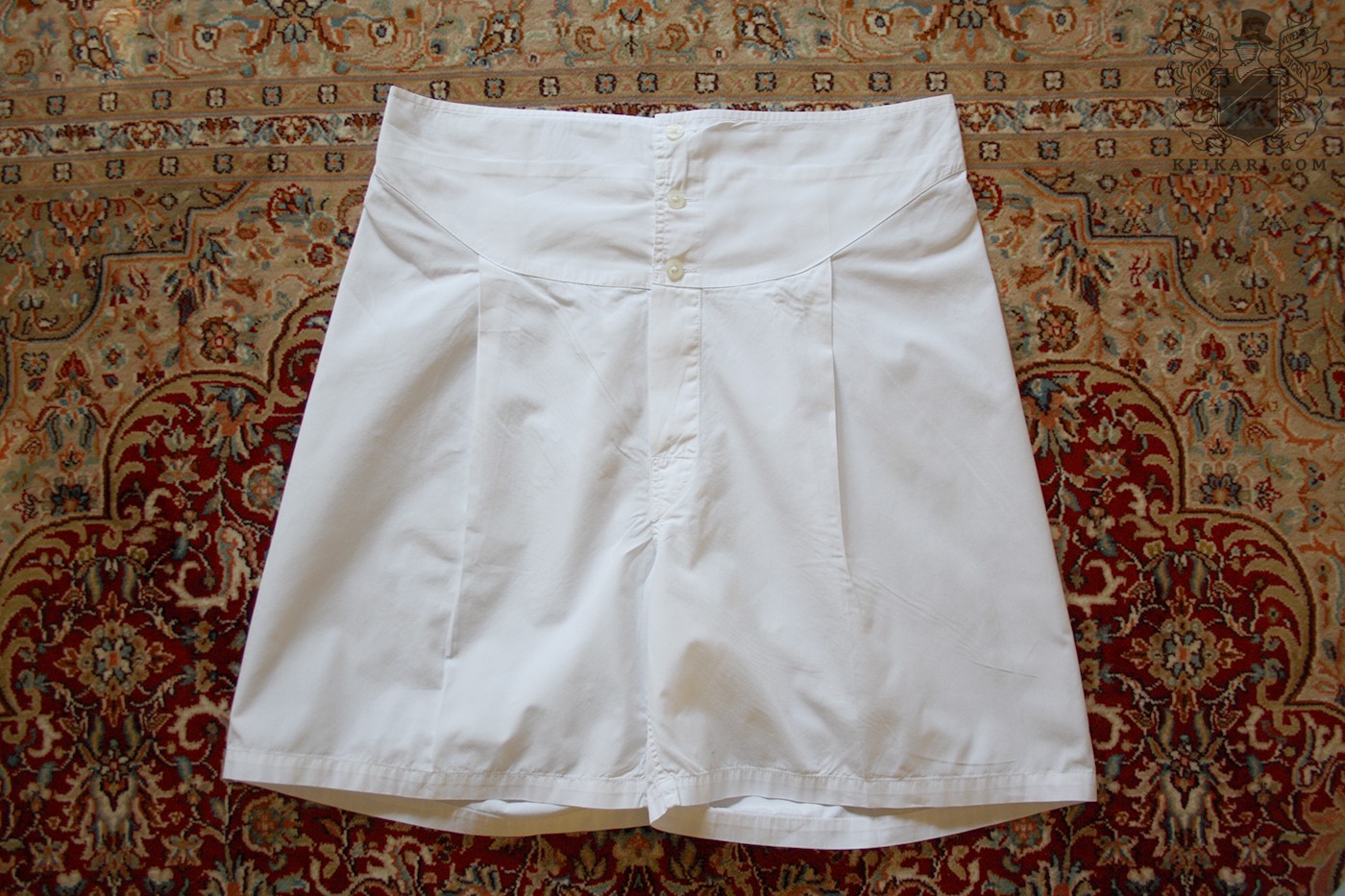
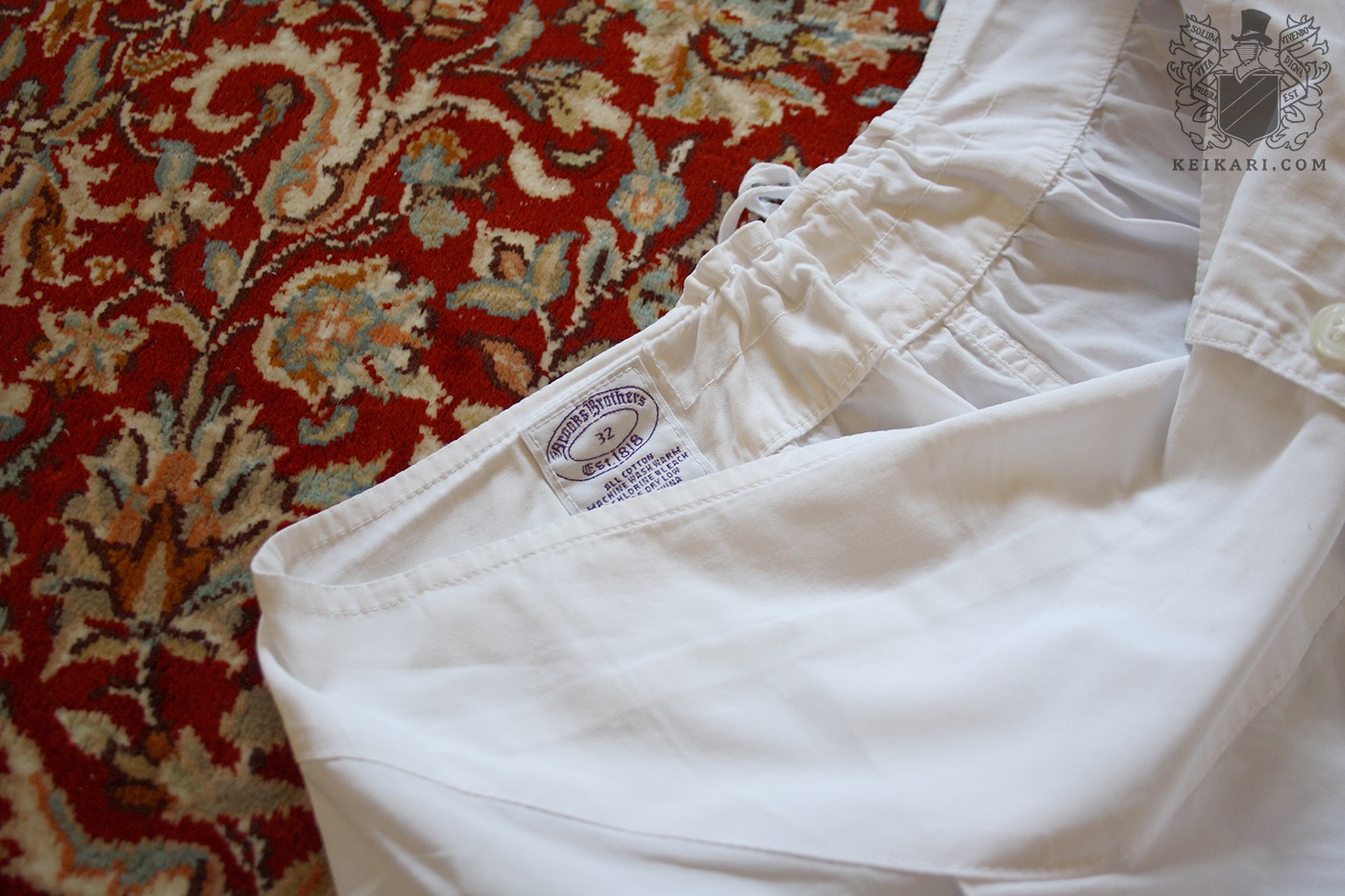
The brothers of Brooks tell us that the model is “A classic staple from our archives in pure cotton broadcloth. This self-fabric waistband without elastic features a button-front yoke, sized by waist size and adjusted with button tabs for the perfect fit.” The waistband is indeed peculiar. There’s no elastic, no internal structure, just two pieces of shirting sewn together. The backside band has a pre-tied bow that cannot be opened, it’s a showpiece with no use other than a quaint vintage look. Then again, I may just have a pair with poor make.
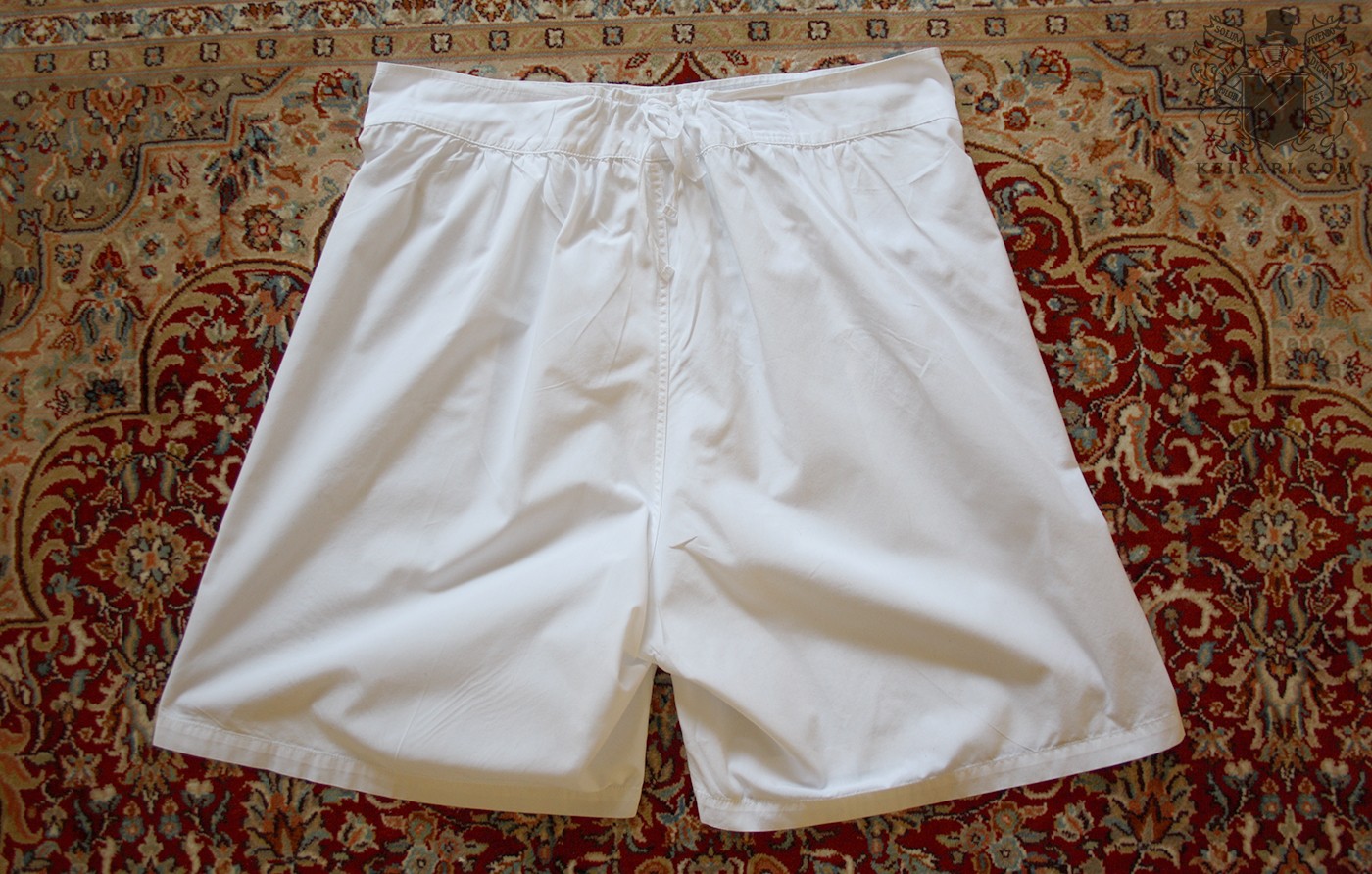
The French backs are cut high on the waist and very loose, and the rise is sky-high so the last, best manly parts have lots of room to roam. They are sized in two-inch increments, the fit is exact and ruthless on those with a size in between. The chap with a 33” waist, say, should either take a size up or move the yoke buttons for additional room. Speaking of the buttons, they are dull plastic and loosely sewn, but work well and look swell.
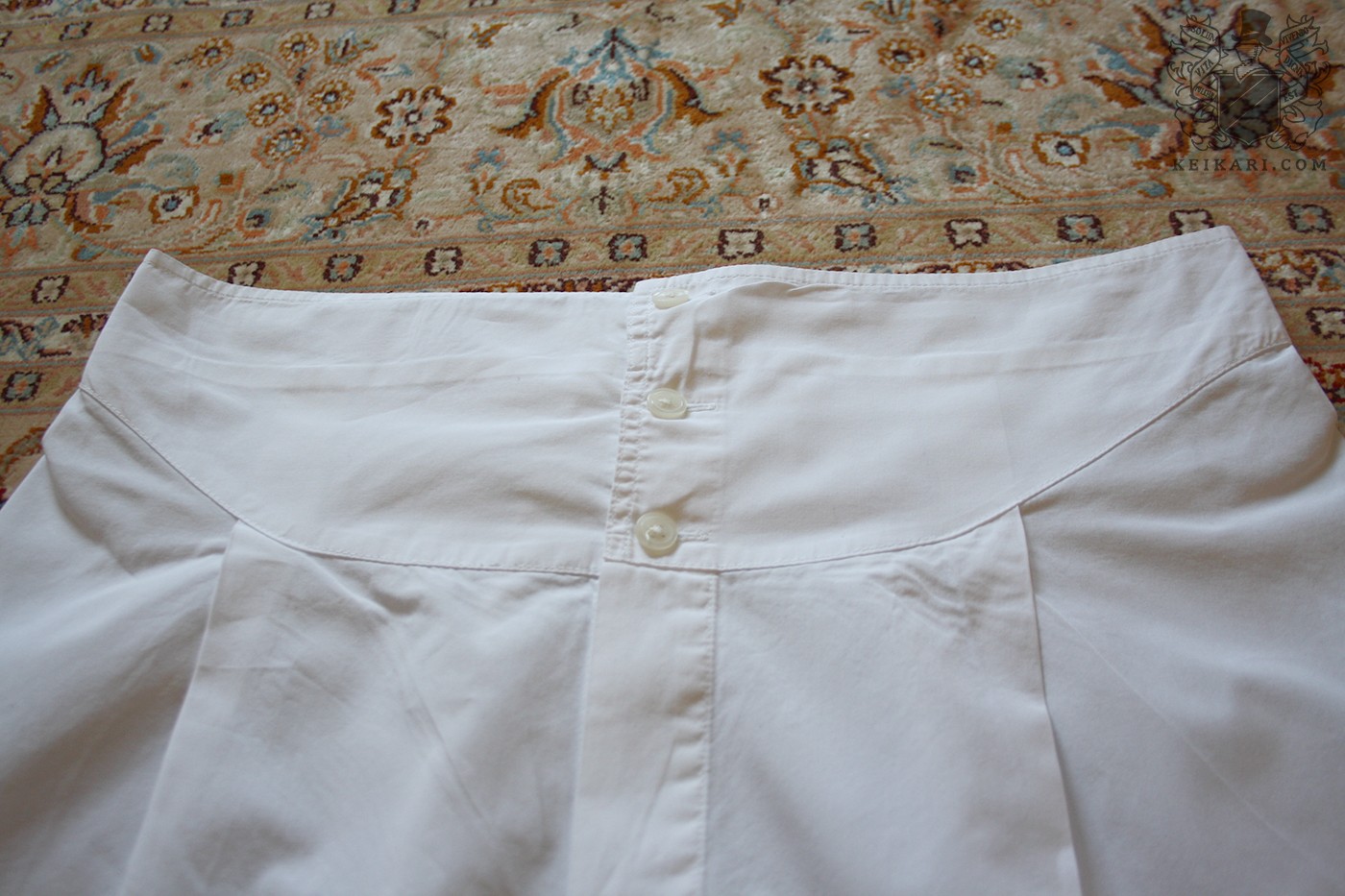
The boxer shorts stay in place very well all day, and the roomy cut is freeing. While the listing states that the pieces are made from broadcloth, my pair is poplin. Luckily it’s the better kind of shirting, very smooth, very soft, very firm. I’ve never had problems with woven shirt fabrics shrinking or pilling, so I trust these will last several years. The shorts are kind to the skin, though the elasticless waisband seems strange at first, and the model looks closer to loincloth than underwear. They reach up an inch below the navel, and down two inches away from the knee.
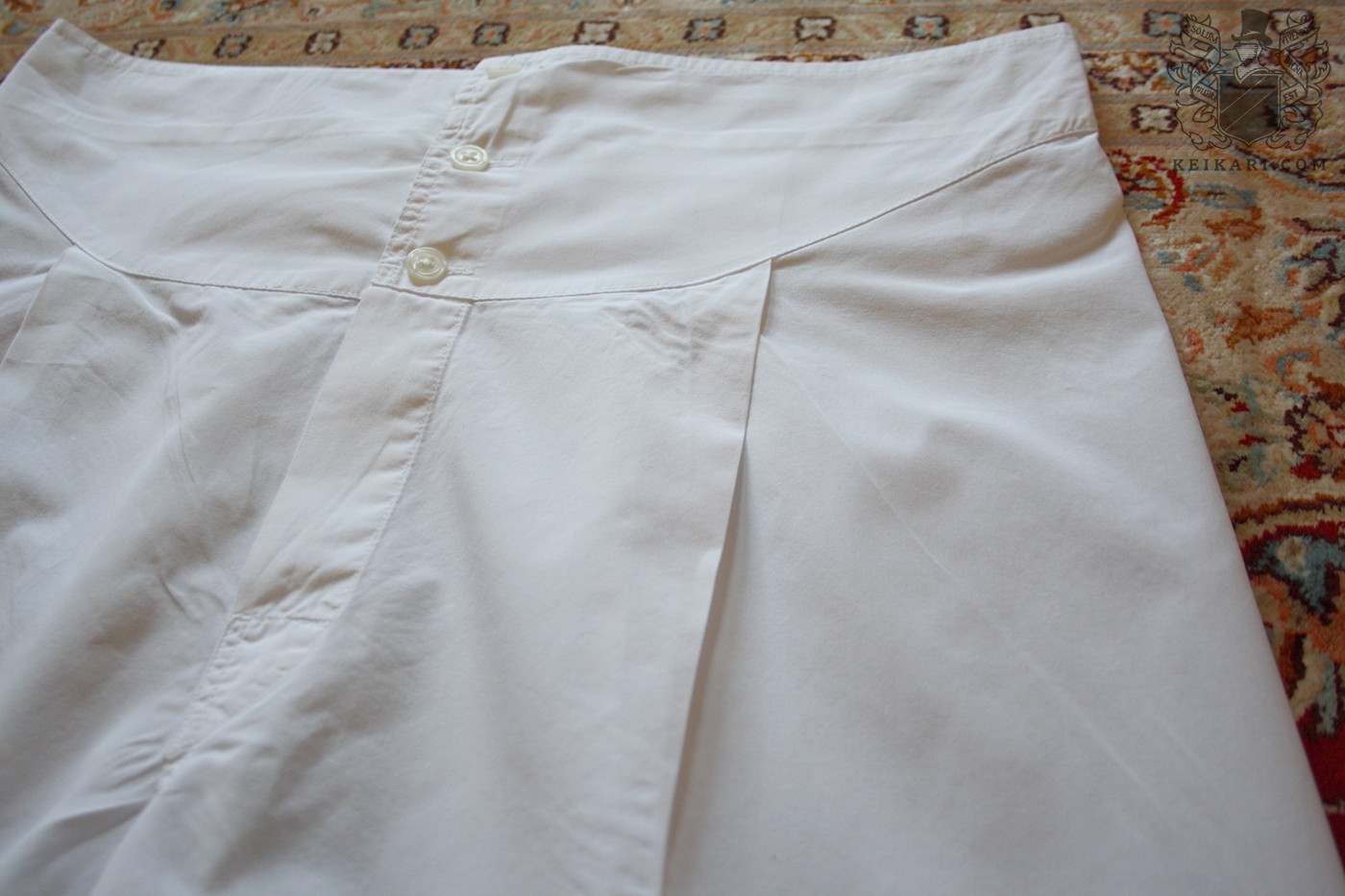
The stitching is straight but not dense, and the front part has inch-deep pleats. The pair is made in China, costs some $30, and only comes in two colours. Summa summarum: the BB French back boxer shorts are charming, well-made, feel excellent, and have a peculiar vintage look I enjoy. I only wish they’d offer it in more colours and fabrics with MoP buttons, and that the dollar’s exchange rate wasn’t so high these days. I hope the model stays in production for many decades to come. These shorts are unique.
Category American style, Reviews, Underwear, Vintage, Web stores
Paul Press of J. Press: A Quasi-Official Yale Man
1March 21, 2015 by Ville Raivio
Here’s a little something I found online, an interview with the scion of the American J. Press tailoring company, purveyors of Ivy League clothing.
A Quasi-Official Yale Man
by Mollie Wilson
from The Yale Journal for Humanities in Medicine, May 9, 2004
‘During all the time I was at Yale, I never really looked past the windows of the J. Press store on York Street. I was familiar with J. Press, of course. In my undergraduate years I had passed the storefront many times, and I knew the company’s reputation as purveyors of the “Ivy League Look”: expensive essentials for discriminating men, including tailored suits, crisp button-down shirts, and eye-catching, perfectly coordinated neckties, as well as quaint accessories like oar-shaped tie bars, polka-dot bow ties, and brightly-colored suspenders with matching two-tone socks. The mannequins in the windows of J. Press were not intended to represent me; they modeled the style of clothing that Yale men wore in the days when the phrase “Yale man” was redundant. For Yalies at the beginning of the twenty-first century the name “J. Press” connotes an old-fashioned look and mindset, a stereotype that no longer reflects the Yale student body. If J. Press does much business with undergraduates these days it is in costuming the members of the ultra-right-wing Conservative Party, who wear their anachronistic J. Press scarves and bow ties to lectures and football games, where they strike poses and smoke pipes in an effort to evoke the spirit of Old Blue. Those Yalies who do not want to be perceived as elitist and backward are careful not to be seen lingering in front of J. Press.
The name “J. Press” conjured a specific set of associations for me by the time I graduated from Yale, but I never considered that there might have been an actual person after whom both store and image were named. I was surprised to find that the “J” is short for “Jacobi,” the given name of a nineteenth-century immigrant who founded a clothing store in New Haven in 1902. I learned this from Jacobi’s son Paul, who worked in the family business from 1932, when he graduated from the University of Pittsburgh, until 1986, when the company was sold to a Japanese firm. At ninety-two, the junior Mr. Press still dresses the part of company president: he greeted me at his New Haven apartment clothed head-to-toe in J. Press merchandise very similar to what is still displayed in the windows of the flagship store on York Street. Even on a warm summer afternoon, alone and dozing in front of his television, Mr. Press is dressed to do business, sporting a blue-and-white seersucker suit that could easily have hung in his closet for decades. His light-blue dress shirt is monogrammed, but the “P” that stands for “Paul” has worn away, leaving only a shadow next to the initials “R. P.” His tightly-knotted necktie is accented with a tarnished gold tie bar shaped like a tennis racket (still available in the display cases on York Street). Aside from the tasseled loafers (“These are Gucci,” he tells me, “which I bought in Rome”), every item of clothing bears the familiar navy blue “J. Press” label whose white lettering indicates both the manufacturer of the article and the status of the wearer.
Like the J. Press style, which has the unique ability to appear both antique and timeless, Paul Press seems hardly to have acknowledged the passage of time since his retirement in 1986. Much younger men would have difficulty keeping up with his schedule: “I keep active,” he tells me, beginning every day with twenty-five sit-ups and a quick run. Over breakfast he scans the papers, paying special attention to the obituaries (which function as society columns for the over-ninety set). “‘Who died?’ I want to see. Nobody I know, I’m happy, but I usually find somebody every time, ’cause I’ve been here so long.” Then he checks himself in the floor-to-ceiling mirror inside his front door and heads out to Payne-Whitney Gymnasium or the Woodbridge Country Club, where he bikes, swims, and showers before meeting “the fellas” for lunch. He goes out again for dinner-“I never eat at home,” he says. And through it all he is impeccably dressed, as befits the name of Press.
The Woodbridge Country Club, one of Paul Press’s frequent haunts, is also the setting of a favorite story. CNBC was blaring from Mr. Press’s television when I arrived at his door, and President Bush went on speaking earnestly into the camera even after we had muted the set so that Mr. Press could fulfill his promise: “I’ll tell you a story about Prescott Bush.” It seems that in the 1950s, when the recently formed Woodbridge Country Club was looking to establish a dress code, club president Morris Bailey naturally turned to resident haberdashery expert Paul Press for guidance. Press and Bailey disagreed when it came to the acceptability of shorts-Mr. Press was in favor of allowing them, but the more conservative Bailey felt they were only permissible as swimwear. The issue was still undecided when Senator Prescott Bush-“The grandfather of this fella,” Mr. Press clarifies, meaning President George W.-showed up at the Club for lunch. Mr. Press paints the picture for me, warming up to the punch line: “I said, ‘Where’s the Senator?’ ‘He’s downstairs getting dressed.’ Pretty soon, in comes a six-foot three or four, tall-looking guy with walk shorts on: Senator Bush.” Bush’s entrance settled the debate: “They wore shorts after that.”
This brush with fame is by no means an isolated event in Paul Press’s life: he rubbed elbows with scores of important men who passed through the Ivy League during the fifty-odd years he peddled suits. According to the company’s Web site, J. Press has spent a century serving “the most dignified clients a clothier has known,” including “Presidents, business executives, members of the entertainment industry, and those still climbing the ladder of success.” At the time Paul Press first met the movers and shakers who loom large in his memories, most fell into this last category, just starting out on that ladder as well-dressed undergraduates at Yale, Harvard or Princeton. J. Press was a formidable presence in those college towns and throughout the country by the time Paul joined his father in running the business in 1932. Along the way he also met Prescott Bush’s son, George-“Very nice man”-and in the forties, when both he and Barbara Bush were working on York Street, he ran into her so often that she teased him, “Mr. Press, you never invite me to lunch.”
For authors like F. Scott Fitzgerald and James Michener, who often endowed their fictional characters with Ivy League pedigrees, dressing a young man in J. Press clothing indelibly marked him as belonging to elite society. Mr. Press is very proud of this reputation, and very happy to share stories of his brushes with the rich and famous. Most of these anecdotes conform to a basic pattern: Paul Press introduces himself to the luminary in question, opening with a humble “You don’t know me, but.” and upon hearing his surname, the addressee almost always exclaims, “Press, as in J. Press? Of course I know you!”
Mr. Press particularly enjoys telling one of the few stories that deviates from this pattern-the tale of his encounter with Martin Luther King, Jr. The two men met for the second time when Paul took a trip to Puerto Rico in 1964: he was headed down a flight of stairs with his wife, and King was coming toward them up the stairs. Their first meeting, four or five years earlier, was more official. The left-leaning Rabbi Goldberg, of New Haven’s Mishkan Israel, had been imprisoned with King in 1959 after a demonstration, and as a result King had accepted his invitation to speak in New Haven at the temple where Paul Press happened to be president. After the talk, Dr. King needed a ride to the train station, and the temple president was nominated to be his chauffeur-Paul even took King to a 24-hour restaurant so he could grab a quick meal of scrambled eggs before heading home. So when they ran into each other again in Puerto Rico, Paul introduced himself: “Dr. King, I don’t know whether you remember me, but we met in New Haven.” To which King replied, “Rabbi Goldberg! Of course I remember you!”
Paul Press still has the black-and-white photo of himself shaking hands with a youthful-looking Dr. King, and he recounts their brief conversation with relish, aware that its humor derives from its unexpected finish. It stands to reason that the man who led the fight against racial injustice would be unfamiliar with the clothing company that epitomized the “Ivy League Look,” and Mr. Press certainly does not hold it against him. “Martin Luther King was a damn fine fellow,” he declares. Indeed, Paul Press has a good word for just about every person he has met, which may be why he is so highly regarded in return. He claims to have known all of Yale’s recent presidents, reporting that “Kingman Brewster was a hell of a fine fellow, and so was Whitney Griswold,” and describing Benno Schmidt’s father as a young entrepreneur making lucrative deals for J. H. Whitney in post-war orange juice sales. He reserves special praise, however, for A. Bartlett Giamatti, whom he counts as a close friend. Valentine Giamatti, Bart’s father, was one of Paul’s high school classmates, and Paul Press was invited to Bart’s inauguration as president of Yale in 1978. When Yale purchased the Jewish Community Center on Chapel Street, Press chastised the younger Giamatti, “You have deprived me of my fitness center!”
“Don’t worry about it,” the future Commissioner of Baseball said. “You’ll belong to the Yale Gym.”
“I’m not a graduate of Yale,” Press reminded his friend, but Giamatti waved away the protest, and before long Press received a letter that he now recites from memory: “You’re a quasi-official part of Yale, and we’re delighted to give you a membership in the Yale Gym.”
Mr. Press still works out and pays his dues at Payne-Whitney, and when he finishes the story he proudly displays the membership card that identifies his status as “special.” “See? I’m special,” he grins.
No Bulldog would dispute the “quasi-official” status of J. Press in the Yale experience, but modern undergraduates are more likely to show up to a seminar wearing jeans than custom-tailored pinstriped slacks, and the “Ivy League Look,” like the varsity sweater, is a relic of the past. Paul Press remembers the days before Yale’s residential colleges dominated York Street, when J. Press was located on the “Gold Coast” of desirable apartments for undergraduates and the store’s neighbors included future celebrities like Cole Porter and Sinclair Lewis. In those days he often met Yale students when they were still in high school, buying uniforms for exclusive boarding schools like Groton and St. Mark’s, and they remained J. Press customers when they matriculated at Yale or Harvard. The old Yale had “a lot of romance it doesn’t have today,” he recalls, but for a man who made his livelihood dressing the privileged sons of Eli he is surprisingly positive about the modernization of the university. He describes Yale’s current admission process as “more civilized. not so racist,” noting that the students who work out around him at Payne-Whitney are often women or minorities. In fact, I was amused to discover, his political views are far more liberal than those of the undergrads who now associate J. Press clothing with their own extreme conservatism. Asked for his opinion of our current Head of State, who is still miming a speech on the television screen in the background, Paul considers for a moment before judging him “fair. I don’t think he’s a great president at all. Well, he was elected by the Supreme Court, not the United States people.” After a moment he adds a characteristic personal note: “I didn’t know or like him as well as his father, or his grandfather.”
Changes at Yale have meant fewer student customers for J. Press, but they still do a brisk business in specially manufactured goods, and the New Haven store sells plenty of scarves and other residential college paraphernalia both to undergrads and returning alumni. “Reunion weekend is a big weekend for J. Press,” says Mr. Press, speaking like a businessman once again. “Matter of fact, when reunion time comes along, I drive by York Street and see these white-haired guys with their wives, and stop for a minute.” He acts out the familiar dialogue once more: “‘Do you remember me?’ ‘No.’ ‘Paul Press.’ ‘Oh! J. Press! Of course!’ Then they tell me their name; nineteen twenty-eight, or thirty, whenever they were at Yale.” As an afterthought, he adds, “I don’t do it anymore. But I used to.”
Nowadays one would have to look hard to find men who graduated from Yale in the thirties, or at least to find those who are active enough to revisit their old stomping grounds (only 9 alumni showed up for this spring’s 70th reunion of the class of 1933). Paul, on the other hand, shows few signs of slowing down: he is looking forward to presiding at the Woodbridge Country Club’s annual “Paul Press Day,” including a tennis tournament named in his honor two years ago as a ninetieth-birthday tribute. He points to the framed photo of himself with Wimbledon champ Fred Perry that hangs on his living room wall. I can easily pick Paul Press out of the group of men lined up behind the net: he still has the same solid frame and a full head of wavy, neatly-combed hair, although it has turned from dark to silvery-gray, and the wrinkles around his eyes do little to soften the intensity of his stare. Mr. Press adds wistfully that he will not be playing in the Club tournament this year, having alarmed his family with a fall, but whenever he begins to tell me about his celebrity encounters he still seems capable of tearing up a tennis court.
Meanwhile, in spite of foreign ownership, the company still promotes itself as “J. Press, an American tradition.” Non-American details, such as the fact that founder Jacobi Press was not native-born, are elided from the online “history” of J. Press, and Paul Press himself cannot remember the name of the country from which his father immigrated. Officially, and in Paul Press’s memory, the J. Press image has become the reality. Yet now, as a Yale graduate, I walk by the J. Press store and the name on the blue awning reminds me of a person, a family, as well as a set of outmoded ideals. J. Press no longer seems designed to exclude. Instead, I think of a man for whom the family clothing business was a window into the walled courtyards of the Ivy League. I am sorry the Press family sold the company, even if Mr. Press is not (“It’s a tough time to be in the suit business,” he says, pragmatically, “and anyway, the name’s still on it”). I am sorry that I cannot go in and ask to see Mr. Press, as so many people have done in the past, and tell him, “You don’t know me, but I knew your father. . .”
When I told Mr. Press that I had graduated from Yale he naturally asked, “What college were you in?” and then, when we had exhausted that list of connections (I was in Saybrook; he was a personal friend of legendary college master Basil Duke Henning), he asked, “Where did you go to high school?” I expected him to be disappointed when I replied, “Scranton High”-not Groton, Hotchkiss, or Andover-but although my public school had sent few customers his way, he was impressed. “You must have been a damn good student to get into Yale.” Once again he is transported back to the Yale of his young adulthood: “If your father went to Yale and you were in the class of 1936 and you were a C minus student, you got in ahead of somebody who was an A student who went to [public] high school,” he gruffly declares. For over fifty years Paul Press depended on such men for business, men whose fathers had been fitted for suits by his father, and so he understands the importance of legacies. His own family name is a legacy of sorts, a legacy that combined with a century of hard work to make Paul Press a “quasi-official” part of Yale.’
Category American style, Arbiter Elegantiae, Reading, Tradesmen
Drake’s of London accessories
2March 19, 2015 by Ville Raivio
Drake’s of London is a unique accessories maker founded in, incidentally, London in 1977 by Michael Drake with Jeremy Hull and Isabel Dickson. The company’s very first accessories were scarves, but handkerchiefs and ties were quick to follow. As years have gone by, the company range has extended to cover everything the classically-minded chap likely likes, from accessories to jackets to knitwear to shoes, with shirts as the latest pieces. Most goods are made by hand for that special human touch, the ties fully so.
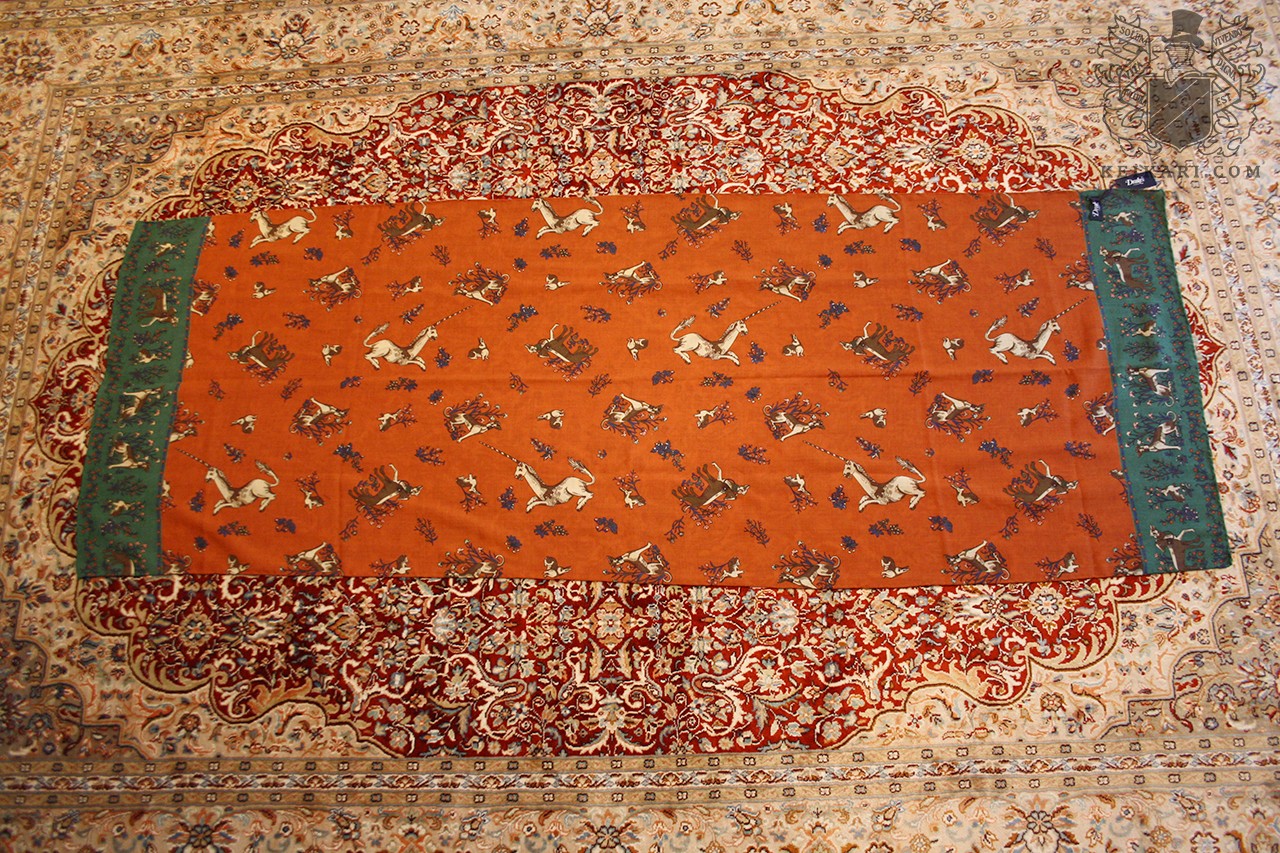
Michael Drake retired in 2010 but his main man, Michael Hill, continues as Creative Director and follows the old ways and consults the company spirits or archives for new designs. Kirby’s hangers has more to say about him. All Drake’s accessories are designed in-house and made in the company’s own factory on London’s quaint Haberdasher Street, or with the help of a few choicest Italian or British makers. Most materials are sourced from the UK. Die, Workwear! has a set of inside photos of the premises and key people.
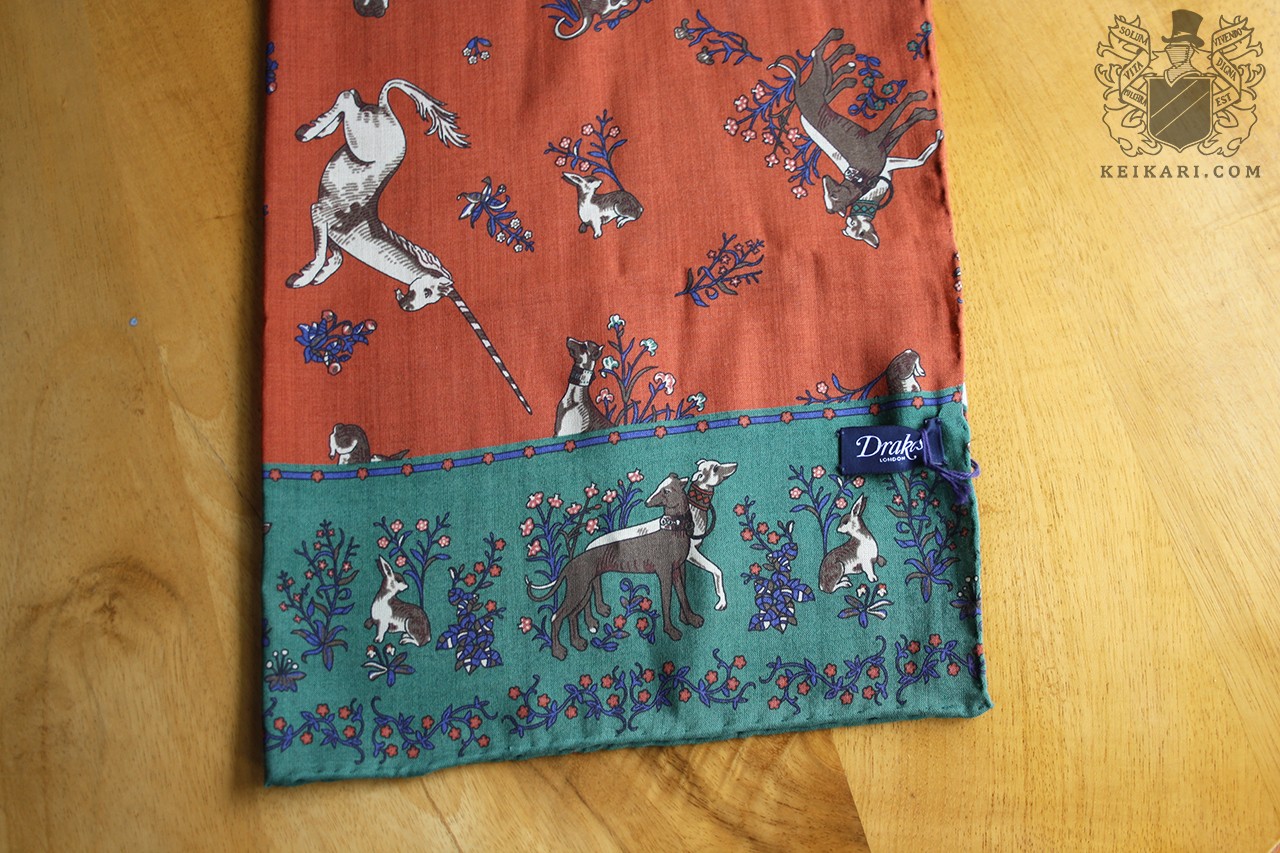
Several of the designs have become, to use that overused C-word, classics. Examples include The Mughal print, The Birds of Paradise, and The Unicorn print, all arduously crafted with dye-and-discharge printing, where the base cloth is first coloured, then each colour is added separately, one at a time. Most makers use inkjet printing, a much faster method with a different look. Drake’s likely has one of the largest collections of tie materials available at any time. Coupled with the maker’s savvy for colours and weaves, their tie range is vast indeed. What’s not available readymade can be made to order. Drake’s is currently the largest independent maker of hand-sewn ties in England, crafting some 100 000 ties each year. The ties bring in around half of the company revenue, and most of them are 8 or 9 cm wide, around 150 cm long. Their large selection, quality as well as eye for colours and materials has made Drake’s the darling bud of the iGentry. Naturally, I wanted a piece of the action to see what the chatter is about.
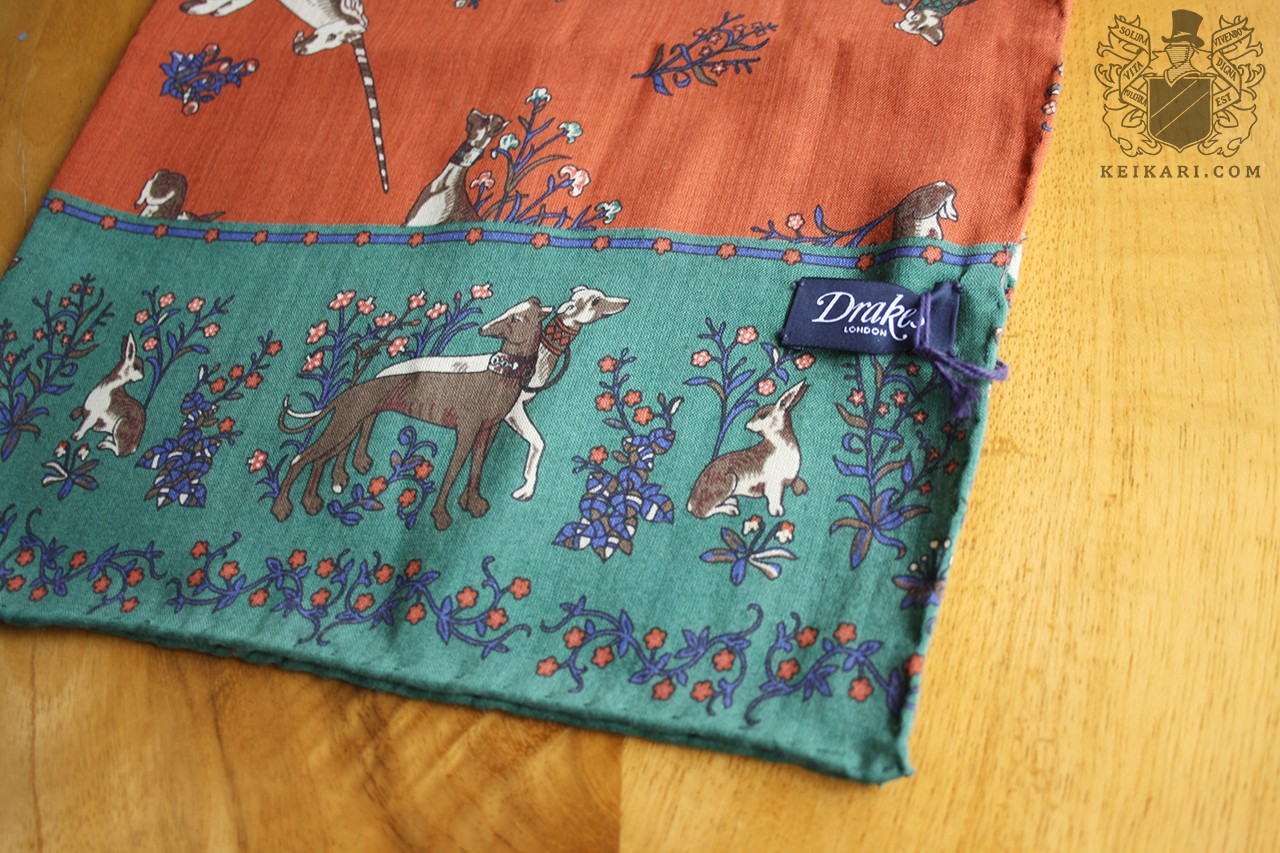
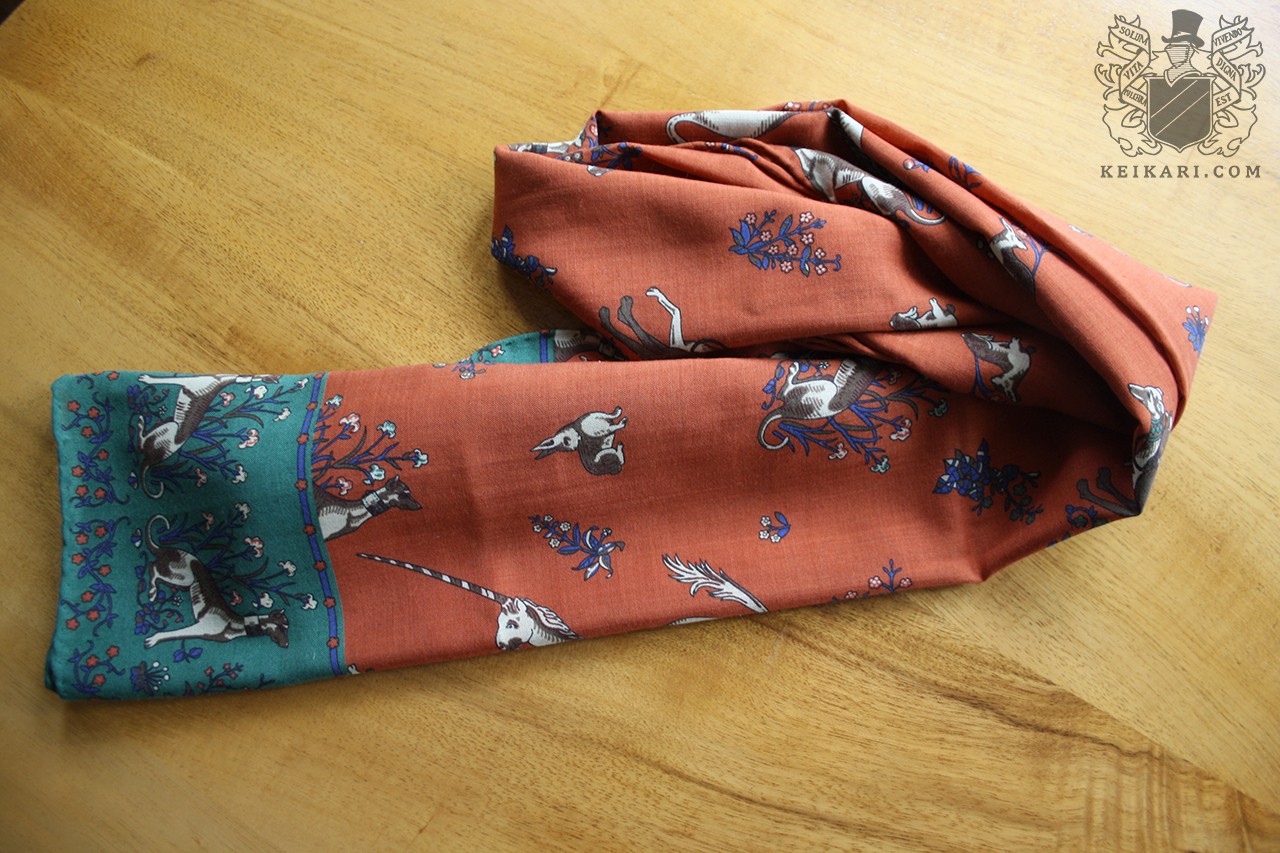
The example accessory is The Unicorn print in scarf form, dyed-and-discharged on a 60% wool/40% silk fabric, with hand-rolled edges. The piece has plenty of length at 175 cm and width at 70 cm, and it reminds me of a ladies’ shawl more than a gents’ scarf. The material is so thin, light, and fine that the scarf must be folded to keep the cold at bay and away. The fabric does feel wonderful on the skin. The large dimensions become useful as without the folds this would be a thin and poor scarf indeed. The hand-rolled edges are nice and rolling, but far from the superlative precision that Vanda Fine Clothing offers. The Unicorn print is a modified copy of the renowned The Lady and the Unicorn tapestries woven around 1500 in Flanders. Despite the copying, I feel this is one of the most beautiful accessory images on the market.
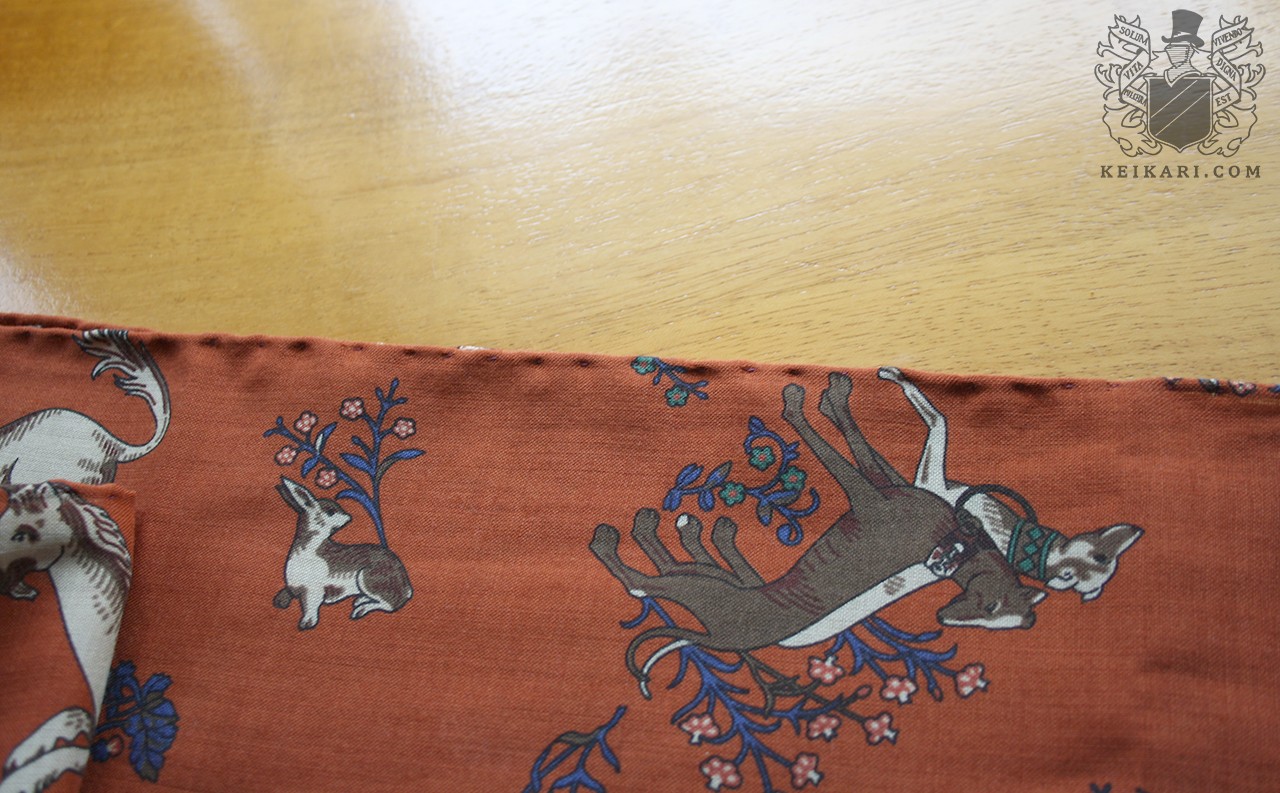
It is even more powerful as the Drake’s colours are something else. My chosen adjectives are vivid, burnt, and living. Most fabrics just don’t have similar colours, and it’s best to see them in real life. As a scarf, that piece of clothing meant to protect the neck, this accessory if flimsy. As an accessory, adornment, or clothes-as-art, it is extraordinary. My only wish is that Drake’s would manufacture it in heavier weight wool. Finally, the accessory costs 235 pounds. This is too much for a readymade scarf, even with a lovely picture, especially given the high exchange rate of the pound. Their prices are what separates me from Drake’s, but there’s always eBay for the cheapos among us. All these considered, it is a very beautiful scarf, and we need beautiful things in our lives.
Category Accessories, British Style, Quality makers, Reviews, Web stores
Copyright © 2013 Ville Raivio