Interview with Joseph P. Marcellino
4June 2, 2013 by Ville Raivio
I am a 40-year-old custom fine bridle leather bag maker from NYC. I Studied philosophy in undergrad and sociology in grad school at The New School University NYC and had some fashion design classes at Parson, which is part of the university. My wife, who is my partner in this business, went to F.I.T. and has almost 20 years experience in the NYC fashion industry working with top designers in men and women’s wear. [My family] thinks I am crazy and obsessive to seek perfection in my art form. It seems like my interests have always been there, not only in fashion but more importantly in fine art and the classics. I don’t term what I do as “leather working” because, at least where I am from, it has connotations of amateur crafts or “western designs.”
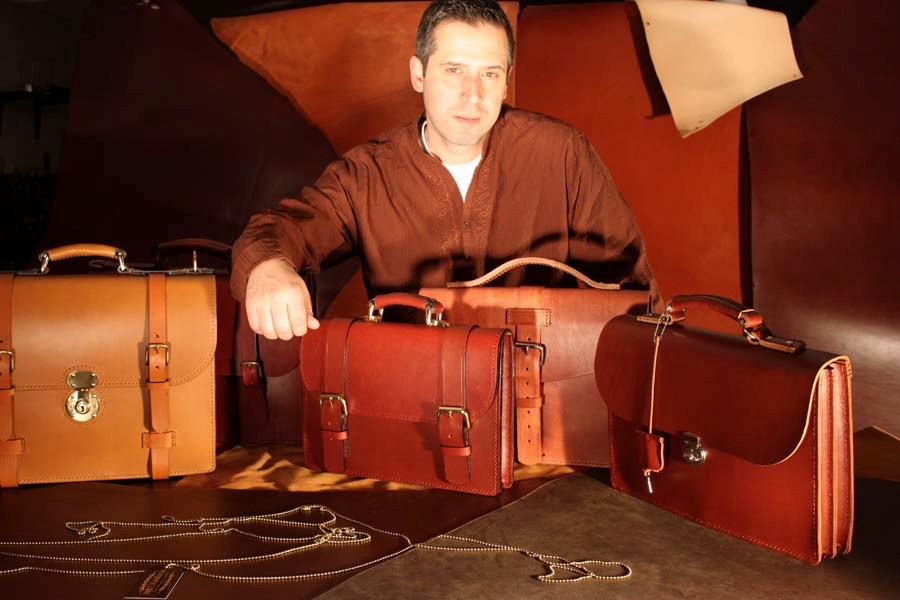
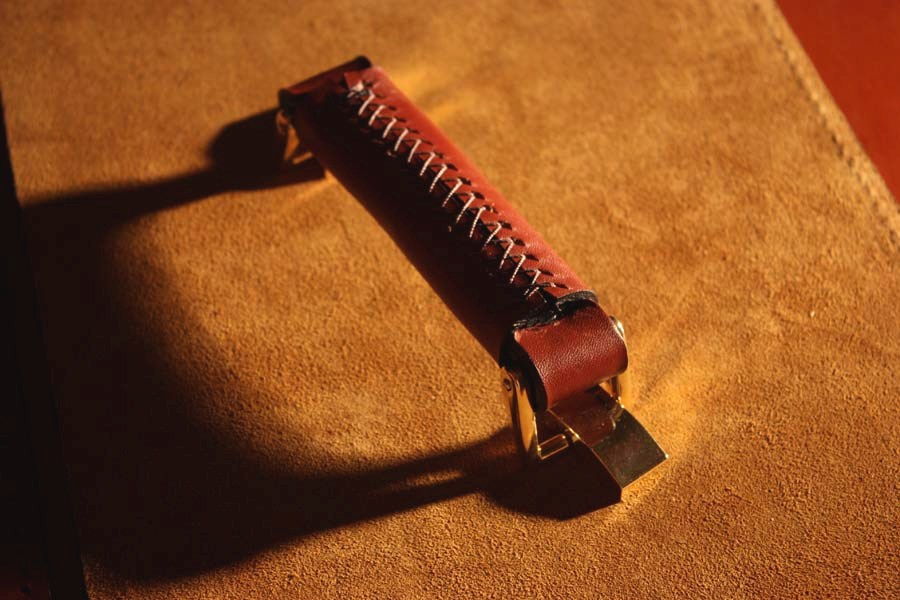
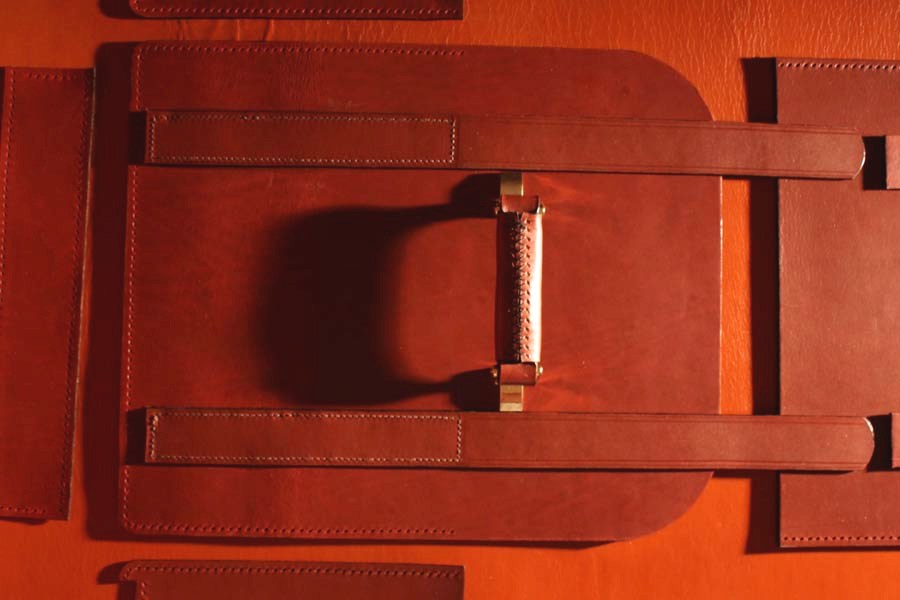
My business was born from the wife’s and my decision to make our designs and from our love of fashion into reality. [My goods are] an artistic expression in a classic bridle leather briefcase and satchel design. I make complicated original works of fine art with bridle leather that are hand sculpted over days of hard labor, and shaped into bags that the user now transforms my work of art into his artistic expression over decades. The end, end result – is a cultural relic. This is how I intellectualize what I do. There is no difference from a painter, musician or fine suit maker. The actual understanding of how to sew and cut leather is easy and came from books and experience, after hundreds and hundreds of bags designed in my head and made with my hands. The ability to form it into an “artistic expression” where people set a high monetary value to it comes from the heart and life’s (often painful) experiences.
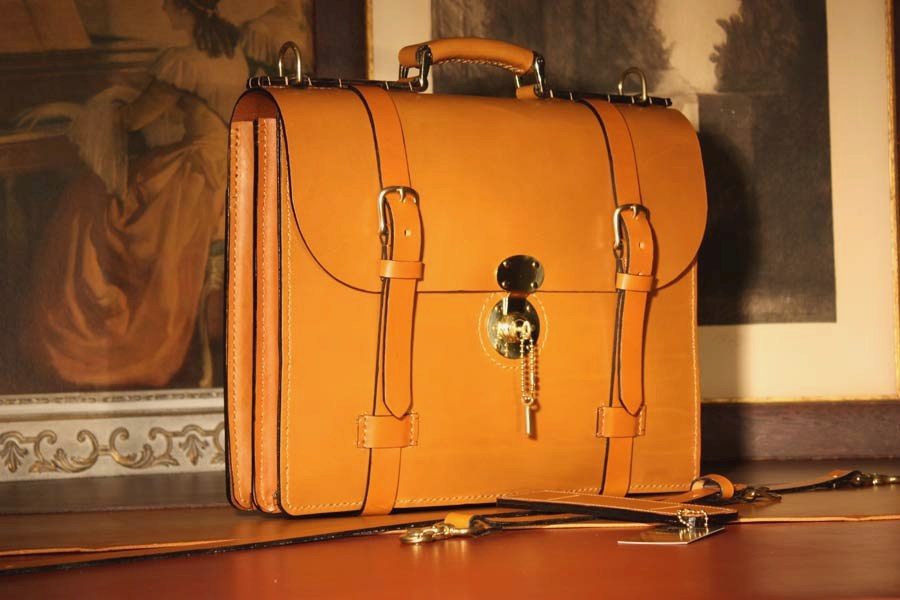
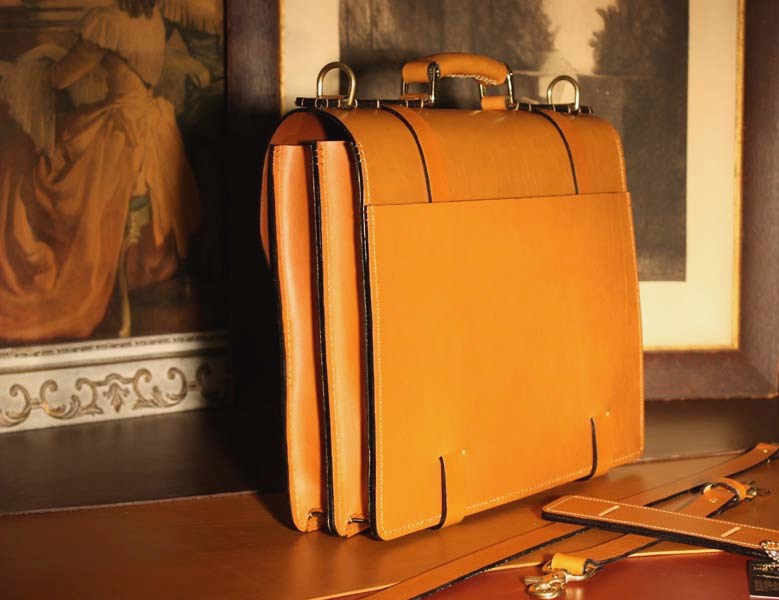
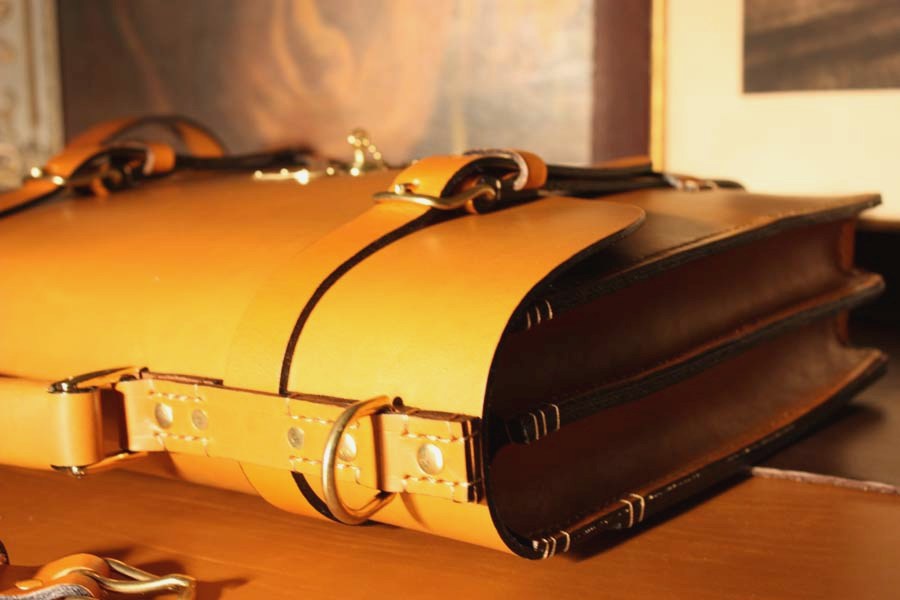
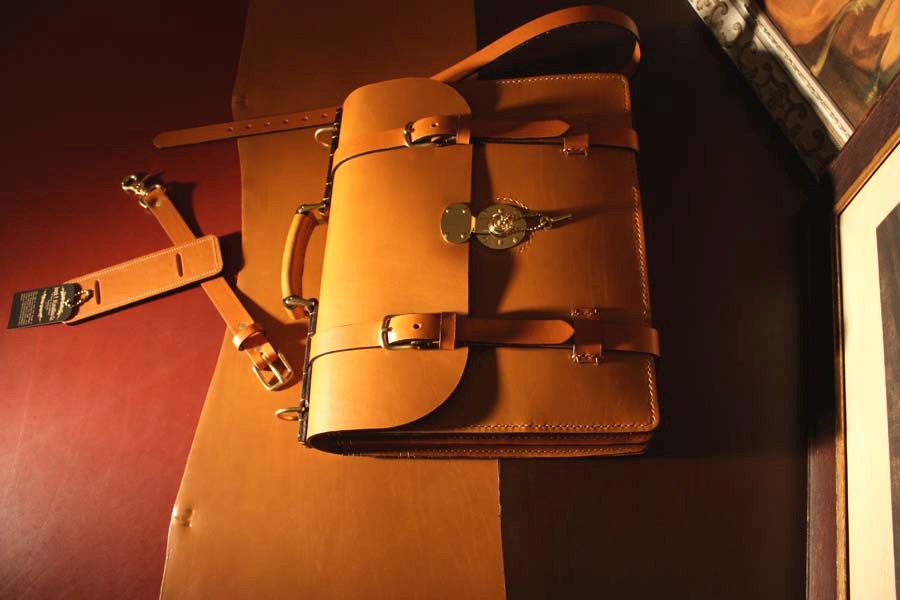
How do you define a casemaker? Anyone who visits a couple of forums, watches a YouTube video and orders some leather scrap on eBay as a “casemaker?” Or a major company that employs hundreds of in-house “casemakers” or, God forbid, has them made in other countries. The first is a hobbyist, that a friend convinced he can sell a case part time online. He might be able to make a copy of a high-end case and post a couple of pictures. And in the best-case scenario, the pictured bag was his best work because he took his time, but the real bag that gets sent to the customer is not even close to the picture. You see, the maker undersold the item and halfway through to building it realized it is just not worth what was paid. So he cuts corners that the average first time buyer won’t even know of until months later when the leather and skill quality shows its ugly head.
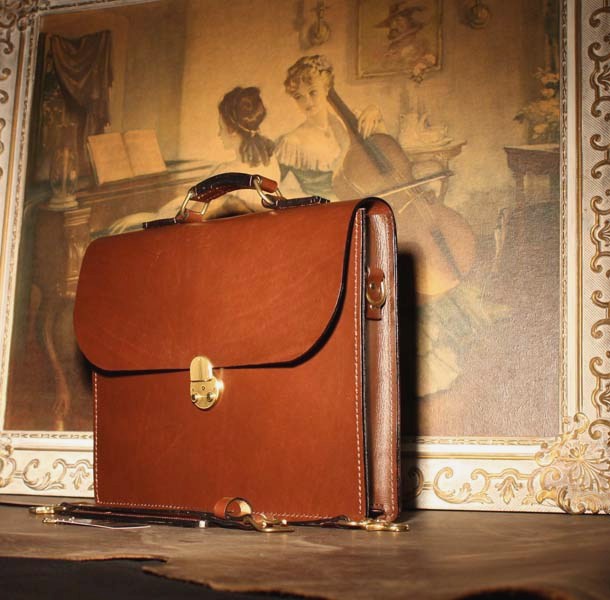
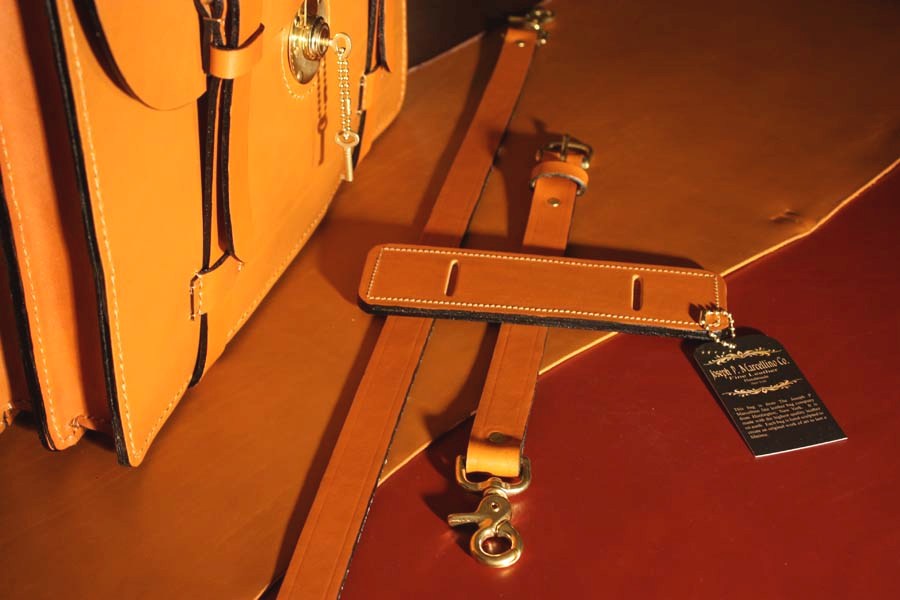
The second I would not call “casemakers,” either because the original “casemaker” no longer makes cases, but is sipping pina coladas on the beaches of Tuscany or his children, who have become “designers,” direct their employees/casemakers to do their job and make their bags. And one thing I learned as a businessman is that when the product is no longer made by the designer, it looses its quality through every copy made by every “employee.” No matter how much marketing, great pictures and famous actors carry the product, no one makes it like the original designer. Now the real “casemakers” who have made countless amounts, treat this like an artform and not a job, use the highest quality materials, build by hand, under their name and their legacy are far fewer. I am one of them.

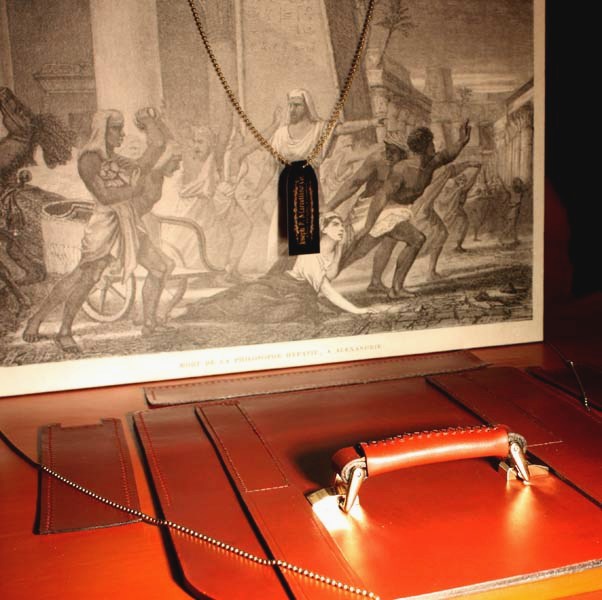
My products have been received exceptionally well. We are in the process of opening up a few retail stores on Long Island and NYC where we can take custom orders for fine bridle leather business bags. We are fortunate to have some of the best tanneries in the world right here in the North East of America, and they make an exceptional bridle leather that will last a lifetime and also maintain a refined appearance. [My hobbies are] philosophy, both political and theoretical, science from technology to biology. I think the one main thing the general public doesn’t fully understand, especially animal rights activists, is that the American steer leather we use comes completely from the food industry. It is a by-product that would go to waste if not used. Also that bridle leather is naturally vegetable-tanned with tree barks in American tanneries that are regulated by the government.’
Pictures: © Joseph P. Marcellino Co.
Category Interviews, Leatherworkers, Quality makers, Web stores
Beau Brummell’s Colour Principles
0June 1, 2013 by Ville Raivio
1. In the composition of colours for dress, there ought to be one predominating colour to which the rest should be subordinate.
2. To the predominating colour the subordinate ones should bear a relation, similar to that between the fundamental or the keynote [in music] and the series of sounds constituting a musical composition. And as, in a piece of music, there is a relation between the successive sounds or notes, so in dress the subordinate colours should be in harmony with each other. The power of perceiving this relation of colours constitutes the faculty called taste in colouring.
3. As painters —
Permit not two conspicuous lights to shine
With rival radiance in the same design
so in dress, one half of the body should never be distinguished by one colour, and the other by another. Whatever divides the attention, diminishes the beauty of the object; and though each part, taken separately, may appear beautiful, yet as a whole the effect is destroyed. Were each particular limb differently coloured, the effect would be ridiculous. It is in this way…that mountebanks are dressed, and it never fails to produce the effect that is intended by it, to excite the mirth and ridicule of common people.
4. The variety of colours which may be introduced in dress, depends on the expression of the predominating colour.
Delicate colours require to be supported and enlivened, and, therefore, are best relieved by contrasts; but the contrast should not be so strong as to equal as to equal the colour it is intended to relieve, for it then becomes opposition, which should always be avoided. Contrast, skilfully managed, gives force and lustre to the colour relieved, while opposition destroys its effect.
5. In the composition of the subordinate colours, there is a maxim of Du Fresnoy’s which applies as well to the arrangement of colours in dress as in painting:
Forbid two hostile colours close to meet
And win with middle tints their union sweet.
6. The choice of the predominating colour will be indicated by the situation, the age, the form and the complexion of the wearer.
~ Beau Brummell in his only study Male and Female Costume: Grecian and Roman Costume, British Costume from the Roman Invasion Until 1822, and the Principles of Costume Applied to the Improved Dress of the Present Day
Category Dandyism, Quotations, Reading
Interview with Andy Gilchrist
2June 1, 2013 by Ville Raivio
‘Wisdom really does come with age and you have to be wise to know all the rules, history and nuances of men’s fashion. My occupation was Occupational Safety and Fire Protection Engineer. But I always had my work done my Wednesday noon so I could go out shopping! I received two BA degrees from Kansas State University – one on sociology and the other in journalism. Plus a Certificate in Fire Protection Engineering. I have a great wife, who I met at Kansas State University and is very supportive of everything I do. Parents have both passed away, but I hope my father (see later answers) would have been proud of me. My father was in oil exploration in the Midwest USA and Canada and dressed in work khakis, but always dressed up for dinner and church. He was very interested in fashion and we took Esquire magazine, when it was a bit risqué, just for the men’s fashion.

[My knowledge comes] from my father, from magazines and some books.I’m very conservative and try to follow the “rules”! I have many advertisers on AskAndyAboutClothes.com that have made me clothing but if I were to pick some it would be MyTailor.com, Caruso, Hiras Tailor, itailor.com, LS Men’s Clothing, Custom Men, Imparali. I started writing my book, The Encyclopedia of Men’s Clothes. One of my longtime friends, Bob McConnell, (a tennis and golf buddy) worked for IBM, and I approached him about doing a website. Bob said, “Sure, it’s easy!” And we went out and bought some Front Page software. The next few weeks were a real learning experience for a non-tech person (me!). But Bob worked with me and got me through setting up some pages. On either August 22, 2001 or November 2, 2001 (can’t quite pin it down!) we were “on the air” and it looked great. I kept adding to the site, and a week later I had received a total of 14 hits! Most of those were me looking at the site.
For some reason (maybe a real need for this kind of information), in a few weeks we started getting noticed. In a couple of months Google had found us. I completed The Encyclopedia of Men’s Clothes, had it reproduced on a CD-Rom and sold the first one on March 27, 2002. Then I talked Bob into putting up a Forum. He was a little hesitant. I’m not sure he was too enthused, and it was a lot of technical work. Plus I don’t think that he saw any value in a site on men’s fashions. The Forum went up on or before August 24th, 2002, and the hits started increasing. The big break came with a story about the site and Forum in The New York Times, September 29, 2004, and the hits shot up to 160,000. They dropped a few days later, but leveled off and then began to climb to 250,000 hits a day! The May 2006 issue of Playboy Magazine recommended this site and most recently we’re getting over 1,300,000 hits a day. Currently the site is averaging over 646,239 unique visitors, and 1,803,388 page views a month, and the Forum registered membership is over 65,000! And it’s growing! We’ve revised the site and are constantly upgrading the server to handle all the new traffic!
Our next AskAndy Event is in London, Sept. 26 and it will be followed by some in Europe including several in Spain. I’ve had the opportunity to write an article for Esquire Magazine and to appear on the Wealth TV Program “What to Wear”, plus I’m constantly quoted in all the major media outlets (including yours!) And I was privileged to write part of the JC Penney men’s sales associate training manual. Look for a collaboration project with Playboy Magazine soon, but I told them I must keep my clothes on! I’m unique in that the website offers lots of free articles full of advice including the Forum. My book, The Encyclopedia Of Men’s Clothes, is all advice it’s not trying to sell a specific brand of clothes like most sites. [I’m inspired by] just being alive and open to all the wonderful opportunities there are out there. I don’t really believe in planning, but just being open and letting fantastic things come into my life. Style is creating your own personal image within the boundaries and rules that apply to men’s clothes and considering the appropriateness in respect to your fellow humans and institutions.
I play golf, love to travel, have been on many wine tasting tours, enjoy exploring single malt Scotch, Classic movies and any old British TV series that happens to be on, and dining in some of the greatest restaurants in the world has been a privilege. I fear that we’re loosing the battle of dressing appropriately out of respect for each other and our institutions, but I hope that AskAndyAboutClothes.com will be a beacon of knowledge and inspiration for those who don’t know the rules and realize that their image is very important in success in life. Just buy a copy of the downloadable PDF, The Encyclopedia of Men’s Clothes (it’s less that you spent for lunch today) and you’ll have more knowledge which you can instantly reference, than anyone!’
http://askandyaboutclothes.com/
Picture: © MRKet
Category AAAC, Interviews
Artist/Rebel/Dandy: Men of Fashion Exhibition
0May 31, 2013 by Ville Raivio
Category Dandyism, Inspiration, Videos
Interview with Rebecca Shawcross
1May 31, 2013 by Ville Raivio
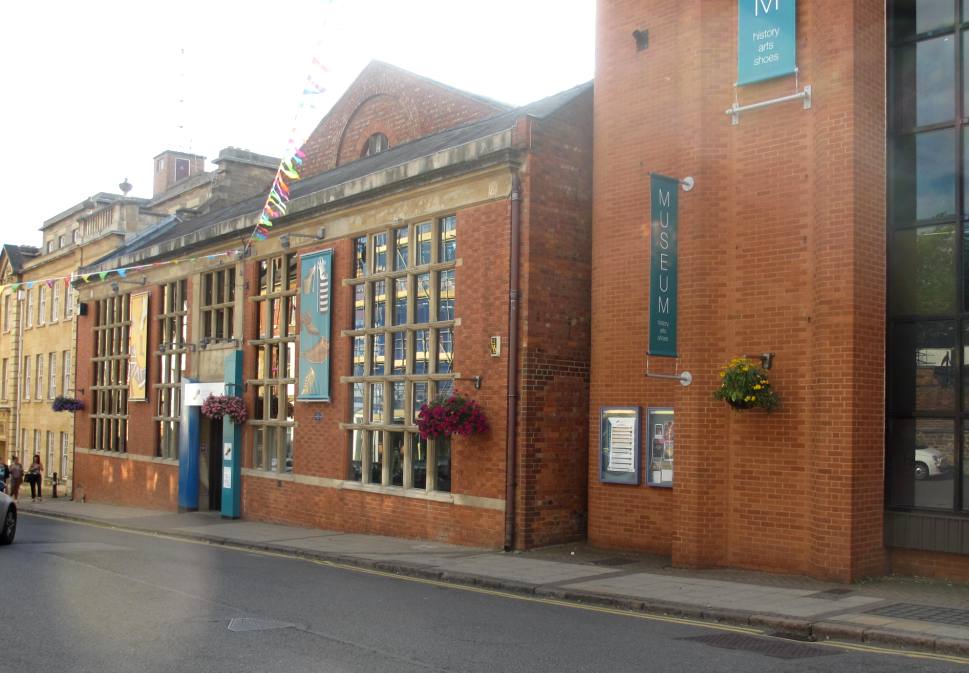
‘My name is Rebecca Shawcross and I am the Shoe Resources Officer at Northampton Museums & Art Gallery, which is part of Northampton Borough Council. I am in my 40s and have been in this post for the last 15 years. I have a honours degree in Anthropology and History of Art from Oxford Brookes University, a post graduate diploma in Museum Studies from St Andrews University and I am an AMA, which is an associate of the Museums Association. I have a partner and young daughter. They both visit Northampton Museum&Art Gallery on a regular basis to see the changing exhibitions and to look at the permanent shoe galleries. My partner has increased his passion for Puma trainers and my daughter loves to check on her favourite exhibits, including the elephant boot and stuffed animals posed as shoemakers!

The Elephant Boot, which is one of four boots made by Lotus for the British Alpine Hannibal Expedition. The expedition aimed to recreate and track Hannibal’s route during his invasion of Italy in the 3rd Century BC. Often disputed by historians that the crossing actually took place, chroniclers reported that Hannibal crossed the Alps with 37 surviving elephants to take into battle. The British Alpine Hannibal Exhibition asked the question: Can an elephant cross the Alps? Turin Zoo was generous enough to provide the non-geological materials. Her name was Jumbo. Jumbo traveled 150 miles in 10 days from France to Susa in Italy. The result of the expedition’s experiment suggested that elephants can indeed cross the Alps. To protect Jumbo from the weather she had a canvas coat and trunk cover made and to protect her feet a set of canvas and leather boots. These boots were made by craftsmen at Lotus Ltd. using the patterns supplied. To find out the size of her feet the elephant stood on a large sheet of paper and someone drew round her feet. Unfortunately Jumbo was unable to finish the last eight kilometres of the expedition, as the track was considered unsafe.
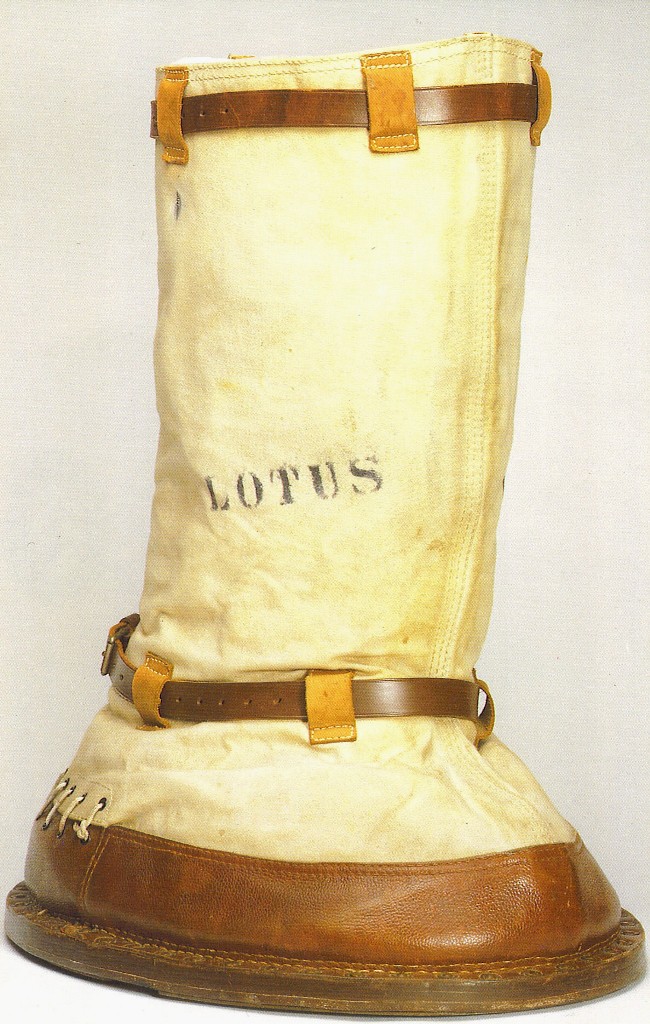
The unique elephant boot, properly welted, of course
We have a model of a Shoemakers Shop with the figures made with stuffed squirrels and stoats. The squirrel is wearing an apron, with clamps between his knees on a shoemaker’s “seat”, the stoat is behind the counter clicking and another squirrel is carrying a mug of beer. It was made by renowned taxidermist Walter Potter and used as an advertisement in the window of Curtis, bespoke shoemaker and repairer, 107 Bostock Avenue, Northampton; 1860-1869. You either love it or loathe it!
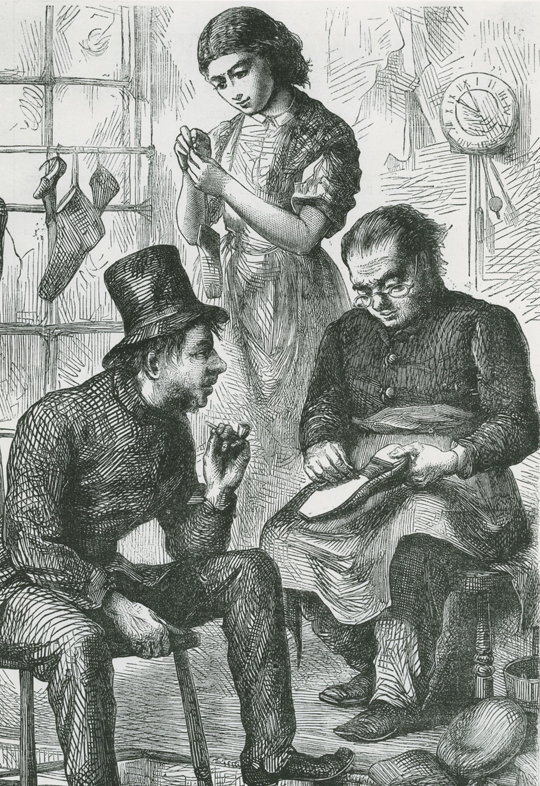 The Northampton Shoemaker, 1860
At the time I started several people did comment on how narrow a subject “just” shoes was, but having now been in the job for several years the subject of shoes is not a narrow one at all. When I got the job I think that the museum were not expecting to find anyone with an in-depth knowledge of shoes and their history, but what I did have was a good background in museums, including collections management, exhibition experience and good customer service skills. My knowledge of the history of shoe fashions, the industry in Northampton and further afield, the ability to date shoes and facilitate peoples’ enquiries whether they be “my grandfather was a shoemaker do you have any information on him?” to school children undertaking a project on shoes has developed over the years I’ve been in the job. Shoes do in fact cover quite a wide range of different areas including the industrial history, social history, the history of fashions and styles, the psychology of wearing shoes – what shoes express about ourselves, how they make us feel and such fascinating practises as concealed shoes.
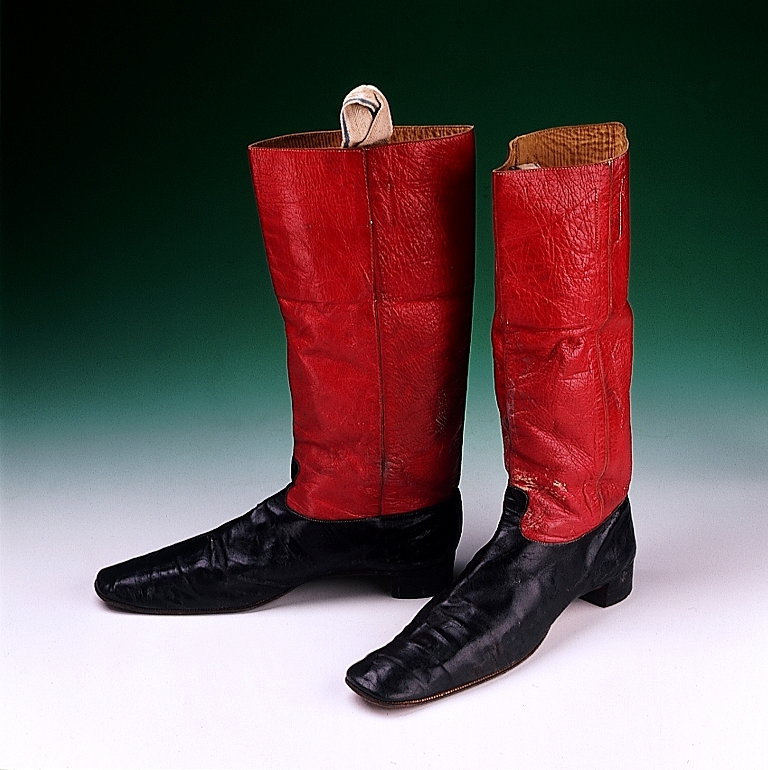
Men’s black and red patent and morocco wellington boots, 1860s
I have developed my knowledge and experience of shoes and their history over many years and I am still developing it, and adding to it as it is a constant process. In terms of becoming familiar with different styles and being able to date historic footwear, there is nothing better than hands on work with the actual collection. The more shoes I see the more I increase my knowledge. I read books and try to keep up to date with new publications. I visit other shoe museums, museums that display shoes within their general displays and museums and art galleries for inspiration. I try to keep up to date with current shoe manufacturing, new innovations and developments. Over the years I have had some excellent advice from Miss June Swann the former shoe curator at Northampton Museums. She has spent 60 years in museums and specifically working with the shoe collection and now acts as an independent consultant. Her depth and breadth of knowledge is amazing.
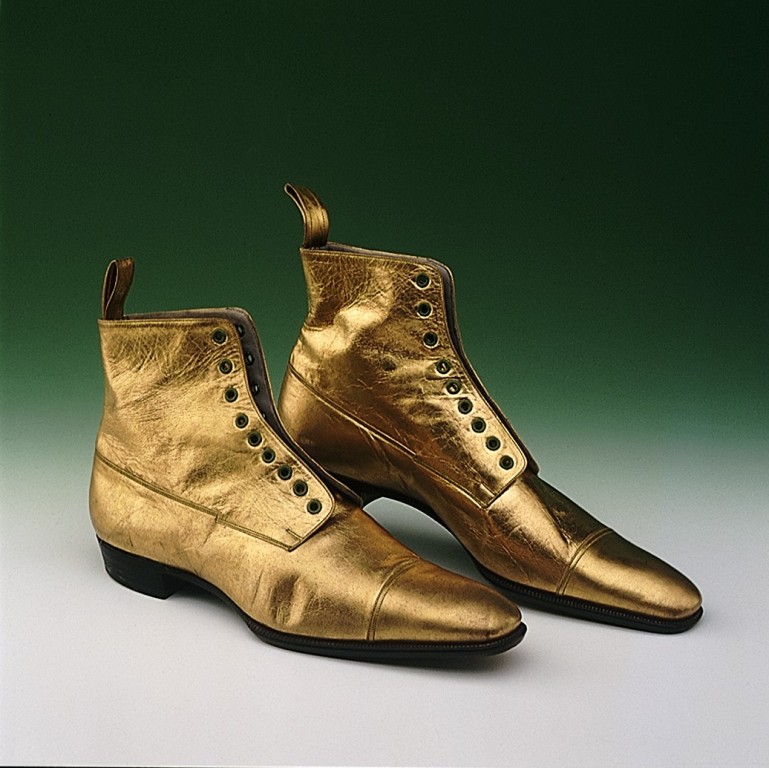
Men’s gold leather Derby boots, Mounts Shoe Factory Co. Ltd., Northampton, 1922
I am obviously interested in fashion and shoes, but this I have to admit does not translate to my own dress! At the moment I’m wearing Dr Marten brogues. We are always looking to increase local, national and international visitors to the Museum and therefore the Shoe Collection and make what we have that is not on display accessible to researchers, designers and the generally interested visitor. Most museums are rather like icebergs. What you see on display is just the tip of it. We have 1,000 shoes on display at any one time and a further 12,000 in store. To give you a brief over view the Shoe Collection is part of Northampton Museums and Art Gallery, which is part of Northampton Borough Council. The Shoe Collection is just one collection the museum houses, the other collections include Fine and Decorative Arts, Geology, Costume, Social History, Military and Archaeology.
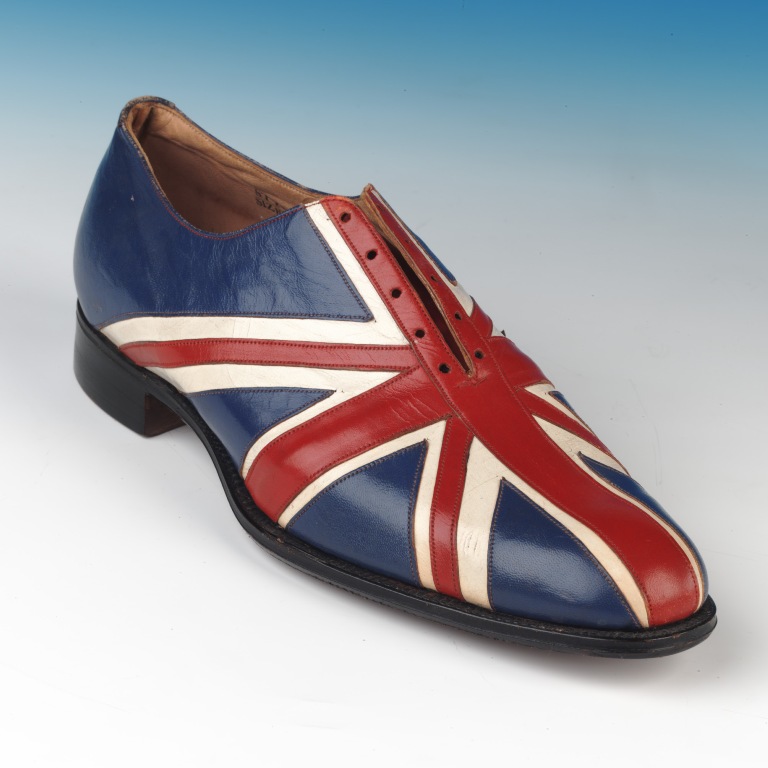 Union Jack oxfords made by George Webb to celebrate the Queen’s Coronation, 1953
How many shoes are in its archives?
- Footwear, more than 12,000 items ranging from ancient Egyptian to contemporary design
- Accessories, including buckles, laces, shoe horns, trees, spats, leggings and polish
- Shoemaking tools, machines and components including lasts
- Retail trade material including shop furniture and fittings and advertising material
- Archive material including trade journals, company catalogues, books and photographs
- Fine and decorative art including paintings and prints depicting shoes and shoemaking
- Index of shoemakers and shoemaking firms from the Roman period onwards
- Index of concealed shoes hidden in buildings to bring good luck
- Specialist Reference Library
The Shoe Collection contains an extensive range of men’s footwear, largely influenced by the fact that Northampton as a shoemaking town has always been known for its manufacturer of men’s footwear, both domestic and military. In 1660 Thomas Fuller wrote that “the town of Northampton may be said to stand chiefly on other men’s legs…the most cheapest, if not the best, boots…in England are to be bought in Northampton.”
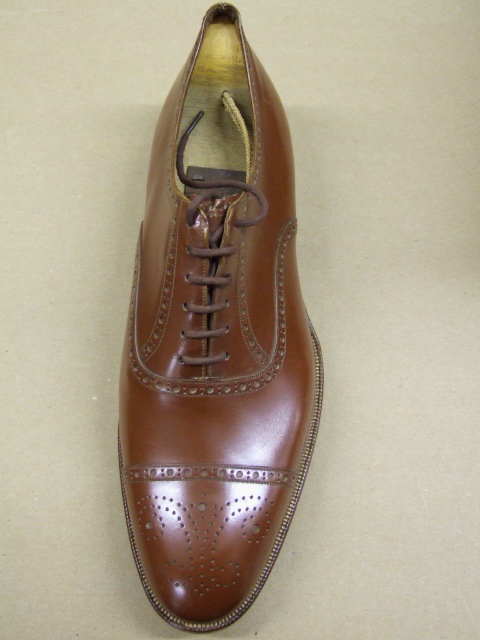 Men’s half-brogue oxfords, 1930s
This emphasis is reflected in the men’s footwear collections which covers ready to wear and bespoke styles from 1600 to the present day, a good collection of military footwear, particularly from World War One and Two, catalogues of men’s footwear from 1900 onwards, and examples of Northampton town and county-made high-end footwear, including examples from current local manufacturers like Jeffery-West, Church and Co. Ltd., Tricker’s and Crockett and Jones who have worldwide renown.
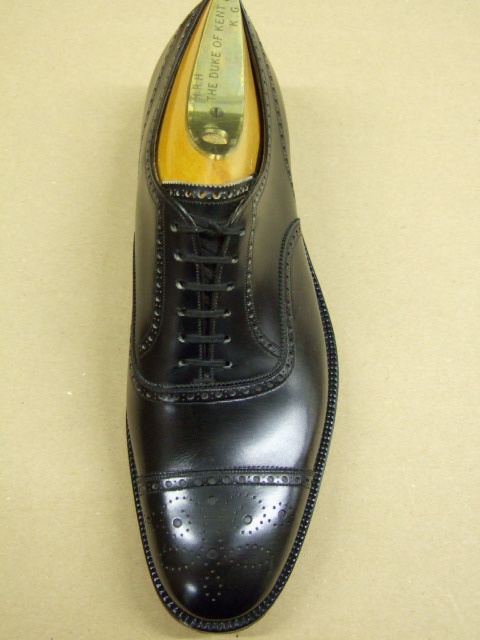 The Duke of Kent’s half-brogue oxfords, 1930s
When you look back over the years, then men’s shoe styles have had mixed fortunes. Quite early on men had some of the most amazing footwear. The medieval poulaine was a flat soled slip on shoe with a pointed toe worn by both men and women, but men took the toe to extreme. The toe on men’s footwear increased and increased in length so much so they had to roll the toes up to aid walking! The long pointed toe was a sign of status and perhaps an indicator of the wearer’s masculinity! Portraits from the 17th century show men wearing the most fabulous shoe creations, sporting high heels, spangles and lace. By the end of the 19th century many shoes and boots worn by men conformed to one of two basic styles, the Oxford or Oxford brogue and the Derby. Even today many men’s footwear is based on these two styles. Of course Northampton is still the home to shoe factories and companies producing top end high quality men’s footwear that has a world-wide reputation, much of what is still produced are the classic Oxford, Oxford brogue, Derby and Monk styles.
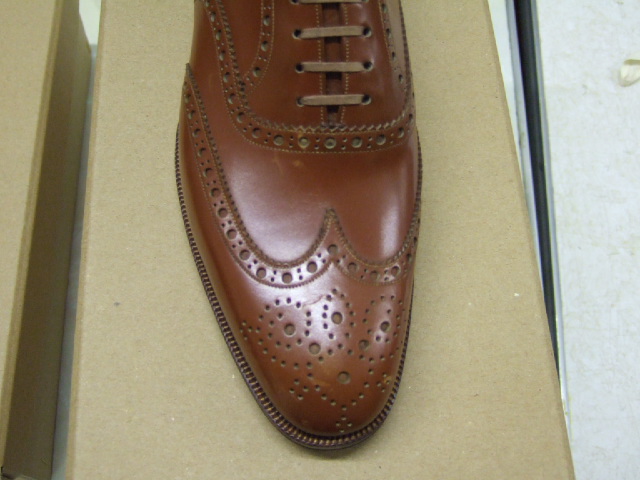 Men’s full-brogue medallion and toe shape, 1940s
It is very hard to pick out favourites from the men’s shoe collection, I’m usually torn between those unassuming men’s shoes that have a great story attached to them or the really amazing one off pairs like the pair made by George Webb for the Queen’s Coronation in 1953. We accepted as a donation a few years ago a pair of black leather Oxfords that under usual circumstances we would have probably said no to but they come with an amazing history attached to them. In brief they were bought by the donors father in the 1920s and then worn at his wedding in 1923. They were worn at many functions and loaned to the donor when he attended school dances in the 1950s. On the death of his father the donor inherited them and wore them at his own wedding in the early 1920s. He too wore them at many functions including those held at Buckingham Palace and Westminster. He finally donated them to the Shoe Collection because they had become uncomfortable to wear. So they look like a dull pair of shoes, but in fact have a great history to them.
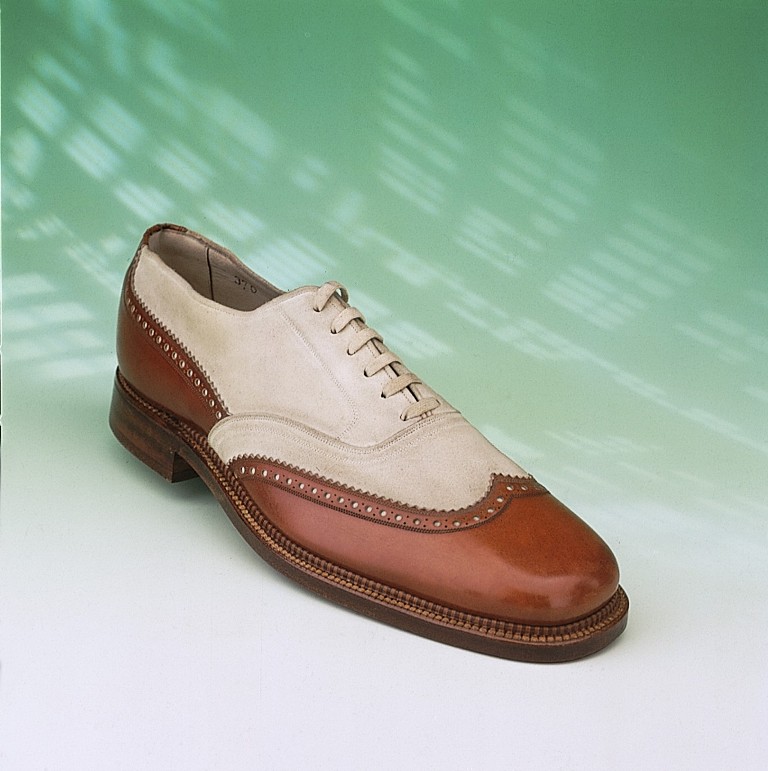
Men’s brown leather and white suede co-respondent Oxford shoe,
Rice & Hutchins, USA, circa 1930
We have two permanent shoes galleries for readers to visit. The Life and Sole gallery highlights the history of shoes and shoemaking, as well as such topics such as Looking after your Shoes, Shoe Mending and Shoes made for Special Purposes. The Followers of Fashion gallery deals with fashion and design and highlights some of the recurring themes in fashionable footwear. We also have a changing programme of temporary shoe exhibitions in our shoe gallery and shoe lounge. At the moment we have an exhibition of photographs showing the working lives of shoemakers working at Alfred Sargent at Earls Barton and a small display of footwear from Walsh Casuals. These will be followed by an exhibition looking at all things Mod including footwear and a small display highlighting the work Sheffield University have undertaken on understanding why we wear the shoes that we do and how shoes influence how we feel about ourselves.
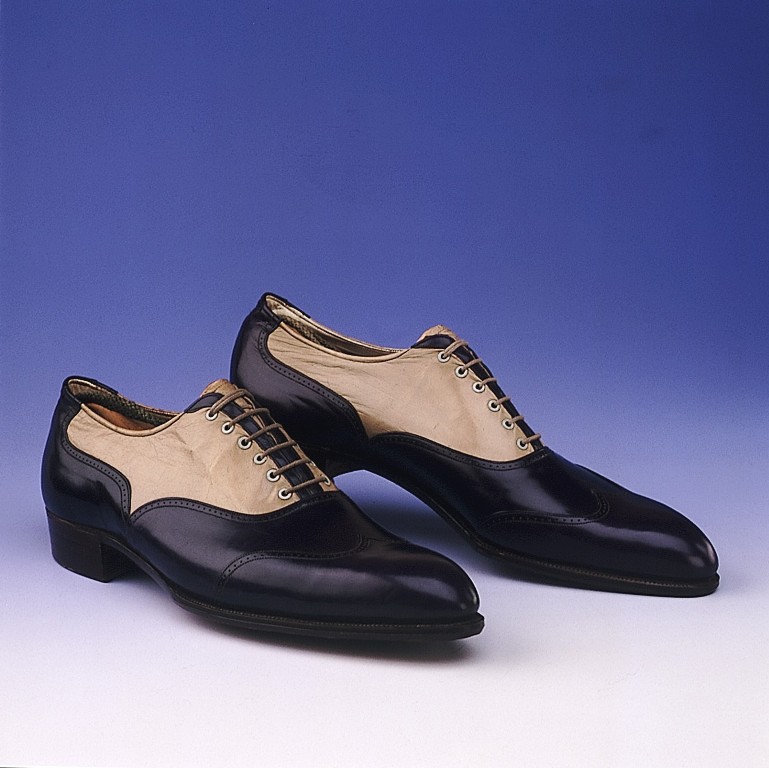
Men’s blue and beige leather co-respondent Oxford shoes,
Mounts Shoe Factory Co. Ltd., Northampton, 1922-29
Highlights of the collection include a boot made for Jumbo the elephant, the stilts in the shape of a pair of Doc Martens made for Elton John to wear in the Pinball Wizard sequence in the film of ‘Tommy, A Rock Opera’, a pair of blue velvet shoes embroidered in gold made about 1660, the shoes Queen Victoria wore on her wedding day in 1840, shoes by top end designers such as Manolo Blahnik and Jimmy Choo and a pair of Super Elevated Ghillies by Vivienne Westwood (the style that caused Naomi Campbell’s downfall in 1994).
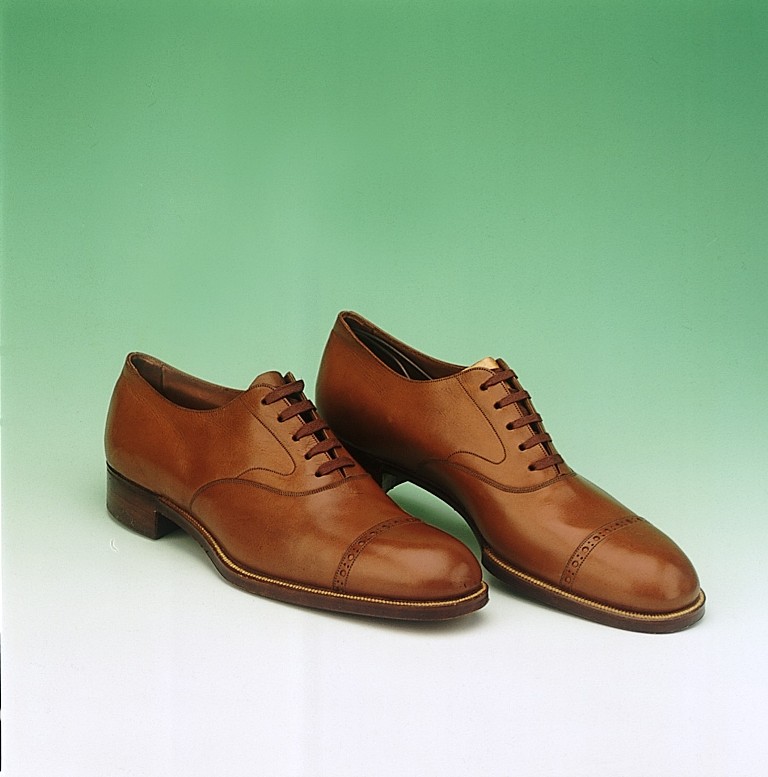
Men’s tan leather Oxford shoes, Pollard&Sons, Northampton, 1910
I love “stuff” and clearly don’t get enough of it working in a museum, so I enjoy trawling antique fairs, visiting country houses and National Trust properties and travelling abroad whenever I can. A good-looking, well-made pair of shoes should be considered a wise investment and really does get you noticed. Don’t always stick with black or brown shoes, a little colour works, too.’
http://www.northampton.gov.uk/museums
More examples of the museum’s unique collection can be found at Flickr.
Pictures: © The Northampton Shoe Museum
Category Arbiter Elegantiae, Interviews, Northampton
Copyright © 2013 Ville Raivio