Why do the Japanese spend so much on clothing?
0February 19, 2016 by Ville Raivio
“For example, why have the Japanese been so interested in fashion — arguably far beyond other cultural fields? As Japanese teens built up their own youth cultures, they always prioritized fashion over music, automobiles, furniture, and cuisine… As a start, urban consumers did not need nice interior goods because no one entertained in their cramped apartments. And between a lack of facilities and little free time from work, sports have not been a major part of adult life. By contrast, fashion worked well with the busy, crowded Tokyo lifestyle… Osamu Shigewatsu explains, ‘Clothes have always had the highest return on investment because, unlike other kinds of culture, they’re seen by others, and the Japanese care a lot about that. Clothes can express personal identity and also act as a communication tool.’
— W. David Marx in his fascinating social history book Ametora
Category Japanese Style, Quotations, Reading
Interview with gusvs
0February 18, 2016 by Ville Raivio
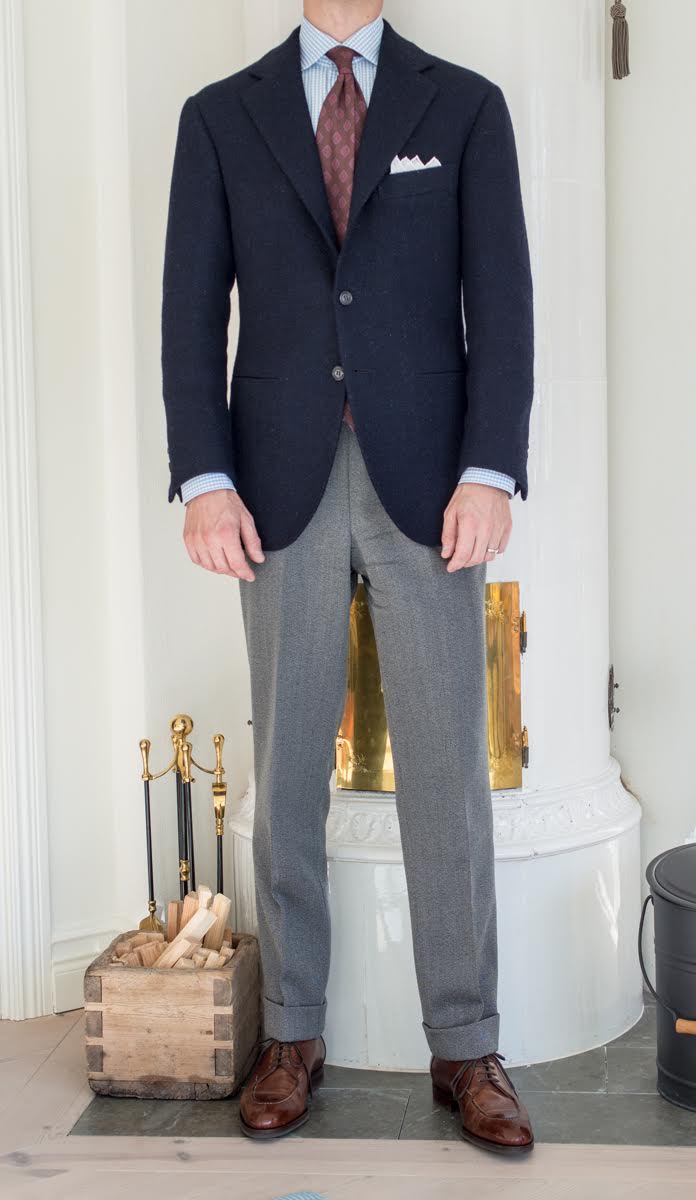
Category Inspiration, Interviews, Men of style, Nordic Style, Styleforum
Boyer on fashion rules
0February 17, 2016 by Ville Raivio
“Most rules about dress turn out to be silly, because fashion, like sin, changes.”
– G. Bruce Boyer I in his interview with StyFo
Category Aphorisms
Some notes on dress at Eton College
4February 10, 2016 by Ville Raivio
“Some notes on dress at Eton College
by an Eton pupil
Dress regulations
It is interesting to note that here were no official school dress regulations at Eton College until the 1960s. Dress was completely governed by fashion and, more importantly, peer pressure – a pressure far greater than any seen today when it comes to sartorial considerations. For example, the often repeated assertion that a boy wore a bumfreezer jacket and Eton collar [at Eton suit] until he reached a particular height is not true. A boy wore the Eton suit until his status within the school and with his peers permitted him to graduate to a tailcoat. A boy who attempted to adopt the tailcoat prematurely would attract ridicule from both his classmates and older boys. In other words, boys remained in bumfreezers until they cut muster with their fellow pupils. As a result, a small and feeble boy might remain in the juvenile Eton suit for most of his school career, however unhappy this might make him feel.
Another point of fact: while Etonians themselves would say they wear ‘tailcoats’, what we in fact wear is a morning coat. In England, a tailcoat per se is generally assumed to be an evening tailcoat, which is cut in above the waist. Another point we have to consider is whether there really is a direct link between the death of King George III in 1820 and the wearing of ‘mourning’ black. In the 1820s, the standard Eton dress was a blue jacket, yellow waistcoat and light trousers. With no official dress regulations, it was the boys who took it upon themselves to die their garments black out of respect and reports say that within a few years the old bright colours had returned. It is only one hundred years later, in 1920, that today’s cut of black tailcoat became standard.
Contemporary Eton uniform
The standard uniform is known as ‘School Dress’. It consists of black pin striped trousers, black waistcoat (always worn with the bottom button undone, a style which can most definitely be directly linked to Edward VIII), black tailcoat (as mentioned, this is in fact a morning coat), well polished black shoes, white tunic shirt, cufflinks, Arundel collar and white tie. In addition, boys in ‘College’ (the house for academic scholars, the original pupils at the school) wear gowns.
The unusual collar and tie worn at Eton need a little more explaining. The broad collar named after the school is no longer worn by any of the pupils. The Arundel collar which is now universal is a small gentleman’s collar, attached with studs at front and back. It is starched and very stiff and most boys will own about five. The laundry collects them to wash and restarch once a week from a boy’s house (along with his other washing) using machines that date back almost to the Second World War.
The tie worn with the collar is not strictly a tie at all but a disposable strip of linen about half an inch wide by ten, with a hole punched in the middle. It evolved from a kind of straight bow tie but now it is simply placed over the stud and folded inside the shirt in a unique way which cannot be easily described on paper. Indeed, most of the F-Tits (first year boys) spend their first night at the school in their Dame’s flat (a Dame is a matron at Eton) learning how to put on their shirts. In theory, the ties are replaced when they become soiled. They are bought a dozen at a time and, in practice, once one is down to number twelve it seems to last remarkably longer than the rest.
The ties are easy to misplace in your room and far too frequently you see boys without ties at all. The better beaks (teachers) might put such a miscreant on a ‘dress offence’ (imposed for various infractions of the regulations) which means wearing full school dress all day for three days and signing in at the school office, properly attired, once an hour during free time (Boys are usually permitted to change out of tailcoats for the afternoon during games and free time.)
Senior Boys and Masters
There are a number of variations of school dress which distinguish boys in positions of authority. All office holders wear stick ups – that is to say, a wing collar with a white bow tie. The Captains of houses wear a grey waistcoat (often double-breasted) as well as stick ups. The twenty highest academic achievers in B-Block (the final year) form ‘Sixth Form Select’, a prefectorial body. In addition to stick ups, they wear silver buttons with their black waistcoats. There is a second, self-elected prefectorial body, known as Pop or The Eton Society. These elite boys are entitled (by their own authority) to wear black and white spongebag trousers, stick ups, and any colourful waistcoat they desire (and great liberty is taken) also trimming their tailcoats with silk piping.
Several times a year, Sixth Form Select give ‘Speeches’. This is a long-standing tradition when boys select passages of literature – from Latin classics to Shakespeare – to recite before the Provost, Headman and senior boys. Dress for this occassion is the most formal seen at the College. The white shirts and stick ups remain from everyday wear but the tailcoat (which as I have pointed out is really a morning coat) is replaced with an authentic tailcoat, the standard black waistcoat with a low-cut black waistcoat, and the pin striped trousers with plain black breeches and tights. The scholars also wear their gowns. This mish mash of modern white tie and old fashioned royal court dress is unique to these rare occasions at Eton.
Finally, it should be mentioned that the beaks also wear a uniform, consisting of white bow tie, black jacket and striped trousers.
A few years back there was a vote to see whether school dress should be abolished. The boys decided to retain it. It is surprisingly comfortable and a tribute to the benefits of proper tailoring. The school is served by four tailors in the high street who solely supply the 1300 boys and several hundred beaks. Boys take a chit, signed by their Dame, to obtain any items they require, with the cost being added to the end of half (ie. that term’s) bill. I find it sad that there are some boys who neglect to wear the uniform properly, especially given that it is so easy to fix any problems.
The peer pressure is still very evident. Having officially taken over a position of responsibility for the annual Fourth of June celebration, I had to decide whether to wear my stick ups for the first time on the great day. In the end, along with my friends who were in in a similar situation I decided it was best to wait until further towards the end of the half lest we were queried too frequently as to our new dress. And there is also the threat of boys pulling your bow tie undone in the street as a prank before you have learnt to refasten it properly without the aid of a mirror.
It is odd to think that one looks out of place in the environs of Eton College if one is not wearing formal clothing. Indeed, any boy not wearing school dress (for example, because of a sports injury) is likely to be bombarded with so many queries as to why he is improperly attired that he will resort to the anonymity of his tailcoat as soon as he can.
A final note on decorations. Carnations used to be worn on a day to day basis by Pop, but now they are only sported on the Fourth of June. The most popular colours are red and yellow (white being unlucky unless worn at a wedding) but this year I took up the old tradition of dying a carnation an approximation of Eton Blue. The odd boy wears a pocket watch on a chain to his waistcoat, but this is rare nowadays and it takes a strong character to do so since the popular consensus is that this practice is not appropriate.”
Category British Style, Eccentricities, Reading
A history of the DAKS waistband
4January 26, 2016 by Ville Raivio
DAKS is an English clothier founded by one Simeon Simpson in the London of 1894. The S. Simpson company originally served as tailors, but as industrialisation gained momentum, Simpson decided to hasten the make with the help of new machines, and change course towards tailored off-the-peg clothing. The shop aimed to stand out from the competition with quality over quantity or price alone. The goal supported them and they were able to set up shop all over Great Britain. What makes DAKS interesting is their greatest public offering to men, the DAKS-waistband invented in 1934 by Alexander Simpson, the second son of Simeon. He was a sportsman and found that the braces so common in his times did not bend well in golf or strong striding, and belts only bit into the guts, so a new kind of solution for the upkeep of trousers was called for.
A. Simpson decided to sew rubbery tabs on the inside waistband of DAKS trousers. The shirt would stay in place against them and trousers against the guts as well. This alone didn’t do the trick, so a tunnel was cut into the waistband and a strong elastic band added inside it. This was attached to buttons at the end of the tunnel ends – and the DAKS waist was born. No more was there need for braces or belts, even though one gained or lost weight. Still, braces could be worn if needed. Simpson believed that he had struck, or rather sewn, into a gold vein and a nice, high price was set for these new kinds of trousers named DAKS. This was a combination of dad and slacks as Alexander was, after all, the son of Simeon and the next link of the family company.
The waistband model of one James Bond in Live and Let Die
The DAKS waist was at the peak of its popularity in the 1930s-’40s Britain. It was invented at a favourable time as men would become bored with braces during their WWII service, and later favoured belts, a part of their uniform, for their civil wear for convenience, speed and custom. If belts either didn’t excite, the new elastic band waist was just the best thing. After these high times, the DAKS model has become a rare sight in readymade clothing. Likely the manifold forms for belts, so easily changed according to occasion, have intrigued more than the discreet DAKS. Still, thanks to its rubber band, it stays up very well and stretches with movement, and neither does it squueze like braces or belts. Most elastic waists have two or three buttons at the ends of the tunnel. They guarantee upkeep even with weight loss or gain. As their placing can be easily changed, I feel the DAKS model is by far the best and most comfortable solution for the man who craves comfort above all.
Bond’s very first trousers from Dr. No
Category British Style, Trousers
Copyright © 2013 Ville Raivio