Dandyism in Oscar Wilde’s Plays Lady Windermere’s Fan and The Importance of Being Earnest
2November 1, 2018 by Ville Raivio
I have a thing for dandyism. I cannot explain why, but I believe each man has a passion or few. This one is among mine and I’m happy to have found it in the tender high school age. Because this topic will surely bring me manifold riches, girls, and job offers as well, I decided to write my Bachelor of Arts degree for English Philology about it. To avoid the piece being entirely lost in Helsinki University’s archives, I’m sharing it here. Who knows, maybe there are a few souls left somewhere who’ve taken a liking to historical dandies, and those who draw inspiration from the well they are.
In this B.A. work, I analyse dandyism in two of Oscar Wilde’s plays. He could have created characters without traits associated with dandyism, but instead we have two main dandy men. This piece first presents the concept of dandyism, then tells the story of George Bryan “Beau” Brummell as he served as the archetype for real-life and imaginary dandies. Then I have a look at the ways dandyism is shown in Lady Windermere’s Fan and The Importance of Being Earnest. The essay also analyses what function dandyism serves in the plays and in the main characters of Algernon Moncrieff as well as Lord Darlington.
The essay’s theoretical background lies in studies that deal with dandyism or its role in Wilde’s works. My references consist of biographies, academic essays, non-fiction books, M.A. works and one doctorate piece. The most important references are Alfred L. Recoulley III’s Oscar Wilde, the Dandy-Artist: A Study of Dandyism in the Life and Works of Oscar Wilde, With Particular Attention Given to the Intellectual Bases of Wilde’s Dandyism, Ellen Moers’s The Dandy: Brummell to Beerbohm, Stephen Calloway’s Wilde and the Dandyism of the Senses as well as William Jesse’s The Life of George Brummell, ESQ., Commonly Called Beau Brummell.
In my analysis, Lord Darlington and Algernon Moncrieff fill the role of an amusing and analytical character, but they have significant differences. Darlington, for one, is conscious of his superficiality while Moncrieff does not take notice of himself. Darlington is ready to abandon his stature and status for the woman he loves, while Moncrieff is ready to abandon his first name. Darlington falls in love with the persona, Moncrieff with the looks.
My study’s finding is that Wilde chose dandyism into his plays as part of his artistic image. His works tell about the upper class life of Britain and poke fun at it. From behind the veil of stylishness and discretion, Wilde’s dandy characters are able to present social critique that Wilde as well launched at his contemporaries. These dandy characters, like Wilde, do this so charmingly that the other characters don’t take offence. To generalise, Wilde’s dandies are akin to Middle Age court jesters, from whose mouths the truth is heard, this truth brings amusement but nothing changes. Omnia mutantur, nihil interit!
My B.A. work can be found through this link:
Dandyism in Oscar Wilde’s Plays Lady Windermere’s Fan and The Importance of Being Earnest
An interview with shoemaker Dominic Casey
0October 24, 2018 by Ville Raivio
VR: Your age and occupation?
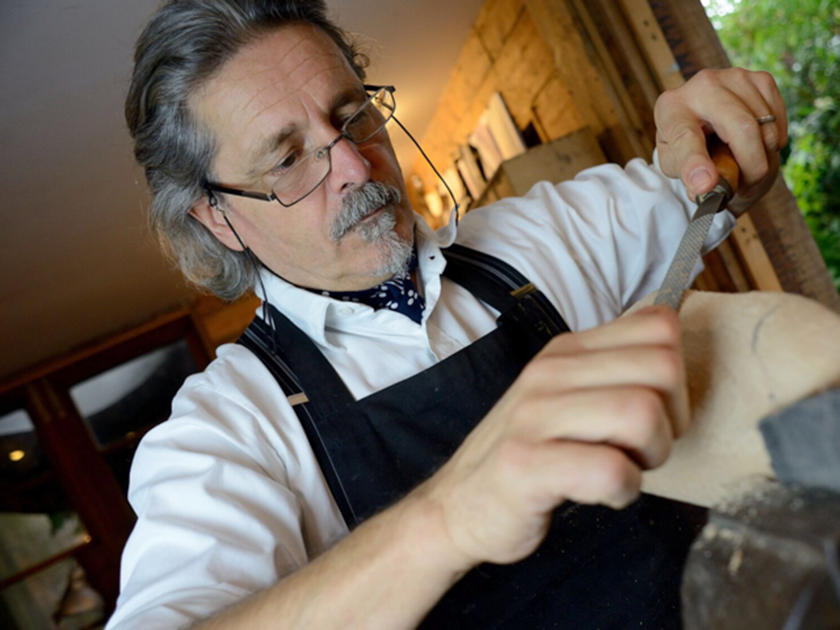
DC: I am 59 and work as a bespoke shoemaker.
VR: Your educational background?
DC: I have a degree in Geography and a Diploma in Footwear Design.
VR: Have you any children or spouse (and how do they relate to your shoe enthusiasm)?
DC: I’m married to a Specialist Community Midwife who works with teenagers but we have no children of our own.
VR: …and your parent’s and siblings’ reactions back when you decided to become a shoemaker?
DC: I was in my early 20’s when I decided to change career and become a shoemaker. My family’s view was that if it was going to make me happy, then it was a good thing.
VR: What other hobbies or passions do you have besides footwear?
DC: I love the opera and luckily live on the Glyndebourne estate in East Sussex, so I have world class opera on my doorstep. I have practiced tai chi for over 35 years. I fought until my 30s but now just practice for fun. I still get on the mats with the young men but after a full minute of scraping I’m beginning to puff. I also enjoy gardening, cycling and cooking.
VR: How did you first become interested in shoes, and when did you turn your eyes towards artisanal shoemaking? Why classic models instead of fashion?
DC: I first became interested in shoes and shoemaking when I was working as a management consultant for Birmingham Museum and Art Gallery and they had an exhibition organised by the Crafts Council on shoemakers. I was really interested in training as a craftsperson, making something in a workshop. That something turned out to be shoes. I wanted the best craft training I could get, so I wrote to John Lobb in St James’s and started from there. Even though my styling is classical in nature, I taught at the MA in Footwear Design at the Royal College of Art for 15 years in the fashion department. I always tried to impress on the students that good Design was permanent and Fashion was just a passing concept. At the Royal College the strength was always to do fashion with a solid foundation of craft and technical skill borrowed from artisanal shoemaking.
VR: How have you gathered your knowledge of the craft — from books, in-house training, workshops or somewhere else?
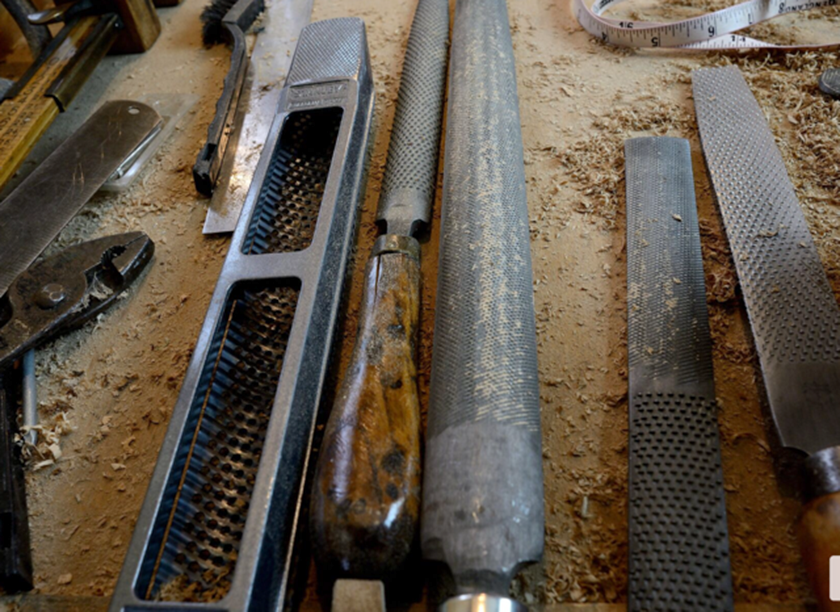
DC: I never understood it at the time, but I was blessed to be trained by the last of the great working Shoemakers that came to England as a result of the Second World War. All Eastern European, many Jewish, all unheard of and all dead now, but those lucky enough to have known them were humbled by their skill and speed. I started off as a closer making uppers and at the interview this wonderful Hungarian shoemaker took one look at me and told me to go away and make myself a skiving knife — with no Internet, few books on shoemaking and no idea what “skiving” was. I still have the knife I made.
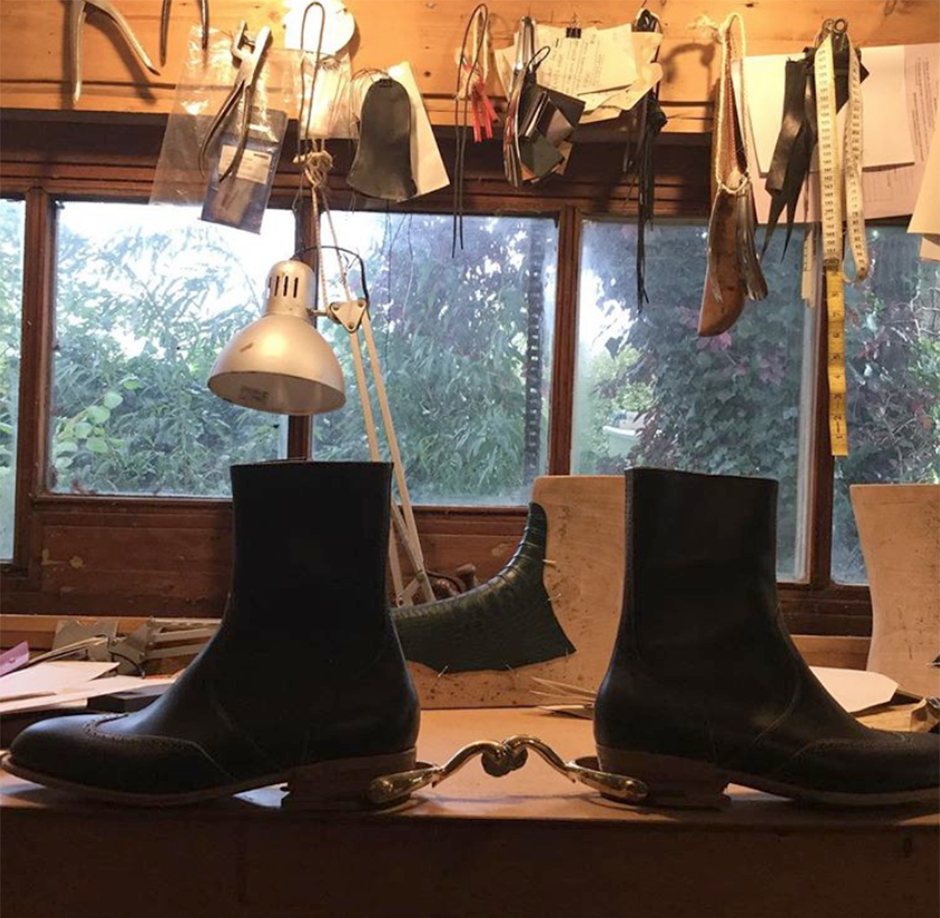
VR: How would you describe the House Style of the Dominic shoes?
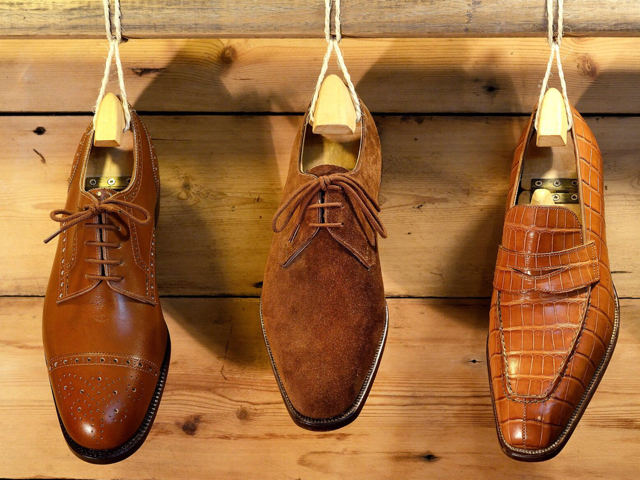
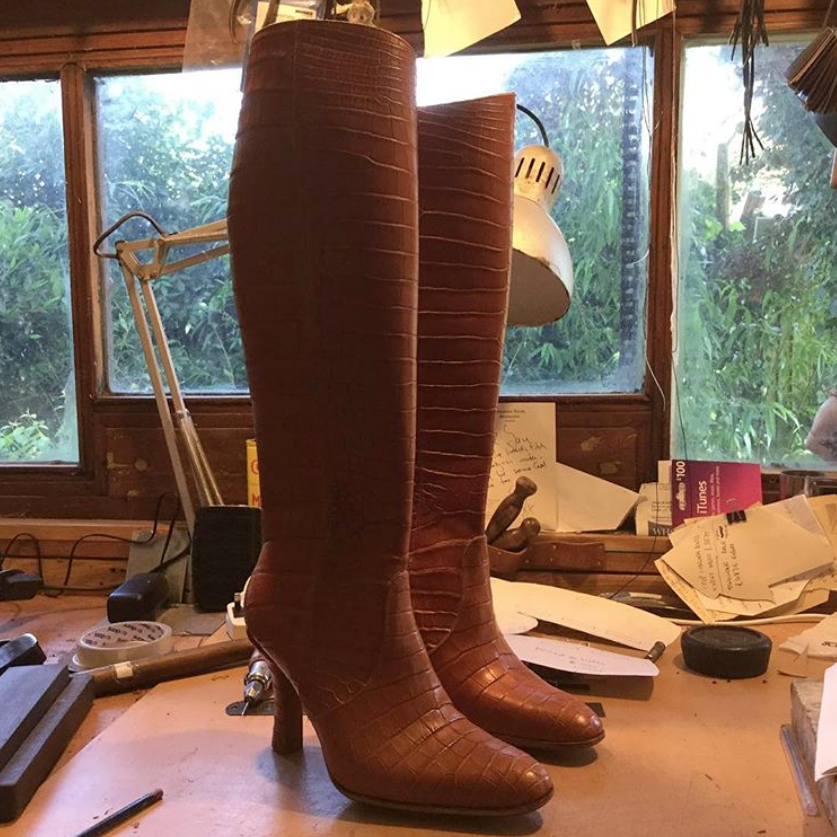
DC: I like to think of myself as a modern version of a classic English shoemaker. My last lengths are classical, not elongated, and my proportions traditional. My design style is asymmetric, using classical pattern structures, and my bottom making is deeply rooted in the traditional welted construction. However, I am proud to call myself a bespoke maker, so ultimately I make what the client requests. I’m more interested in the client’s style rather than imposing my house style.
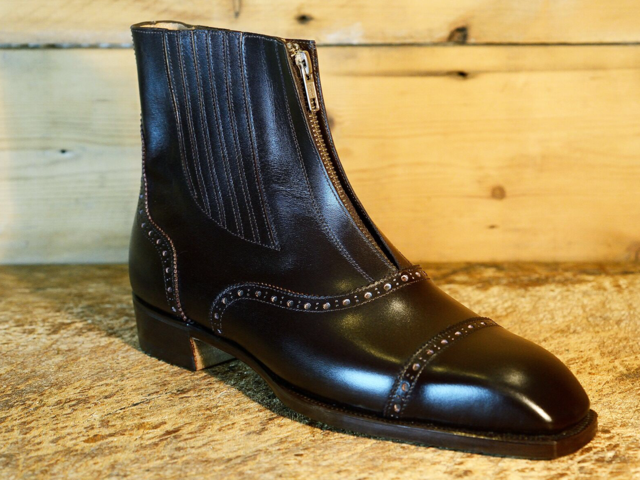
VR: Do you have a favourite shoe model (eg. monk, derby, oxford, balmoral boot) and leather type?
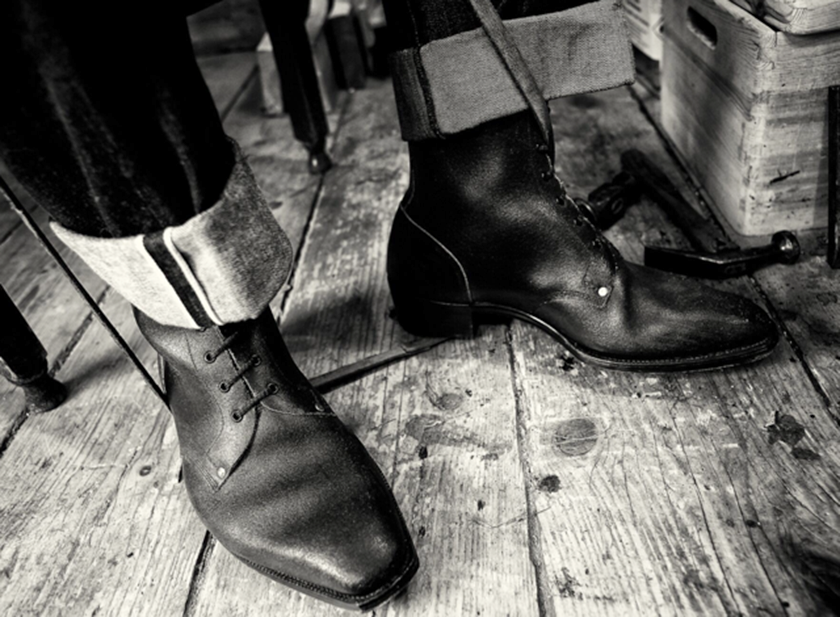
DC: My favourite model is the English Wellington boot, now sadly only worn by army officers as part of their mess uniform. I keep an old bespoke pair in the workshop to remind me of the simplistic beauty of this style of Footwear and was overjoyed to see both Princes William and Harry get married wearing them.
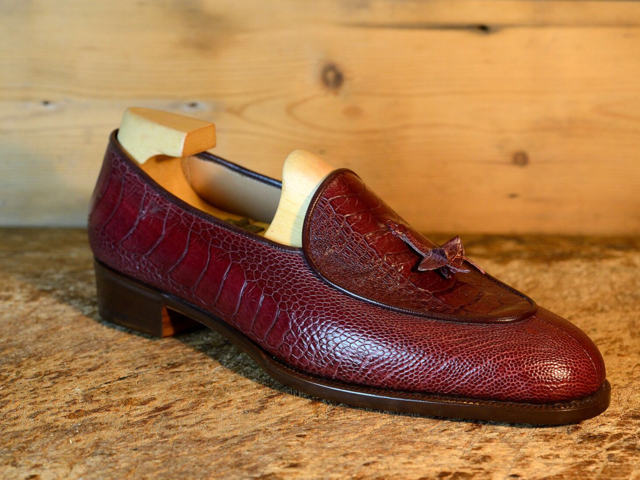
VR: There are several fine shoemakers in Britain — why should my readers try you?
DC: Shoemaking has changed remarkably in the past few years in Britain. You still have the big firms and now, as a result of the Internet and social media, clients can track down many smaller independent craftsmen. In London we have Jim McCormack, Nick Templeman, Sebastian Tarek and Mariano Crespo all making good shoes, but bespoke is not about the shoes, it’s about the relationship between the client and the maker. A client has to feel he can sit down and talk to his shoemaker and the maker has to listen. If this relationship works then the shoes will take care of themselves.
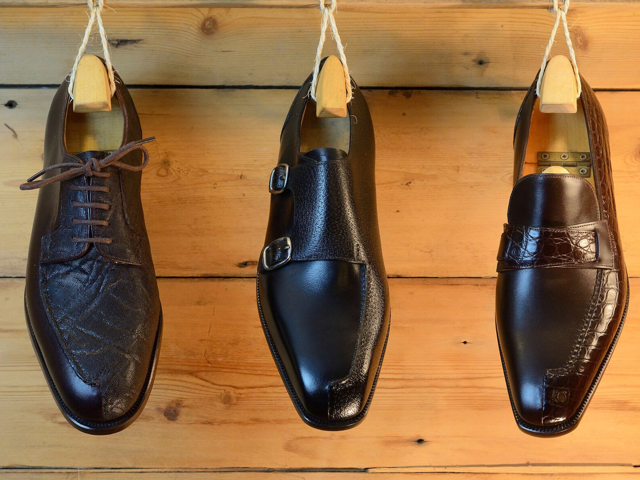
VR: What is your definition of a well-made shoe?
DC: A shoe made with care, consideration and a depth of beauty.
VR: Who or what inspires you?
DC: Young people and people willing to train as shoemakers. I recently set up a business with Steven Lowe, an ex-Lobb lastmaker teaching lastmaking. We had the facilities at Lastmaker House and wanted to pass on some of our skills and experience to other people. I always feel honoured to have young and old come and study with us and see such enthusiasm, drive and skill, very humbling. Thankfully, I always learn more from the students than I ever seem to teach them.
VR: Finally, how would you say British artisanal shoemaking differs from Italian shoemaking?
DC: Language, character and temperament.
Category Cordwainers, Interviews
The effect of a suit’s cut on physique
0October 22, 2018 by Ville Raivio
This is a story of two suits. The picture below is from 2014 and depicts the tyrant of Equatorial Guinea, Teodoro Obiang Nguema Mbasogo, as well as the head honcho Obama from the US. Like several African dictators, Mbasogo has taken a liking to French tailors. This is shown true by the superb cut of his jacket along with its Parisian lapels (cran Parisienne). As far as I know, Obama has been clothed by the American tailoring factory of Martin Greenfield.
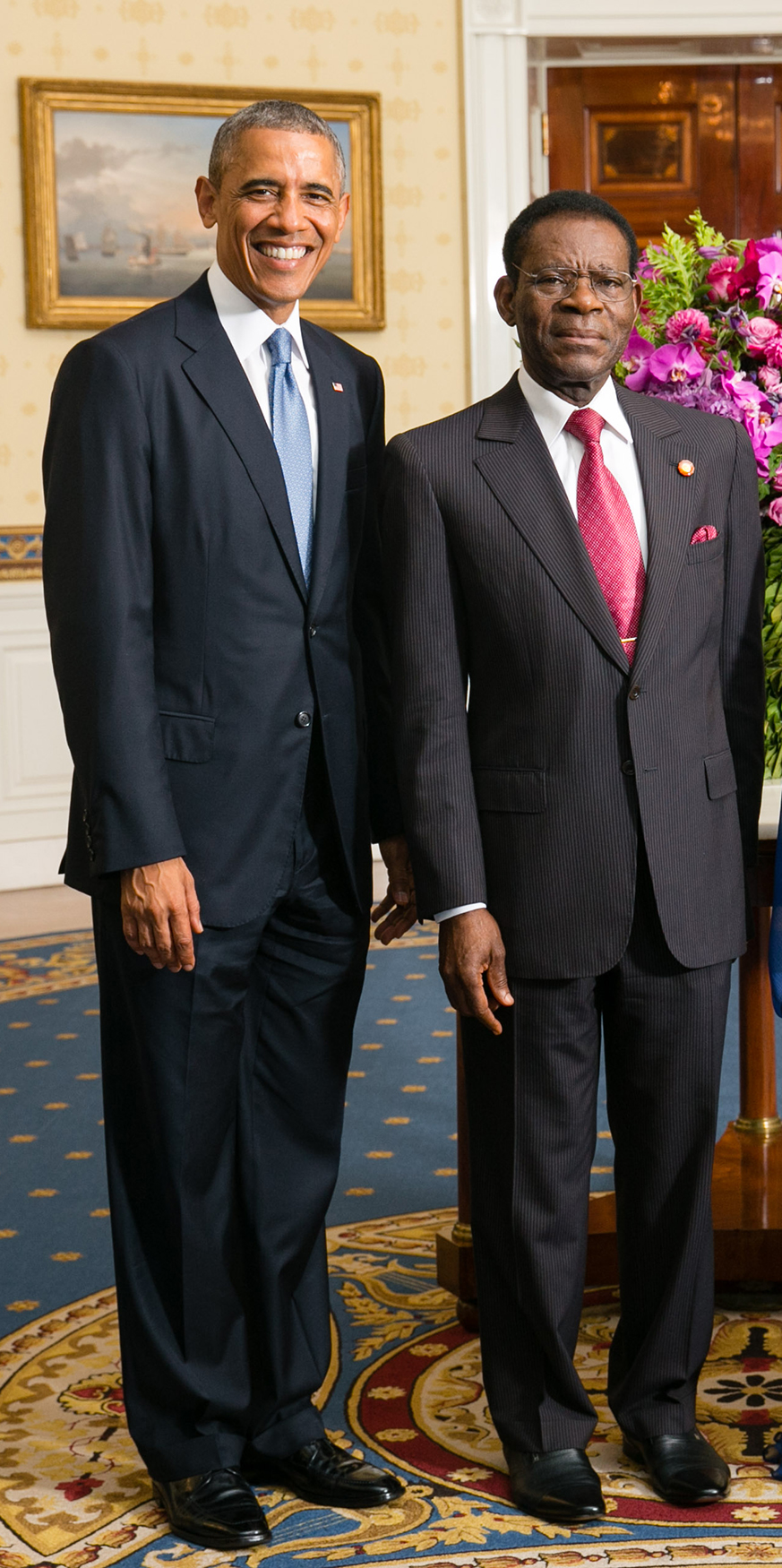
First we will have a look at Obama. His suit follows the traditional American line where comfort trumps all else, so the outfit is loose in all directions. The shoulder line from the neck to the sides is uneven and bubbled, though the collar does stay well around the neck. The point where the sleeve has been set to the body seems to be drooping downwards. The lapels are similarly bubbled and the cloth forms an X-wrinkle around the buttoning point. The shape of the gorge is, at least to my eye, weak. The cloth on top of the clavicle looks empty and wrinkled, as the cut is too loose on this point. The sleeve looks empty and wrinkly around the bicep as well as the elbow, though it cleans up towards the wrist. The shirt cuff is hidden. The trouser legs are loose and droop all the way down. The jacket is loose but adequately clean around the buttoning point.
Next, the tyrant Mbasogo. His cut is the heroic mold of an Adonis, an Atlas or a Hercules. The shoulder line from the neck to the sides is straight and powerful, the collar stays very well and high around the neck. The point where the sleeve has been set is raised, like a muscle. The lapels are likewise bullet straight and the cloth is clean around the buttoning point. The gorge has been aggressively shaped and looks interesting. The cloth on top of the clavicle looks clean and pushes aggressively outward, as if stressed by pectoral muscles. The sleeve is clean and straight around the bicep as well as the elbow, and shows the shirt cuff. The trouser sleeves are loose but drape fairly well to the knees. Only after this does the line not hold. The skirt of the jacket clean.
Summa summarum: Obama looks weak and loose in his suit, Mbasogo looks healthy and strong. This is the subliminal effect that a suit’s cut has on onlookers. Most likely Obama, who runs and visits the gym, looks slim and healthy outside his suit but it’s difficult to say about the tyrant from Africa. Thus, a cut does matter and most of its effect comes from fit. I can find no better photo to illustrate my point. While Mbasogo is a poor ruler, his tailor is indeed an artist of the cloth.
Photo: Amanda Lucidon/The White House
The decadence of the Made in Italy-label
0October 13, 2018 by Ville Raivio
The superb New Yorker magazine sent its investigative journalist to Prato, Italy, to find out about a nasty phenomenon. The lengthy piece published in NY’s April issue sheds light on an ugly business concerning the coveted, revered Made in Italy-label. Dozens and hundreds of Chinese-migrant workshops as well as factories have sprung up in Prato since the 1990s. In most of them, the rights of the workers are trampled and taxes are avoided with abandon. In practice, this roulette of abuse turns in a similar vein of which Roberto Saviano reported in his excellent, horrifying book, Gomorrah. Large fashion giants, such as Gucci or Dolce&Gabbana or Fendi, want an X-amount of products. They deal out this commission to a sub-contractor that can offer the highest quality with the lowest price. The shop that wins the deal may sub-contract several stages in its production, or the whole process, and darken the origin completely under several layers. If abuse comes to light, the fashion house itself may just say that their contract is with the original subcontractor.
The main reason under all of this is, of course, maximising profits ever bigger and the magic of the Made in Italy-label. The problems of abuse cannot be escaped by favouring handmade, pricey garments as New York Times, in turn, reported last month about the exploitation of seamstresses. In Bari, in the boot heel of Italy, sub-contracted seamstresses are paid a measly few dimes per hour and their jobs have no security or benefits. The region simply has not enough jobs, so housewives take what they can. The roulette keeps spinning everywhere.
If the morale of the Italian garment industry also represents the country’s general morale, Italy’s poor economic state, tax avoidance, youth unemployment, shattering infrastructure and societal woes are self-earned. For the man in search of a moral Italian garment the only solution in to favour artisans or makers that own their own means of production. In larger scale, these are the likes of Isaia, Brioni, Kiton, and in smaller scale private workshops. Fashion houses, in turn, keep sub-contracting and creating more bad than good.
Category Italian Style, Reading, Society
Fashioned by Philip Knitwear
0October 2, 2018 by Ville Raivio
Fashioned by Philip Knitwear is a one man operation. Joseph Philip, a retired 79-year-old knitwear worker, hand-loom knits his own pieces at home with the help of an old Santa Gostino machine. He uses British wool yarns such as Saxony, Shetland, merino, lambswool, and cashmere mix pieces. The store offers beanies, scarves, and chunky knitwear for men and women. The best part are the prices: some 50 or 60 pounds for a piece. This is rare for an artisanal operation and I feel Philip Knitwear deserves a look. Once his skills are gone, they are gone for good.
Category Knitwear, Quality makers, Web stores
Copyright © 2013 Ville Raivio